
HISTORICAL DIG · JUL—AUG 2026
Should this task start in an editor, terminal, or office agent?
These products can all look like “agents,” but they work in different places: editor-based coding, terminal repository work, multi-task workspaces, and office-file actions need different context and permissions.
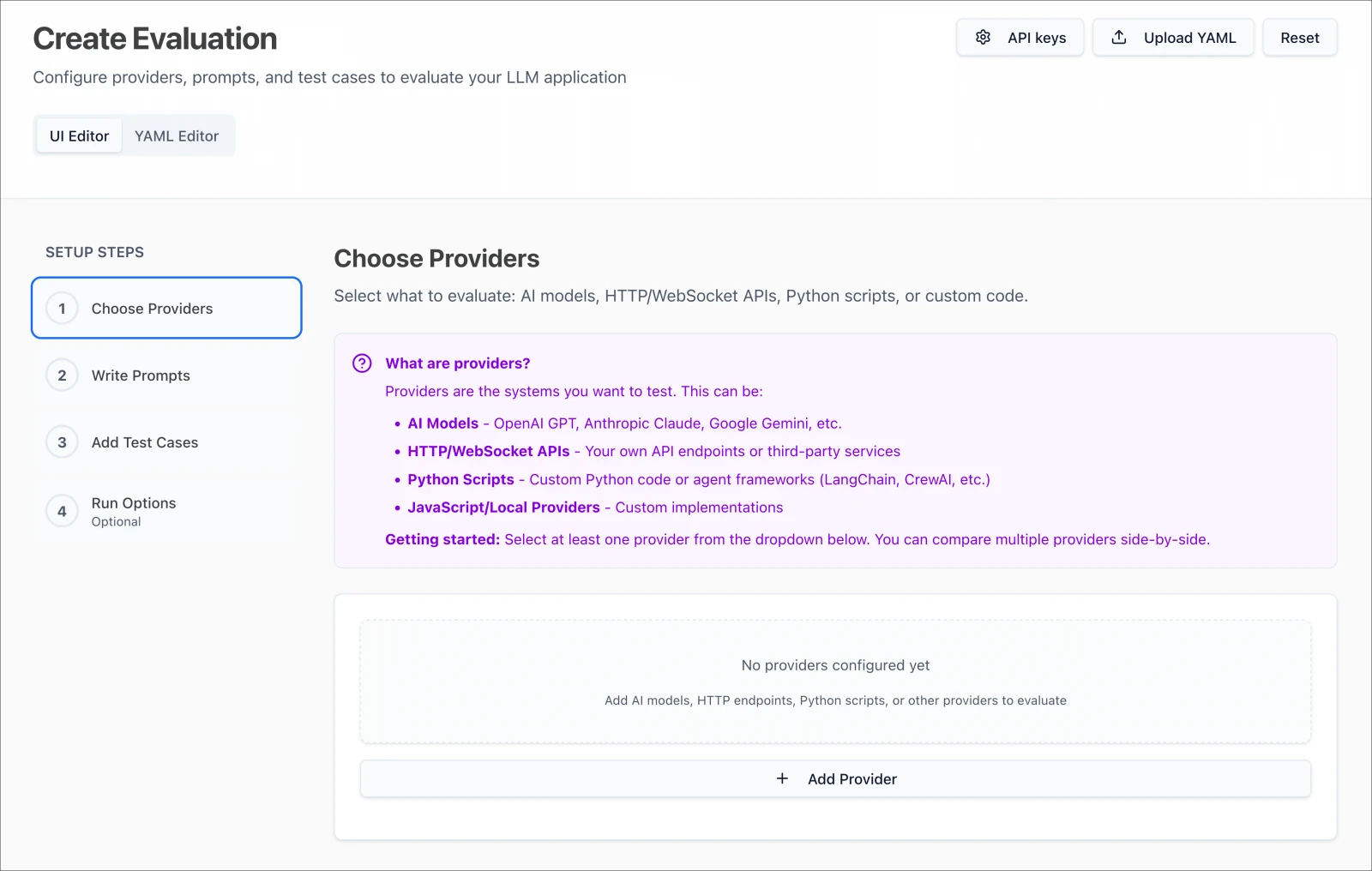
This empty setup screen shows one comparison order: define candidates and test conditions before reading results. It does not establish local data handling, controlled permissions, or a completed run.
About this image and its source
Promptfoo repository evaluation setup, © Promptfoo 2025, MIT; visible icons are separately covered by the Lucide ISC/MIT terms. BitShovel only resized it proportionally and converted it to WebP. This empty setup screen shows that candidates, prompts, and test cases are defined before comparison; it does not establish local data handling, controlled permissions, or a completed run. Promptfoo does not participate in or endorse BitShovel.
Open source page ↗WORKFLOW 001 · NODE POSITION
Current node 017 nodes total
Set the deliverable before the tool
HOW IT RELATES TO WORKFLOW 001
Relation to the current subject
This was an earlier cut into the problem.
This record narrowed “which agent is better?” to “what result do I need, and where will the work happen?” Workflow 001 continues from there: once tools, sessions, and plugins multiply, how can a project still be finished and resumed days later? Each record keeps its own date and evidence state instead of being merged into a falsely continuous conclusion.
Record state at the time
- Coding & agents
- AI agent collaboration
- In-depth guide
- Developing
- Sources cross-checked · no same-task run
THE GUIDANCE AT THE TIME
Judgment at the time
Choose the result and working environment before the product name.
Open full rationale and return rules
Define the result and working environment first. For changes you want to see inside an editor, compare Cursor or TRAE; for repository work from a terminal, compare Codex or Claude Code. For office files and browser tasks, check Tencent WorkBuddy separately for file, model, and external-service permissions.
- Who it was for
- People with access to AI who feel buried by tools, plans, and jargon and want one concrete result first
- Why it mattered then
Open note
Starting from a product name often means taking on learning, permission, and subscription costs before knowing whether it will help deliver the result.
- Where the judgment stops
Open note
Official pages show what each product currently offers and claims, not how well, reliably, or cheaply it handles the same task. The added open-source Promptfoo screens show only a method for defining tests before comparing results; they are not real benchmark results for these agent tools. Features, plans, and data handling change, so check again before a trial.
CHECK BEFORE READING ON
Fit check
Check whether it fits the task you are trying to finish.
This record may help
- You have access to AI but feel buried by tools, plans, and jargon, and want one concrete result first.
- You can define the result and working environment before comparing two categories that could actually finish the task.
Do not use it yet when
- You still cannot say what result should exist at the end.
- The first trial already requires consequential permissions, long-term payment, or a large data migration.
- Your decision requires a BitShovel same-task test or an independent-user completion rate—this record does not have either.
THE 20-MINUTE TRIAL IT LEFT BEHIND
Historical trial
Compare only two categories and finish with a result you can open.
- Time needed
- About 20 minutes
- Likely cost
- Use a free tier or local sample first; do not prepay annually
- Permission boundary
- No real accounts and no write access to production
- 01
First step
Open this step
Write down the required result, inputs, and deadline, then compare only two tool categories that could finish it.
- 02
What should exist
Open this step
One category choice and one minimal test capped at 20 minutes.
- 03
How to tell it worked
Open this step
The test ends with a result you can open, not merely a chat transcript or demo.
- 04
Stop when
Open this step
You cannot define the result, or the trial demands consequential permissions, long-term payment, or a large data migration first.
- 05
How to back out
Open this step
Export the result, revoke access, cancel the trial, and record why it did not finish.
COMPARISON METHOD, NOT A BENCHMARK
Method and interfaces
Define test conditions first, then place results from the same inputs side by side.
Open method boundary
The two Promptfoo documentation screens show only the order of comparison. They are not same-task tests of Codex, Claude Code, Cursor, TRAE, or WorkBuddy.
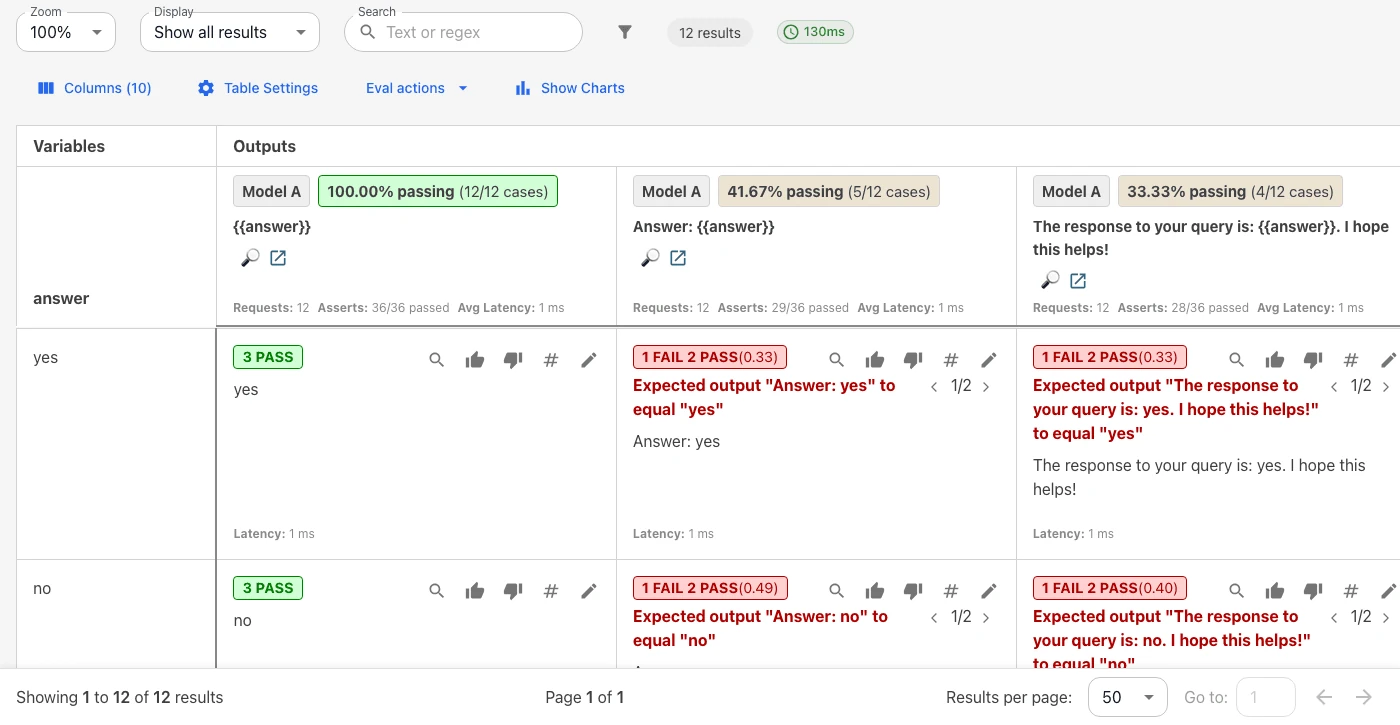
All three columns are prompt variants of Model A—not different agent tools or a BitShovel or market benchmark. It only demonstrates how results from the same inputs can be compared side by side.
About this image and its source
Promptfoo repository Web Viewer documentation image, © Promptfoo 2025, MIT; visible icons are separately covered by Lucide ISC/MIT, MUI MIT, and Google Material Icons Apache-2.0. BitShovel only cropped the top metadata area containing the project author email and evaluation ID, then converted the image to WebP. The three columns are prompt variants of Model A, not different agent tools and not a BitShovel or market benchmark. Promptfoo, MUI, Lucide, and Google do not participate in or endorse BitShovel.
Open source page ↗SOURCES AND EVIDENCE
Sources and evidence
As of August 8, 2026, these sources established how the products described their entry points and capabilities—not how they performed on the same task.
Open evidence boundary
Official pages for five tools were cross-checked with community discussions and release information. The same task was not run across these tools, and there are no independent-user results.
- 01Community report · Checked then
User signal: many subscriptions, unclear daily return
Open source boundary
The discussion brings selection back to whether a tool solves a core problem and creates visible impact.
Open original source ↗ - 02Community report · Checked then
User signal: too many tools, no clear foundation
Open source boundary
Several replies favor starting with one small project and one workflow that can actually be completed.
Open original source ↗ - 03Method source · Checked then
How Product Hunt launches and ranking work
Open source boundary
Used to treat launch attention as discovery, not a user outcome.
Open original source ↗ - 04First-party source · Checked then
Official OpenAI Codex app introduction
Open source boundary
Checked maker descriptions of multiple agents, workspaces, review, and automation.
Open original source ↗ - 05First-party source · Checked then
Official Anthropic Claude Code overview
Open source boundary
Checked maker descriptions of terminal use, repository understanding, edits, and command execution.
Open original source ↗ - 06First-party source · Checked then
Official Cursor Agent modes documentation
Open source boundary
Checked permission differences among Agent, Ask, and manual modes.
Open original source ↗ - 07First-party source · Checked then
Official TRAE product entry
Open source boundary
Checked the current editor and agent positioning; no same-task run was performed.
Open original source ↗ - 08First-party source · Checked then
Tencent WorkBuddy terms and risk boundaries
Open source boundary
Disambiguates Tencent's desktop office agent and checks its third-party model, tool-call, and human-safeguard terms.
Open original source ↗
REVISION RECORD
Revision record
Every change keeps its date and reason.
Open 2 revisions
- Revision 3
Added Codex, Claude Code, Cursor, TRAE, and Tencent WorkBuddy, then reorganized the choices around editors, terminals, and office tasks.
- Revision 2
Changed a broad tool comparison into choosing the simplest workable option for one concrete result, cost limit, and permission level.
WHAT THIS RECORD LEAVES
What this record leaves
Keep the old judgment—and the distance between it and today.
The current Workflow continues with delivery, context recovery, complexity, and permissions. This historical record keeps its date and evidence state so the narrowing of the problem remains visible.
Back to the Dig index