
HISTORICAL DIG · JUL—AUG 2026
How do I keep a source behind every claim?
Research products can let people choose sources, review a plan, and receive citations, but more citations do not automatically make scope, dates, original claims, or uncertainty clear.
HOW IT RELATES TO WORKFLOW 001
Relation to the current subject
It supplies the source layer beneath a Dig—not another research-tool recommendation.
Workflow 001 separates personal history, maker descriptions, current reproduction, and unknowns. The recoverable-automation record preserves inputs, runs, and retry boundaries. AI-output verification returns to the actual material. This historical record states the step all three depend on: scope the question and sources first, then make every critical claim traceable to the original.
Record state at the time
- Information research
- Recoverable automation
- Standard record
- Developing
- Historical E2 · three maker sources · no BitShovel same-question run
THE GUIDANCE AT THE TIME
Judgment at the time
A summary is an entry point to the source table—not a replacement for it.
Open full rationale and return rules
Define the question, date range, and allowed sources first. Require every critical claim to carry a direct link, date, and a plain statement of what the source supports. The summary is only an entry point to the source table; consequential claims still need the original material checked.
- Who it was for
- People who repeatedly research markets, products, or editorial topics and cannot deliver an unsourced summary
- Why it mattered then
Open note
The smoother an automated summary reads, the easier it is to hide search boundaries, source freshness, and evidence gaps inside apparently complete prose that is hard to update or correct later.
- Where the judgment stops
Open note
This historical record checks public maker descriptions, not research accuracy. A citation's presence does not mean it supports a claim, and search, connector, or export capability does not establish a correct conclusion for a topic. BitShovel has not run a standardized same-question comparison or connected private drives, email, or accounts.
CHECK BEFORE READING ON
Fit check
Use it only when the question is narrow, the sources can stay public, and a person can still spot-check the result.
This record may help
- The question is narrow enough to limit by date and source type, and you already know at least part of the answer.
- You need a source table whose items can still be opened, updated, and corrected later.
Do not use it yet when
- The first trial already requires email, a private drive, customer material, or another sensitive source.
- You need these three maker sources to establish factual accuracy, independence, or current general performance.
- You plan to connect one result directly to publishing, payment, or another irreversible action.
HISTORICAL TRIAL · UNRUN AND UNFROZEN
Historical trial
Run one capped public-source trial and inspect only the three claims most likely to change the decision.
- Time needed
- 20–30 minutes (earlier trial cap)
- Likely cost
- One capped trial only; do not schedule a recurring job first
- Permission boundary
- Public sources only; do not connect private drives, email, or accounts
- 01
First step
Open this step
Choose one narrow question whose answer you know, limit it to the last 30 days and three source types, and require claims, direct links, dates, support scope, and conflicts.
- 02
What should exist
Open this step
A source table that opens item by item, plus a short summary that states unknowns.
- 03
How to tell it worked
Open this step
Spot-check the three claims most likely to affect the decision; the original text, publication date, and context support the wording.
- 04
Stop when
Open this step
Stop when links fail, dates fall outside scope, citations do not support claims, conflicting sources are left unmarked, or the task requests private-data access.
- 05
How to back out
Open this step
Discard the automated summary, keep the question and checked sources, narrow the scope, and then decide whether to rerun.
METHOD INTERFACES · NOT BITSHOVEL RESEARCH RESULTS
Method and interfaces
Narrow scope first, then keep sources, notes, and answers traceable.
Open method boundary
The two pinned open-source project images show “clarify before research” and “sources, notes, and answers in one workspace.” They explain a work structure; they do not establish correct citations, working links, or a BitShovel run of either project.
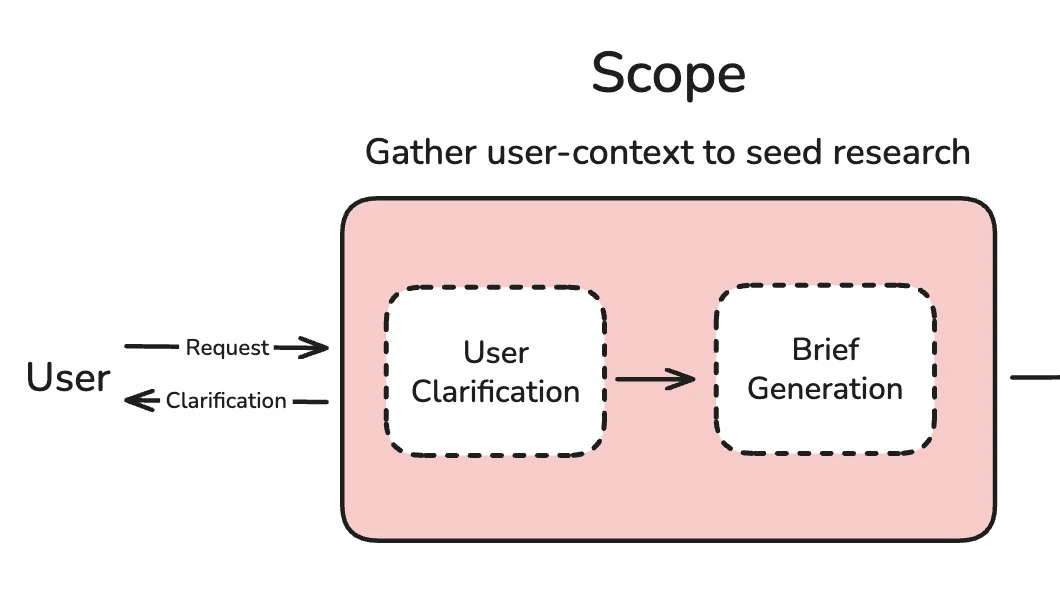
This Scope stage shows one ordering: clarify the request, then form a research brief. It does not establish a checked date range, source scope, citation support, or accuracy.
About this image and its source
Open Deep Research repository diagram, © 2025 LangChain, MIT. BitShovel only cropped the Scope stage and converted it to WebP without redrawing text, arrows, or relationships. It is not a BitShovel run. LangChain does not participate in or endorse BitShovel.
Open source page ↗Read use and attribution guidelines ↗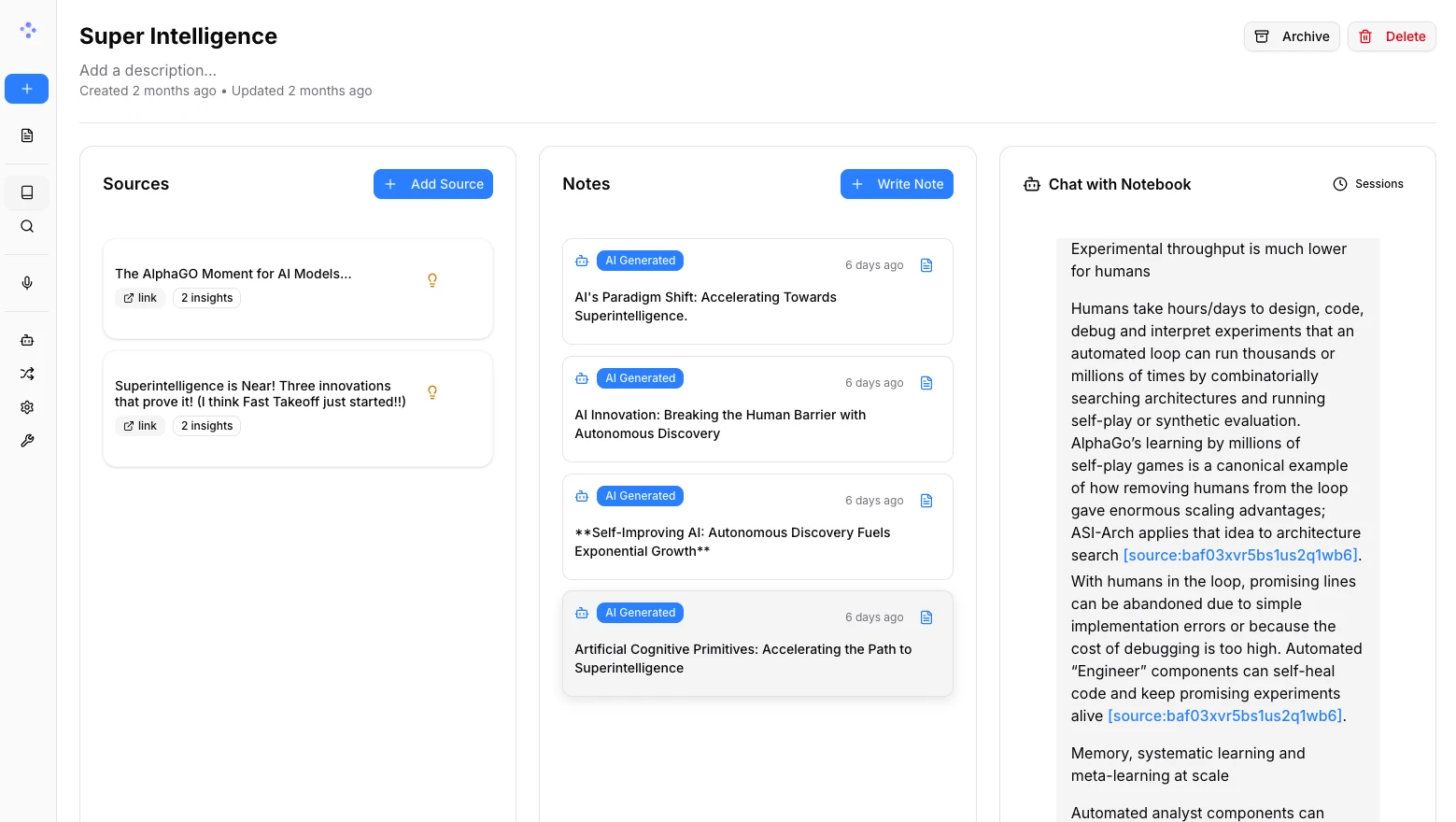
Sources, generated notes, and answers with source identifiers can share one workspace. This does not establish that a citation supports a claim, a link opens, a conclusion is correct, or BitShovel ran Open Notebook.
About this image and its source
Open Notebook repository demo, © 2024 Luis Novo, MIT. BitShovel only removed metadata and converted it to WebP without cropping, translating, or redrawing the interface. The project author does not participate in or endorse BitShovel.
Open source page ↗Read use and attribution guidelines ↗SOURCES AND EVIDENCE
Sources and evidence
As of August 15, 2026, all three records are maker sources. They describe features and launch-era risks—not independent accuracy or user outcomes.
Open evidence boundary
The historical E2 label came from reading two maker descriptions alongside an OpenAI launch-era risk document. It supports the need for a checking method—not an accuracy rate, saved time, or a claim that automated research is reliable.
- 01Current maker guidance · Rechecked
OpenAI deep research: define the outcome, sources, and plan before reviewing citations and activity
Open source boundary
The current help page describes public web, uploaded files, or connected apps, plus plan review, citations, a sources section, and activity history. This earlier trial remains limited to public sources with no private material connected.
Open original source ↗ - 02Launch-era risk document · Rechecked
OpenAI deep research system card: launch-era prompt-injection, privacy, and hallucination boundaries
Open source boundary
This is a 2025 launch-era risk document for the early model at the time. It defines checks to consider, not a current error rate for the product or all research tools.
Open original source ↗ - 03Maker documentation · Rechecked
Perplexity Sonar Deep Research documentation
Open source boundary
The page now appears under Legacy API navigation. It is another maker's description of multi-source search and citation output—not proof of accuracy.
Open original source ↗
REVISION RECORD
Revision record
Revision 2 separates current source status, product capability, and factual accuracy again.
Open 2 revisions
- Revision 1
Changed the research output to a source table readers can reopen, rather than only automated prose.
- Revision 2
Rechecked current maker guidance: kept connectors and private material out of the first trial, returned the launch-era system card and Legacy API page to their time contexts, and removed a third product image without an open reuse license.
- What the record said before
- Three sources together showed that research products support source selection, plan review, and citations.
- What changed
- The three maker sources only help define steps and risks to check. Whether a source supports a claim still requires opening the original, and the first trial uses public sources only.
WHAT THIS RECORD LEAVES
What this record leaves
Keep every important claim connected to its source—and keep unknowns visible.
The current Workflow continues separating personal history, project records, and maker material. This historical method only protects source, date, support scope, and stop conditions.
Back to the Dig index