
HISTORICAL DIG · JUL—AUG 2026
How do scattered messages become a usable handoff?
Chats, email, and meeting notes often mix facts, actions, waiting points, gaps, and decisions that still need a person. Forwarding everything transfers the reading burden; over-summarizing can erase constraints and ownership.
HOW IT RELATES TO WORKFLOW 001
Relation to the current subject
It addresses handing work to the next person—not choosing another AI tool.
Workflow 001 asks whether a primary workflow can finish a project and keep it usable. Q03 asks whether the correct context can be recovered days later. This historical record comes after both: when work moves to another person, it puts the next action, waiting points, gaps, and human decisions on one page instead of forwarding an entire session or an unbounded summary.
Record state at the time
- Work handoff
- Checkable work results
- Standard record
- Historical route preserved
- E3 · one BitShovel run with four synthetic messages
THE GUIDANCE AT THE TIME
Judgment at the time
A handoff is not complete because one page was generated. It is complete when the next person knows where to continue.
Open full rationale and return rules
A one-page handoff should not compress everything into one paragraph. It should separate actions, waiting points, gaps, and human decisions, preserve uncertainty, and count as complete only when the next person can continue.
- Who it was for
- People handing over one low-risk task to a colleague, family member, or collaborator when the material can be lawfully copied and redacted
- Why it mattered then
Open note
A handoff often fails not because it lacks a polished summary, but because the next person cannot see the next step, owner, pending item, or decision they must not make alone.
- Where the judgment stops
Open note
E3 comes only from one local run with four fully synthetic messages. It establishes that the page generated, reviewed, copied, and downloaded that sample—not that a real team completed a handoff, saved time, or reduced errors. The current site provides only a static route and template; it does not read, upload, or retain material.
CHECK BEFORE READING ON
Fit check
Use it only for one low-risk task whose material can be lawfully copied and redacted.
This record may help
- There is one low-risk task, its material can be redacted, and the next person needs the next step and blockers quickly.
- You can check facts against the source messages and keep uncertainty visible as questions.
Do not use it yet when
- The material must not be copied, cannot be redacted, or conflicts across sources.
- The handoff involves payment, publishing, approval, deletion, a legal commitment, or another irreversible action.
- You need this synthetic example to establish real-team outcomes or automation reliability.
CURRENT USABLE ROUTE · NO MATERIAL ENTERED HERE
Historical trial
Copy the four-part structure into an approved local document, then check every item against the source.
- Time needed
- Allow about 5 minutes (earlier estimate)
- Likely cost
- No site fee or external API required
- Permission boundary
- Use redacted plain text for one task only, in an editor you are permitted to use
- 01
First step
Open this step
Copy the four-part structure from the static route into a local document and add only 3–8 redacted items from one task.
- 02
What should exist
Open this step
One handoff page with next actions, waiting points, information gaps, and human decisions kept separate.
- 03
How to tell it worked
Open this step
The recipient can state the next step, owner, blocker, and what they must not decide alone—and can return to the source to check it.
- 04
Stop when
Open this step
The material cannot be redacted or copied, sources conflict, or the task contains consequential or irreversible actions.
- 05
How to back out
Open this step
Keep the source messages. If the handoff is not used, delete the local copy and return to the source channel for owner confirmation.
SYNTHETIC RESULT · NOT USER MATERIAL
Method and interfaces
The earlier page did generate this result, but the evidence covers only four fictional messages.
Open method boundary
The English page shows only the English production-build crop. Its training material, dates, and counts are fixed demo information—not account, customer, team, or real business data.
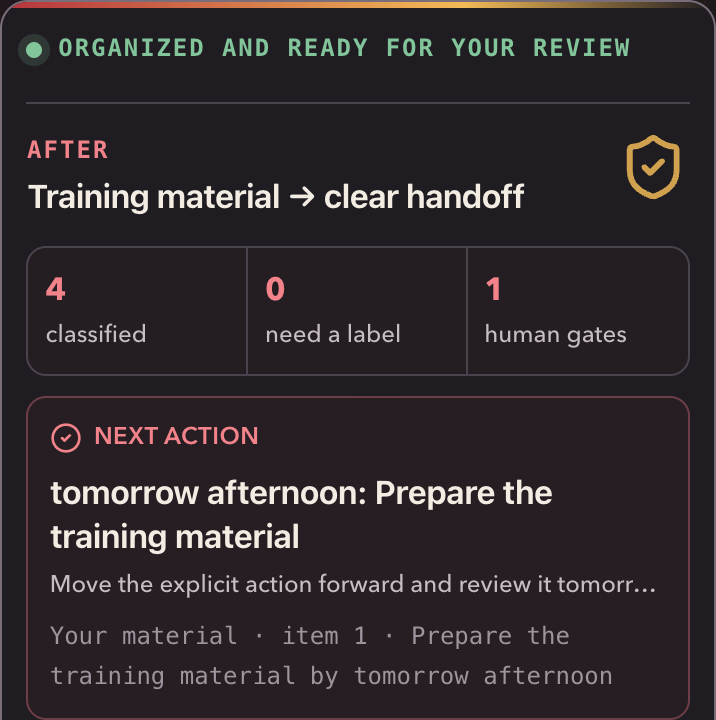
The same four fictional messages captured separately in the English interface. It is not user material, a team completion record, or efficiency evidence.
About this image and its source
BitShovel-owned interface and fictional messages, captured from a local production build on August 14, 2026 at a fixed region. Public and archived files share SHA-256 11407a0a084a927c1988bd2eb61ee9d48593f43659055dcc5b850d249c2225ef.
Open source page ↗SOURCES AND EVIDENCE
Sources and evidence
As of August 15, 2026, the evidence consists of one synthetic run and one BitShovel field note—no independent-user result or efficiency data.
Open evidence boundary
Four synthetic messages completed classification, review, copy, and Markdown download in the earlier BitShovel page; the result captures are byte-identical to the public files. There is no real material, connected account, automatic sending, independent completion report, or outcome data.
- 01BitShovel synthetic run · Route checked
One-page result from four fictional messages
Open source boundary
The earlier route published its input boundary, result, completion check, and stop conditions. The current route keeps only the static template and result; it does not restore the input tool, account connection, automatic sending, or behavior tracking.
Open original source ↗ - 02BitShovel field note · Route checked
Make one material handoff sheet first
Open source boundary
A separate historical note uses source, purpose, and gaps to show why “organized” is not yet a handoff someone can question and continue. It is a BitShovel editorial record, not an independent-user outcome.
Open original source ↗
REVISION RECORD
Revision record
Revisions 2 through 6 preserve both the narrowing of the problem and the change in the website's role.
Open 5 revisions
- Revision 2
Rewrote the steps so scattered messages ended in a page another person could use.
- Revision 3
Connected the usable route and field note to the same handoff question.
- Revision 4
Removed a generic project overview that did not represent a handoff and used the actual BitShovel synthetic result instead.
- Revision 5
Shortened the title and made locale-specific crops of status, counts, and the first action; the fictional-sample boundary remained unchanged.
- Revision 6
Reframed the input tool as a static route under the site's current role: the synthetic run, four-part template, completion check, and stop conditions remain, while no material is accepted and one sample is not presented as a team outcome.
- What the record said before
- Open the BitShovel handoff tool, paste redacted messages, and generate the handoff in the browser.
- What changed
- The site provides a handoff structure readers can understand and copy into their own local document tool; material processing stays there.
WHAT THIS RECORD LEAVES
What this record leaves
Take the handoff structure with you. Keep real material in an approved environment.
The static route provides a four-part template, completion check, and stop conditions. The field note explains why source, purpose, and gaps must remain visible together.
Back to the Dig index