Model and integration · Local deployment, vision and tasks
Nemotron 3.5: what else does a local agent need?
What work do Super VL and Bolt suit? Original figures, memory recipes and speed comparisons explain what the “24GB” name leaves out of a full runtime budget.
NVIDIA released Nemotron 3.5 Super VL and Bolt 74B-A9B on October 15. One is the larger multimodal model; the other compresses it for local agents. We checked the original report, model cards and independent leaderboard on October 20 Beijing time. This is source analysis, without downloading weights, installing runtimes or testing hardware.
Start with the work: files, pages and tools
Consider an expense document containing a table: an agent must read it, extract fields, apply rules and pass a result to a tool. Super VL combines text, image and video understanding: 120B parameters, 12B active, up to 1M context. It outputs text, rather than generating video.
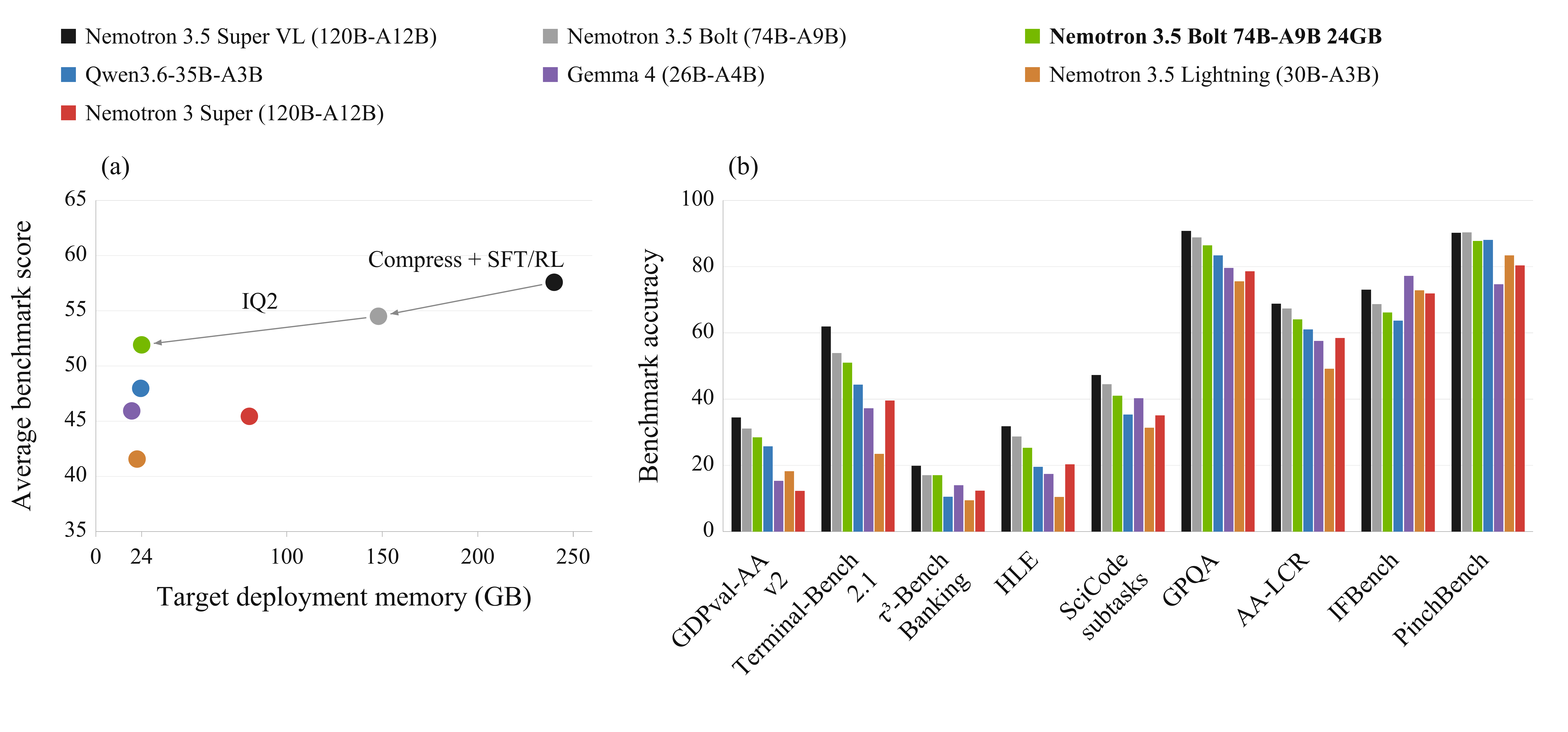
Bolt is compressed from Super VL to 74B parameters and 9B active, followed by low-bit quantization and recovery training. Super VL also has a DGX Spark NVFP4 route, while Bolt targets sharing local resources with other applications. Model, format, runtime and hardware all matter.
Sources and further reading
- NVIDIA · Super VL and Bolt launchVendor release · October 15, 2026Two released models, intended uses and the later E4B plan; plans do not establish availability.
- Super VL workflows and specializationNVIDIA technical sourceHow documents, tools and vision combine; named company results and efficiency claims have specific scopes.
- Super VL BF16 model cardOfficial NVIDIA card · read this round120B/12B active, up to 1M context, BF16 hardware recipes and OpenMDW-1.1.
- Super VL NVFP4 model cardOfficial NVIDIA quantized versionA quantized route for the same model. Check DGX Spark and GPU recipes separately from BF16.
- Bolt compression, quantization and inference comparisonNVIDIA research report · October 15Original figures, the hardware/runtime/workload behind 84 TPS and AgentPerf Local replay time; vendor results, not BitShovel tests.
Why does a “24GB model” list 28GB and 32GB recipes?
The model name is not a complete machine budget. The GGUF card also supplies a vision projector and a separate LiLiCorr drafter. Context state, concurrency and other applications require room. Its 28GB and 32GB recipes each use one concurrent sequence at different context lengths; “24GB” does not validate every 24GB GPU.
Bolt’s up-to-256K window is shared by prompts, visual inputs, history, tool results and generated output. Super VL’s BF16 examples use four H100s or two GB200s; its NVFP4 card separately lists DGX Spark and H200 routes. Context, speed and memory belong to a complete configuration.
| Recipe | Context and concurrency | Hardware listed in the card |
|---|---|---|
| 28GB | 65,536 tokens; one sequence | RTX Spark 64GB or discrete GPU 32GB+ |
| 32GB | 262,144 tokens; one sequence | RTX Spark 128GB or discrete GPU 48GB+ |
Sources and further reading
- Super VL BF16 model cardOfficial NVIDIA card · read this round120B/12B active, up to 1M context, BF16 hardware recipes and OpenMDW-1.1.
- Super VL NVFP4 model cardOfficial NVIDIA quantized versionA quantized route for the same model. Check DGX Spark and GPU recipes separately from BF16.
- Bolt compression, quantization and inference comparisonNVIDIA research report · October 15Original figures, the hardware/runtime/workload behind 84 TPS and AgentPerf Local replay time; vendor results, not BitShovel tests.
- Current Bolt GGUF deployment recipesOfficial NVIDIA model card28GB/32GB recipes, one concurrent sequence, a vision projector and separate drafter, with shared context limits.
Faster on which machine, doing what?
NVIDIA’s local comparison uses one 128GB Surface Laptop Ultra with Windows and llama.cpp. Bolt reaches about 84 tokens/s on SPEED-Bench-Coding and 601 seconds on AgentPerf Local trace replay; Qwen3.6 35B-A3B records about 97 tokens/s and 454 seconds. Bolt is not fastest in that table. Replay time is not your project’s delivery time.
On the October 20 AA table, Super VL scores 26 and Bolt 21, with no separate effort label. This index, the vendor’s selected averages, tool-task success and decoding speed answer different questions. They do not combine into “best local model.” Compare complete outputs with the same material and tools.
Sources and further reading
- Bolt compression, quantization and inference comparisonNVIDIA research report · October 15Original figures, the hardware/runtime/workload behind 84 TPS and AgentPerf Local replay time; vendor results, not BitShovel tests.
- Current Artificial Analysis leaderboardIndependent source table · read October 20Super VL 26 and Bolt 21, v4.3.2; the rows do not separately label effort. Distinct from vendor-selected benchmark averages.
Choose one small job before moving it onto a computer
A useful comparison could use the same permitted receipts or documents, requiring identical fields, missing-value handling and source references. Inspect errors, waiting and resource use. This is an editorial suggestion, not a test we ran. Local weights do not make a workflow offline when it still calls web or external tools.
Qwen3.8 Flash Next FP4-Local is another quantized deployment route, rather than a new Qwen capability generation. Its card describes roughly 96GiB on disk, DGX Spark and RTX PRO 6000 Blackwell validation, and specific community vLLM containers. “FP4,” “Local” and disk size do not establish ordinary-laptop compatibility.
For occasional work, comparing an existing service’s output and total cost may be easier than purchasing hardware. Decide which material must stay local, the necessary context and task volume before choosing a backend. Check the current model card for download terms and deployment recipes.
- Continue: task cost versus token prices
- Continue: client and hosted credentials
- Read the full conditions for the Qwen quantized route
Sources and further reading
- Super VL BF16 model cardOfficial NVIDIA card · read this round120B/12B active, up to 1M context, BF16 hardware recipes and OpenMDW-1.1.
- Super VL NVFP4 model cardOfficial NVIDIA quantized versionA quantized route for the same model. Check DGX Spark and GPU recipes separately from BF16.
- Current Bolt GGUF deployment recipesOfficial NVIDIA model card28GB/32GB recipes, one concurrent sequence, a vision projector and separate drafter, with shared context limits.
- Current Qwen3.8 Flash Next FP4-Local cardNVIDIA quantization route · not a new Qwen generationAn approximately 96GiB checkpoint on disk, validated hardware and required containers; disk size is not a runtime-memory promise.