Model update · Capability and access
Mistral Large 4 arrives: drawings, code and ways to try it
The multimodal model opens an API preview. Connect its official drawing demo, coding results and independent index score with existing GLM, Kimi and Beam choices.
Access opened as a public API preview in Mistral Studio on October 6, 2026; from October 29 the weights are also available, as promised for the end of the month (see the last two sections).
Point the question back to the drawing
Mistral announced the Large 4 public preview on October 6 as a trillion-parameter-scale general multimodal model. Its release materials emphasize coding, tool-based work and visual understanding, with drawing, chart and document demonstrations.
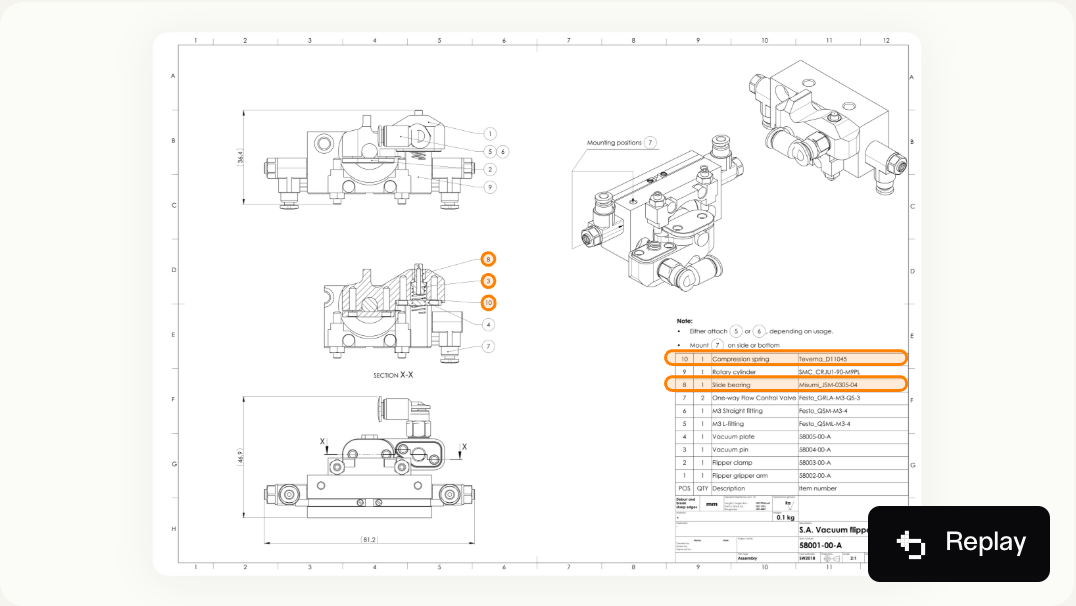
The drawing example starts with a question about whether two components touch, then checks the parts list, zooms into a section view and follows labels. The useful feature is a path from the question back to inspectable evidence. This is an official replay; independent work on the same task can extend that picture.
Sources and further reading
- Mistral Large 4 announcementOfficial · October 6, 2026Model positioning, official demonstrations and task charts.
- Visual demo embedded in the announcementOfficial public replayA localization and drawing-inspection replay. Its data names the internal patchstral-sft-260921 model; it is not a BitShovel run of the current API.
Task results and an overall index provide different references
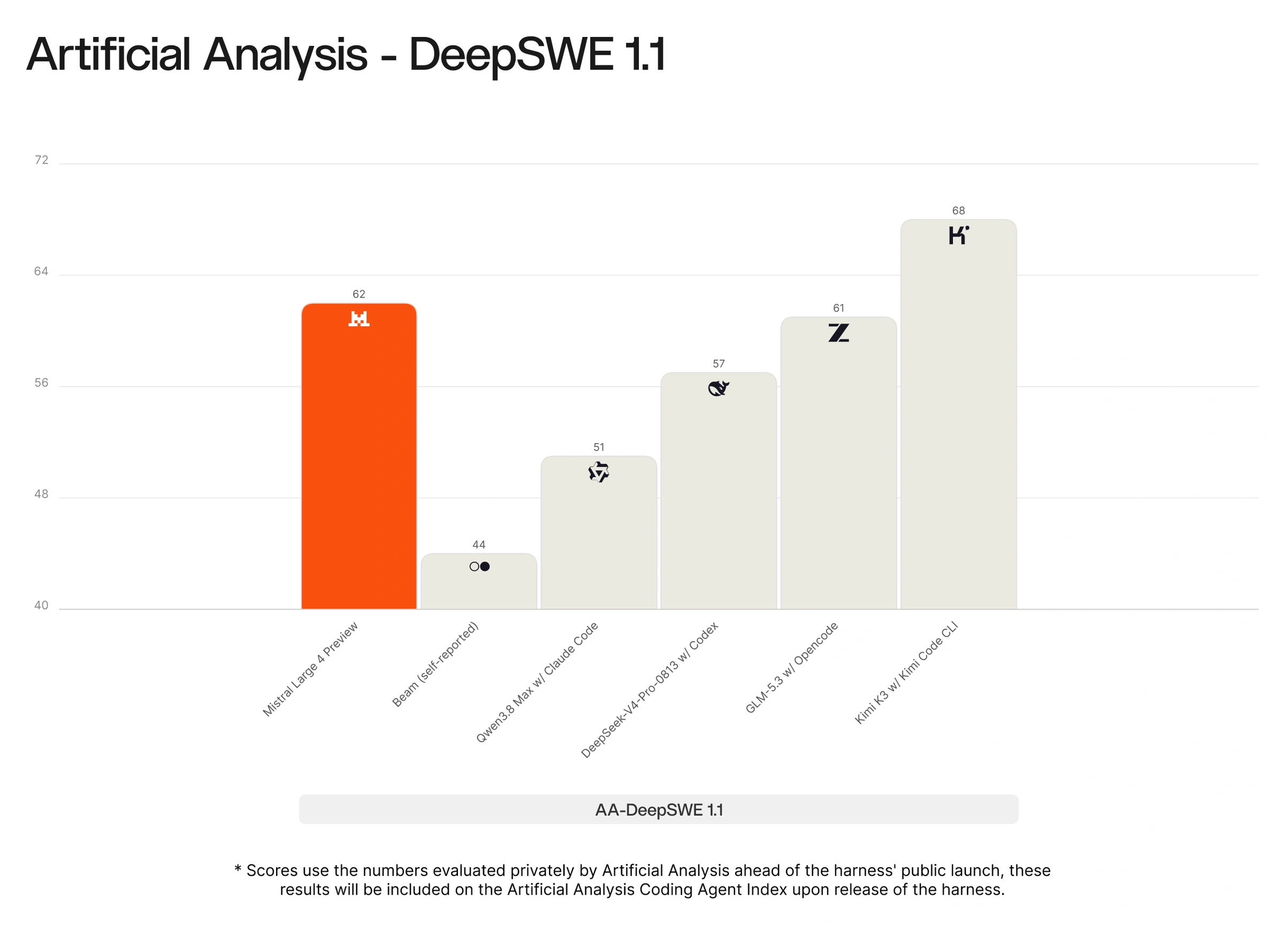
Mistral reports 61.7% on DeepSWE 1.1, rounded to about 62 in its chart alongside GLM, Kimi and their tools. That concerns a specific coding task set; tool conditions and the self-reported entry belong with the scores.
Artificial Analysis currently displays 38 for Mistral Large 4 Preview. The table keeps the tested settings of several existing choices. It gives an approximate position; different settings do not imply equal compute, and index points are not success rates on drawings or Chinese tasks.
| Model and setting | Intelligence Index |
|---|---|
| GLM-5.3 · max | 45 |
| Kimi K3 · max | 44 |
| DeepSeek V4.1 Flash · max | 39 |
| Mistral Large 4 Preview · effort not specified in the source table | 38 |
Sources and further reading
- Mistral Large 4 announcementOfficial · October 6, 2026Model positioning, official demonstrations and task charts.
- Artificial Analysis model leaderboardIndependent evaluator · checked October 7Displayed integer scores from the same v4.3.2 index, with each configuration retained.
Start through the API; follow the weights release separately
The current model card lists mistral-large-4 with 1M context, multimodal chat, document questions, tool calling and structured outputs. This is hosted access. End-of-month weights remain a plan, rather than a downloadable equivalent of today’s preview.
This connects to two existing threads. Beam also separates preview access from weights, while the GLM/Kimi Bedrock example shows how services and tools carry a model into work. Public outputs and revisions using matched material and tools are the next useful evidence.
- See Studio access and current model details
- How a model reaches an existing coding tool
- Read Beam’s preview and release plan
Sources and further reading
- Mistral Large 4 model cardOfficial documentation · checked October 7Public preview, model ID, context and current access conditions.
- Mistral changelogOfficial · October 6 entryThe API preview is available; weights remain a later release.
Weights arrive as promised; the license draws where “open” ends
The end-of-month weights promised at preview arrived on October 29: Hugging Face now hosts an FP8 main repository (54 shards) alongside an official NVFP4 quantization for Blackwell GPUs, with community GGUFs from the Unsloth and llama.cpp teams the same day; vLLM, SGLang, transformers and llama.cpp support it out of the box, and the full technical report is still pending. Hosted access is unchanged — the API remains mistral-large-4, priced at $0.70 per million input tokens, $0.07 cached and $2.10 output.
The license is the Mistral Ecosystem Open-Weight License, a modified MIT: use, modification, fine-tuning and commercialization are free, with one added condition — a business operating the model as a service (MaaS) must sign a separate commercial license with Mistral before commercial use. Self-hosting, internal use and embedding the model inside a product’s features are unrestricted. Compared with the Apache 2.0 used by Beam 1.0 earlier this month, the substance of “open weights” lives in the license terms, not in downloadability alone.
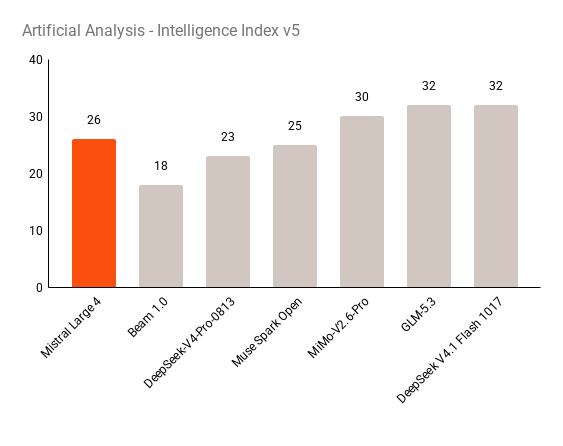
Artificial Analysis adjusted its source table the same day: the Preview row is retired, and the released weights enter the v5.0 Intelligence Index at 26 on the high setting (23 on medium). This site’s board was updated in the same full re-read — the other 28 rows are unchanged. Mistral’s model card calls it “the highest among western open-weight models”, and the official chart honestly shows higher Chinese open models: GLM-5.3 and DeepSeek V4.1 Flash 1017 both at 32. The index mainly measures English text tasks and cannot stand in for drawings or Chinese-language performance.
Sources and further reading
- Mistral Large 4 open-weights release postOfficial · October 29, 2026Task charts, the license explanation, API pricing and the stated safety boundaries.
- Weights repository and model cardOfficial repository · checked October 3054 FP8 main shards, the NVFP4 variant entry, deployment recipes and the license text; an official NVFP4 quantization is listed separately.
- Artificial Analysis model leaderboardIndependent evaluator · checked October 7Displayed integer scores from the same v4.3.2 index, with each configuration retained.
Three more weeks of RL after preview: coding leads, security keeps edges
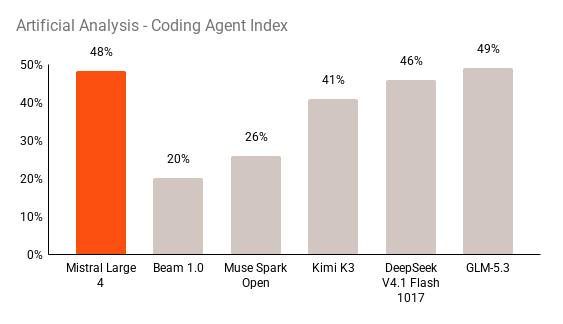
The published results are vendor-reported: 19.7% on Cognition’s private FrontierCode 2.0, leading its compared set (Beam 1.0 at 19.3%, GLM-5.3 at 17.8%); Terminal-Bench 4.0 rises from the preview’s self-reported 28% to 41% with 30% fewer output tokens; and 48% on the Artificial Analysis Coding Agent Index, effectively tied with GLM-5.3 (49%) in that framing at 47% fewer tokens per task on average. These describe the economics of agentic coding, not a BitShovel measurement.
Security leads the announcement, but its position matters: 51% on the Artificial Analysis Cyber Index, with Mistral’s own chart showing higher DeepSeek V4.1 Flash 1017 (57%) and MiMo-V2.6-Pro (56%). The differentiator is the refusal balance — a 96.6% average refusal rate on malicious cyber requests, the highest Mistral measures among open models, while defensive performance is retained and the B3 agent-security benchmark resists 97.1% of attacks (93.3% at preview).
The edges are stated too: after the preview, Mistral monitored live traffic and saw the model refuse black-box attacks against live targets, while still judging there is potential uplift to conduct real attacks, and is updating its guardrails accordingly; a specialized variant for penetration testing and red-team work is restricted to vetted partners under contractual safeguards. As of this section’s publication, none of these numbers has been re-tested by BitShovel, and the weights have not been downloaded or run here.
Sources and further reading
- Mistral Large 4 open-weights release postOfficial · October 29, 2026Task charts, the license explanation, API pricing and the stated safety boundaries.