Model update · Official demonstration
Beam weights are open: from a game to tools people can revise
Continue from the astronaut game: Beam 1.0 weights and a 1M API are available. A dictation app shows how model-written code, later repairs and local speech recognition become source others can continue building.
The preview is dated October 5; its demonstration and API record retain the October 6 check. Weights were released October 16. The new access and dictation-tool sections were checked October 17, Beijing time.
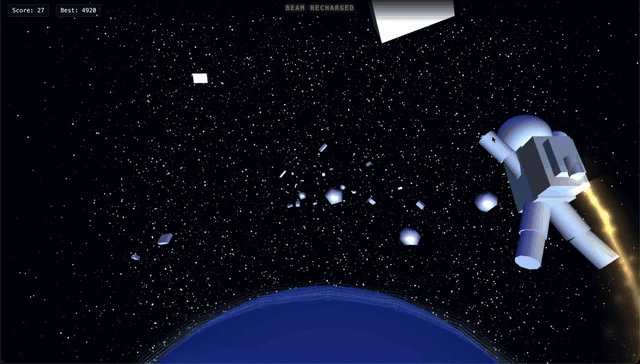
Start with the game it produced
Reflection's October 5 Beam preview includes a p5.js astronaut game: dodge asteroids or fire beams. Its demonstration turns a coding request into a visible artifact.
Beam takes text. Generating graphics through code differs from reading a photograph. Kimi's SVG and image-description example and GLM's 3D penthouse offer useful connections: inspect the artifact, then follow the code, tools and human revisions.
Sources and further reading
- Reflection: BeamVendor announcement · October 5Demos, compute estimates and weight plans.
What do capability and compute each tell us?
The Beam preview is a sparse mixture-of-experts model with 501B total and about 23B active parameters. Size and active computation do not replace task outcomes. Preview launch scores are vendor-reported; our October 6 record had no independent Beam score. The new section covers the later 1.0 result.
The efficiency chart estimates generation compute, excluding prompt processing, attention and serving overhead. Keep that estimate distinct from task success, speed and actual charges; it is not an API bill.
Sources and further reading
- Reflection: BeamVendor announcement · October 5Demos, compute estimates and weight plans.
How far had preview access opened on October 6?
When checked October 6, documentation listed Beam-501B-A23B with 256K context counting input and output together, 128K maximum output and medium default effort. The beta API then opened gradually through a waitlist. The announcement's 1M effective training context was distinct from that early serving window.
The October 5 announcement planned Apache 2.0 weights and further artifacts later that month; GLM-5.3 and Kimi K3 already listed downloadable files. This table preserves that preview stage. The next section follows Beam's actual October 16 release.
| Model | Public material | Weight stage |
|---|---|---|
| Beam preview | Official demos and beta API documentation | Planned for this month |
| GLM-5.3 | Model explanation, evaluations and deployment materials | Files in the official repository |
| Kimi K3 | Model explanation, evaluations and deployment materials | Files in the official repository |
- Check the current Beam model and API
- Continue to GLM-5.3 evaluations and works
- Continue to Kimi K3 evaluations and works
Sources and further reading
- Reflection: BeamVendor announcement · October 5Demos, compute estimates and weight plans.
- Reflection model documentationOfficial API reference · October 6 recordThe 256K context, 128K output and effort settings recorded then; the live page has since changed, as explained below.
- Reflection API introductionOfficial beta documentation · October 6 recordThe gradual waitlist access recorded then.
- Official GLM-5.3 weightsOfficial model repositoryCurrently public weight files and license.
- Official Kimi K3 weightsOfficial model repositoryCurrently public weight files and license.
Weights are open: what changes for access?
On October 16, Reflection released Beam 1.0 with BF16, FP8 and NVFP4 weights, a DFlash2 drafter, model cards and a safety technical report. Apache 2.0 main weights are now real files for deployment, modification or further training. The earlier preview's planned release has happened. Public sources do not establish that 1.0 and the October 5 preview are the same checkpoint, so their identities remain separate.
It remains a text-input, text-output model. The current Beam-1.0-501B-A23B API allows 1M tokens for input and output combined, up to 128K output and five effort settings; query the actual default for your organization. That does not rewrite the October 6 record of a 256K service. For self-hosting, 23B active parameters do not mean storing only 23B weights. Hugging Face estimates about 1 TB for BF16 or 280 GB for NVFP4 weights, before context-cache and runtime overhead.
There is also a new independent result: Artificial Analysis lists Beam 1.0 at 30 on October 17, without naming an effort setting. This is its text intelligence index, separate from the vendor's coding, tool and safety evaluations; it is not assigned retroactively to the preview. Open weights make inspection, adaptation and self-hosting possible. Success in a particular job still needs evidence from that job.
| Route | What it enables | Conditions |
|---|---|---|
| Hosted API | Connect coding tools or your service | Account and plan access; 1M capacity need not be filled on every request |
| Self-host weights | Choose precision, adapt or train further | NVFP4 needs compatible hardware; the SGLang recipe uses four B300s, with FP8 for older GPUs |
- See the official checkpoints and precisions
- See the current API model and access
- Read deployment recipes and build accounts
Sources and further reading
- Reflection: Beam is now availableOfficial release · October 16The 1.0 release, three weight precisions, DFlash2 and current access routes.
- Official Beam 1.0 weights and model cardOfficial repository · pinned revisionActual weight files checked October 17; 501B total, 23B active and text input/output.
- Beam 1.0 licenseOriginal license fileApache License 2.0; use, modification and distribution follow its terms.
- Current Beam 1.0 API modelOfficial documentation · checked October 171M combined context, 128K maximum output and five effort settings; access depends on account and plan.
- Hugging Face: deployment and build examplesOriginal integration and build account · October 16Weight memory, hardware recipes and the BeamSpeak build; its small trial runs are not formal benchmarks.
- Artificial Analysis source leaderboardIndependent text evaluation · read October 17Beam 1.0 scores 30, with effort unnamed in the table; this is not assigned to the earlier preview.
- Reflection model cardOfficial capabilities and limitationsText modality, context, vendor evaluations and weight precisions.
- Beam Safety Technical ReportOfficial reportPublished safety evaluations and methods, separate from the independent intelligence index.
From a game to a dictation tool people can revise
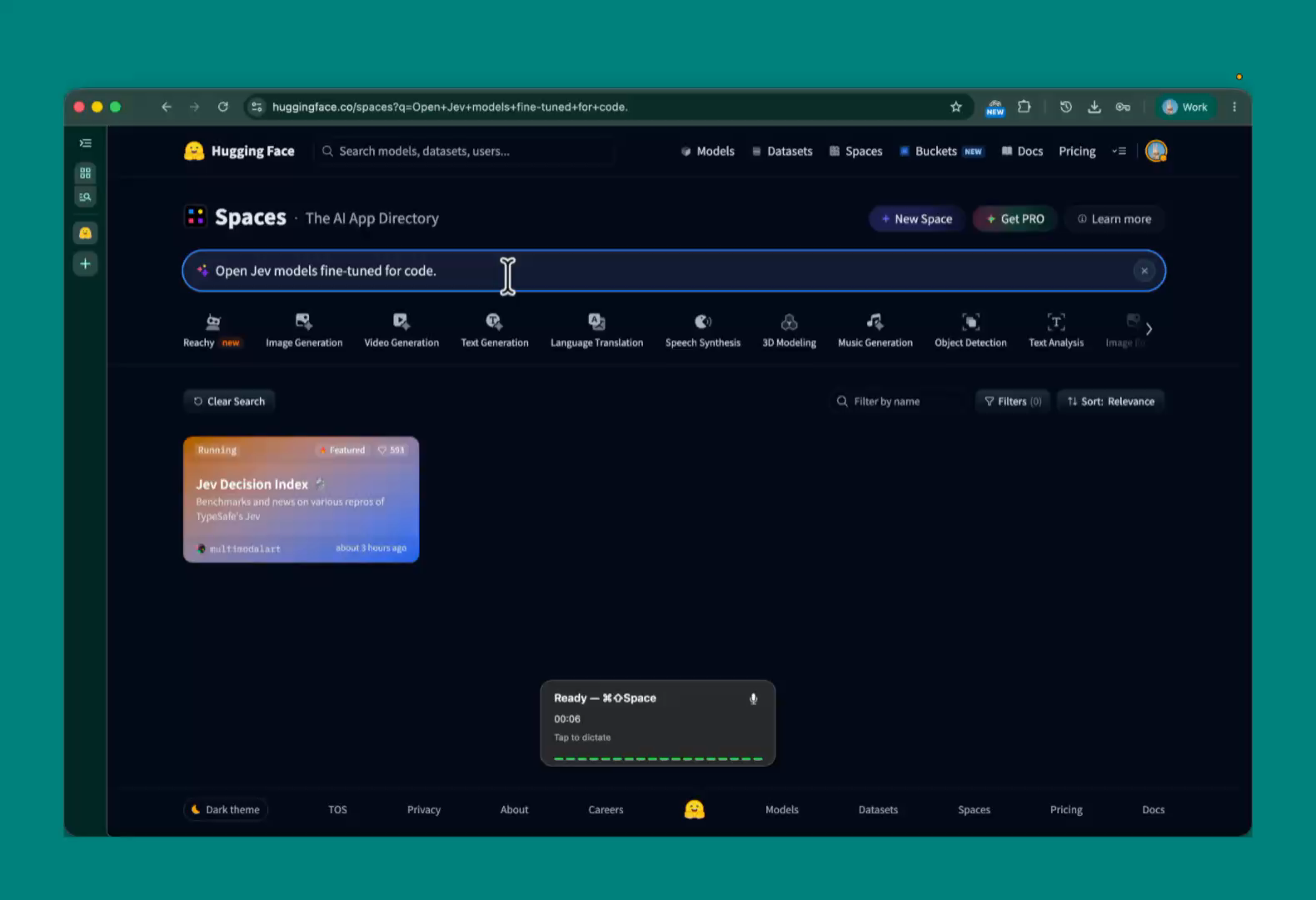
The accompanying Hugging Face post offers another concrete result: BeamSpeak, a menu-bar dictation tool for Apple Silicon Macs. Command+Shift+Space starts and stops recording, and the transcript can reach the clipboard. Local recognition uses Parakeet v3 through MLX. Beam's role is writing the app's code; this is not evidence of the 501B model running on that Mac.
The build notes preserve the handoff: Beam generated the first implementation through Pi; after a provider rate limit, Codex reviewed and repaired it and renamed it BeamSpeak. The author separately checked local recognition, microphone capture, the physical shortcut and clipboard delivery. Automatic paste remains unverified. The video shows the recording pill and text; the notes distinguish what that view establishes from what still needs checking.
What is public is source code with development instructions. It needs Xcode command-line tools, Python 3.13, uv, ffmpeg and the speech model. The development bundle is not notarized and cannot be moved as a standalone .app. It is a readable, repairable starting point for a builder; someone seeking an install-and-go dictation app should first check these conditions. We read the notes and inspected video frames, without installing the app, calling Beam or downloading model weights.
- Watch the author's video
- Read the running and verification notes
- Get the original source archiveDevelopment material requiring the documented environment.
Sources and further reading
- Hugging Face: deployment and build examplesOriginal integration and build account · October 16Weight memory, hardware recipes and the BeamSpeak build; its small trial runs are not formal benchmarks.
- BeamSpeak running and verification notesAuthor's source documentation · checked October 17Local Parakeet recognition, development-bundle requirements, Codex repairs and the unverified automatic-paste step.