Model, work and access
Kimi K3.1 Pro: beyond 55, what matters in 3D work and access?
Connect the official 3D entry, CAD evaluation and Code tiers. Separate the new model’s independent index, tool use, speed quotas and pending weights.
Kimi Code dates rollout to October 23; the research index dates its article to October 24. We read primary sources and independent evaluation without calling the model, upgrading a plan or testing account access.
Start with the 3D entry—and identify what the image shows
A pagoda, typewriter and jet engine appear in the official 3D Make template entry. The release describes previewing and editing models, with download and sharing routes. The screenshot still says K3 High: it neither attributes every template to K3.1 Pro nor proves access in an individual account.
K3.1 Pro continues K3 through post-training, targeting coding, 3D creation and longer tasks, with a Highspeed route alongside it. A useful follow-up is whether an attractive model has editable geometry and responds to requested changes. A name or polished preview does not establish that outcome.
Sources and further reading
- K3.1 Pro original technical accountPrimary material · read October 24Research-index date October 24; examples, BenchCAD footnotes, product access and future weights.
- Kimi Code models and membershipPrimary material · read October 24256K/1M, thinking, IDs and Highspeed quotas; not our account test.
Tools and scoring matter in the CAD evaluation
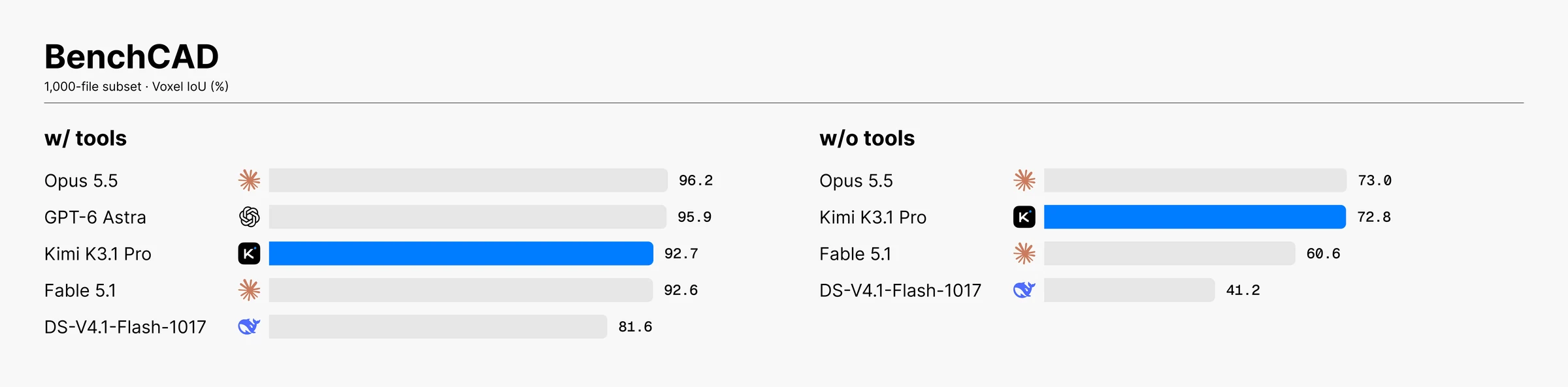
In the report’s 1,000-file BenchCAD subset, multi-view images are reconstructed through CAD code. K3.1 Pro reports 92.7 with tools and 72.8 without, measured by Voxel IoU. The tool-assisted agent and single-shot settings differ; this is not a model-only gain or a 92.7% print-acceptance rate.
For actual creation, inspect geometry files, dimensional constraints, before-and-after edits and exports together. A preview shows appearance; the model exposes editable parts. Printing adds mesh, scale and material checks. This is our interpretation of the evaluation, not a generation or printing test.
Sources and further reading
- K3.1 Pro original technical accountPrimary material · read October 24Research-index date October 24; examples, BenchCAD footnotes, product access and future weights.
AA 55 is a different measure; K3 remains a separate model
Artificial Analysis v4.3.2 lists K3.1 Pro at 55 without naming its exact effort setting. It enters our included-model comparison below 58/56 and above 53. This mainly English text index is distinct from the CAD evaluation. K3’s separate AA page still reports max 44, so its identity and source remain rather than being overwritten.
The 55 score is not automatically a Highspeed measurement. The vendor describes equivalent capability, but the board does not separately evaluate that route. Speed, price and quotas need their own evidence. For a workload comparison, retain the actual model, effort, tools and completed result.
Sources and further reading
- AA: separate K3.1 Pro model pagePrimary material · read October 24Independent 55 and reasoning version; exact effort unnamed, not a Highspeed test.
- AA: original K3 model pagePrimary material · read October 24Still readable at max 44, preserving its identity and configuration as the aggregate page moves to the new model.
Separate context, quota and weights when choosing access
In Kimi Code, Plus/Moderato can use Pro at 256K; up to 1M requires Pro/Allegretto or above. Highspeed requires the higher tier too, with documented 2–3× speed and about twice the quota use. Both Pro routes require thinking, default to max, and recommend a new session rather than reusing an older model’s reasoning and cache.
Metered API billing is separate. The Chinese platform checked October 24 lists Pro at RMB 13 input / 68 output per million tokens, and Highspeed at 26 / 136; cache hits are RMB 1.30 for both. These are that page’s RMB rates, not Code quotas, other regions or whole-task cost. The release schedules full weights by November 4; current product access is not weight availability, and enterprise access requires administrator enablement.
- Check Code models, plans and routing
- Check current metered API pricing
- Continue with local tools and cloud modelsThe original AWS example uses K3; this release does not establish K3.1 availability on Bedrock.
Sources and further reading
- K3.1 Pro original technical accountPrimary material · read October 24Research-index date October 24; examples, BenchCAD footnotes, product access and future weights.
- Kimi Code models and membershipPrimary material · read October 24256K/1M, thinking, IDs and Highspeed quotas; not our account test.
- Code series rollout recordPrimary material · read October 24October 23 Code rollout is distinct from the October 24 research-index date.
- Kimi Chinese public API ratesPrimary material · read October 24RMB per-million-token rates, separate from other regions, Code quotas and whole tasks.