Open weights and creation tools
31B down to 13.7B: a community compression of MiniMax H3 reaches consumer GPUs
Singapore video company Video Rebirth compressed MiniMax's open-weights joint audio-video model H3 into a few-step version: drop 3 of 50 blocks, low-rank-factor 102 linear layers, quantize 180 layers to rotated W8A8 INT8, and add two-time conditioning for 4–8-step CFG-free sampling. A 5.2-second clip runs end-to-end in 92 seconds on one RTX 5090; the Q4_K_M weights are 9.1 GB. The speed ledger is published and the quality ledger is not — no comparison against full H3, a gap the Hacker News thread called out; the weights carry H3's community license, applicable outside the US, EU, UK and South Korea.
This account draws on the GitHub repository Video-Rebirth/hyperflow-h3-flash (API-checked November 9, 2026: created November 6, single branch, 139 stars) and its full README, the Hugging Face weights page VideoRebirthAI/hyperflow-h3-flash (checked November 9: created November 4, four weight folders, 40,788 downloads at observation), the Hacker News thread (submitted November 7, read November 9), MiniMax H3's official model card and community license text (read November 9), and the Video Rebirth website (read November 9). All speed figures are Video Rebirth's own end-to-end measurements; this site downloaded no weights, ran no model and generated no video. The publisher provides no quality comparison against full H3, and this site ran none either.
Three days, three numbers
First, the timeline. MiniMax's H3 landed on Hugging Face on July 28 (the community license text states release/license date August 2); the official card describes a general-purpose omni-modal generative system — unified understanding of text, images, video and audio, generating video with native stereo audio up to 15 seconds, 24 fps, 32 kHz stereo, up to 2K; our November 9 API check counted 6.43M downloads and 6,664 likes. On September 17, Singapore video company Video Rebirth shipped an 8-step LoRA for the full-size H3 (full transformer kept, only the sampling schedule compressed). On November 4 its compressed weights went up on Hugging Face; the GitHub repo followed on November 6; Show HN landed late on November 7; by our November 9 check the compressed weights had 40,788 downloads.
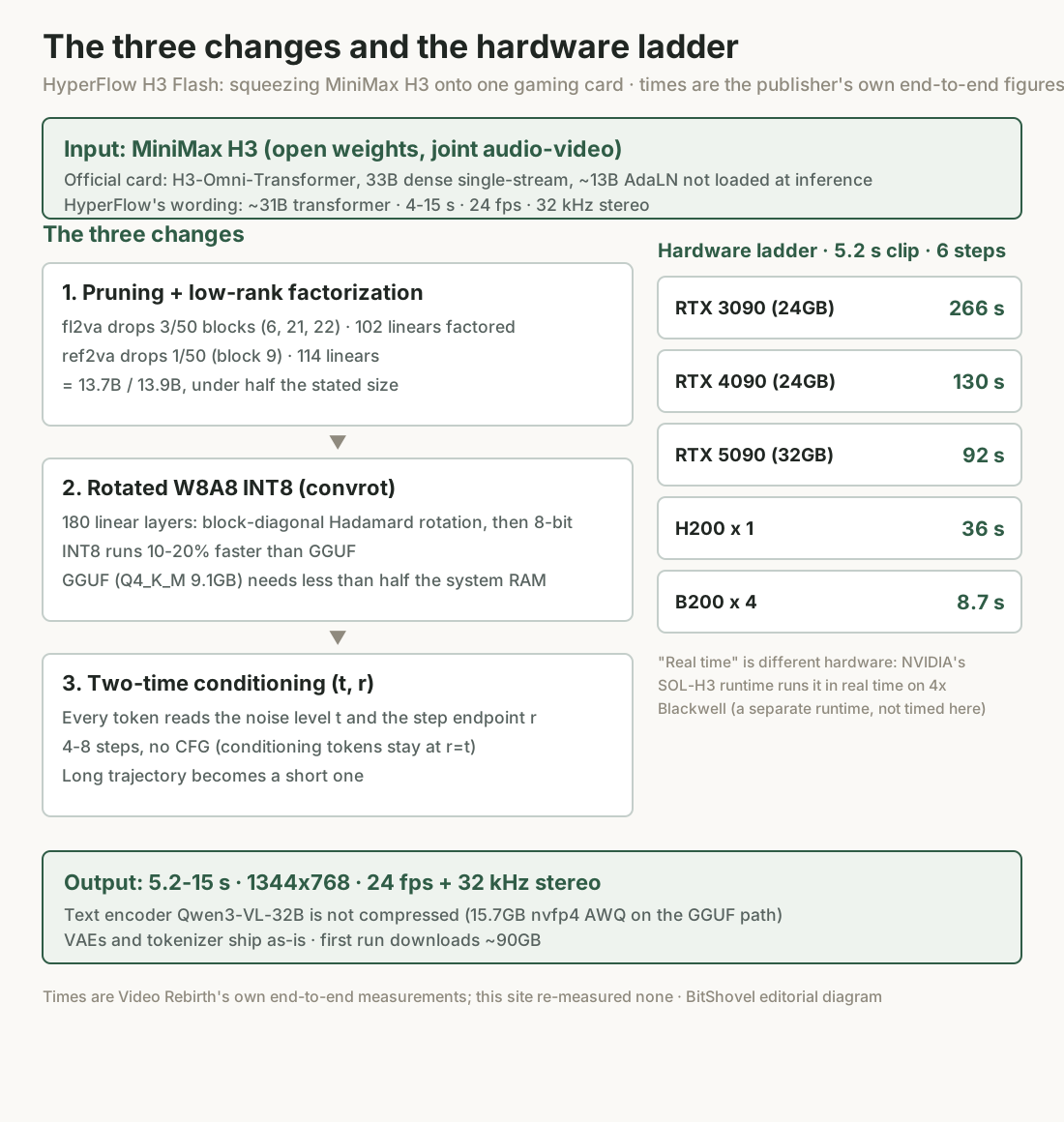
What gets compressed: the official card puts the H3-Omni-Transformer at 33B dense single-stream, with ~13B in AdaLN-related branches that need not load at inference; HyperFlow's own wording says "~31B MiniMax-H3 transformer". The two are not quite the same denominator and are kept separate here. Flash's output: 13.7B (fl2va, serving text-to-video and first/last-frame tasks) or 13.9B (ref2va, the omni-reference task), producing 5.2–15 seconds at a default 1344×768, 24 fps, with 32 kHz stereo — and its three tasks, t2va / fl2va / ref2va, map one-to-one onto H3's two official variants.
Three numbers for the feel of it. A 5.2-second clip, 6 steps, 1344×768, end-to-end (text encoding plus both VAE decodes included): 92 seconds on an RTX 5090 (INT8 build; 99 s GGUF), 130–157 s on an RTX 4090, 266–325 s on an RTX 3090, 36 s on one H200, 8.7 s on 4×B200. A 15-second clip runs about nine minutes on the 5090 (551 s INT8); 1088p at 15 s takes 743 s on an H200. The deployment floor: Q4_K_M weights are 9.1 GB and run in ComfyUI on a 24 GB card with 16 GB of system RAM (with --fast-disk); 16 GB-VRAM cards are unmeasured. All figures are Video Rebirth's own; this site re-measured none.
"Real time" needs the right home: 8.7 seconds to generate a 5.2-second clip is not real time. The README itself attributes real time to NVIDIA SOL-H3 — an inference runtime that runs Flash in real time on 4× Blackwell GPUs, day-0 support by its description (this site verified the directory exists on NVlabs/Sana's sol-engine branch; nothing was run or timed). What a card owner gets is "a short clip in minutes"; "while you talk" belongs to different hardware and a different runtime.
Sources and further reading
- GitHub: Video-Rebirth/hyperflow-h3-flash (code and README)Machine-checkable code · API-checked November 9 + full README readCreated 2026-11-06T08:31:59Z, last push 12:52:55Z, Apache-2.0, 139 stars at observation, single main branch. README read in full: task table (t2va / fl2va / ref2va), two runtimes (GGUF: ComfyUI / Unsloth Studio / stable-diffusion.cpp; INT8 convrot: Python package), benchmark tables (consumer RTX and datacenter GPUs, end-to-end 5.2 s / 15 s), architecture notes (pruning + low-rank factorization, convrot rotated INT8, two-time (t,r) conditioning), offload modes and ref2va token accounting (one 2048-short-edge reference ≈ 14,300 tokens; the clip itself 37,710 tokens at 5.2 s and 109,062 at 15 s — attention grows with the square). "Real time" is attributed to NVIDIA SOL-H3 on 4× B-series GPUs, day-0 support by their description.
- Hugging Face: VideoRebirthAI/hyperflow-h3-flash (compressed weights)Publisher weights page · API-checked November 9Created 2026-11-04T13:54:24Z, last modified 11-06T12:10:20Z; 40,788 downloads and 102 likes at observation. Four folders: fl2va_gguf, ref2va_gguf, fl2va_int8_convrot, ref2va_int8_convrot. NOTICE in brief: the weights are a Model Derivative of MiniMax-H3 (as defined in Section I.11 of that license), distributed under the same H3 Community License; the upstream text encoder, VAEs, tokenizer and processor are not redistributed here; "HyperFlow H3 Flash is not an official MiniMax product and is not affiliated with or endorsed by MiniMax."
- Hugging Face: MiniMaxAI/MiniMax-H3 (original model card and community license)Original publisher's model card and license · read November 9The card: H3 is a general-purpose omni-modal generative system with unified understanding of text/image/video/audio, generating video with native stereo audio at up to 2K and 15 seconds, 24 fps, 32 kHz stereo; the H3-Omni-Transformer is a 33B dense single-stream Transformer with ~13B in AdaLN-related branches that need not load for inference-only deployment. Variants H3-Base-FL2VA (first/last frame) and H3-Base-Ref2VA (omni-reference: ≤9 images, ≤3 videos, ≤3 audio, ≤12 total) map one-to-one onto Flash's fl2va/ref2va; an H3-Context-IR input-understanding module is separate. The HF repo was created July 28, 2026 (our Nov 9 API check); the license text states release/license date August 2, 2026; 6.43M downloads and 6,664 likes at observation. The community license's Applicable Territory excludes the US, EU, UK and South Korea.
What each of the three changes buys
Step one, structural pruning plus low-rank factorization. The fl2va branch drops 3 of 50 blocks (blocks 6, 21, 22) and low-rank-factors 102 linear layers; ref2va drops 1 of 50 (block 9) and factors 114. Parameters fall from HyperFlow's stated ~31B to 13.7B / 13.9B — less than half. What this buys is VRAM and bandwidth: the transformer takes over 80% of pipeline time and is compute-bound, so halving the layers discounts every step.
Step two, rotated W8A8 INT8 quantization (the team calls it convrot). 180 linear layers keep weights and activations in 8-bit integers, quantized behind a block-diagonal Hadamard rotation — the rotation flattens activation distributions so the narrow bit width loses less. The INT8 build runs 10–20% faster than GGUF; GGUF (Q3_K_M to Q8_0, 7.2–15.2 GB) instead cuts system-RAM needs to less than half, with ComfyUI dequantizing Q4_K_M at run time.
Step three, two-time conditioning (t, r). Diffusion models normally walk a long sampling trajectory; Flash feeds every token two times — the current noise level t and the step's endpoint r — so 4–8-step sampling needs no classifier-free guidance (conditioning tokens stay at r=t). This buys trajectory length: 50 steps become 6, and beyond cheaper steps the count itself drops by an order of magnitude. The companion repo holds the contrast: full-size H3 keeps every layer and takes an 8-step LoRA — two works side by side showing that compressing parameters and compressing steps are separable purchases.
What was not touched matters just as much: the text encoder is Qwen3-VL-32B — a 15.7 GB nvfp4 AWQ build on the GGUF path, bf16 by default on the Python path (~50 GiB, fp8 optional), with unused layers above the conditioning tap dropped at load for ~14 GB saved; the VAEs and tokenizer ship as-is. First run downloads about 90 GB (~68 GB with the fp8 text encoder): encoder, VAEs and the chosen INT8 transformer; the 62 GB full base transformer is never downloaded.
Sources and further reading
- GitHub: Video-Rebirth/hyperflow-h3-flash (code and README)Machine-checkable code · API-checked November 9 + full README readCreated 2026-11-06T08:31:59Z, last push 12:52:55Z, Apache-2.0, 139 stars at observation, single main branch. README read in full: task table (t2va / fl2va / ref2va), two runtimes (GGUF: ComfyUI / Unsloth Studio / stable-diffusion.cpp; INT8 convrot: Python package), benchmark tables (consumer RTX and datacenter GPUs, end-to-end 5.2 s / 15 s), architecture notes (pruning + low-rank factorization, convrot rotated INT8, two-time (t,r) conditioning), offload modes and ref2va token accounting (one 2048-short-edge reference ≈ 14,300 tokens; the clip itself 37,710 tokens at 5.2 s and 109,062 at 15 s — attention grows with the square). "Real time" is attributed to NVIDIA SOL-H3 on 4× B-series GPUs, day-0 support by their description.
The license boundary and the unpublished quality ledger
Read the license chain layer by layer. The code is Apache-2.0 (the ComfyUI nodes alone are GPL-3.0); the weights are not — the NOTICE states they are a Model Derivative of MiniMax-H3 (as defined in Section I.11 of that license), distributed under the same H3 Community License, whose Applicable Territory is "worldwide, excluding the EU, the UK, South Korea and the United States" — those four need separate MiniMax authorization. The NOTICE also says "not an official MiniMax product", and the upstream text encoder, VAEs and tokenizer are not redistributed with the compressed weights: installing Flash still means fetching those stock parts from official channels.
The quality ledger did not ship with the speed ledger. The README and model card deliver a meticulous speed record: three GPU benchmark tables, three offload modes, and ref2va token accounting (one 2048-short-edge reference image adds ~14,300 tokens — about seven 768p latent frames; the clip itself is 37,710 tokens at 5.2 s and 109,062 at 15 s, with attention cost growing as the square). What no release provides is a quality comparison against full H3 — how much picture and sound degrade after three layers are cut, 180 layers quantized and the sampling schedule collapsed to 6 steps. The Hacker News thread says it plainly: amelius likened it to "compressing a JPEG to 50% of its size ... and we didn't check what it looks like"; vrighter: "if they did the whole thing would seem a lot less impressive"; swiftcoder and Reubend asked for per-quant quality-versus-time tables. The showcase page is curated demos.
How to read the gap: the engineer answered speed and license questions in the thread and stated plainly that 16 GB-VRAM cards are unmeasured; the missing quality data is a boundary, not a scandal. Pruning, low-rank factorization and few-step conditioning can each move quality — by how much, and what breaks first (distant text? hands? audio-video sync?), there is as yet no public answer; only third-party evaluation or a user's own side-by-side will fill it. This site downloaded no weights and ran no model, and cannot fill that space for readers. Separating "it runs" from "it runs as well" is the first cut when reading releases like this one.
Sources and further reading
- Hugging Face: VideoRebirthAI/hyperflow-h3-flash (compressed weights)Publisher weights page · API-checked November 9Created 2026-11-04T13:54:24Z, last modified 11-06T12:10:20Z; 40,788 downloads and 102 likes at observation. Four folders: fl2va_gguf, ref2va_gguf, fl2va_int8_convrot, ref2va_int8_convrot. NOTICE in brief: the weights are a Model Derivative of MiniMax-H3 (as defined in Section I.11 of that license), distributed under the same H3 Community License; the upstream text encoder, VAEs, tokenizer and processor are not redistributed here; "HyperFlow H3 Flash is not an official MiniMax product and is not affiliated with or endorsed by MiniMax."
- Hacker News: Show HN thread (with the engineer's top comment)Maker statement and community thread · submitted November 7, 2026 (23:16 Beijing), read November 975 points and 14 comments at observation. jiant, self-identified as one of the project's engineers, opens with the three changes and speed figures, and states the license boundary: code Apache-2.0 (ComfyUI nodes GPL-3.0), weights a Model Derivative under the H3 Community License, which "does not cover the US, EU, UK or South Korea without MiniMax's authorization". The thread presses hard on the missing quality comparison between quantization levels and full H3 (swiftcoder, Reubend, amelius, vrighter); the showcase page is curated demos; the engineer answered speed and license questions.
- Hugging Face: MiniMaxAI/MiniMax-H3 (original model card and community license)Original publisher's model card and license · read November 9The card: H3 is a general-purpose omni-modal generative system with unified understanding of text/image/video/audio, generating video with native stereo audio at up to 2K and 15 seconds, 24 fps, 32 kHz stereo; the H3-Omni-Transformer is a 33B dense single-stream Transformer with ~13B in AdaLN-related branches that need not load for inference-only deployment. Variants H3-Base-FL2VA (first/last frame) and H3-Base-Ref2VA (omni-reference: ≤9 images, ≤3 videos, ≤3 audio, ≤12 total) map one-to-one onto Flash's fl2va/ref2va; an H3-Context-IR input-understanding module is separate. The HF repo was created July 28, 2026 (our Nov 9 API check); the license text states release/license date August 2, 2026; 6.43M downloads and 6,664 likes at observation. The community license's Applicable Territory excludes the US, EU, UK and South Korea.
A new execution channel, and this site's H3 dialect
The most direct connection on this site is the zenstory case. Its H3 dialect — first-frame mode ignoring turn direction (6/6, 3/3 reversed; all 9 candidates reversed), speech onset 1.3–2.4 s late, reference audio bound when a character speaks across two or more shots — was all measured on one execution channel: full-size H3 first-frame image-to-video. The case states its own boundary: the continuity numbers come from one 13-shot episode on one channel, and must be re-measured when the model version or channel changes. Flash is a new channel — pruned, rotated-INT8, 4–8 steps — so those numbers do not carry over, and whether the dialect itself (name the medium, name the light source, anchor the blocking) still holds must be re-tested too.
Who is doing this is worth a note. Video Rebirth self-describes as "the enterprise company behind BACH": custom video models and commercial-ready output, with BACH its proprietary commercial model ($0.12/s at 1080p and a claimed No. 2 image-to-video rank on AA are its own claims, unchecked here); the page also cites Forbes (a Singapore startup founded by Tencent's former AI head) and Bloomberg (funding, November 2025). Its open-source line does not train a new foundation — it compresses someone else's open-weights model until consumer hardware can run it. H3's own model card points users to a prompt-writing guide; the official guide, third-party skill repos like drama-skills, and compressed runtimes all grow on the same open-weights base.
In this site's open-weights line: Cosmos 3 put post-trained examples on a download page; HALO ran a stock open-weights model as a humanoid's brain; Flash squeezes someone else's open weights onto one gaming card — all three share one fact: open weights allow redistribution and modification, closed weights do not. The board gap stays stated: H3 and Flash are audio-video generation models, outside the AA / Pi text calibers; the Physics-IQ board scores video continuation (v2v), a different track from text- or image-to-video, and its 15 rows read on November 7 include no H3. No comparable score, no invented ranking — a site rule that applies to popular projects too.
- Compare: the zenstory case's H3 dialect and re-measure rule
- Compare: Cosmos 3's post-trained examples on a download page
- Compare: HALO running a stock open-weights brain
Sources and further reading
- GitHub: Video-Rebirth/hyperflow-h3-flash (code and README)Machine-checkable code · API-checked November 9 + full README readCreated 2026-11-06T08:31:59Z, last push 12:52:55Z, Apache-2.0, 139 stars at observation, single main branch. README read in full: task table (t2va / fl2va / ref2va), two runtimes (GGUF: ComfyUI / Unsloth Studio / stable-diffusion.cpp; INT8 convrot: Python package), benchmark tables (consumer RTX and datacenter GPUs, end-to-end 5.2 s / 15 s), architecture notes (pruning + low-rank factorization, convrot rotated INT8, two-time (t,r) conditioning), offload modes and ref2va token accounting (one 2048-short-edge reference ≈ 14,300 tokens; the clip itself 37,710 tokens at 5.2 s and 109,062 at 15 s — attention grows with the square). "Real time" is attributed to NVIDIA SOL-H3 on 4× B-series GPUs, day-0 support by their description.
- Hugging Face: MiniMaxAI/MiniMax-H3 (original model card and community license)Original publisher's model card and license · read November 9The card: H3 is a general-purpose omni-modal generative system with unified understanding of text/image/video/audio, generating video with native stereo audio at up to 2K and 15 seconds, 24 fps, 32 kHz stereo; the H3-Omni-Transformer is a 33B dense single-stream Transformer with ~13B in AdaLN-related branches that need not load for inference-only deployment. Variants H3-Base-FL2VA (first/last frame) and H3-Base-Ref2VA (omni-reference: ≤9 images, ≤3 videos, ≤3 audio, ≤12 total) map one-to-one onto Flash's fl2va/ref2va; an H3-Context-IR input-understanding module is separate. The HF repo was created July 28, 2026 (our Nov 9 API check); the license text states release/license date August 2, 2026; 6.43M downloads and 6,664 likes at observation. The community license's Applicable Territory excludes the US, EU, UK and South Korea.
- Video Rebirth website (company self-description)Company page · read November 9Self-description: "The enterprise company behind BACH. We build custom video models and produce commercial-ready video", centered on production-grade video built on customers' own IP (BACH at $0.12/s at 1080p and a claimed No. 2 image-to-video ranking on AA are the company's own claims, not independently checked here); HyperFlow is its open-source line based on MiniMax H3. The page also cites Forbes (a Singapore startup founded by Tencent's former AI head) and Bloomberg (funding reported November 2025) — press retellings are kept separate from self-description.