Robots and models
Apple's HALO: two layers of a humanoid stack run open-weights models
Apple's HALO research system — paper submitted November 4, code opened November 5 — splits humanoid control into three clocks: the decision layer runs the open-weights Qwen3.6-35B-A3B (4-bit, ~20 GB) locally on a Mac mini riding the robot's back, and the motion generator uses a frozen Qwen3.5-2B encoder; the training corpus is synthesized across 1,000 procedurally generated homes, “scales with compute rather than human labor”. 91% over 360 single-task trials in six unmapped real homes — while composite tasks split between real and sim, code is open but weights don't ship, and there is no contact sensing beyond vision.
This account draws on the arXiv 2611.06908 abstract page and full HTML text (submitted November 4, 2026; read by this site on November 8), the Apple AIML Research project page and GitHub repository (read / API-checked November 8); IT Home's November 7 report serves as a timeline reference only — its “3D-printed enclosure” line is not in the paper, and the body follows the paper's wording. All figures are the paper's own; this site reproduced no trials, ran no robot and downloaded no weights.
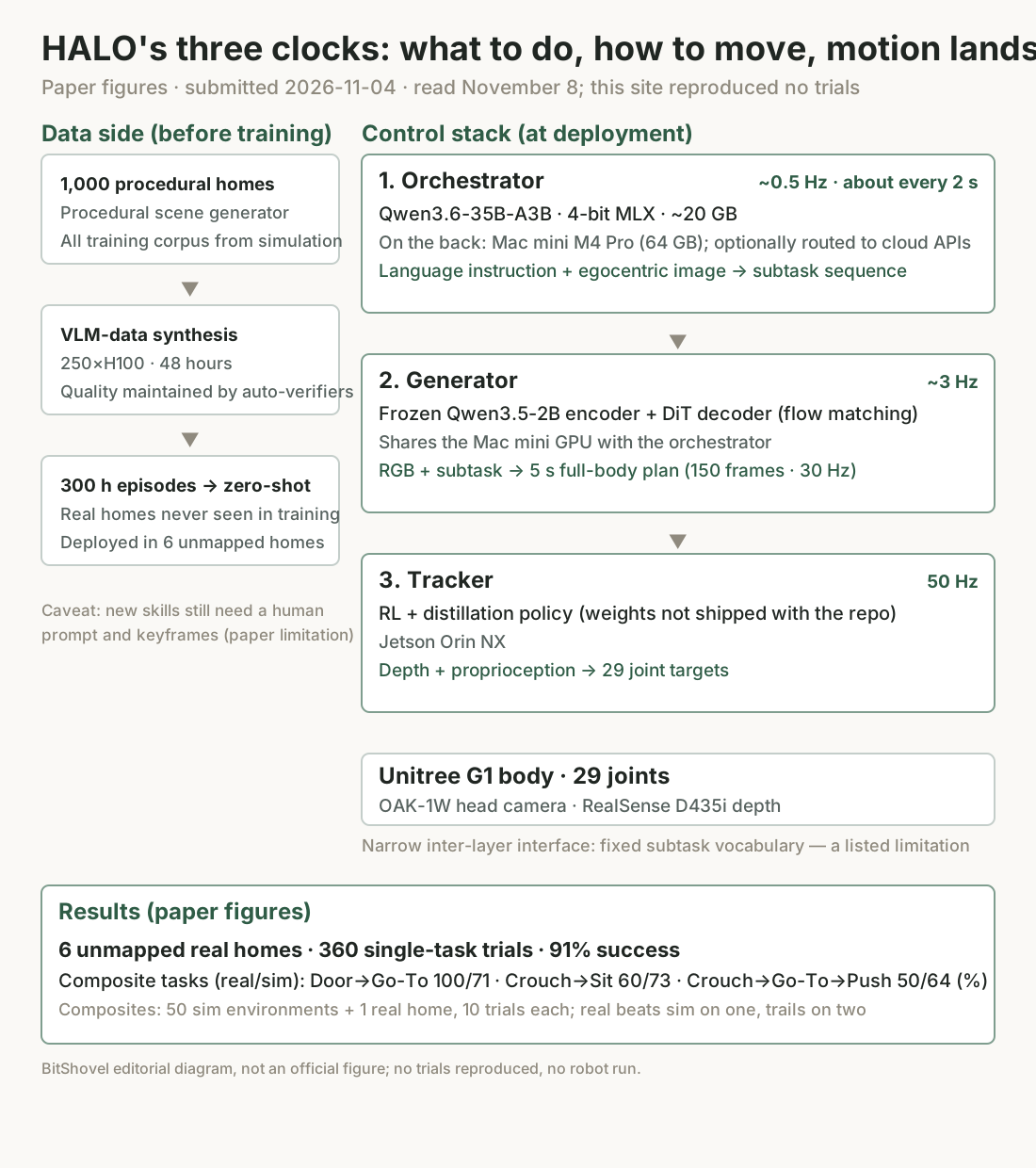
One humanoid, three clocks
On November 4, Apple's research team posted “Perceptive Humanoid Motion from Simulation”, unveiling HALO, a humanoid autonomy system; the next morning (November 5, 01:47Z) the companion repo went up (our November 8 API check: single main branch, 3 commits, 186 stars at observation). The paper states the scale and result: six unmapped real homes, 360 single-task trials, 91% average success; the same single tasks hit 91% in simulation across 6,000 trials.
The stack has three layers on their own clocks. The orchestrator ticks about every 2 seconds (~0.5 Hz): the open-weights Qwen3.6-35B-A3B, 4-bit (MLX, ~20 GB), on a Mac mini (M4 Pro, 64 GB) inside the robot's rear enclosure; it reads the language instruction plus the egocentric image and outputs a subtask sequence — crouch, sit, push, follow — from a fixed subtask vocabulary (skills.yaml). The paper notes the orchestrator can optionally route to frontier cloud models via APIs. The generator ticks ~3 Hz: a frozen Qwen3.5-2B encoder with a DiT decoder (flow matching) turns RGB + subtask into a 5-second full-body plan (150 frames, 30 Hz). The tracker ticks 50 Hz: an RL + distillation policy on the G1's stock Jetson Orin NX takes depth + proprioception and outputs 29 joint targets.
Why layers? The paper's reasoning is direct: different problems need different frequencies. Deciding what to do need not be re-thought every frame; a 5-second plan re-planned at ~3 Hz suffices; balance and contact stability need a hard real-time loop at 50 Hz. Each layer consumes only what it needs. Cloud is swappable, the bottom layer is not: the orchestrator can upgrade to stronger cloud models, while the tracker must stay on the onboard chip.
Sources and further reading
- arXiv: Perceptive Humanoid Motion from Simulation (abstract page; full HTML read separately)Publisher paper · submitted November 4, 2026 (read November 8, abstract + full HTML)Read in full: three-layer stack (orchestrator is a stock VLM ticked about every 2 s, optionally routed to cloud APIs; generator uses a frozen Qwen3.5-2B encoder with a DiT decoder trained by flow matching, ~3 Hz 5-second plans; 50 Hz tracker). Hardware: Unitree G1 (29 joints) + OAK-1W head camera + rear enclosure housing a Mac mini M4 Pro (64 GB); tracker on the stock Jetson Orin NX; depth RealSense D435i. Results: 91% across 360 single-task trials in 6 unmapped real homes (91% over 6,000 sim trials); multi-task eval used 50 sim environments + 1 real home, 10 trials per task per environment, success requires all subtasks, three combos real/sim 100/71, 60/73, 50/64 (means 70/69). Training: 1,000 Infinigen homes, 300 h corpus, synthesis 250×H100·48h, generator 64×B200, tracker 4×H100; abstract: “corpus scales with compute rather than human labor”, “an hour of data costs at least an hour of human time”. Limitations: new skills need human-written prompts + authored keyframes; once an object leaves the FOV or is occluded the policy has no signal it is still there and contact-rich tasks degrade — tactile sensing the natural fix; narrow inter-layer interface; simple orchestrator needing a more agentic system.
- Apple AIML Research: HALO project page (demo video, interactive viewer, real-task gallery)Publisher project page · read November 8The project page offers a demo video (fully autonomous run: voice command sequence + onboard stack timeline: orchestrator picks a subtask every 2 s, generator re-plans every 1/3 s, tracker at 50 Hz) and an interactive 3D sim replay (ego/depth views); gallery of ~27 real-robot task clips (sit on chairs/sofa, crawl under tables, sidestep doors, push boxes, follow people, crawl). The page's BibTeX cites arXiv:2611.06908; this site watched no full video and reviewed no gallery frame by frame.
A thousand procedural homes: the corpus scales with compute
The data pipeline answers an old question: where does humanoid-robot data come from? The abstract: teleoperation and wearable capture “require at least an hour of human time to produce an hour of data”. HALO synthesizes vision-language-motion data across 1,000 Infinigen-generated home scenes: 300 hours of episodes, all from simulation. Synthesis took 250 H100s for 48 hours; the generator trains on 64 B200s, the tracker on 4 H100s.
“The corpus scales with compute rather than human labor” is the paper's own claim, with “quality is maintained by automated verifiers” in the introduction. The accurate reading: corpus size is no longer bounded by human hours — machine hours replace human hours — but “adding a new physical task still requires a human to write its prompt and author the keyframes” sits in the paper's limitations: scale is still bounded by human design capacity.
Sim-to-real is zero-shot: no real home appears in the training corpus; deployment went straight to six real homes. That bounds what 91% means: it measures “homes never seen in training”, not “all homes”. Six is a small sample; the paper claims no generalization to all households.
Sources and further reading
- arXiv: Perceptive Humanoid Motion from Simulation (abstract page; full HTML read separately)Publisher paper · submitted November 4, 2026 (read November 8, abstract + full HTML)Read in full: three-layer stack (orchestrator is a stock VLM ticked about every 2 s, optionally routed to cloud APIs; generator uses a frozen Qwen3.5-2B encoder with a DiT decoder trained by flow matching, ~3 Hz 5-second plans; 50 Hz tracker). Hardware: Unitree G1 (29 joints) + OAK-1W head camera + rear enclosure housing a Mac mini M4 Pro (64 GB); tracker on the stock Jetson Orin NX; depth RealSense D435i. Results: 91% across 360 single-task trials in 6 unmapped real homes (91% over 6,000 sim trials); multi-task eval used 50 sim environments + 1 real home, 10 trials per task per environment, success requires all subtasks, three combos real/sim 100/71, 60/73, 50/64 (means 70/69). Training: 1,000 Infinigen homes, 300 h corpus, synthesis 250×H100·48h, generator 64×B200, tracker 4×H100; abstract: “corpus scales with compute rather than human labor”, “an hour of data costs at least an hour of human time”. Limitations: new skills need human-written prompts + authored keyframes; once an object leaves the FOV or is occluded the policy has no signal it is still there and contact-rich tasks degrade — tactile sensing the natural fix; narrow inter-layer interface; simple orchestrator needing a more agentic system.
Code is open; weights don't ship
In the early hours of November 5 the repo went up (November 8 API check: created 01:47Z, last push 04:58Z, single main branch, 3 commits, 186 stars at observation). Six directories cover the full pipeline: datagen (Infinigen scenes + Kimodo motion + Isaac/MuJoCo rendering), generator, tracker (Isaac Lab three phases: privileged experts → multi-teacher distillation → multi-critic fine-tuning), orchestrator (co-served via halo_serve), system (run_sim.py / run_real.py launchers, halo_comm messaging, halo_serve on-device scheduling), assets (G1 MJCF/URDF/USD).
The boundary of “open” needs spelling out. A TODO comment left unrendered in the README: “No tracker weights ship; the proprio and depth tracker students are trained with tracker/training” — tracker weights do not ship; reproducing requires training them yourself with the repo's training code. The orchestrator model is a stock community 4-bit quantization (mlx-community/Qwen3.6-35B-A3B-4bit, ~20 GB), needing ≥32 GB Apple silicon. The license is not open source in the usual sense: the LICENSE is Apple's own terms (use/modify/redistribute with conditions, GitHub tags Other/NOASSERTION, not an OSI license), and third-party assets keep their original licenses.
This “open code, train-your-own-weights” mode sits alongside release paths we have recorded: Cosmos 3 put post-trained checkpoints on a download page (open weights, run them yourself); K3.1 Pro published open weights just under its promised deadline; HALO is “full recipe open, train the weights yourself”. The three differ in what the public actually gets: Cosmos gives runnable checkpoints, HALO gives the complete recipe from data synthesis to deployment.
Sources and further reading
- GitHub: apple-aiml-research/ml-halo (code repository)Machine-checkable code · API-checked November 8Created 2026-11-05T01:47Z, last push 04:58Z, 186 stars at observation, main branch, 3 commits. Six dirs: datagen (Infinigen scenes + Kimodo motion + Isaac/MuJoCo rendering), generator, tracker (Isaac Lab three phases: privileged experts → multi-teacher distillation → multi-critic fine-tuning), orchestrator (co-served via halo_serve), system (run_sim.py / run_real.py, halo_comm, halo_serve on-device scheduling), assets (G1 MJCF/URDF/USD). LICENSE is Apple's own terms (use/modify/redistribute with conditions; GitHub Other/NOASSERTION, not an OSI license; G1 assets keep original licenses). README's unrendered TODO comment: “No tracker weights ship; the proprio and depth tracker students are trained with tracker/training” — tracker weights do not ship; reproduce by training yourself. orchestrator/README points to mlx-community/Qwen3.6-35B-A3B-4bit (~20 GB, ≥32 GB Apple silicon).
- Hugging Face: mlx-community/Qwen3.6-35B-A3B-4bit (orchestrator model)Orchestrator model source · identified via the HALO repo README (read November 8)The orchestrator's default model is the community 4-bit quantization: ~20 GB, ≥32 GB Apple silicon, served on-device by halo_serve, sharing the GPU with the generator. Qwen3.6-35B-A3B and Qwen3.5-2B are Qwen open-weights models; Apple trained no model of its own and ships no weights.
How to read the numbers and the boundaries
What 91% covers: the average success rate of 360 single-task trials (sit on chairs, navigate to named objects, sidestep half-open doors, crouch under tables and crawl, push boxes) across six unmapped real homes; the same tasks hit 91% in simulation over 6,000 trials. Composites are tiered: the paper's multi-task eval used 50 sim environments + 1 real home, 10 trials per task per environment, success requires all subtasks. Three combos real/sim: Door→Go-To 100%/71% (real beats sim), Crouch→Sit 60%/73%, Crouch→Go-To→Push 50%/64% — two combos trail in the real world, one beats sim; the direction is not uniform, and single-task 91% must not be projected onto composites.
Boundary one: vision is the only sense. Limitations section: “once an object leaves the camera's field of view or is occluded, the policy has no signal that it is still there, and contact-rich tasks degrade accordingly. Tactile sensing would be a natural solution.” Boundary two: six homes is a small sample; no claim of generalization to all households. Boundary three: the orchestrator is itself simple; the authors call for a more agentic orchestration system, and the narrow inter-layer interface (fixed subtask vocabulary) is a listed limitation.
In this site's picture: our Qiyuan Q1/T1 piece recorded domestic humanoids entering homes; our Genie 4 piece recorded DeepMind's world model wired to a robotics experiment; our weights piece recorded open-weights models as readable and writable. HALO ties the three lines together: a procedurally generated world as data engine (the Genie 4 direction), an open-weights model as the brain (Qwen3.6-35B-A3B ~20 GB local), landing on a G1 in real homes. Apple trained no model of its own and ships no weights — a stock open-weights model in a three-layer stack, a procedural world making data, moving “capability from source to real homes” one notch closer to life; touch, occlusion and a more agentic orchestrator are the next steps the authors name.
- Compare: Qiyuan Q1/T1 (robots at home)
- Compare: Genie 4 (world model + robotics)
- Compare: weights you can read and write
Sources and further reading
- arXiv: Perceptive Humanoid Motion from Simulation (abstract page; full HTML read separately)Publisher paper · submitted November 4, 2026 (read November 8, abstract + full HTML)Read in full: three-layer stack (orchestrator is a stock VLM ticked about every 2 s, optionally routed to cloud APIs; generator uses a frozen Qwen3.5-2B encoder with a DiT decoder trained by flow matching, ~3 Hz 5-second plans; 50 Hz tracker). Hardware: Unitree G1 (29 joints) + OAK-1W head camera + rear enclosure housing a Mac mini M4 Pro (64 GB); tracker on the stock Jetson Orin NX; depth RealSense D435i. Results: 91% across 360 single-task trials in 6 unmapped real homes (91% over 6,000 sim trials); multi-task eval used 50 sim environments + 1 real home, 10 trials per task per environment, success requires all subtasks, three combos real/sim 100/71, 60/73, 50/64 (means 70/69). Training: 1,000 Infinigen homes, 300 h corpus, synthesis 250×H100·48h, generator 64×B200, tracker 4×H100; abstract: “corpus scales with compute rather than human labor”, “an hour of data costs at least an hour of human time”. Limitations: new skills need human-written prompts + authored keyframes; once an object leaves the FOV or is occluded the policy has no signal it is still there and contact-rich tasks degrade — tactile sensing the natural fix; narrow inter-layer interface; simple orchestrator needing a more agentic system.
- Apple AIML Research: HALO project page (demo video, interactive viewer, real-task gallery)Publisher project page · read November 8The project page offers a demo video (fully autonomous run: voice command sequence + onboard stack timeline: orchestrator picks a subtask every 2 s, generator re-plans every 1/3 s, tracker at 50 Hz) and an interactive 3D sim replay (ego/depth views); gallery of ~27 real-robot task clips (sit on chairs/sofa, crawl under tables, sidestep doors, push boxes, follow people, crawl). The page's BibTeX cites arXiv:2611.06908; this site watched no full video and reviewed no gallery frame by frame.
- IT Home: Apple discloses the HALO humanoid system (press retelling)Press retelling · November 7, 2026Timeline reference only: published November 7, 09:40Z. Headline figures (6 environments · 360 trials · 91%) match the paper; the “3D-printed enclosure” line is not in the paper; architecture and training resources match. Facts rest on the paper and official pages/repo.