Model and access
Genie 4: the world model gains audio and edits while you move
Google DeepMind updates its world model to Genie 4: the first in the series to generate audio natively in real time, walked with a keyboard and rewritten by text on the fly, while Gemini 3.8 Flash directs and plans multi-step events. Scenes hold together for about two minutes, double Genie 3. A research preview reaches trusted testers first, then Project Genie for AI Ultra subscribers in coming weeks. None of the three independent boards list it — world models sit outside those evaluations, so the gap stays stated.
This account draws on DeepMind's official blog, TechCrunch's report and our October 28 reading of the Physics-IQ physical-video board. Unless noted, capability descriptions follow the vendor; we did not run the model. Both body images are frames from official demo videos, not generated or tested here.
Four capabilities: the first real-time world model that speaks
On October 27 Google DeepMind released Genie 4, billed as a new generation of real-time, interactive world simulation. Beyond photorealistic frames, it is the first real-time world model in the series to generate audio natively — ambient sound (wind, waves), music, effects, and adaptive real-time dialogue that shifts with input and in-world events, all produced during the simulation itself. TechCrunch reports scenes now hold together for roughly two minutes, double Genie 3, which launched in August 2025. The vendor frames four core capabilities: real-time natural-language world modification, more realistic physics and human action (aerodynamics, collisions, natural character motion), native audio and dialogue, and multi-step event simulation powered by Gemini reasoning.
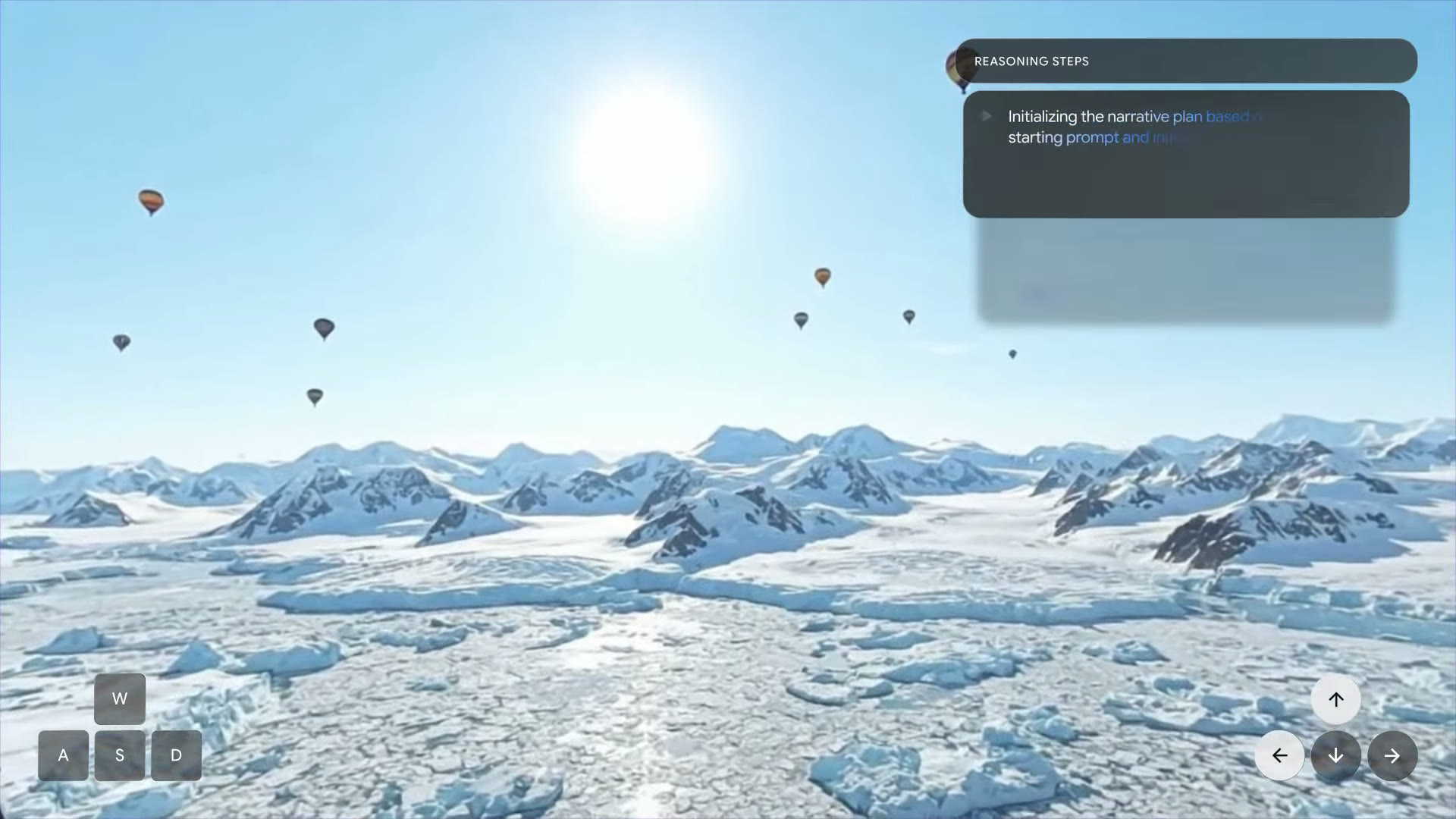
The interaction is direct in the demos: walk with the keyboard, steer with text — change the weather, shift the camera, add people — and between inputs Gemini keeps watching the world to hold it coherent. Official demos span a first-person balloon ride over Antarctica, dragon racing at 140 km/h, a Hong Kong motorcycle scene in 35mm film grain, and a macro maple-seed fall. In the frame below, the WASD cluster sits bottom-left while a REASONING STEPS panel top-right lists planning steps live — the key to this generation: Genie renders the world, while a Gemini beside it decides what happens next.
Sources and further reading
- Google DeepMind: Genie 4: A new generation of world simulationOfficial release · October 27Used for the four core capabilities, the native-audio scope, keyboard and text steering, the Gemini Omni anchor versus Gemini 3.8 Flash guiding split, the Gemini 4 Argon + Gemini Robotics + Appptonik Apollo checkers experiment, the research-preview and Project Genie / AI Studio rollout, the four trusted-tester uses, the official limitation list and SynthID watermarking. The cover is the official hero image (1200×630); both body images are frames from official demo videos.
- TechCrunch: Genie 4 world model adds audio and real-time steeringPress report · October 27Used for the roughly two-minute scene coherence (double Genie 3), research director Tejas Kulkarni on hybrid world models, engineer Diego Rivas's pre-visualization quotes and his "still a ways off" boundary, plus the industry context of Runway's GWM Worlds 2 and AMD's $8.2B World Labs acquisition.
Gemini as director: from scene edits to a robot experiment
The vendor draws the split explicitly: Gemini Omni anchors the simulation in real-world appearance and behavior, while Gemini 3.8 Flash acts as the guiding agent — observing frames, decomposing goals into steps, verifying progress and replanning on the fly. Text inputs are first adapted by Gemini to the scene's context before Genie executes them. Research director Tejas Kulkarni described the direction to TechCrunch as "hybrid world models": Gemini reasons in code and language, Genie simulates pixels at different levels of abstraction, and the two layers work together.
One experiment extends the line to robots: Gemini 4 Argon paired with Genie 4 and Gemini Robotics simulates Appptonik's Apollo humanoid playing checkers, with planning steps interleaved as text captions alongside the frames. The world model is thus not only a creation tool — testing robot scenarios in simulation before real hardware is an officially shown use. This site has recorded Gemini 4 Argon's path from invited testers to the paid API; its catalog entry is there to compare. The other on-site reference is Odyssey-3: also a world model organized around "what happens to the environment after an action", with two configurations scored on the physical-video board — where Genie 4 does not yet appear (see below).

Sources and further reading
- Google DeepMind: Genie 4: A new generation of world simulationOfficial release · October 27Used for the four core capabilities, the native-audio scope, keyboard and text steering, the Gemini Omni anchor versus Gemini 3.8 Flash guiding split, the Gemini 4 Argon + Gemini Robotics + Appptonik Apollo checkers experiment, the research-preview and Project Genie / AI Studio rollout, the four trusted-tester uses, the official limitation list and SynthID watermarking. The cover is the official hero image (1200×630); both body images are frames from official demo videos.
- TechCrunch: Genie 4 world model adds audio and real-time steeringPress report · October 27Used for the roughly two-minute scene coherence (double Genie 3), research director Tejas Kulkarni on hybrid world models, engineer Diego Rivas's pre-visualization quotes and his "still a ways off" boundary, plus the industry context of Runway's GWM Worlds 2 and AMD's $8.2B World Labs acquisition.
Who gets it, and for what
Genie 4 opens as a research preview to trusted testers first, with an official waitlist live; in the coming weeks Google AI Ultra subscribers reach it through Project Genie, and early-access partners of the Gemini API and Google AI Studio are also in the plan. All generated video and audio carries a SynthID watermark, and the vendor stresses internal safety evaluations, strict guardrails and a trusted-tester-first rollout. For most readers today that means watching the demos and joining the waitlist — a subscription tier and a few weeks still stand between you and opening it casually.
Four trusted-tester uses are worth remembering: filmmakers run live pre-visualization "takes"; photojournalists turn archival 2D photos into dynamic simulations (floods, wildfires); game developers prototype in seconds before writing engine code; enterprise partners test "zero-to-one" scenario generation. Engineer Diego Rivas told TechCrunch the real-time flow matters "in the ideation phase, in the storyboarding phase" — while turning these prototypes into finished creative assets with Gemini Omni is "still a ways off". The industry context deserves the same record: Runway's GWM Worlds 2 is already playable with audio; AMD is acquiring Fei-Fei Li's World Labs for $8.2B, Amazon is in talks for Decart, and Rivian bought Third Dimension for driving simulation. World models are now a track several companies are betting on at once — Genie 4 is Google's hand.
| Path | Status | Who it fits |
|---|---|---|
| Trusted testers · research preview | Open now; waitlist available | Film, journalism, games, enterprise partners |
| Project Genie · Google AI Ultra | Rolling out in coming weeks | Top-tier subscribers |
| Gemini API / AI Studio early access | For early-access partners | Developers and platforms |
| Independent boards (AA / Pi / Physics-IQ) | No Genie entry on any | A scope gap, not a ranking |
Sources and further reading
- Google DeepMind: Genie 4: A new generation of world simulationOfficial release · October 27Used for the four core capabilities, the native-audio scope, keyboard and text steering, the Gemini Omni anchor versus Gemini 3.8 Flash guiding split, the Gemini 4 Argon + Gemini Robotics + Appptonik Apollo checkers experiment, the research-preview and Project Genie / AI Studio rollout, the four trusted-tester uses, the official limitation list and SynthID watermarking. The cover is the official hero image (1200×630); both body images are frames from official demo videos.
- TechCrunch: Genie 4 world model adds audio and real-time steeringPress report · October 27Used for the roughly two-minute scene coherence (double Genie 3), research director Tejas Kulkarni on hybrid world models, engineer Diego Rivas's pre-visualization quotes and his "still a ways off" boundary, plus the industry context of Runway's GWM Worlds 2 and AMD's $8.2B World Labs acquisition.
Limits, safety and the board gap
The vendor's own limitation list deserves keeping whole: visual details drift and object permanence weakens over longer sessions; complex physical interactions, audio accuracy, legible in-world text, spatial accuracy and long-term consistency are known weak spots. The blog also frames the model as a step toward AGI — that is the vendor's narrative; reading it as a research preview is safer: what it can do, watch the demos; what it cannot, read the list above. All output carries a SynthID watermark; safety evaluations and guardrails are the vendor's, and nothing here was tested by this site.
The independent-board gap is stated plainly: our October 28 reread of the Physics-IQ physical-video board — all 26 v2v entries — shows no Genie listing; Google's rows there are Veo 3.1 Lite, Veo 3.1 Fast and two Gemini Omni Flash configurations. The AA intelligence board and the Pi coding board target language models, and Genie 4, an interactive world model, sits outside their scope. No same-method independent evaluation exists for world models yet; the closest on-site reference is Odyssey-3's two configurations and the explainer on how to read those physics scores. When a fitting independent evaluation appears, this site will add it under the board's rules rather than pre-computing a rank.
Sources and further reading
- Google DeepMind: Genie 4: A new generation of world simulationOfficial release · October 27Used for the four core capabilities, the native-audio scope, keyboard and text steering, the Gemini Omni anchor versus Gemini 3.8 Flash guiding split, the Gemini 4 Argon + Gemini Robotics + Appptonik Apollo checkers experiment, the research-preview and Project Genie / AI Studio rollout, the four trusted-tester uses, the official limitation list and SynthID watermarking. The cover is the official hero image (1200×630); both body images are frames from official demo videos.
- Physics-IQ physical-video board (v2v, all listings)Independent board · full reread October 28This round reread all 26 entries: no Genie listing appears; Google's rows are Veo 3.1 Lite, Veo 3.1 Fast and two Gemini Omni Flash configurations. That is a scope gap, not a basis for ranking.