Model and access
The other path for world models: NVIDIA puts Cosmos 3 post-trained checkpoints on a download page
NVIDIA publishes four open-weight Cosmos 3 post-trained checkpoints on Hugging Face: 32GB-class checkpoints, driving simulation with up to 11 camera views generated jointly with LiDAR, and robot actions to video, under OpenMDW1.1. The same week, the Physics-IQ physical-video board grows Cosmos rows — Cosmos 3 Super (Astra) lands second at 65.47, just below Odyssey-3 Pro — while Genie 4, released ten days earlier, still has no independent board row. Download-and-run versus subscribe-and-use are becoming the two release paths for world models.
This account draws on NVIDIA's official Hugging Face blog (November 5), the technical report PDF (dated November 4), HF API checks of the weight repos (November 7), and our November 7 browser read of the Physics-IQ Verified physical-video board (v2v · verified · all listings). Vendor, board and API provenances are kept separate. This site downloaded no weights, ran no model and reproduced no experiment.
Four checkpoints: what landed on the download page
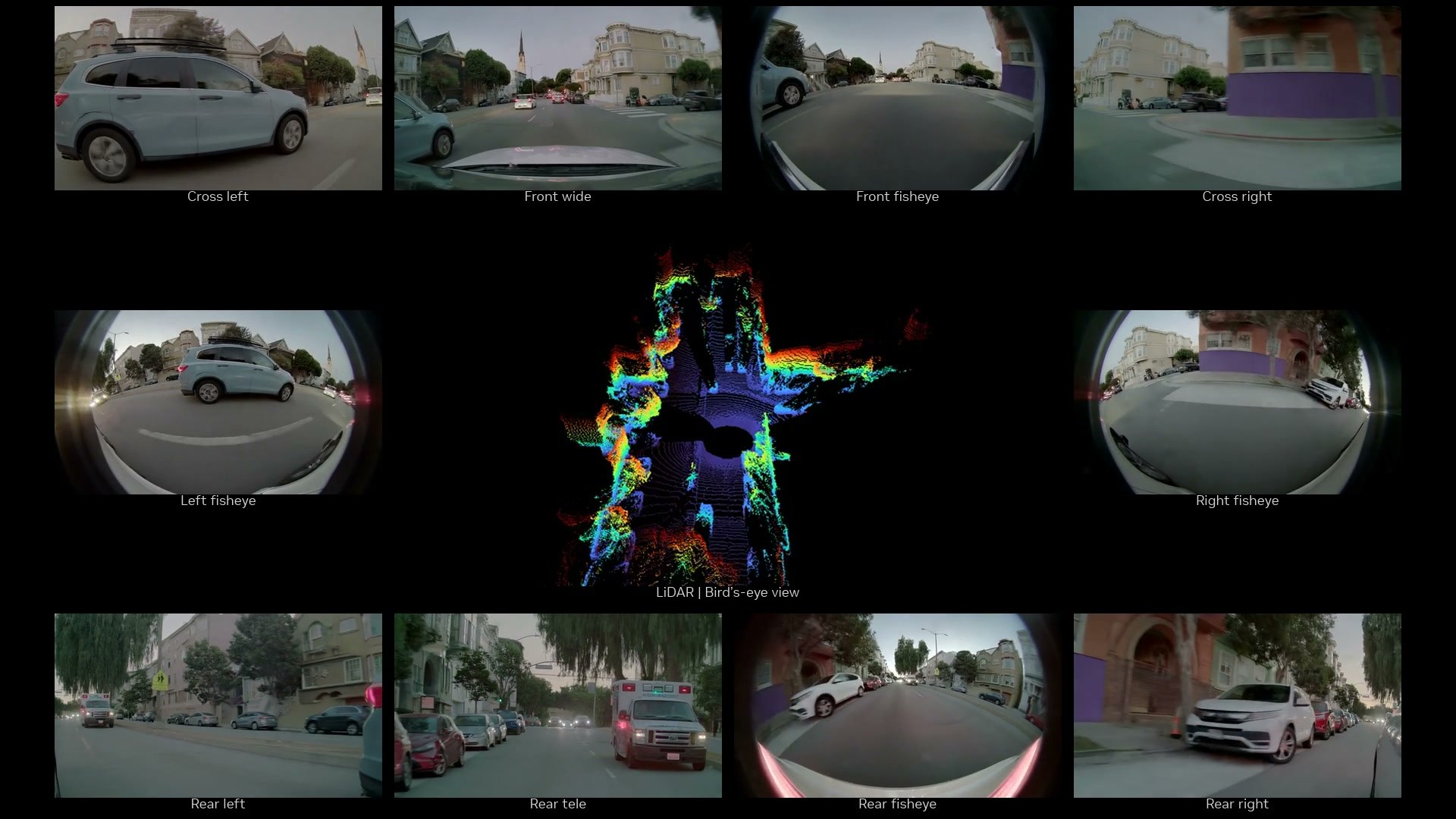
On November 5 NVIDIA announced on the official Hugging Face blog four open-weight checkpoints of the Cosmos 3 family: Cosmos3-Nano-Transfer-Auto (multi-view driving data generation, up to 11 camera views with RGB and LiDAR generated jointly), Cosmos3-Nano-Sim-Auto (a distilled streaming variant of camera-plus-LiDAR observations, emitting small chunks in a few denoising steps), Cosmos3-Nano-Sim-Transfer (simulator controls plus text prompts to photorealistic video) and Cosmos3-Nano-Sim-Bimanual (robot actions to video, supporting YAM and AgiBot embodiments). All four are post-trained variants of Cosmos 3 Nano, 16B trainable parameters each, under the OpenMDW1.1 license. Our November 7 HF API check: the four repos were created August 20/31, weights updated October 30, 32.4–34.5 GB per repo — the November 5 blog post announces weights that had already been sitting in the repos.
The GA bases are open too: the Cosmos3-Super/Nano/Edge base repos carry open weights as well (created March 10, Edge July 1, updated September 16), with Nano at 137k downloads, Super 38k and Edge 64k at observation — these weights are already in real use, not an empty shelf. The runtime conditions are stated plainly: Linux, an NVIDIA GPU, Docker and the NVIDIA Container Toolkit; the vendor demo environment is one GB200, and the blog itself notes "this is not a minimum-memory specification". Across the aisle sits October 27's Genie 4: stronger emphasis on interaction (keyboard walking, text-driven scene edits, native audio), but no public weights, trusted testers first, then Project Genie inside the AI Ultra subscription.
Sources and further reading
- Hugging Face: New NVIDIA Cosmos 3 Open Models for Interactive World SimulationOfficial release · November 5Used for the four checkpoint names and purposes (multi-view driving + LiDAR, streaming observations, simulator-control transfer, bimanual robots), 16B trainable parameters, OpenMDW1.1 license, the four-stage post-training recipe and streaming inference (4 RGB frames per latent step), runtime requirements (Linux, NVIDIA GPU, Docker; vLLM-Omni tested on one GB200 and explicitly not a minimum-memory spec), the closed-loop requirement for a simulation runtime and WSM renderer, and "a successful short run verifies execution, not convergence". The cover is the blog's title image (LiDAR bird's-eye point cloud with the Interactive world simulation title); the multi-view frame is taken from an official demo video.
- Hugging Face: Cosmos3 family collection (checked via HF API)Weight-repo check · API checked November 7The four post-trained repos were created August 20/31 with weights updated October 30, 32.4–34.5 GB each, and showed 2,213/3,386/2,059/1,279 downloads at observation; the GA base repos Cosmos3-Super/Nano/Edge were created March 10 (Edge July 1), updated September 16, with Nano at 137k downloads, Super 38k and Edge 64k at observation. Download counts and timestamps are recorded as of the API check.
New rows on the physics board: open weights reach second place
On November 7 we read all 15 rows of the Physics-IQ Verified physical-video board's v2v · verified · all-listings view in a browser. The two catalogued Odyssey rows are unchanged: Odyssey-3 Pro BoN×8 66.10 first, Odyssey-3 BoN×8 64.43 third. What is new are the Cosmos rows: Cosmos 3 Super (Astra) BoN×8 65.47 second, Cosmos 3 Nano (Astra) BoN×8 61.83 sixth, and the same weights without prompt enhancement in single-run rows — Cosmos3 Super 50.80, Cosmos3 Nano 43.00. The "OPEN SOURCE" label now sits this high on this board: a downloadable model scoring just under the top spot on verified physics continuation, with the sixth-place Nano as the board's other open-weights row.
The configuration gap deserves its own reading: the highest Cosmos rows carry an (Astra) suffix, and the board's hover note says it is GPT-6-Astra prompt upsampling — an OpenAI model writing prompts for Cosmos. Strip the enhancement and sample once, and the same weights score 50.80 / 43.00. The distance from 43.00 to 61.83 lives in prompting and sampling configuration, not in the weights — half of an open-weight model's score comes from its harness. The same view also has two proprietary FLUX 3 [large] rows (Black Forest Labs) and two Microsoft Research Asia Physical Registry rows (marked NOT YET AVAILABLE — method public, model unreleased), a reminder that score tables can contain rows you cannot obtain.
Genie 4 still has no row: the gap recorded on October 28 stands in our November 7 read, and the view has no Google rows at all — the Veo / Gemini Omni Flash rows from the October 28 record are not in this 15-row layout. The row set has changed since October 28's 26 rows; the source-side change is recorded as-is. World models still lack an independent evaluation covering interactive capability; this physical-continuation board measures how environments change after actions, and Genie 4's audio and live scene editing sit outside its scope. When a fitting independent evaluation appears, this site will add it under the board's rules rather than pre-computing a rank.
Sources and further reading
- Physics-IQ Verified physical-video board (v2v · verified · all listings)Independent board · browser read November 7We read all 15 rows of this view in a browser: Odyssey-3 Pro BoN×8 66.10 first, Odyssey-3 BoN×8 64.43 third (unchanged from the October 26 record); new Cosmos rows — Cosmos 3 Super (Astra) BoN×8 65.47 second, Cosmos 3 Nano (Astra) BoN×8 61.83 sixth, Cosmos3 Super single-run 50.80, Cosmos3 Nano single-run 43.00; plus two FLUX 3 [large] rows (Black Forest Labs, proprietary) and two Microsoft Research Asia Physical Registry rows (marked NOT YET AVAILABLE). Per the board's hover note, (Astra) means GPT-6-Astra prompt upsampling. This view has no Google rows and no Genie entry. The row set differs from the 26-row layout recorded on October 28; the source-side change is recorded as-is, without inferring history.
Numbers from the report: a 16B student against 14B teachers
The technical report "Interactive World Simulation with Cosmos for Physical AI" (PDF dated November 4) supplies the vendor's own numbers. Robot benchmarks use 232 AgiBot-World windows (186 source episodes) plus 100 AgiBot-GEAR windows (30 source episodes): the final SF-DMD student of Sim-Bimanual (4 denoising steps, a K/V window of 64 with 8 sink frames) beats all listed DreamDojo teachers on five metrics across both benchmarks — against DreamDojo 14B, PSNR rises 2.06 dB (World) and 1.90 dB (GEAR) while LPIPS drops about 3.7% and 6.2%. A 16B-trainable post-train outperforming 14B references on vendor-chosen benchmarks is the report's most direct selling line.
Sim-Transfer raises all four spatial-control metrics against the Cosmos 3 GA reference: segmentation IoU 0.6433→0.7378, blur SSIM 0.8559→0.8867, Edge F1 0.2140→0.3407 (+59.2%) and depth SI-RMSE 0.8423→0.6194 (−26.5%); VLM Quality moves 4.9296→4.9508. But the costs sit on the same page: DOVER and Prompt drop 1.8% and 2.2%, quality drift and Sampson geometric error rise, and across distillation stages the bidirectional teacher stays stronger than the final causal student on all nine metrics — streaming-causal realtime is bought with metrics.
Every number here is NVIDIA's own reporting, not an independent reading. The report's own boundaries deserve keeping whole: the public benchmarks evaluate action-conditioned observation prediction, "work remains to measure where the models faithfully support policy learning and evaluation"; closed-loop interaction needs a simulation runtime and a WSM renderer; and "a successful short run verifies execution, not convergence". This site downloaded no weights, ran no model and reproduced nothing — read 65.47 as the independent physics-board reading and the report figures as vendor-reported, and do not mix the two.
Sources and further reading
- NVIDIA technical report: Interactive World Simulation with Cosmos for Physical AIVendor technical report · PDF dated November 4Read in full from the PDF: robot benchmarks use 232 AgiBot-World windows (186 source episodes) plus 100 AgiBot-GEAR windows (30 source episodes); the final SF-DMD student (4 denoising steps, K/V window of 64 with sink 8) beats all listed DreamDojo teachers on five metrics across both benchmarks — against DreamDojo 14B, PSNR +2.06 dB (World) / +1.90 dB (GEAR), LPIPS down about 3.7% / 6.2%; Sim-Transfer versus the Cosmos 3 GA reference raises Seg IoU 0.6433→0.7378, Edge F1 0.2140→0.3407 (+59.2%) and depth SI-RMSE 0.8423→0.6194 (−26.5%), with VLM Quality 4.9296→4.9508, while DOVER and Prompt drop 1.8% / 2.2% and the bidirectional teacher stays stronger than the final causal student on all nine metrics. The stated evaluation scope is action-conditioned observation prediction; faithfulness for policy learning and evaluation remains to be measured. All numbers are vendor-reported.
Two paths: download-and-run versus subscribe-and-use
Set Genie 4 beside Cosmos 3 and the two release paths for world models become clear. Google takes the subscription side: the model exists only inside its interface, no weights, no independent board row, SynthID watermark, with capability staked on interaction — walk in with a keyboard, edit the world with text, native audio, about two minutes of scene coherence. NVIDIA takes the download side: 32GB-class checkpoints under OpenMDW1.1, aimed at autonomous-driving and robotics simulation research, requiring Linux, an NVIDIA GPU and Docker, with a GB200 as the vendor demo environment; capability is staked on data generation and policy evaluation, not on interactive experience. The audiences differ too: those who want to step into a world join Genie's waitlist; those who want to fit a world into a training loop go to Cosmos's download page.
Three actionable points for readers: first, to know where open weights stand on independent physics evaluation, Cosmos 3 Super's 65.47 is the highest "OPEN SOURCE" row on the board today (the other is Nano at 61.83); second, those with a GPU and their own data can download the checkpoints — but the vendor itself says a successful short run is not convergence, and post-training needs your data and your verification; third, for the step-into-a-world experience, Genie 4's entry remains the trusted-tester waitlist and the AI Ultra subscription. Of our boards only the physical-continuation one gives world-model readings; AA and Pi target language and coding models, and the calibers do not convert.
| What you get | Who it fits | Current gaps |
|---|---|---|
| Genie 4 · proprietary research preview: in-interface interaction, keyboard walking, text edits, native audio, about two minutes of coherence; SynthID watermark | Film pre-visualization, game prototyping, robot scenario testing (the four trusted-tester uses) | No public weights; no independent board reading; entry via waitlist and AI Ultra subscription |
| Cosmos 3 bases (Super/Nano/Edge): open weights on HF; physics board Super 65.47 / Nano 61.83 (both with Astra prompt upsampling + BoN×8) | World-simulation research and world-model benchmarking | High rows depend on prompt upsampling (single-run 50.80 / 43.00); running needs Linux + NVIDIA GPU + Docker |
| Four Nano post-trains: 32–34.5 GB checkpoints for 11-view + LiDAR driving simulation and bimanual robot actions to video; vendor-reported wins over 14B teachers | Physical AI training-data generation and policy evaluation (driving, robotics) | All numbers vendor-reported; faithfulness for policy learning still unmeasured; vendor demo environment is one GB200, not a minimum-memory spec |

Sources and further reading
- Hugging Face: New NVIDIA Cosmos 3 Open Models for Interactive World SimulationOfficial release · November 5Used for the four checkpoint names and purposes (multi-view driving + LiDAR, streaming observations, simulator-control transfer, bimanual robots), 16B trainable parameters, OpenMDW1.1 license, the four-stage post-training recipe and streaming inference (4 RGB frames per latent step), runtime requirements (Linux, NVIDIA GPU, Docker; vLLM-Omni tested on one GB200 and explicitly not a minimum-memory spec), the closed-loop requirement for a simulation runtime and WSM renderer, and "a successful short run verifies execution, not convergence". The cover is the blog's title image (LiDAR bird's-eye point cloud with the Interactive world simulation title); the multi-view frame is taken from an official demo video.
- Physics-IQ Verified physical-video board (v2v · verified · all listings)Independent board · browser read November 7We read all 15 rows of this view in a browser: Odyssey-3 Pro BoN×8 66.10 first, Odyssey-3 BoN×8 64.43 third (unchanged from the October 26 record); new Cosmos rows — Cosmos 3 Super (Astra) BoN×8 65.47 second, Cosmos 3 Nano (Astra) BoN×8 61.83 sixth, Cosmos3 Super single-run 50.80, Cosmos3 Nano single-run 43.00; plus two FLUX 3 [large] rows (Black Forest Labs, proprietary) and two Microsoft Research Asia Physical Registry rows (marked NOT YET AVAILABLE). Per the board's hover note, (Astra) means GPT-6-Astra prompt upsampling. This view has no Google rows and no Genie entry. The row set differs from the 26-row layout recorded on October 28; the source-side change is recorded as-is, without inferring history.