From capability to daily life
Tencent open-sources Hy-SimulMT: interpreting in three seconds, measured against CATTI-certified professionals
A 30B-total, 3B-active Chinese–English simultaneous speech-translation model goes open source under Apache-2.0: on the long-audio RealSI set its ~3-second lag is the lowest in the vendor chart while outscoring most commercial interpreting APIs; across 18 recordings in ten domains it scores 85.8% against 77.9%/72.1% for CATTI Level 1/2 interpreters, at 3.3s versus 4.5/4.7s. Readers can try it free in the Hy Translate app; developers deploy it with one command.
This account draws on Tencent Hunyuan's open-source repository, its official model pages and news reports. All comparison numbers are vendor evaluations (GEMBA scores judged by GPT-6.1-Sol); we did not run them. Self-hosting needs an NVIDIA GPU large enough for a 30B model plus a separate TTS service; the license is Apache-2.0 with third-party components under their original terms.
Interpreting while listening: what a three-second response means
The hard part of simultaneous interpreting is not accuracy alone but keeping up: interpreters hear unfinished sentences while the speech moves on. On October 26, Tencent Hunyuan open-sourced Hy-SimulMT, a simultaneous-translation model for bidirectional Chinese–English speech-to-speech: it translates while listening and can clone the speaker's voice and tone in real time. ITHome measured responses at about three seconds; professional human interpreters average four to five. Three seconds means subtitles and translated audio can roughly track the speaker in meetings, talks and interviews rather than waiting for a paragraph.
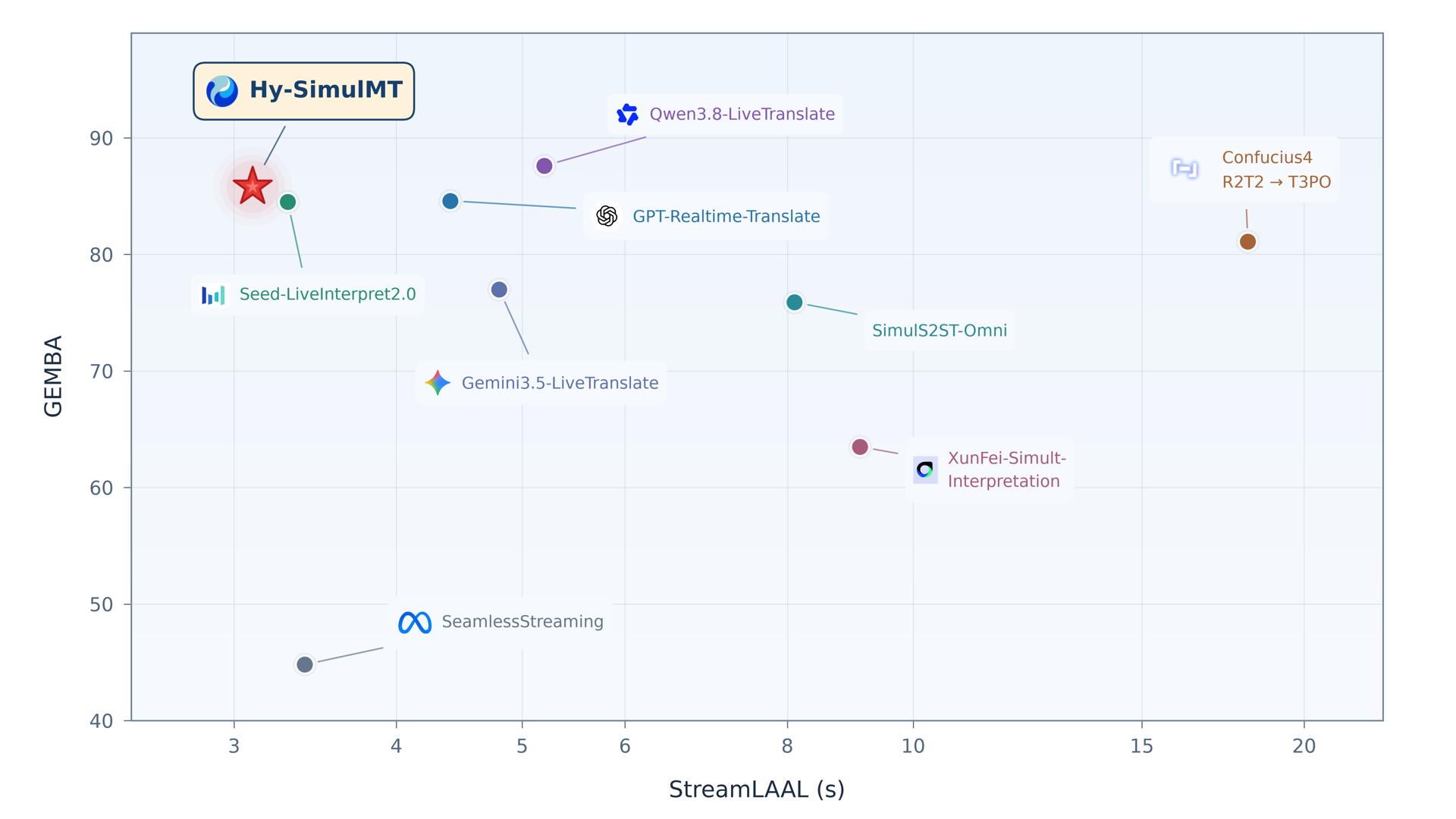
In the vendor's RealSI long-audio comparison, Hy-SimulMT sits furthest upper-left: its ~3.0-second lag is the lowest in the chart, with quality around 86 (GEMBA) above every system shown except Qwen3.8-LiveTranslate — which scores slightly higher (~87.5) at about 5.2 seconds; GPT-Realtime sits near 4.3s/84.5, Gemini3.5-LiveTranslate near 4.8s/77, and Meta's SeamlessStreaming has comparable lag but quality around 45. The vendor's phrase is “better than most commercial interpreting APIs” — read against the chart, most, not all.
Sources and further reading
- Tencent Hunyuan Hy-SimulMT repositoryOfficial repository · released October 26, read October 27Used for the two base models with FP8/GGUF variants, the Apache-2.0 statement, RealSI and four short-audio benchmarks, the 18-recording human comparison, vLLM deployment and SimulTrain tools. The RealSI scatter and the human-comparison charts come from the repository's assets; the human chart exists in Chinese and English versions.
- ITHome report on the Hunyuan interpretation modelNews report · October 26Used for the free Hy Translate app experience, the ~3-second measured response against human professionals' 4–5 seconds, ten-domain fresh audio, six interpreters (three CATTI Level 1, three Level 2, humans scored at best-of-three), GPT6.1-Sol as the GEMBA judge, and the claim of surpassing most commercial interpreting APIs on long audio.
The open-source package: weights, code and one command
Two things are open. On the weights side: two base models — Hy-SimulMT-30B-A3B outputs the translation only, while the Interleave variant emits source text and translation together — each with FP8 and GGUF quantized versions, downloadable from Hugging Face and ModelScope. The 30B-A3B naming implies a mixture-of-experts structure with about 30 billion total and 3 billion active parameters. On the code side: the SimulInfer inference service and SimulTrain continued-training tools. Per the repository, the license is Apache-2.0 (third-party components keep their terms) — far friendlier for commercial deployment than many research-only weight releases.
The deployment path is equally concrete: Linux, Python 3.12+, an NVIDIA GPU that fits a 30B model, and vLLM 0.31+ for its HYV3ForCausalLM architecture. One deploy.sh command brings up a web UI with upload and WebSocket on port 8080 and the model API on 8800, with multi-GPU tensor parallelism; the GGUF builds have a llama.cpp bridge, though upstream support is not merged yet. Two boundaries to state plainly: speech output and voice cloning depend on a separately configured TTS service — the model itself emits text — and SimulTrain continues training from a downloaded checkpoint for your own domain.
Sources and further reading
- Tencent Hunyuan Hy-SimulMT repositoryOfficial repository · released October 26, read October 27Used for the two base models with FP8/GGUF variants, the Apache-2.0 statement, RealSI and four short-audio benchmarks, the 18-recording human comparison, vLLM deployment and SimulTrain tools. The RealSI scatter and the human-comparison charts come from the repository's assets; the human chart exists in Chinese and English versions.
- Hugging Face model collectionWeights download entryDownload entries for tencent/Hy-SimulMT-30B-A3B and the Interleave variant; a ModelScope collection also exists.
Reading the numbers: three scoreboards, one judge
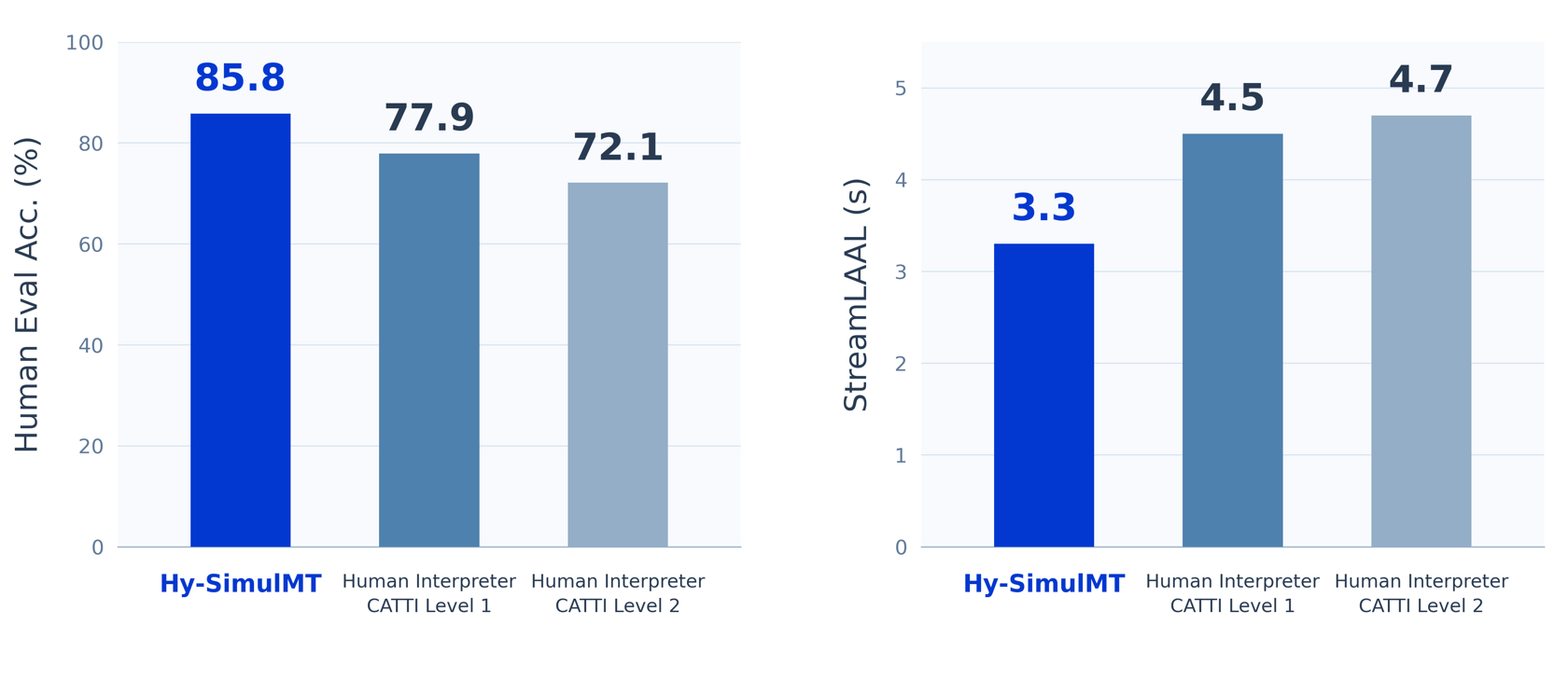
The evaluation has three layers. The most tangible is the human comparison: 18 fresh recordings of roughly six minutes each across ten domains — AI software, medicine, manufacturing and energy, natural science, agriculture and food, business, law, education, culture and tourism, sports and daily life — set against six professionals: three CATTI Level 1 interpreters and three Level 2, with humans scored at best-of-three. Hy-SimulMT reaches 85.8% human-evaluated accuracy against 77.9% and 72.1%, at 3.3 seconds versus 4.5/4.7s. Equal to or above the strongest human group, and faster to speak.
The second layer is four short-audio benchmarks, with wins and losses kept as they are: FLEURS 90.3 (Gemini higher at 92.4), CoVoST2 75.5 (Qwen clearly higher at 82.1), ACL6060 81.2 (Gemini slightly higher at 82.6) and RealSI-Sentence 84.7, the highest listed. The third layer is the judge itself: GEMBA scores are assigned by GPT-6.1-Sol — meaning the “beyond human” conclusion is an OpenAI model grading both Tencent's model and the human interpreters. LLM judging and human judging do not always agree; the usual caveat for vendor evaluations applies: the numbers are a reference, not our test, and not a guarantee for your meeting.
| Benchmark | Hy-SimulMT | Best comparison |
|---|---|---|
| FLEURS | 90.3 | Gemini3.5-LiveTranslate at 92.4 |
| CoVoST2 | 75.5 | Qwen3.8-LiveTranslate at 82.1 |
| ACL6060 | 81.2 | Gemini3.5-LiveTranslate at 82.6 |
| RealSI-Sentence | 84.7 (highest listed) | Qwen3.8-LiveTranslate, below 84.7 |
- Next: Terra, the newest of judge GPT-6.1 Sol's family
- Next: fewer wrong words at the same price in transcription
Sources and further reading
- Tencent Hunyuan Hy-SimulMT repositoryOfficial repository · released October 26, read October 27Used for the two base models with FP8/GGUF variants, the Apache-2.0 statement, RealSI and four short-audio benchmarks, the 18-recording human comparison, vLLM deployment and SimulTrain tools. The RealSI scatter and the human-comparison charts come from the repository's assets; the human chart exists in Chinese and English versions.
- ITHome report on the Hunyuan interpretation modelNews report · October 26Used for the free Hy Translate app experience, the ~3-second measured response against human professionals' 4–5 seconds, ten-domain fresh audio, six interpreters (three CATTI Level 1, three Level 2, humans scored at best-of-three), GPT6.1-Sol as the GEMBA judge, and the claim of surpassing most commercial interpreting APIs on long audio.
From VRAM to the phone: two ways in
For readers the entry is simplest: Tencent's Hy Translate app (Android/iOS) already offers the experience free, no command line involved. For developers the entry is the repository: one deploy.sh starts a local service with a web UI for uploads or a WebSocket live stream — for meeting tools, subtitle teams and online events, that is the starting point of bringing interpretation in-house. A middle layer deserves attention: Apache-2.0 permits commercial use, so a small team can build it into a product instead of calling someone else's API.
Placed beside the speech capabilities this site has recorded, the division of labor clarifies: MAI's live transcription solves “hearing what was said,” Grok Transcribe 2 handles “fewer wrong words,” Dessa lets a conversation “speak and listen at once”; Hy-SimulMT adds “interpret while listening.” Simultaneous interpreting is more than chaining those three, but for users it is the first time cross-language meetings, classes and interviews have an option you can both self-host and carry on a phone. What remains unverified stays stated: noisy real meeting rooms, dense terminology and hours-long stability are not covered by the vendor evaluation, nor tested here.
Sources and further reading
- Tencent Hunyuan Hy-SimulMT repositoryOfficial repository · released October 26, read October 27Used for the two base models with FP8/GGUF variants, the Apache-2.0 statement, RealSI and four short-audio benchmarks, the 18-recording human comparison, vLLM deployment and SimulTrain tools. The RealSI scatter and the human-comparison charts come from the repository's assets; the human chart exists in Chinese and English versions.
- ITHome report on the Hunyuan interpretation modelNews report · October 26Used for the free Hy Translate app experience, the ~3-second measured response against human professionals' 4–5 seconds, ten-domain fresh audio, six interpreters (three CATTI Level 1, three Level 2, humans scored at best-of-three), GPT6.1-Sol as the GEMBA judge, and the claim of surpassing most commercial interpreting APIs on long audio.