Speech and conversation
Dessa: what changes when AI listens while it speaks?
Use the publisher’s two-track recording and captions to separate conversational timing, speech modeling and local inference. Natural delivery, access and useful actions are different questions.
This is a research preview. The official page read October 25 still routes general download and waitlist actions to coming-soon messages; Mandarin support, memory and API conditions are not listed. This account uses the page and readable captions, without auditioning audio or running the model.
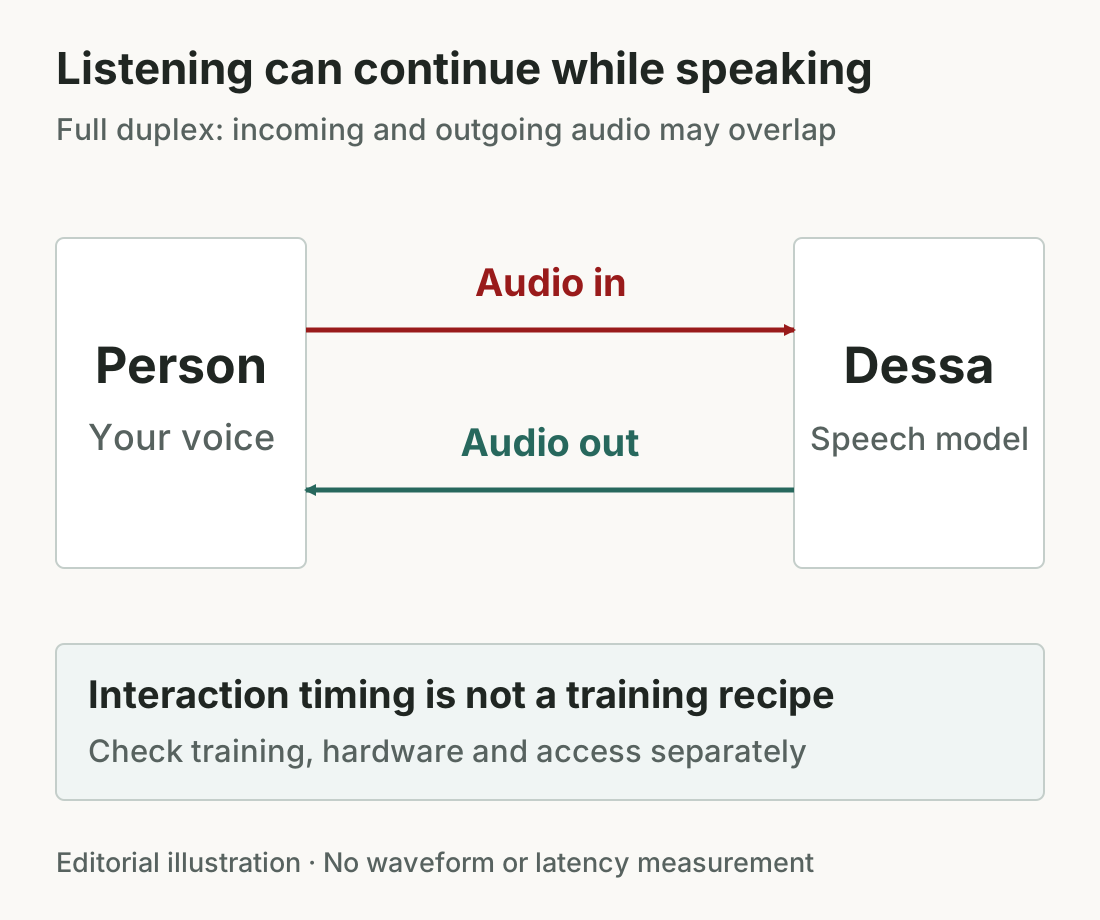
Start with two voices on one timeline
The release-conversation example has two speaker tracks and post-added captions. The file metadata lists about 2 minutes 53 seconds. In the post-added caption timeline, around 35 seconds, a brief interjection overlaps an unfinished sentence about the model. That small moment illustrates full duplex: producing audio need not close the listening channel. This is publisher-supplied timing, not an independent latency test.
In the original, distinguish timely interjections, retaining meaning after an interruption, and responding to requests about delivery. The conversation also includes requests to move closer to the microphone and speak more clearly. Captions locate those moments; laughter, volume and tone require the sound itself. A selected recording does not establish everyday behavior in a noisy room.
- Open the original release conversationContinue with both tracks and captions on the publisher’s page; no audio is rehosted here.
Sources and further reading
- Dessa original page and two-track examplesPublisher material · read October 25Official account, post-added captions and player timing metadata. Training, hardware and naturalness are publisher claims, not our measurements.
Full duplex and speech-only training are separate claims
Full duplex first describes interaction timing: listening and speaking can overlap. Transcription, a text model and speech synthesis describe an implementation route; some such systems also support streaming and interruptions. They cannot all be reduced to rigid sentence-taking. The next questions are what audio information survives and how the system decides to pause or continue.
Block separately says Dessa was trained from human conversation audio without text or pretrained models. That is a training claim to investigate, not evidence that full duplex is new. Moshi’s published design already uses parallel user/model audio with predicted text inner monologue. Published architectures and a new training claim need separate evidence; Dessa’s naturalness claim is not a comparable ranking.
Sources and further reading
- Dessa original page and two-track examplesPublisher material · read October 25Official account, post-added captions and player timing metadata. Training, hardware and naturalness are publisher claims, not our measurements.
- Moshi’s public model and implementation accountResearch team material · background comparisonThe README describes separate user/model audio and text inner monologue, with separate code, weight and backend conditions. Moshi’s latency or release terms do not establish Dessa’s.
A Mac claim is not yet a deployment specification
The stated hardware is a MacBook Pro M4 Max or better, not every MacBook, and the publisher says inference is faster than real time. That does not specify memory, precision, microphone echo handling or a distribution of complete interaction delays. It cannot become an offline installation guarantee or inherit another model’s millisecond measurements.
Jack’s original announcement is dated October 23 at 18:23 UTC, already October 24 in Beijing. October 25 is this editorial follow-up and the Chinese report’s date. A research showing, public access, a versioned download and an actual machine run need their own dates. A versioned run with clear hardware would be a useful next piece of evidence.
Sources and further reading
- Dessa original page and two-track examplesPublisher material · read October 25Official account, post-added captions and player timing metadata. Training, hardware and naturalness are publisher claims, not our measurements.
- Jack’s original announcementPublisher record · time checked through official embed dataOfficial syndication created_at is 2026-10-23T18:23:45Z, or October 24 at 02:23:45 in Beijing. This is not a first announcement on October 25.
From a convincing voice to a usable interface
The checked page provides no public weights, model license, API documentation, price or Mandarin-support list; general download and waitlist actions remain coming-soon messages. A separate invitation addresses a small group of safety researchers. Studying the recordings and integrating a model into your app are different stages; the conversational direction remains worth understanding as a preview.
More natural feedback could support brainstorming, speaking practice or asking questions while working. It does not by itself establish reliable answers or computer control. The existing Whistle, Needle and Atticus accounts separate transcription, decisions and execution—a useful reference for asking what speech changes and how it connects to actions a person can confirm and correct.
- Continue with Whistle and Needle’s route to program actions
- See Atticus’s transcription, rule and model roles
Sources and further reading
- Dessa original page and two-track examplesPublisher material · read October 25Official account, post-added captions and player timing metadata. Training, hardware and naturalness are publisher claims, not our measurements.