Model and access
Gemini 4 Carbon: 59 on the new ruler, access opens with cyber defenders first
Google announced Gemini 4 Carbon on October 28 (Pacific time): on Artificial Analysis's new Intelligence Index v5.0 it ranks first at 59 (high effort). The official cybersecurity numbers span three stages — SEC-bench Pro 88.2%, ExploitGym 54.8%, CWE-bench 71.0%. The same benchmark change reshuffles every catalogued model's score, so v4.3.2 and v5.0 figures cannot be mixed. Access opens this week to a small group of cyber defenders; developers and consumers wait. Introductory API pricing is $2 input / $10 output per million tokens, later $4 / $20. This site read the official page and the board on October 29; we ran no model.
This account draws on Google's official announcement (blog.google, published October 28 Pacific time, read directly October 29), the Artificial Analysis leaderboard and methodology pages (read directly October 29; the methodology page names v5.0), and IT Home's October 29 Chinese report. All scores are Google-reported or from AA's independent board; we ran no model. The text flags which numbers have a third-party benchmark behind them and which are vendor-internal figures.
First at 59 — and the first door opens to cyber defenders
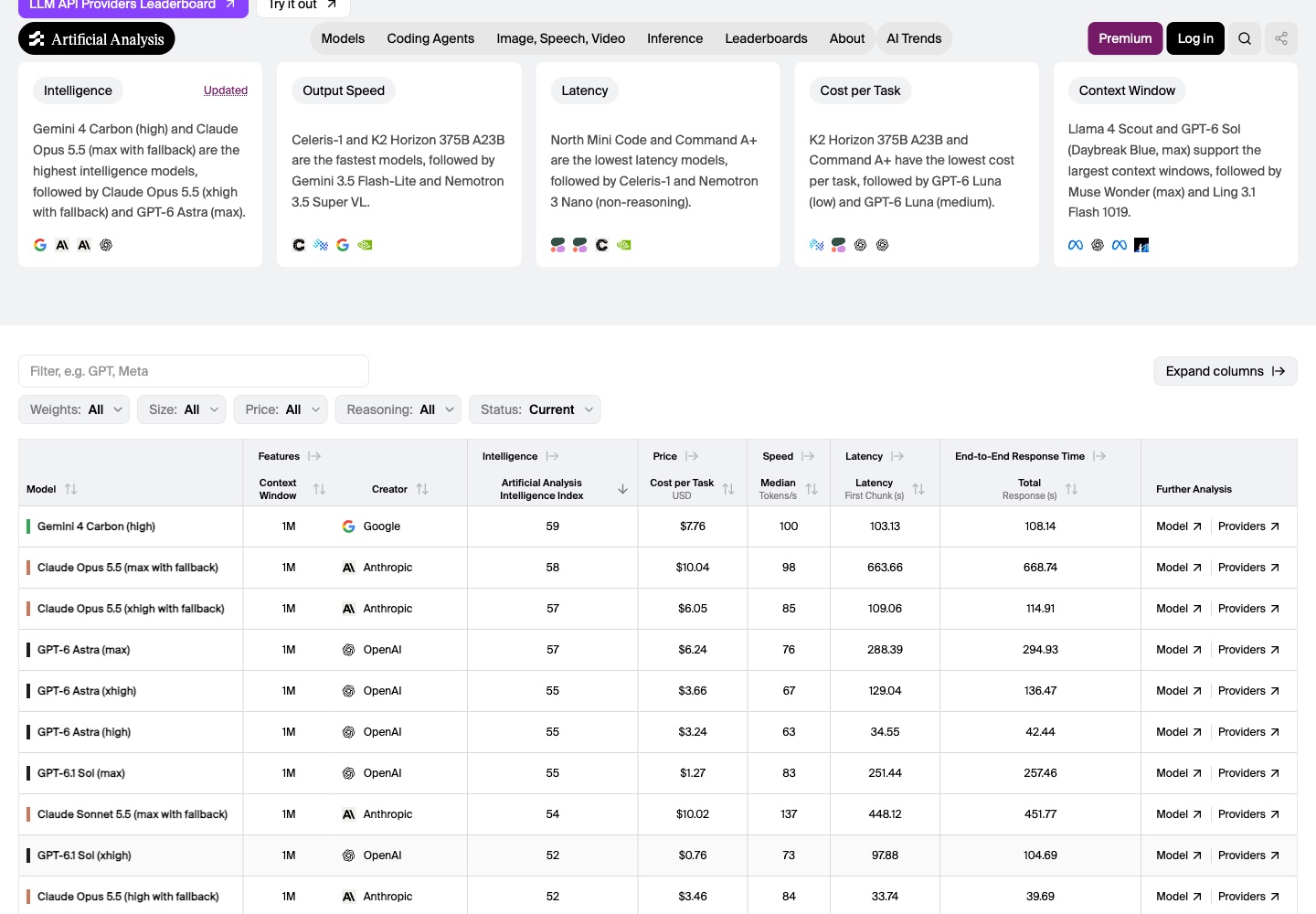
Google announced Gemini 4 Carbon on October 28, Pacific time, positioning it as its strongest model yet, state-of-the-art at cybersecurity and long-horizon work. The independent board immediately gave it an external rank: on Artificial Analysis's new v5.0 index, Carbon (high effort) sits first at 59, one point above Claude Opus 5.5 (max, 58). When this site read the board on October 29 it already led the table, at $7.76 per task and a 100 tokens/s median; both the summary card and the FAQ name Carbon as #1. Before Carbon joined, Opus 5.5 led the v5.0 table. Google also offers one long-horizon coding reference: fourth place on WebDev Arena (+89 Elo).
The more unusual part of this release is the order of access. Carbon reaches “a subset of cyber defenders” this week, then trusted partners through the Fairwind Program, alongside the US government's voluntary pre-release testing process; developers, businesses and consumers get only “soon”, and no Gemini-app availability is mentioned. Google's stated reason sits on the page: deliberate staged rollout under capability risk, gathering feedback and iterating on guardrails first. The strongest model by the general index hands its first keys not to early-adopter developers but to the people who watch security alerts for others — a product positioning that is also a release strategy. Nor is this Google's first security-facing model: the 3.8 Flash generation spun off a Flash Cyber variant in early September, and Carbon pushes that line up to flagship.
Sources and further reading
- Google's official announcement: Gemini 4 Carbon — Our next frontier modelOfficial release · October 28, 2026 (Pacific time)Full text read October 29. Checked the overall-index claim (AA v5.0, 59, first), the three security benchmarks (SEC-bench Pro 88.2%, ExploitGym 54.8%, CWE-bench 71.0% — CWE-bench is Collinear's), the behavior figures (Terminal-Bench 4.0 cheating 0.0%, Gray Swan indirect prompt injection 0.0% vs Argon 0.7%, internal high-severity alerts down nearly 80%, overreach -26%, under-service -29%), the Chrome team's “more than 10X better than another lab's large frontier model” patch claim and the Wiz Scan for Good relay, the access order (cyber defenders first, Fairwind expansion, US government voluntary pre-release testing), pricing ($2/$10 per million tokens introductory, cached input 95% off, later $4/$20), and the “benchmarks evaluated without guardrails” note plus the staged-rollout rationale. WebDev Arena fourth (+89 Elo). The post carries no inline images; our cover uses the official social-share artwork.
- Artificial Analysis LLM LeaderboardIndependent board · read directly October 29, 2026Full board reread October 29. Gemini 4 Carbon (high) leads at 59, with $7.76 per task and a 100 tokens/s median; the summary card and FAQ both confirm Carbon at #1. Reread every catalogued model's highest tested row (Opus 5.5 max 58, Astra max 57, Sol max 55, Sonnet 5.5 max 54, Terra max 51, Argon high 50, Fable 5.1 xhigh 50, Wonder Full max 50, K3.1 Pro 46, Wonder max 43, Haiku max 36, Grok 4.7 high 35, among others) and confirmed that Kimi K3, GLM-5.3-Flash, Qwen3.8-Flash-Next and Nemotron 3.5 Bolt 74B-A9B currently have no scored row on the source table.
The official cybersecurity numbers, stage by stage
Google splits cybersecurity into three stages of the defense lifecycle, one benchmark each: finding vulnerabilities — 88.2% on SEC-bench Pro; validating exploitation — 54.8% on ExploitGym; producing fixes — 71.0% on Collinear's CWE-bench. Two relayed claims surround these scores: Chrome's team reports Carbon is “more than 10X better than another lab's large frontier model” at producing high-quality patches, and security firm Wiz says Carbon leads the web-pentesting benchmarks tied to its Scan for Good initiative. Against the previous Argon, Google claims a more-than-2× uplift in generating secure code.
The boundaries matter: every figure is vendor-reported — Google chose the benchmarks and publishes the scores on its own page; the “10X” claim names neither the comparison model nor raw data; and the page notes external benchmarks were “evaluated without guardrails.” What does line up independently is the rank: AA's board does place Carbon first. Reading 88.2% as “it will auto-fix ninety percent of real vulnerabilities” overreaches — the page never quantifies the gap between benchmark environments and production networks. For a model with security in its positioning, the follow-up worth waiting for is independent replication from firms like Wiz, not the next vendor-run suite.
Sources and further reading
- Google's official announcement: Gemini 4 Carbon — Our next frontier modelOfficial release · October 28, 2026 (Pacific time)Full text read October 29. Checked the overall-index claim (AA v5.0, 59, first), the three security benchmarks (SEC-bench Pro 88.2%, ExploitGym 54.8%, CWE-bench 71.0% — CWE-bench is Collinear's), the behavior figures (Terminal-Bench 4.0 cheating 0.0%, Gray Swan indirect prompt injection 0.0% vs Argon 0.7%, internal high-severity alerts down nearly 80%, overreach -26%, under-service -29%), the Chrome team's “more than 10X better than another lab's large frontier model” patch claim and the Wiz Scan for Good relay, the access order (cyber defenders first, Fairwind expansion, US government voluntary pre-release testing), pricing ($2/$10 per million tokens introductory, cached input 95% off, later $4/$20), and the “benchmarks evaluated without guardrails” note plus the staged-rollout rationale. WebDev Arena fourth (+89 Elo). The post carries no inline images; our cover uses the official social-share artwork.
- IT Home: Google's strongest AI model Gemini 4 Carbon tops the global intelligence index, specialized in cybersecurityPress report · October 29, 2026Full text read October 29. The report's scores, pricing and access order match the official page (it writes 1769 for WebDev Arena; this article cites only the official +89 Elo to fourth and no absolute score). The report carries no images; our cover is Google's official social-share artwork.
A new ruler: AA v5.0 reshuffles the same models
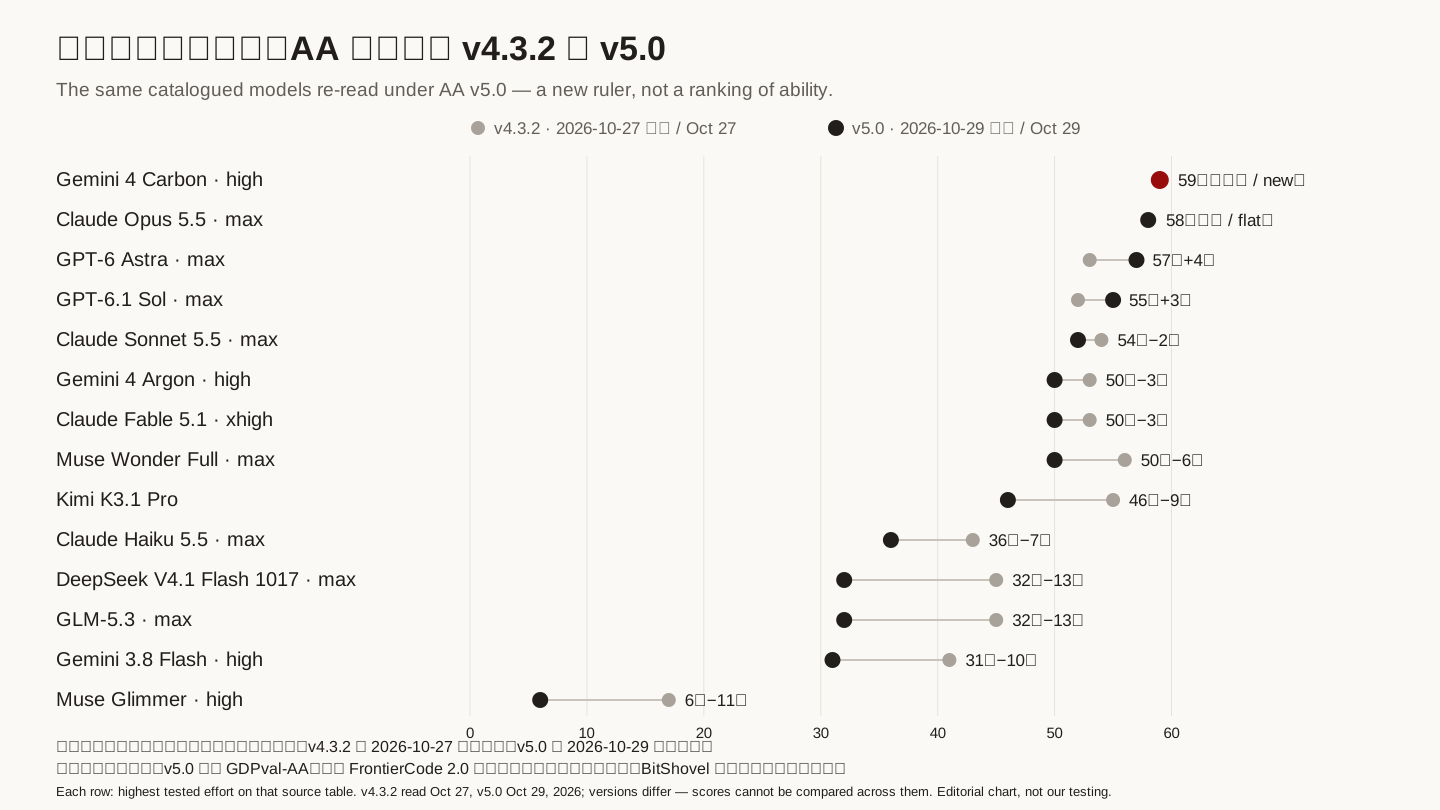
The day Carbon topped the board, AA swapped its overall index from v4.3.2 to v5.0. The methodology page is explicit: nine evaluations across four categories — knowledge work, coding, science and general — at 25% each; GDPval-AA exits (v4.3.2 was its last version); FrontierCode upgrades to 2.0 and joins the index at 15% — all 132 tasks come from real open-source repositories, scored not by unit tests passing but by repository maintainers' willingness to merge the PR, with any blocking check failure scoring zero; coding also carries Terminal-Bench 4.0 (10%). Several evaluations are marked private-data, limiting the chance that public question banks leak into training.
The immediate consequence is a wholesale reshuffle of the same models. Among catalogued entries: DeepSeek V4.1 Flash 1017 falls from 45 (v4.3.2) to 32 (v5.0), GLM-5.3 likewise 45→32, Muse Glimmer 17→6, Kimi K3.1 Pro 55→46; others rise — GPT-6 Astra 53→57, GPT-6.1 Sol 52→55. Under the new terms the gap between released-weights open models and the closed frontier widens: DeepSeek and GLM-5.3 at 32 sit 27 points behind the top (K3.1 Pro's 46 comes with weights not yet released). This site's model board has switched in full to v5.0 with the changes noted; the line to take away — models did not collectively get worse, the ruler changed, and v4.3.2 versus v5.0 scores cannot be compared.
Sources and further reading
- Artificial Analysis LLM LeaderboardIndependent board · read directly October 29, 2026Full board reread October 29. Gemini 4 Carbon (high) leads at 59, with $7.76 per task and a 100 tokens/s median; the summary card and FAQ both confirm Carbon at #1. Reread every catalogued model's highest tested row (Opus 5.5 max 58, Astra max 57, Sol max 55, Sonnet 5.5 max 54, Terra max 51, Argon high 50, Fable 5.1 xhigh 50, Wonder Full max 50, K3.1 Pro 46, Wonder max 43, Haiku max 36, Grok 4.7 high 35, among others) and confirmed that Kimi K3, GLM-5.3-Flash, Qwen3.8-Flash-Next and Nemotron 3.5 Bolt 74B-A9B currently have no scored row on the source table.
- Artificial Analysis methodology page (Intelligence Index v5.0)Methodology · read directly October 29, 2026Read October 29. v5.0 combines nine evaluations (AA-Briefcase v1.1, AutomationBench-AA, GDP.pdf, FrontierCode 2.0, Terminal-Bench 4.0, AA-Omniscience v1.1, HLE-Diamond, CritPt v2 Hard, Terminal-Bench-Science 0.1) across four categories at 25% each; GDPval-AA is removed as of v5.0 (v4.3.2 was its last version); FrontierCode 2.0 weighs 15% and Terminal-Bench 4.0 10%; several evaluations are marked as using private data.
- IT Home: AA Intelligence Index v5 launches; DeepSeek V4.1 Flash 1017 is the top released-weights open modelPress report · October 29, 2026Full text read October 29. Used as the Chinese reference for the v5.0 switch: 60% of weight from private or hidden test sets, FrontierCode 2.0 scored by maintainers' willingness to merge, a wider open-vs-closed gap and wider effort-level spreads — consistent in direction with AA's methodology page, whose composition and weights govern here. Its figures (Opus 5.5 at 58, K3.1 Pro 46, DeepSeek and GLM-5.3 at 32) match our board reread.
Cheating, injection and overreach: the official behavior figures
Beyond capability, the page posts a behavior list: cheating success on Terminal-Bench 4.0 down to 0.0% (attempts 0.4%); a 0.0% attack-success rate on Gray Swan's indirect prompt injection benchmark, against Argon's 0.7%; high-severity misalignment alerts in internal live coding down nearly 80%; overreach down 26% and under-service down 29%; unsupported fabricating claims roughly halved versus Argon.
These figures are not equally verifiable: the injection and cheating numbers have named third-party benchmarks behind them; “internal environment, nearly 80%” cannot be checked independently. The direction is what's worth recording — the stronger and more autonomous the model, the more “will it cut corners, take bait, or overstep” turns from a philosophy question into an operating metric, and Google publishing these numbers on the launch page itself shows this layer is now sold as product competence. The practical takeaway for readers: once Carbon actually opens up, re-test the official claims against your own tasks.
Sources and further reading
- Google's official announcement: Gemini 4 Carbon — Our next frontier modelOfficial release · October 28, 2026 (Pacific time)Full text read October 29. Checked the overall-index claim (AA v5.0, 59, first), the three security benchmarks (SEC-bench Pro 88.2%, ExploitGym 54.8%, CWE-bench 71.0% — CWE-bench is Collinear's), the behavior figures (Terminal-Bench 4.0 cheating 0.0%, Gray Swan indirect prompt injection 0.0% vs Argon 0.7%, internal high-severity alerts down nearly 80%, overreach -26%, under-service -29%), the Chrome team's “more than 10X better than another lab's large frontier model” patch claim and the Wiz Scan for Good relay, the access order (cyber defenders first, Fairwind expansion, US government voluntary pre-release testing), pricing ($2/$10 per million tokens introductory, cached input 95% off, later $4/$20), and the “benchmarks evaluated without guardrails” note plus the staged-rollout rationale. WebDev Arena fourth (+89 Elo). The post carries no inline images; our cover uses the official social-share artwork.
Access, price, and what to wait for
What can be pinned down now: introductory API pricing matches Argon — $2 input / $10 output per million tokens, cached input 95% off; regular pricing afterward is $4/$20. The access order per the official page: cyber defenders first (this week), expansion via Fairwind, the US government's voluntary pre-release testing in parallel, and “soon” for developers, businesses and consumers; no Gemini-app mention. The 59 on the board comes from an evaluator with existing access; ordinary readers cannot yet re-verify it with their own API key.
On-site follow-ups: the model page now carries a Gemini 4 Carbon entry, and the overall board has switched in full to v5.0 (Carbon first at 59, high). The existing Argon long-read's chapter on separating the overall index from automation tasks still applies — 59 is likewise a text-index figure — and yesterday's contrast stands too: Argon placed sixth on Google's own Android long-horizon engineering board, a reminder that high general scores must be re-verified on specific tasks. When the developer door opens and external security replications appear, this site continues along the same line.
- See the Gemini 4 Carbon model entry
- Next: separating the overall index from automation tasks (Argon piece)
- Next: Argon's Android long-horizon debut, sixth of eleven
Sources and further reading
- Google's official announcement: Gemini 4 Carbon — Our next frontier modelOfficial release · October 28, 2026 (Pacific time)Full text read October 29. Checked the overall-index claim (AA v5.0, 59, first), the three security benchmarks (SEC-bench Pro 88.2%, ExploitGym 54.8%, CWE-bench 71.0% — CWE-bench is Collinear's), the behavior figures (Terminal-Bench 4.0 cheating 0.0%, Gray Swan indirect prompt injection 0.0% vs Argon 0.7%, internal high-severity alerts down nearly 80%, overreach -26%, under-service -29%), the Chrome team's “more than 10X better than another lab's large frontier model” patch claim and the Wiz Scan for Good relay, the access order (cyber defenders first, Fairwind expansion, US government voluntary pre-release testing), pricing ($2/$10 per million tokens introductory, cached input 95% off, later $4/$20), and the “benchmarks evaluated without guardrails” note plus the staged-rollout rationale. WebDev Arena fourth (+89 Elo). The post carries no inline images; our cover uses the official social-share artwork.
- Artificial Analysis LLM LeaderboardIndependent board · read directly October 29, 2026Full board reread October 29. Gemini 4 Carbon (high) leads at 59, with $7.76 per task and a 100 tokens/s median; the summary card and FAQ both confirm Carbon at #1. Reread every catalogued model's highest tested row (Opus 5.5 max 58, Astra max 57, Sol max 55, Sonnet 5.5 max 54, Terra max 51, Argon high 50, Fable 5.1 xhigh 50, Wonder Full max 50, K3.1 Pro 46, Wonder max 43, Haiku max 36, Grok 4.7 high 35, among others) and confirmed that Kimi K3, GLM-5.3-Flash, Qwen3.8-Flash-Next and Nemotron 3.5 Bolt 74B-A9B currently have no scored row on the source table.