Model and access
Google's Android coding board updates: Gemini 4 Argon debuts sixth
Google updated Android Bench 2.0 on October 26: results now label reasoning effort, and three new model-agent pairs joined — Claude Sonnet 5.5, GPT-6.1 Sol and Gemini 4 Argon. Argon debuts at a 21.3% pass rate, sixth of eleven pairs. In our AA board records it sits 3 points behind Sonnet 5.5 (53 vs 56); on this Android long-horizon board the gap stretches to nearly double (21.3 vs 40.0). The distance to Claude Fable 5.1 above sits inside overlapping confidence intervals; one full run costs $267.6 and averages 52.8 hours. Figures are Google's, read directly on October 28; we ran no tests ourselves.
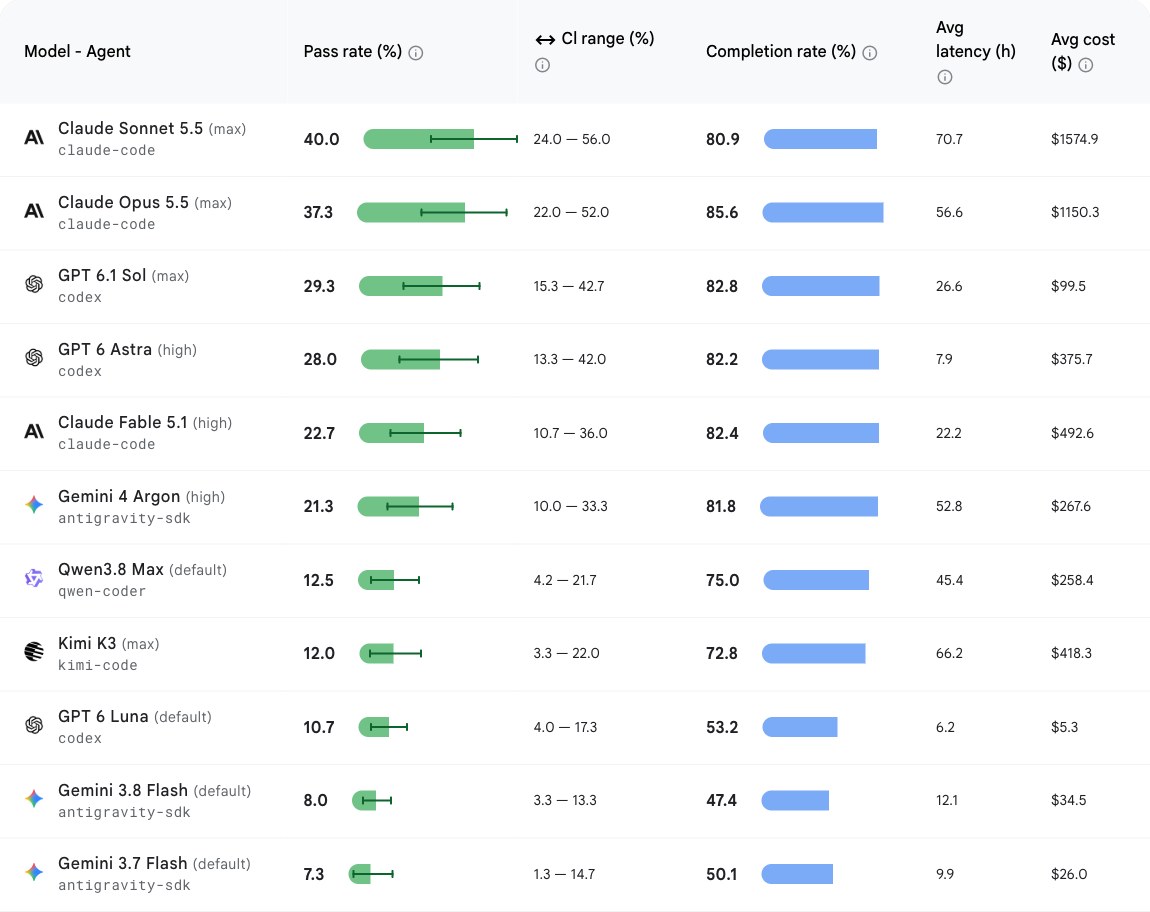
This account draws on the official Android Bench page (developer.android.com/bench, read directly by this site on October 28; the page marks latest results as of October 26) and IT Home's October 28 report. All figures are Google's; we ran no model or agent. The board screenshot was captured by this site from the official page; the cover is official branding via the report's page.
What the October 26 update changed
Android Bench is Google's engineering benchmark for Android development. The 2.0 "long-horizon" suite puts 30 tasks on real repositories: a model-plus-agent pair gets a request and must add a feature, carry out a migration or fix a real Android project — tasks drawn from actual apps including Signal, Bitwarden, WordPress, Pocket Casts, Now in Android, Food Vibes and Fossify File Manager, in four categories: migration (13), app creation (10), new feature (5) and app conversion (2), with five runs per task. Each pair gets five numbers: pass rate (the average share of the 30 tasks resolved across all runs), a confidence interval (p below 0.05), completion rate (how close a run got even when it failed), average latency (hours to work through the 30 tasks) and average cost per full run.
The October 26 update did three things, spelled out in the official changelog: results now label the reasoning effort used; three new pairs joined — claude-code running Claude Sonnet 5.5, antigravity-sdk running Gemini 4 Argon, and codex running GPT 6.1 Sol; and Claude Sonnet 5 plus GPT 6 Sol were archived (the latter had joined on October 6 and is succeeded by 6.1 Sol). The long-horizon board now holds eleven rows. IT Home's October 28 report carried these numbers to Chinese readers, but two details disagree with the official page: it places Argon "fifth", while the official eleven-row board has it sixth; and it lists GPT-6 Sol among this round's additions, whereas the changelog records it joining October 6 and being archived October 26. This article follows the official page.
Sources and further reading
- Android Bench 2.0 official board (Android Developers)Official board · page marks latest results as of October 26Read directly on October 28. Used for all 11 long-horizon rows (model · reasoning effort · agent, pass rate, CI, completion rate, average latency, per-run cost), the official definitions of the five metrics, the changelog (long-horizon tasks and agent-based runs launched September 17; Opus 5.5 and GPT 6 Luna/Sol added and Opus 5 plus the GPT 5.6 trio archived on October 6; reasoning-effort labels added and Sonnet 5.5 / Argon / GPT 6.1 Sol added, Sonnet 5 and GPT 6 Sol archived on October 26), the task-category mix, and the per-task tables (the Flutter-to-Android conversion at 0/5 for every shown pair). The page also archives the 1.0 task results (100 tasks, September-era models), which are not mixed with 2.0 figures.
- IT Home: Google updates Android Bench; Gemini 4 Argon trails Claude and GPTPress report · October 28, 10:09Full text read October 28. This round's discovery lead; the report's images include the official branding (our cover) and a board screenshot. Two inconsistencies with the official page are corrected in the text: the report places Argon fifth, while the official eleven-row board has it sixth; and it lists GPT-6 Sol among this round's additions, while the changelog records it joining October 6 and being archived October 26 (replaced by GPT 6.1 Sol). The report also relays post-announcement "internal" claims that the model struggled with parts of coding.
Argon debuts: 21.3%, sixth of eleven
Argon's debut: a 21.3% pass rate (CI 10.0–33.3), 81.8% completion, 52.8 hours of average latency and $267.6 per full run — labeled high reasoning effort, running on Google's own antigravity-sdk, sixth of eleven pairs. Claude Sonnet 5.5 (max) leads at 40.0%, with Claude Opus 5.5 second at 37.3%. One caveat first: the distance to Claude Fable 5.1 above (22.7%) falls inside their overlapping confidence intervals — under the board's p < 0.05 framing, one rank is not a settled ordering. Where "far behind" does hold is the top two against the rest: 40.0 versus 21.3, nearly double.
Placed beside what this site already tracks, the split gets concrete. In our AA board records (observed October 27), Argon's 53 sits in the same band as Claude Fable 5.1 and GPT-6 Astra, just 3 points under Sonnet 5.5's 56 — on the general index they are neighbors. On this Android long-horizon board, Sonnet 5.5 is at 40.0 and Argon at 21.3, nearly double the gap; Astra (28.0) and Fable 5.1 (22.7) remain Argon's neighbors here. Models that score close on a general index get pulled apart on long-horizon engineering in real repositories — and the model pulled farthest is Argon against the two Claude flagships. After the announcement, "internal" reports that the model struggled with parts of coding made the rounds (relayed by IT Home); there is now a public number for that, from Google itself.
| Model (effort) · agent | Pass rate · CI | Completion | Avg latency | Cost/run |
|---|---|---|---|---|
| Claude Sonnet 5.5 (max) · claude-code | 40.0 · 24.0–56.0 | 80.9 | 70.7 h | $1574.9 |
| Claude Opus 5.5 (max) · claude-code | 37.3 · 22.0–52.0 | 85.6 | 56.6 h | $1150.3 |
| GPT 6.1 Sol (max) · codex | 29.3 · 15.3–42.7 | 82.8 | 26.6 h | $99.5 |
| GPT 6 Astra (high) · codex | 28.0 · 13.3–42.0 | 82.2 | 7.9 h | $375.7 |
| Claude Fable 5.1 (high) · claude-code | 22.7 · 10.7–36.0 | 82.4 | 22.2 h | $492.6 |
| Gemini 4 Argon (high) · antigravity-sdk | 21.3 · 10.0–33.3 | 81.8 | 52.8 h | $267.6 |
| Qwen3.8 Max (default) · qwen-coder | 12.5 · 4.2–21.7 | 75.0 | 45.4 h | $258.4 |
| Kimi K3 (max) · kimi-code | 12.0 · 3.3–22.0 | 72.8 | 66.2 h | $418.3 |
| GPT 6 Luna (default) · codex | 10.7 · 4.0–17.3 | 53.2 | 6.2 h | $5.3 |
| Gemini 3.8 Flash (default) · antigravity-sdk | 8.0 · 3.3–13.3 | 47.4 | 12.1 h | $34.5 |
| Gemini 3.7 Flash (default) · antigravity-sdk | 7.3 · 1.3–14.7 | 50.1 | 9.9 h | $26.0 |
Sources and further reading
- Android Bench 2.0 official board (Android Developers)Official board · page marks latest results as of October 26Read directly on October 28. Used for all 11 long-horizon rows (model · reasoning effort · agent, pass rate, CI, completion rate, average latency, per-run cost), the official definitions of the five metrics, the changelog (long-horizon tasks and agent-based runs launched September 17; Opus 5.5 and GPT 6 Luna/Sol added and Opus 5 plus the GPT 5.6 trio archived on October 6; reasoning-effort labels added and Sonnet 5.5 / Argon / GPT 6.1 Sol added, Sonnet 5 and GPT 6 Sol archived on October 26), the task-category mix, and the per-task tables (the Flutter-to-Android conversion at 0/5 for every shown pair). The page also archives the 1.0 task results (100 tasks, September-era models), which are not mixed with 2.0 figures.
- IT Home: Google updates Android Bench; Gemini 4 Argon trails Claude and GPTPress report · October 28, 10:09Full text read October 28. This round's discovery lead; the report's images include the official branding (our cover) and a board screenshot. Two inconsistencies with the official page are corrected in the text: the report places Argon fifth, while the official eleven-row board has it sixth; and it lists GPT-6 Sol among this round's additions, while the changelog records it joining October 6 and being archived October 26 (replaced by GPT 6.1 Sol). The report also relays post-announcement "internal" claims that the model struggled with parts of coding.
How to read this board
By its own terms, four things need settling first. One: it measures model-plus-agent pairs — claude-code, codex, antigravity-sdk, qwen-coder and kimi-code each field their own models; the same model on another agent is a different row, and Argon runs on Google's antigravity-sdk. Two: reasoning effort is now labeled but mixed across three tiers — the top three rows are max, Argon, Fable 5.1 and Astra are high, Qwen3.8 Max and GPT 6 Luna are default — align tiers before comparing neighbors. Three: confidence intervals are wide (the leader: 24.0–56.0), so single-digit rank gaps rarely separate anything statistically. Four: cost is a first-class column: the 15.8× spread between first and third ($1574.9 vs $99.5) is the starkest cell on the board — Argon's $267.6 is over 80% cheaper than the leader yet about 2.7× the higher-ranked 6.1 Sol.
Latency is easy to miss: Argon's 52.8 hours sits on the slow side — only Sonnet 5.5 (70.7), Kimi K3 (66.2) and Opus 5.5 (56.6) are slower — while Astra on the same board reaches 28.0% in 7.9 hours, faster and higher. The completion column packs the top six into 80.9–85.6, which says the separation is not about stalling out: by the official definition, completion measures how close failed runs got to a full solution, and most Argon runs got near-complete before tripping on tests or validation. The per-task tables add board-wide difficulty markers: across the per-pair tables the page currently carries, no pair passes the Flutter-to-Android conversion (Habo, 0/5 everywhere), only one pair takes 2/5 on the React Native conversion, and the Compose migration of Signal's phone-number entry tops out at 1/5. And keep the two generations apart: the 1.0 task results below (100 tasks, September-era models, Claude Opus 5 first at 91.8%) are an archive, not comparable to the 2.0 thirty-task long-horizon board.
Sources and further reading
- Android Bench 2.0 official board (Android Developers)Official board · page marks latest results as of October 26Read directly on October 28. Used for all 11 long-horizon rows (model · reasoning effort · agent, pass rate, CI, completion rate, average latency, per-run cost), the official definitions of the five metrics, the changelog (long-horizon tasks and agent-based runs launched September 17; Opus 5.5 and GPT 6 Luna/Sol added and Opus 5 plus the GPT 5.6 trio archived on October 6; reasoning-effort labels added and Sonnet 5.5 / Argon / GPT 6.1 Sol added, Sonnet 5 and GPT 6 Sol archived on October 26), the task-category mix, and the per-task tables (the Flutter-to-Android conversion at 0/5 for every shown pair). The page also archives the 1.0 task results (100 tasks, September-era models), which are not mixed with 2.0 figures.
Boundaries and on-site references
Pin the basis first: every figure here comes from the official Android Bench page — Google-reported, read directly by this site on October 28. We ran no model or agent; this is accurate relay of an official release, not independent replication. The board itself moves: long-horizon tasks and the agent framing launched September 17, with two rounds of turnover on October 6 and October 26 — cite these numbers with dates. That Google benchmarked its own model on its own home turf, placed it sixth, and published the full archive-and-changelog trail is worth recording; it remains a vendor-built benchmark, with the task set and agent choices decided by Google. IT Home was this round's discovery lead; its two discrepancies are corrected against the official page.
This site's three independent boards (AA intelligence, Pi coding, Physics-IQ physical video) each keep their own terms; Android Bench does not join them — it is outside the boards we track, and no catalog scores change this round; Argon's AA 53 and its original observation date stay. To keep reading on-site: the existing Argon article's chapter on separating automation, terminal coding and the overall index is the previous episode of exactly this story — models close on a general index can wear a different face on specific tasks; and in this morning's Genie 4 piece, Argon appears as the reasoning layer paired with Gemini Robotics in a world-model experiment. Same models, different boards and tasks — different ranks and different uses. That is the line worth taking away.
- Next: separating the overall index from automation tasks (on-site)
- Next: Genie 4 and Argon's world-model experiment
Sources and further reading
- Android Bench 2.0 official board (Android Developers)Official board · page marks latest results as of October 26Read directly on October 28. Used for all 11 long-horizon rows (model · reasoning effort · agent, pass rate, CI, completion rate, average latency, per-run cost), the official definitions of the five metrics, the changelog (long-horizon tasks and agent-based runs launched September 17; Opus 5.5 and GPT 6 Luna/Sol added and Opus 5 plus the GPT 5.6 trio archived on October 6; reasoning-effort labels added and Sonnet 5.5 / Argon / GPT 6.1 Sol added, Sonnet 5 and GPT 6 Sol archived on October 26), the task-category mix, and the per-task tables (the Flutter-to-Android conversion at 0/5 for every shown pair). The page also archives the 1.0 task results (100 tasks, September-era models), which are not mixed with 2.0 figures.
- IT Home: Google updates Android Bench; Gemini 4 Argon trails Claude and GPTPress report · October 28, 10:09Full text read October 28. This round's discovery lead; the report's images include the official branding (our cover) and a board screenshot. Two inconsistencies with the official page are corrected in the text: the report places Argon fifth, while the official eleven-row board has it sixth; and it lists GPT-6 Sol among this round's additions, while the changelog records it joining October 6 and being archived October 26 (replaced by GPT 6.1 Sol). The report also relays post-announcement "internal" claims that the model struggled with parts of coding.