
HISTORICAL DIG · JUL—AUG 2026
How do I make characters and worlds traceable?
A reference-image feature can save an appearance without telling the next operator which version is valid, what must not change, or how wardrobe and props hand off across shots. When identity lives only in prompts, every retry can silently alter another detail.
AI SHORT-DRAMA MOTHER WORKFLOW · NODE 03
Relation to the current subject
Node 02 decides what happens; node 03 decides which exact asset each shot means.
After the shot package passes, cast, wardrobe, settings, and props still cannot live as prompt names. This node gives every item one version and source, then connects entering state, allowed change, and leaving state per shot. The model-route node opens only when another operator can resolve the contract without the prompt.
Record state at the time
- AI short drama
- Character and world assets
- Deep record
- Developing
- Historical E2 · maker method and public issues rechecked · no BitShovel generation or consistency result
R7 CURRENT JUDGMENT
Judgment at the time
Consistency starts as an asset-and-state contract before it becomes a model problem.
Open full rationale and return rules
Node 03 neither generates a character nor proves consistency. First build a versioned register for cast, wardrobe, settings, props, palette, and voice permission. Every entry names a stable ID, source and rights receipt, owner, immutable traits, allowed changes, do-not-change rules, and replacement relation. Then resolve every node-02 shot row into an entering state, one allowed change, and a leaving state using only those asset versions. Ask another operator—without prompts or source prose—to state who appears, what they wear, where they stand, what they hold, and what may change. Return every missing, ambiguous, or untraceable item to its asset or shot row. Only a fully resolved contract may enter node 04 for model probes.
- Who it was for
- People who passed node 02, hold an inspectable shot package, and need to turn its cast, wardrobe, settings, props, and states into assets downstream operators can reference
- Why it mattered then
Open note
If one asset ID cannot resolve to one version and source, node 04 has no common baseline for model probes. Failures get mistaken for prompt or model problems and cannot be returned to a specific asset.
- Where the judgment stops
Open note
This is an unrun, unfrozen, zero-generation asset contract—not a character-design tutorial, training plan, prompt, voice-cloning permission, or model-consistency proof. The fixed fictional contract and open-film turnaround explain inspectable structure only. BitShovel has not created a real character, uploaded references, called a model, generated views, had a second operator execute the contract, or completed a short drama.
BEFORE REGISTERING ASSETS
Fit check
Do not continue while node 02 has returned rows or node-01 rights receipts will not open.
This record may help
- Node 02 left a versioned shot package with one visible action and explicit first and last state per row.
- Character, material, and voice permissions already have openable source or rights receipts rather than a promise to fill them later.
Do not use it yet when
- The shot package still has returned story or action rows; return to node 02 first.
- Rights for a real likeness, voice, character design, or reference remain unknown; pause and return to node 01.
- You need BitShovel to guarantee model reproduction, savings, or completed collaboration—this record has none of those results.
HISTORICAL TRIAL · UNRUN, UNFROZEN 60-MINUTE ZERO-GENERATION CONTRACT
Historical trial
One lead, one main setting, and only assets already used by the shot package.
- Time needed
- A sixty-minute ceiling for one lead, one main setting, and only the assets used by node 02; this round remains unrun
- Likely cost
- Zero generation credits; use only cleared material, text fields, and self-made placeholders
- Permission boundary
- Every reference, character design, real-person likeness, and voice permission must resolve to the node-01 rights record; pause on unknowns
- 01
First step
Open this step
Extract every cast, wardrobe, setting, prop, palette, and voice field from node 02. Give each an ID and version and record its source or rights receipt, owner, immutable traits, allowed changes, and do-not-change rules. Then write entering state, one allowed change, and leaving state per shot using only those versions. Ask another operator to retell each shot's assets and change from the contract alone and mark every unresolved row.
- 02
What should exist
Open this step
One versioned asset register, one per-shot state ledger, and a pass, return, or close decision for every gap.
- 03
How to tell it worked
Open this step
Without prompts, another operator can resolve every shot to one cast, wardrobe, setting, and prop version and state its one allowed change. Every source and rights receipt opens. This only permits entry to the model-route node; it does not mean a character has been generated or is consistent.
- 04
Stop when
Open this step
Stop when a shot references ambiguous versions, an asset source or rights receipt will not open, immutable and allowed-change rules conflict, or a failure cannot be located to one asset or shot row.
- 05
How to back out
Open this step
Keep asset IDs, versions, and return reasons. Remove unresolved references, simplify cast, wardrobe, setting, or props, or return to node 02 to change the shot. Do not upload references, train an asset, or buy credits.
BITSHOVEL R7 ASSET CONTRACT · FIXED FICTION + OPEN PRODUCTION ASSET
Method and interfaces
P-02 is returned because “an old key” is not a resolvable asset version.
Open method boundary
The first visual makes fixed fictional cast, wardrobe, setting, props, and shot state returnable. The second is a real open-film character turnaround. Neither is a BitShovel generation result.

Every character, wardrobe, setting, prop, rights receipt, and shot state in DEMO CONTRACT 03 is fixed fictional data. P-02 lacks a source and version, so the model route stays closed. This is not character design, a generation result, or a real project record.
About this image and its source
Created by BitShovel on August 17, 2026 with no real person, IP, project material, model interface, account, or generated frame.
Open source page ↗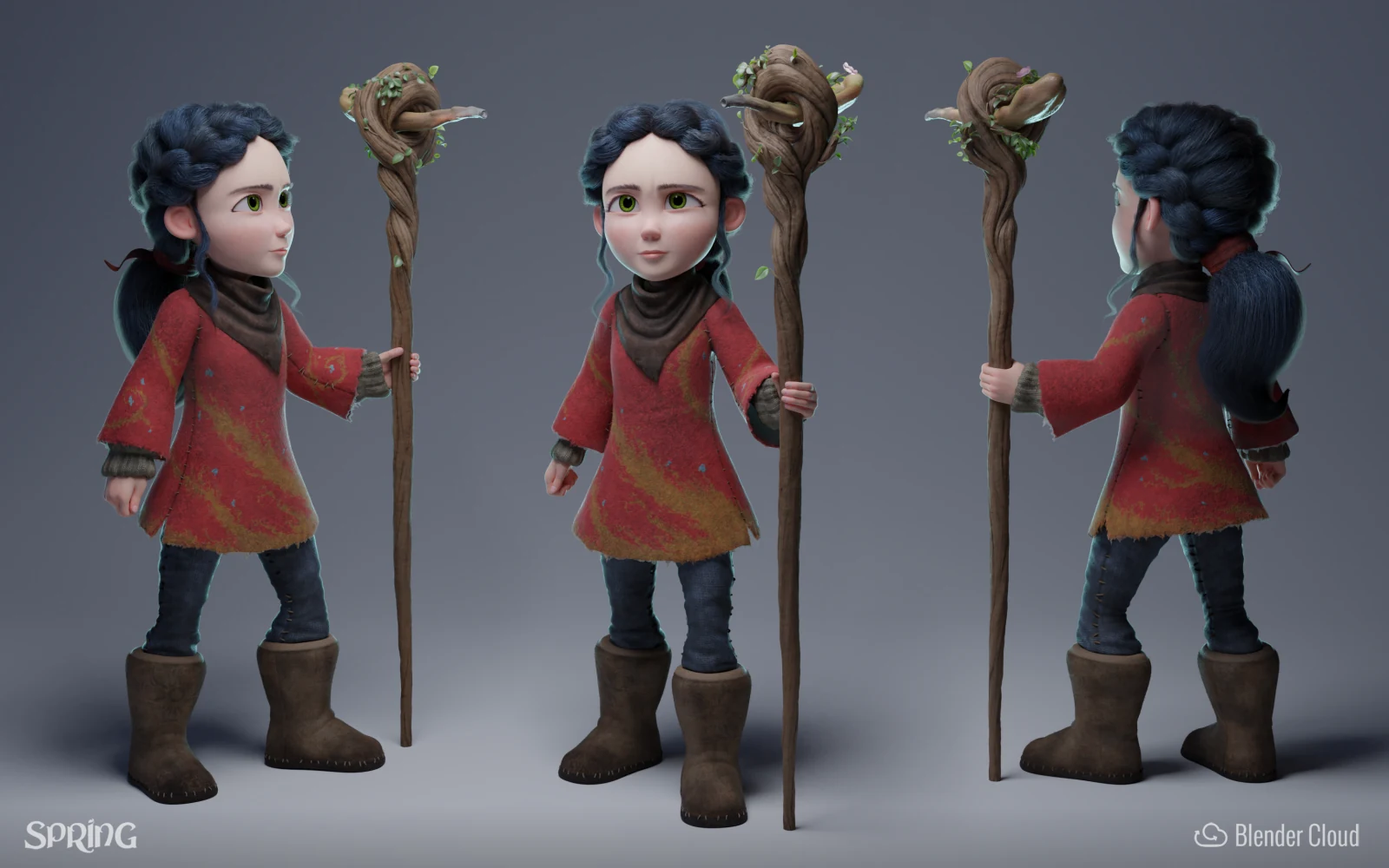
This official turnaround shows how a production asset makes hair, silhouette, wardrobe, boots, and props inspectable across views. It is not an AI short drama, a BitShovel character pack, a user project, or a cross-shot consistency test.
About this image and its source
Official Spring character turnaround | Julien Kaspar / Blender Studio | CC BY 4.0. BitShovel only resized it proportionally, removed metadata, and converted it to WebP without cropping, redrawing, generating, or rewriting text.
Open source page ↗Read use and attribution guidelines ↗SOURCES AND EVIDENCE
Sources and evidence
A maker reference method, one version-specific bug report, one character-variant feature request, and one open-production asset explain why versions and state need explicit records; they do not prove this contract works or a model is stable.
Open evidence boundary
Historical E2 remains the old page label. Revision 7 uses one maker reference method, one version-specific bug report, one character-variant feature request, and one open-film multi-view asset to explain why versions and state need explicit records. They do not prove this BitShovel contract works, reduces rework, or makes a model consistent.
- 01Maker method · Rechecked
Runway reference saving, combining, and separate iteration paths
Open source boundary
The maker explains saving, naming, combining, and iterating character and scene references. This is a feature method and maker claim, not a cross-shot success rate or a BitShovel run.
Open original source ↗ - 02Public bug report · Rechecked
ArcReel 0.24: storyboards did not anchor project assets
Open source boundary
One user reports that version 0.24 in Docker did not reliably carry character, setting, and prop-library data into storyboards. It is one specific report, not a result across versions, models, or users.
Open original source ↗ - 03Public feature request · Rechecked
ArcReel character-variant request: named wardrobe and forms
Open source boundary
The issue says the data model supports one appearance per character and requests everyday, battle, or form variants. It supports explicit version fields; it is not evidence of generated wardrobe drift.
Open original source ↗ - 04Open-production asset · Rechecked
The Spring turnaround inspects one identity across several views
Open source boundary
The CC BY 4.0 Blender Studio production asset shows how multi-views can carry silhouette, wardrobe, and prop constraints. It does not prove AI reproduction or a completed BitShovel asset.
Open original source ↗
REVISION RECORD
Revision record
R7 leaves generation probes to node 04 and corrects the old framing of a character-variant request as wardrobe-drift failure.
Open 7 revisions
- Revision 1
Changed character consistency from a prompt trick into versioned assets with recorded sources.
- Revision 2
Added entering and leaving state, setting and prop versions, voice permission, and public asset-binding and character-variant signals.
- Revision 3
The old site moved its hero from editorial art to an openly licensed released frame and demoted product UI to a process reference.
- Revision 4
The old site began assigning task-specific source visuals instead of using one film for every production step.
- Revision 5
The old site reiterated the boundary between a released narrative frame and process interfaces.
- Revision 6
Removed a narrative hero unrelated to the asset task and used a traceable official character turnaround.
- Revision 7
Narrowed node 03 to a zero-generation asset contract, corrected the old framing of an ArcReel character-variant request as wardrobe-drift failure, and left generation probes to node 04.
- What the record said before
- Create character views, wardrobe, expressions, settings, and props, then directly generate three consistency probes.
- What changed
- Node 03 first resolves every shot to one asset version, source, and state. If another operator cannot explain it from the contract, return the exact row. A pass only permits model comparison in node 04; it does not mean the character is consistent.
WHAT THIS RECORD LEAVES
What this record leaves
The asset contract is useful when every ambiguity can return to one exact row—not when every field looks full.
When P-02 lacks a version and source, remove it, repair the receipt, or return the shot package. Do not ask a model to guess. A pass only gives the next node a common baseline; it does not mean the character has been generated, is consistent, or deserves further production.
Back to the Dig index