
HISTORICAL DIG · JUL—AUG 2026
How do I keep an AI novel consistent?
As chapters accumulate, the problem is no longer how much text a model can accept, but which character, time, place, and open-thread facts are still valid. A plausible new line must not silently become later canon.
ONE SCENE, FOUR REGISTERS
Four registers. One canon.
Classify the fact first, then give the draft only the IDs this scene needs. New lines enter a diff; the author makes the final call.
- 01Fixed canonProse cannot overwrite it
- 02Current stateWhere people are and what they know
- 03Open threadsForeshadowing and unknowns stay open
- 04Change logMerge or rollback keeps a reason

The ledger is not a second manuscript. It holds referenceable canon, current state, open threads, and author-approved changes. Drafts submit diffs; they cannot update canon directly.
About this image and its source
BitShovel explainer created August 16, 2026. North Shore Zero, its people, times, places, IDs, and conflict are fixed fictional examples with no real manuscript, user data, or model-run result.
Open source page ↗HOW IT RELATES TO WORKFLOW 001
Relation to the current subject
It changes “which model?” into “how do project facts survive outside the tool?”
Open note
Choosing a tool does not preserve continuity. An ID-based ledger, scene packet, and draft diff can retain author-approved facts when chats, models, or entry points change. That directly supports Workflow 001’s project-continuity question and gives Q03 a writing-specific re-entry case.
Record state at the time
- AI novel writing
- Characters & timeline
- Standard record
- Developing
- Historical E2 · two writer discussions align with structured-writing methods · no real long-form run completed
THE GUIDANCE AT THE TIME
Judgment at the time
Drafts submit diffs. The author merges canon or rolls the prose back.
Open full rationale and return rules
Move canon out of chat and split it into versioned fixed facts, current state, open threads, and a change log, each with a stable ID. Before one scene, extract only its required facts, allowed changes, and author-voice references into a minimum scene packet. New draft facts enter a pending diff: the author merges them into the next canon version or rolls the prose back. Prose never rewrites canon automatically.
- Who it was for
- Writers with at least three chapters of their own work who are seeing motive, time, location-rule, or open-thread conflicts and are willing to approve canon changes themselves
- Why it mattered then
Open note
The later canon drift is found, the more chapters a repair can cross. The risk grows when the same model both drafts and declares itself consistent: it can reuse a newly invented error as its own evidence.
- Where the judgment stops
Open note
The two Reddit threads are writer self-reports, and one poster later disclosed building a related app; they are signals about the problem and possible practices only. novelWriter is not an AI writing tool, and its pinned interface establishes only that tags, references, and a novel-wide outline can be structured. The long-context paper studies question answering and retrieval, not literary quality. Git explains version history, not completion, quality, or sales. BitShovel has not completed a real novel with this method, compared models, or recruited independent writers to reproduce it.
CHECK BEFORE READING ON
Fit check
The trial is useful only when you have connected draft material and one identifiable conflict.
This record may help
- You have at least three chapters of your own work and can identify one character, time, place, or open-thread conflict.
- You are willing to keep the ledger as an author-maintained source instead of letting a model decide which canon is true.
Do not use it yet when
- You do not yet have connected draft material and only want a ranking of which model “writes novels best.”
- Continuing would require uploading an unpublished manuscript, character notes, or plot to an unauthorized third-party plugin.
- You want the system to adjudicate character motivation, author voice, or intentionally unreliable narration automatically.
HISTORICAL TRIAL · THREE CHAPTERS, ONE CONFLICT
Historical trial
Build 12–20 fact rows manually before deciding whether one model should assist with the same redacted packet.
- Time needed
- 35–50 minutes for three chapters and one conflict; stop at the cap
- Likely cost
- No model call is required for the first pass; use existing documents and local version history
- Permission boundary
- 01
First step
Open this step
Choose one known contradiction across three chapters. Build a 12–20-row ledger with stable IDs and at least four sections: fixed canon, current state, open threads, and change log. Extract a one-page minimum packet for the conflicting scene, then list every new or changed draft fact as a diff. The author first chooses merge, keep unknown, or roll back. Only after the manual route is clear may one model assist with the same redacted packet.
- 02
What should exist
Open this step
One versioned continuity ledger, one scene packet, one draft diff, and one author-approved merge or rollback decision.
- 03
How to tell it worked
Open this step
Every character, time, place, and open-thread claim in the revised scene points to an ID, and every new fact has an author decision plus a change record. This confirms only that one conflict was handled, not literary quality or future continuity.
- 04
Stop when
Open this step
Stop if no authoritative version exists; the packet still resembles a full chapter or book; the model flattens author voice or decides motivation; ledger upkeep exceeds drafting time; or continuing requires an unauthorized manuscript upload.
- 05
How to back out
Open this step
Restore the prior manuscript and ledger, keep the conflict as an open item, record why it was not merged, and revoke any new plugin or cloud-index permission.
BITSHOVEL R2 EXPLAINER · AUTHOR-CONTROLLED CONTINUITY GATE
Method and interfaces
Separate fixed canon, scene requirements, and new draft facts.
Open method boundary
The first image uses a fixed fictional story to explain the ledger, scene packet, diff, and author decision. The other two are pinned novelWriter maker Sample Project interfaces. They establish structured references and a novel outline—not an AI run or BitShovel test.
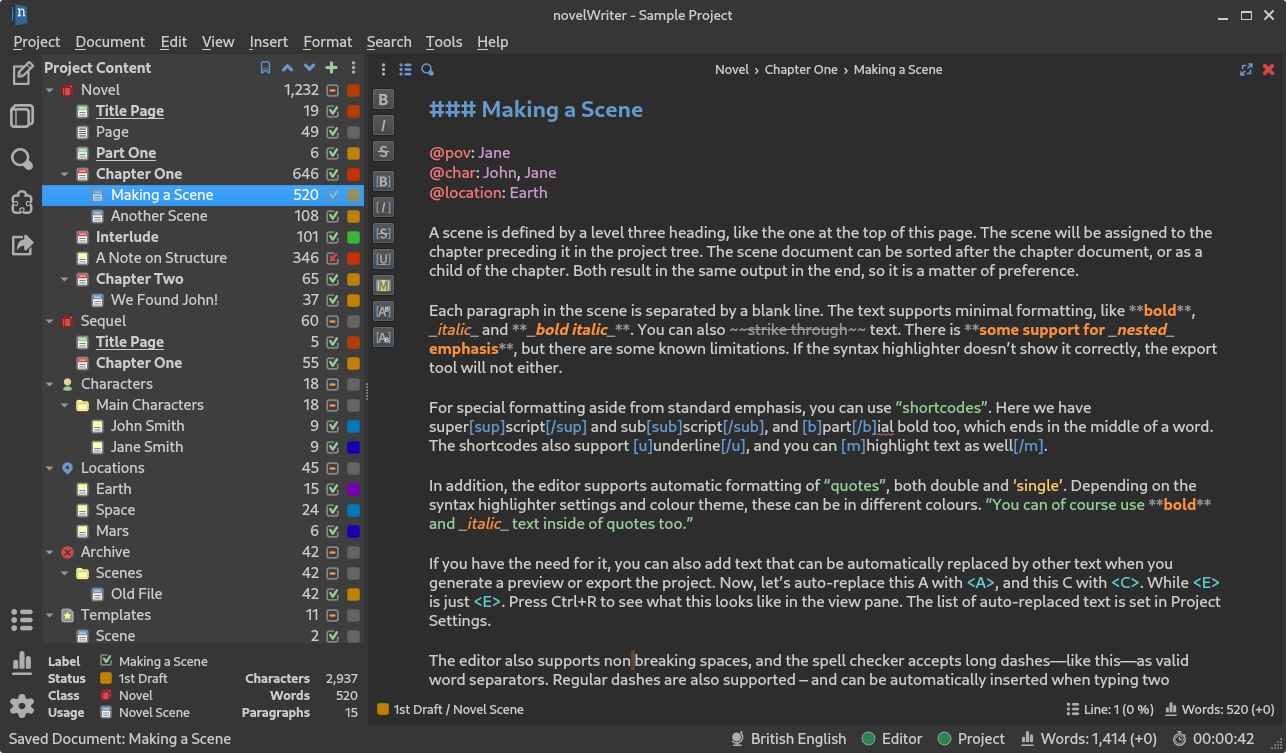
This maker sample turns people, locations, and POV into scene references. It establishes a visible information structure, not that AI will obey references or catch conflicts.
About this image and its source
Complete documentation screenshot from novelWriter pinned commit 4160785 by Veronica Berglyd Olsen and contributors; the application is GPL-3.0-or-later, with visible Material Symbols by Google Inc under Apache-2.0. BitShovel converted it uncropped and without text edits to WebP. It is the upstream Sample Project, not a BitShovel manuscript or run; novelWriter does not participate in or endorse BitShovel.
Open source page ↗Read use and attribution guidelines ↗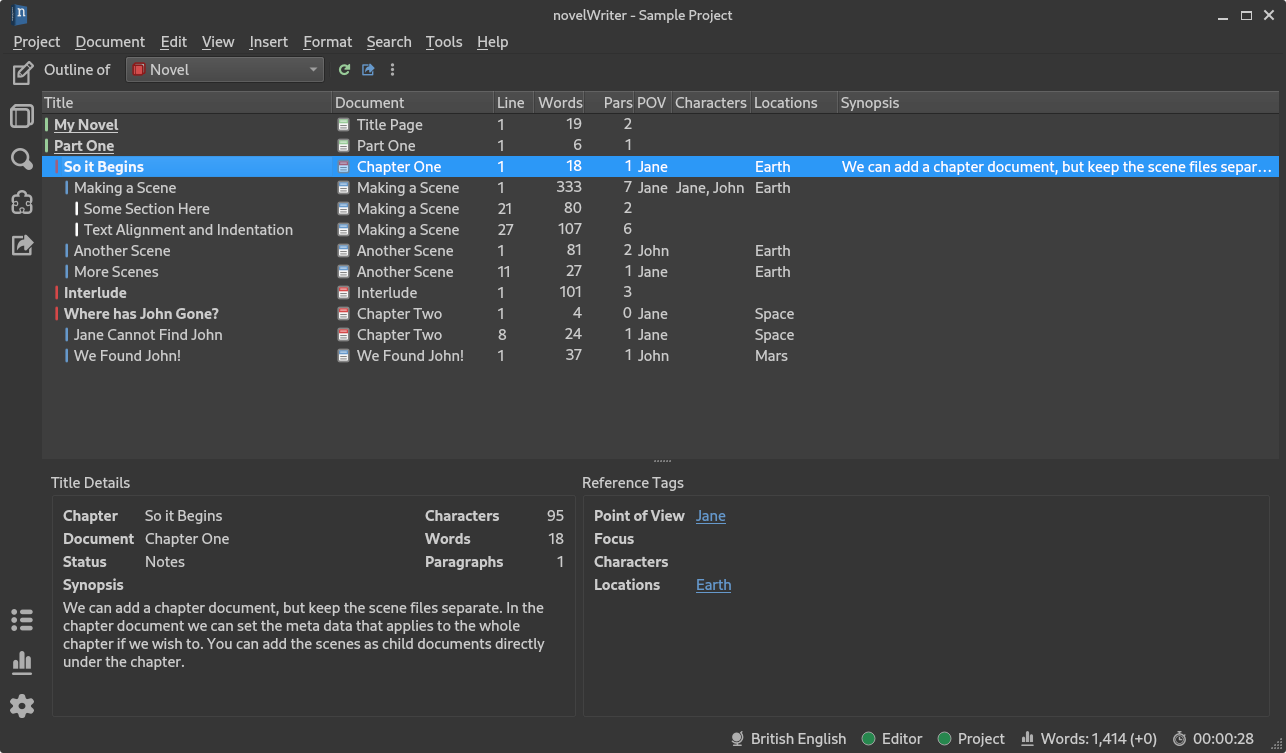
The novel outline places scene order, people, locations, and synopsis side by side for human review. It is not AI memory, automated continuity checking, manuscript completion, or literary-quality evidence.
About this image and its source
Complete documentation screenshot from novelWriter pinned commit 4160785 by Veronica Berglyd Olsen and contributors; the application is GPL-3.0-or-later, with visible Material Symbols by Google Inc under Apache-2.0. BitShovel converted it uncropped and without text edits to WebP. It is the upstream Sample Project, not a BitShovel manuscript or run; novelWriter does not participate in or endorse BitShovel.
Open source page ↗Read use and attribution guidelines ↗SOURCES AND EVIDENCE
Sources and evidence
As of August 16, 2026, writer discussions, structured-writing software, long-context research, and versioning methods support different parts of the problem and method. They do not show that AI writes a good novel.
Open evidence boundary
Historical E2 remains the label from the original record. Revision 2 adds current novelWriter documentation and long-context research to separate writer-reported drift, implementable structured references, and whether a model writes a good novel. There is still no BitShovel manuscript completion, reader feedback, or independent-writer outcome.
- 01Writer community signal · Rechecked
One serialized-fiction writer describes character, timeline, and plot drift as an ongoing problem
Open source boundary
This is one writer's question and comment thread. It shows the problem is experienced, not a sampled study, successful workflow, or model-capability finding.
Open original source ↗ - 02Community signal with commercial context · Rechecked
A second thread names story bibles, chapter summaries, and manual tracking while the poster discloses building a related app
Open source boundary
It remains a lead on the problem and common coping practices, with the commercial context disclosed. Comment methods, app effectiveness, and cross-genre results are not treated as validated.
Open original source ↗ - 03Current maker documentation · Rechecked
novelWriter: tags and references feed the project index and can be displayed together in the novel outline
Open source boundary
Maker documentation supports the method claim that structured facts and scene references can live in an interface. novelWriter is not an AI tool and does not establish automated conflict detection.
Open original source ↗ - 04Long-context research · Rechecked
Lost in the Middle: the position of relevant information can materially affect model use of long contexts
Open source boundary
The paper studies multi-document QA and key-value retrieval, not fiction writing. It is used only against the assumption that fitting information into context guarantees robust use.
Open original source ↗ - 05Versioning method reference · Rechecked
GitHub: version history can record, compare, and restore file changes
Open source boundary
This supports versioning and rollback mechanics, not continuity, author voice, literary quality, or manuscript completion.
Open original source ↗
REVISION RECORD
Revision record
Revision 2 stops one growing story bible from acting as source, context, and revision decision at once.
Open 2 revisions
- Revision 1
Changed AI continuation into one chapter at a time, with the author maintaining characters, world rules, timeline, and open conflicts.
- Revision 2
Split a growing story bible into an ID-based ledger, a minimum scene packet, and a draft diff. Prose cannot update canon; the author merges or rolls back every change.
- What the record said before
- Keep characters, world rules, timeline, and unresolved conflicts in one versioned story bible; provide the facts needed for a chapter, then have the author update canon.
- What changed
- Separate and ID fixed canon, current state, open threads, and the change log; give one scene only its minimum packet. New facts enter a draft diff, then the author merges them into the next ledger version or rolls the prose back. Prose cannot change canon silently.
WHAT THIS RECORD LEAVES
What this record leaves
Continuity comes from an author-maintained source—not a longer chat log.
If the revised scene cannot show which fact was merged, kept unknown, or rolled back, the process has not yet created recoverable project memory.
Back to the Dig index