Google DeepMind blog via AIHOT featured · Published 2026-08-27
Gemini 3.5 Transcribe: live dictation or recorded audio
A recording can become polished prose or a transcript with word timings and speaker labels. Gemini 3.5 Transcribe offers live and prerecorded endpoints, with different feature combinations for each job.
Speak live or process a recording
Google announced public preview on August 26. Streaming suits dictation and live captions; the prerecorded endpoint processes interviews, meetings and calls. Both detect 85+ languages, but only prerecorded processing provides word timestamps and speaker diarization.
A dictation app prioritizes fluent input; an interview tool needs a route back to the recording. The launch announcement listed the macOS app as English-only. The API language count does not establish Chinese support in that app.
Keep the wording or polish it
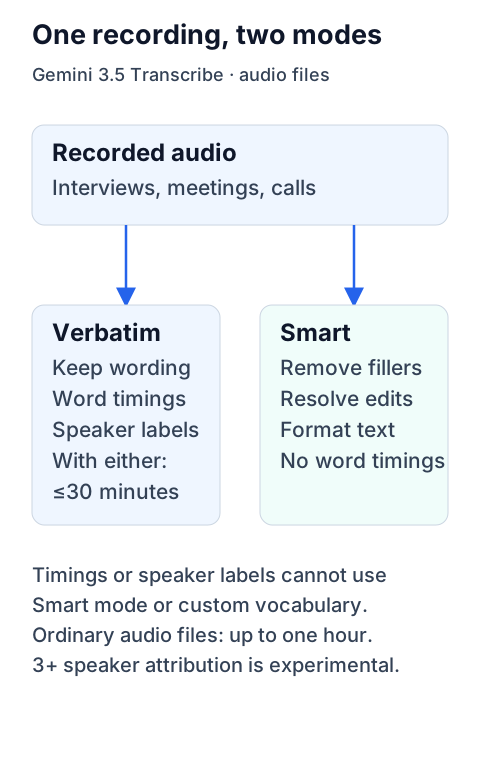
The default verbatim mode retains fillers, repetitions and spoken corrections. Smart mode cleans them up and formats the text. For example, “Tuesday—no, Wednesday” becomes Wednesday; this illustrates the feature, rather than a recording we tested.
Official API documentation allows ordinary prerecorded requests up to one hour. Timestamps or diarization reduce that to thirty minutes and cannot be combined with smart mode or custom vocabulary. Diarization supports up to eight speakers, with attribution for three or more experimental. Timestamps may also reduce transcription accuracy: easier navigation and better recognition are separate benefits.
Important additions and corrections
Dates below mark changes to our coverage.
- Addition ·
Added live versus recorded workflows and the feature limits of verbatim and smart modes.
- Addition ·
Separated API and app language coverage, and added the 30-minute audio limit and feature-combination restrictions for timestamps and speaker labels.
Sources and notes
sources中文
Sources and notes
- Read the originalGoogle DeepMind blog via AIHOT featured
- Google transcription model specifications
- Google announcement
- Google transcription API documentation
Retained summary and context
With timestamps or speaker labels, prerecorded audio is limited to 30 minutes and cannot use smart mode or custom vocabulary. Attribution for three or more speakers remains experimental. We have not tested accuracy on noisy Chinese recordings.
Sources and evidence · 4 links
Each link has a purpose and scope. Link counts do not establish independent confirmation; direct support applies only to the statements specified below.
- Google DeepMind blog via AIHOT featuredDirect support
The original DeepMind URL redirects to Google’s announcement. Current API documentation lists up to eight speakers; the announcement still lists three. Use current API limits without inferring when they changed. Retain publishedAt=2026-08-26T17:01:00.000Z; September 6 is verification only. Lack of our own testing does not negate the independence of cited Artificial Analysis measurements. See evidence-manifest.json.
Limits: With timestamps or speaker labels, prerecorded audio is limited to 30 minutes and cannot use smart mode or custom vocabulary. Attribution for three or more speakers remains experimental. We have not tested accuracy on noisy Chinese recordings.
Source timeline
- · Found this reading link via AIHOT featured.
- · The Verge and Ars Technica ran same-day stories confirming the launch; both highlight the smart-transcription traits such as filler removal and automatic formatting.
- · Lateral (Google Gemini): "Gemini Omni 1.1 Flash ships with stronger generative-video controls for developers" (zh post, translated)
- · Release watch (Google Gemini): "Gemini 3.5 Transcribe arrives: a more precise real-time speech transcription model" (zh post, translated)
- · Release watch (Google Gemini): market chatter captured via AIHOT featured (headline in Chinese). Same-class release moves reshape expectations and alternatives.
- · Release watch (Google Gemini): market chatter captured via aihot-featured (headline in Chinese). Same-class release moves reshape expectations and alternatives.
- · Comparison (Google Gemini): "Google DeepMind's Gemini 3.8 Flash Beats Claude " — lead via alphasignal-daily. Same-class comparisons and sentiment signal the market's relative standing.
- · Release watch (Google Gemini): market chatter captured via ithome (headline in Chinese). Same-class release moves reshape expectations and alternatives.
- · Release watch (Google Gemini): "Gemini 3.8 Flash is now available in GitHub Copi" — lead via github-changelog. Same-class release moves reshape expectations and alternatives.
- · Release watch (Google Gemini): "Supabase is now available in Gemini Enterprise" — lead via supabase-blog. Same-class release moves reshape expectations and alternatives.
Collection record
First discovered:
Collection and source publication have distinct dates.
Editorial record
Sources reviewed
· Beijing time (UTC+8)
Added live versus recorded workflows and the feature limits of verbatim and smart modes. Event, discovery and collection dates remain unchanged.
Sources and full record
This dates our review of the wording and sources, not a project release or product update.
- Google transcription model specifications
- Google announcement
- Google transcription API documentation
- Source page: ai.google.dev
See how these changes connect
Compare another route to keeping meeting notes: recording hardware paired with a transcription service.
Compare notes, images and websites as different results you can keep using.