AI video · Case study
Great Havoc in Heaven: why the climax shot needed another take
Open the complete demo file in the original repository, then compare the two rows of Shot 05 frames: how one revision balances the gate impact with a readable full-body hero.
Published · Reviewed
 View original work ↗
The maker reports five shots and 25 story assertions passing its own review; this is project QA, not evidence of audience size or earnings.
Check this resultA 30-second live-action-style Journey to the West trailer moves from an approaching celestial army to the South Heavenly Gate's collapse. Its maker kept a comparison of the first and selected climax cuts. The first has spectacle, yet the hero and weapon do not read clearly. That makes one production decision visible: detect a shot that has impact but loses its subject, revise it, and check the resulting cut. This is an independent tool demo, not an official continuation of the classic animated film or a proven commercial success.
Verified material
Start with the finished demo
The original repository holds a 30-second film file, five-shot script and final shot prompts.
The maker presents it as a cinematic Great Havoc in Heaven trailer. Five generated shots and a title card form a roughly 30-second MP4 in the repository. The maker says MiniMax H3 Max produced the footage, one action continued from a stable frame in the prior shot, and lightning, sound and a separately typeset title card joined the edit. The public file and production notes can be checked; GitHub's file page has not been treated as a verified in-page player here.
Success here means a completed, inspectable project: a film file, script, prompts and review report. The maker reports all five scenes and 25 story assertions passing its own checks. Public view counts, paid viewing, commissions and receipts are not provided.
Sources for this section: InkToFilm project and demo overview · Great Havoc in Heaven 30-second file · Five-shot script and sound handoffs · Shot 05 automated visual review
Verified material
Two cuts of one shot: spectacle without a readable hero
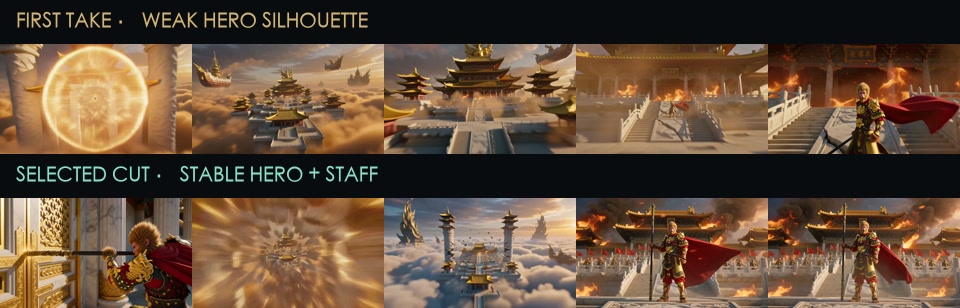
The maker shows five frames each from the first and selected cuts; the problem was not a lack of spectacle.
 Check visual source ↗
The image labels the upper row 'first take: weak hero silhouette' and the lower row 'selected cut: stable hero + staff'. The first row already has a gate burst, cloudscape and burning architecture, but the hero only appears near the edge at the end. In the selected row, the gate impact leads to a longer, steadier full-body hero composition with a more readable hero and weapon silhouette. This reading comes from ten published frames; it is not a claim to have watched the whole first-take video.
The maker says the first take had a strong explosion but an indistinct hero and unstable weapon. A targeted retry kept the best impact beat, and useful moments were edited into the final shot. This is a production choice inside one project, not a ranking between unrelated projects.
Documented process
Shot 05: from first-take problem to selected cut
Both frame rows and the revision account come from one fixed version of the maker's repository.
First take · the spectacle is present
The upper five frames show the gate impact and burning setting, but a weak hero and unstable weapon. No complete first-take video is public.
Inspect the upper first-take rowTargeted retry · retain impact, clarify the hero
The maker describes a retry aimed at hero and weapon readability while keeping the strongest impact beat; a full retry log is not public.
Read the maker's revision accountSelected cut · full body and staff hold
The lower five frames show a sustained hero composition after impact; the repository also holds the final Shot 05 video file.
Inspect the lower selected-cut row
Evidence limitThe image samples five frames from each cut. The full first take, its prompt, every generation setting and elapsed time are not public, so there is no documented bad-prompt-to-good-prompt experiment.
Sources for this section: InkToFilm project and demo overview · Shot 05 first and selected cut comparison
Public account
Turning 'keep the hero clear' into shot requirements
The final Shot 05 prompt and selected-cut review are public; the first prompt is not available for a literal comparison.
The final prompt divides five seconds into checkable beats: a side view of a normal-sized Monkey King striking the gate with one straight staff in the first second; layered destruction in seconds two and three; an unobstructed full-body pose with one head, two arms and one visible staff in the last two seconds. These constraints address the stated first-take problem. The first prompt is unpublished, so no individual wording change can be credited as the cause; selection and editing also shaped the result.
The maker's Shot 05 review scores gate impact, layered destruction, final hero, anatomical and weapon stability, and clean overlays at 0.91, 0.87, 0.96, 0.94 and 1.00 using eight sampled frames. This is the project's automated visual QA, not an audience rating or a full-frame inspection of the entire video. Its cited frames let readers inspect the basis for each judgment.
Sources for this section: Final video prompt for Shot 05 · Shot 05 automated visual review · Five-shot script and sound handoffs
Our analysis
What to borrow, and what the economics establish
The transferable practice is shot-level diagnosis with before/after samples and review criteria; the demo has no market-return evidence.
A small trial can begin with one unmistakable story action and a clear character endpoint, then divide the shot into reviewable time beats. After generation, compare aligned frames for character, prop, motion and ending rather than asking only whether the spectacle looks impressive. Record what was retained and what was redone. This is an editorial practice drawn from the example, not a promise of the same result.
The maker reports $2 in fal generation charges for selected shots and targeted retries, plus under $0.10 for three spoken lines. These are reported service charges, not the full cost of writing, editing, tool maintenance, time or promotion. Views, orders, revenue and profit are not disclosed, so API spend alone cannot estimate the cost of a profitable AI video.
The repository has an MIT licence for software and associated documentation, but no separate commercial-use grant was found for every generated video, image, sound or likeness. BitShovel presents the attributed maker comparison for reading and verification. Reusing its media, character depiction or audio in a commercial work calls for checking the rights holder and terms for each asset.
Sources for this section: InkToFilm project and demo overview · InkToFilm repository MIT licence · Shot 05 first and selected cut comparison
Sources and limits
Where the material comes from
- InkToFilm project and demo overviewMaker's accountChecked
Film, Shot 05 problem and revision, reported service charges and self-check results.
- Great Havoc in Heaven 30-second fileMaker's MP4 fileChecked
Complete film file at the fixed commit; in-page playback has not been verified.
- Shot 05 first and selected cut comparisonMaker's frame comparisonChecked
Five frames per row compare a weak hero silhouette with the stable hero and staff.
- Five-shot script and sound handoffsMaker's screenplayChecked
Five generated shots, title card and sound transitions.
- Final video prompt for Shot 05Maker's production promptChecked
Divides the five-second climax and requires one stable staff and unobstructed full-body hero.
- Shot 05 automated visual reviewMaker's self-check with frame evidenceChecked
Eight sampled frames and five semantic scores; not audience ratings.
- InkToFilm repository MIT licenceSoftware and documentation licenceChecked
Does not separately enumerate commercial rights for every generated media and likeness asset.