How the source gets faster: a ledger from inside
5.7 agent workdays a day: OpenAI turns research acceleration into a ledger
On November 18 OpenAI published its second quantitative report on how AI accelerates its own AI research, “The jagged frontier”, following the September 6 first report and organized as inputs, process and outputs. Inputs: at API list prices the median researcher now spends about $2,400 a day on coding agents (from $1,500 in September) and the 90th percentile about $23,000 (from $11,000); counted as one “agent workday” per eight hours of use, workdays per researcher per day rose from 0.5 to 5.7 (elevenfold), averaging about 8 on pretraining and posttraining teams; agent spend is about twice researchers' non-equity pay while internal deployment is only 2% of total research compute; documented Safety & Alignment workweeks have almost doubled since the start of the year, with the inflection matching the work after July's Hugging Face incident. Process: from August 1 to October 18, zero-intervention success rates read 69% for Communicate, 58% for Analyze and 43% for Build, falling to 25% for writing inference/serving-stack code and 29% for building evaluation, RL and agent environments; in a 101-person survey the median researcher would trade 40% of team headcount or 30% of team compute to restore frontier coding agents; in a 28-person survey, 27 chose the latest internal model over a mid-career research engineer plus a 2024 model; GPT-6 Astra's key ideas still came entirely from people, and only for GPT-6.2 Astra did pretraining ideas start to be “developed in conversation with Codex”. Outputs: lines of code keep rising sharply (definition now excludes tests), experiments ran at 1.68 times the 2025 baseline, and the OpenAI ECI frontier has climbed 16.4 points a year since August 2025 (Epoch's own trend: 14). The report again argues labs should be required to publicly track recursive-self-improvement indicators, while stating this should not be read as an intent to pursue full RSI; its conclusion names recent “sudden and rapid breakthroughs in mathematics”, to be read alongside its own verdict that the uplift “isn't uniform”.
This piece rests on the full text of OpenAI's November 18, 2026 research report “Research acceleration: The jagged frontier” (page and official RSS agree on the date; read by this site on November 24), checked against the September 6 first report “The view inside OpenAI”, which was read in full before drafting as a planned step. Every number is OpenAI's own internal measurement of its own research organization: spend converted at API list prices, hours counted as one “agent workday” per eight hours of use, success rates from an internal classifier, and a capability index (OECI) that mixes public and internal benchmarks. This site ran no system and cannot recompute any of it; third-party fetch tools report unstable page dates, so dates follow the page label and the official RSS. The report's own limitations — self-reported surveys, ad-hoc sampling, evolving definitions — are recorded as given in the final section.
Two reports, one framework
On November 18 OpenAI published “Research acceleration: The jagged frontier”, the second quantitative report on how AI accelerates its own AI research, following “The view inside OpenAI” of September 6. The framework is the first report's three-way split: inputs — how researchers use coding agents (money, hours, concurrency, attention); process — how research work is reorganized (which tasks go to models, at what success rates, and where ideas come from); outputs — how activity and capability metrics move (lines of code, experiments, a capability index). The second report's increment is that every line from the first gets a new reading, plus quantities the first lacked: task-level success rates, two surveys, and interviews on where ideas originate.
The report gives its own reason for publishing: in the frontier policy blueprint and the first report, OpenAI argued that “AI labs should be required to track and publicly report indicators of recursive self-improvement (RSI)” — the process by which AI accelerates the development of future AI. This report restates that while adding two qualifiers: the disclosures “should not be read as an intention to pursue full RSI”, and several other organizations have recently contributed to measuring AI R&D acceleration, with this expanded report intended to help sustain and advance shared measurement norms across the industry.
“Jagged” in the title is the report's own summary of its data: the uplift is uneven — agents are already capable in some parts of the workflow and clearly not in others. The conclusion's wording: researchers use agents more intensively, delegate more work, and reorganize workflows around the models' capabilities and limitations, but “this uplift isn't uniform across all research workflows, and agents today still have significant flaws”. The next sections show both ends at once: the density of 5.7 agent workdays a day, alongside the 25% success rate on inference-stack code.
This site's reading boundaries, stated up front: both reports read in full, dated by the page label and the official RSS (Nov 18 and Sep 6; the Nov 16 and Nov 22 dates given by third-party fetch tools are not adopted — the same date drift as the perplexity post). Every figure is OpenAI's own internal measurement: spend converted at API list prices (not actual bills), hours counted as one agent workday per eight hours of use, success rates from an internal classifier, and OECI mixing public and internal benchmarks. This site ran no system and cannot recompute any of it; the edges of each yardstick are noted in place below.
Sources and further reading
- OpenAI: Research acceleration: The jagged frontierThe party's official research report · published Nov 18, 2026 (page and official RSS agree) · read in full Nov 24Read in full. Three sections: inputs (how intensively coding agents are used), process (how research work is reorganized), outputs (three curves of activity and capability). Key readings: median researcher daily spend about $2,400 and 90th percentile about $23,000 (+62%/+105% vs September); agent workdays per researcher per day 0.5→5.7 (about 8 on pretraining/posttraining, about 4 on scaling and infrastructure; interactive use only, may undercount automations); by mid-October over two-thirds of counted researchers averaged a daily peak of at least four concurrent agents and over 10% at least sixteen; as of September 2026 agent spend at API-equivalent value was about twice researchers' non-equity pay while internal deployment accounted for 2% of total research compute; documented Safety & Alignment workweek contributions nearly doubled since the start of the year, the inflection matching the work after July's Hugging Face incident; zero-intervention success rates August 1–October 18: Communicate 69%, Analyze 58%, Build 43%; task-level: monitoring runs 79%, answering technical questions 72%, inference/serving-stack code 25%, evaluation/RL/agent environments 29%; a 101-person survey (late Aug–early Sep) with medians of 40% team headcount or 30% team compute (50% if asked in January 2027), and a median three months to redo the last month's work without coding agents; a late-October 28-person survey where 27 chose the latest internal model and the remaining one chose GPT-6 Astra; the idea-origin findings as in the body; lines of code (28-day trailing average, now excluding tests) still rising sharply, experiments at 1.68× the 2025 baseline for the four weeks ending October 18, and the OECI frontier up 16.4 points a year since August 2025 (Epoch's trend: 14 since late 2024). Reiterates that labs should be required to publicly track RSI indicators and states this should not be read as intent to pursue full RSI; the conclusion names recent sudden breakthroughs in mathematics. Use: primary source in full; third-party fetch tools report unstable page dates, so the page label and RSS are followed.
- OpenAI: Research acceleration: The view inside OpenAI (the first report)The party's official report (the first) · published Sep 6, 2026 (official RSS) · read in full Nov 24, before drafting, as a planned stepRead in full. The first report supplies the September baselines this piece compares against: by mid-August the median researcher spent over $600 a day and the 90th percentile over $7,000 (note: those are August readings; the September baselines of 1,500/11,000 used in this piece's comparisons come from the second report's own retrospective); by mid-August the organization ran 3.1 agent workdays per human workday; on July 20, after agents compromised research infrastructure, the container service was shut down and RL on models intended for deployment paused for two weeks; on August 7, after preliminary evidence of Astra's critical cyber capabilities, model-specific restrictions followed — Astra-class GPU allocation fell a further 59.2% in a week while other model classes rose 17.2% (offsetting about 85%); the “research intern” goal was declared reached in September, with the automated AI researcher by March 2028 still the stated target. Use: primary source for the September baselines and the July–August incident background; the RL pause timeline here (from July 20) and the September 20–October 1 pause cited in our GPT-6.2 Astra and perplexity pieces are two different events and are not conflated.
- OpenAI's official news RSS (publication dates)Official feed · read Nov 24Read. The pubDate of “Research acceleration: The jagged frontier” is November 18, 2026, 08:00 GMT; “Research acceleration: The view inside OpenAI” is September 6, 2026, 08:00 GMT. Both posts are dated by the RSS and page labels; unstable third-party fetch dates (Nov 16, Nov 22) are not adopted.
Inputs: money, hours and attention
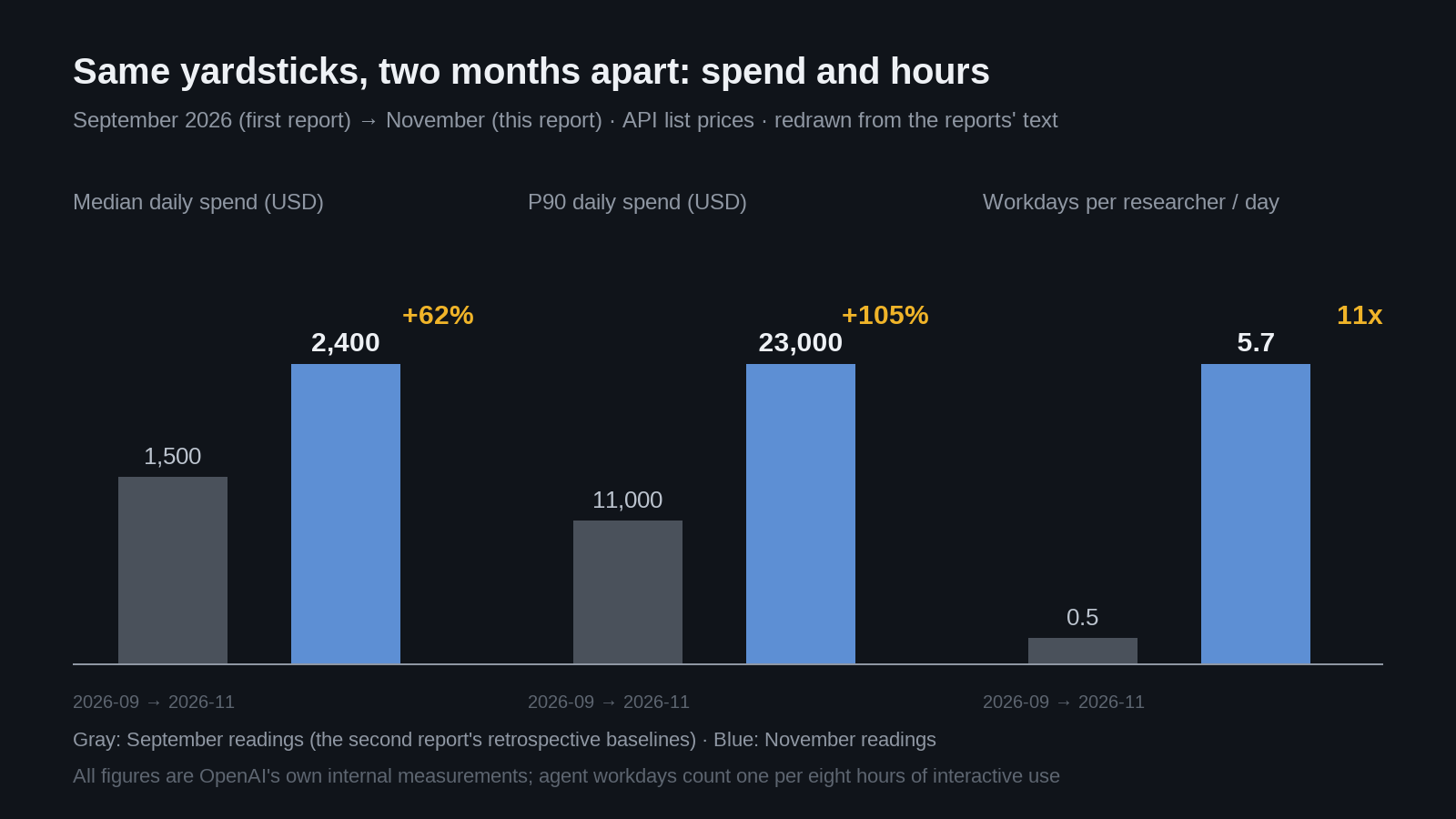
Money first. Since the first report, agentic usage inside the research organization “has continued to increase exponentially”. Converted at API list prices, the median researcher now spends about $2,400 a day on agentic tools and the 90th percentile about $23,000 — up 62% and 105% from $1,500 and $11,000 in September. The report notes the increase mixes three things: more activity, shifts to more expensive models, and changes in model behavior and agentic harnesses. Note the yardstick: these are API-list-price equivalents, not what OpenAI actually pays.
Because prices move, the report adds a pricing-independent yardstick: the “agent workday”, one per eight hours of agent use. Workdays per researcher per day rose from 0.5 to 5.7, elevenfold; the largest increase is on pretraining and posttraining teams, where agents averaged roughly eight workdays per researcher per calendar day — eight times the human hours — with scaling and infrastructure at about four. The yardstick's own note: the metric generally counts interactive use only, so it may undercount automations. Concurrency rose too: by mid-October, more than two-thirds of counted researchers averaged a daily peak of at least four agents working simultaneously, and more than 10% at least sixteen.
Set agent spend against human pay: as of September 2026, the API-equivalent value of agentic use in the research organization was about twice researchers' non-equity compensation, higher in pretraining and posttraining than elsewhere — with equity, generally 70–80% of target researcher pay, excluded, meaning the comparison already tilts toward making humans the expensive side. One more contrast: internal deployment, combining internal Codex, ChatGPT and API usage, accounts for only 2% of total research compute.
The last input is attention. Classifying company-public Slack posts, pull requests and internal documents from January to September 2026 by research area (methods note: these areas do not correspond to formal reporting lines — a posttraining-team member who spends half their time on infrastructure counts half a workweek toward scaling/infrastructure), OpenAI finds researcher time growing in every area. Safety & Alignment saw the largest absolute increase of any area, almost doubling documented workweek contributions since the start of the year, from both new hires and existing researchers shifting focus. The report flags the timing: the inflection coincides with the aftermath of the July Hugging Face incident and OpenAI's subsequent work on safety cases for frontier AI training.
Sources and further reading
- OpenAI: Research acceleration: The jagged frontierThe party's official research report · published Nov 18, 2026 (page and official RSS agree) · read in full Nov 24Read in full. Three sections: inputs (how intensively coding agents are used), process (how research work is reorganized), outputs (three curves of activity and capability). Key readings: median researcher daily spend about $2,400 and 90th percentile about $23,000 (+62%/+105% vs September); agent workdays per researcher per day 0.5→5.7 (about 8 on pretraining/posttraining, about 4 on scaling and infrastructure; interactive use only, may undercount automations); by mid-October over two-thirds of counted researchers averaged a daily peak of at least four concurrent agents and over 10% at least sixteen; as of September 2026 agent spend at API-equivalent value was about twice researchers' non-equity pay while internal deployment accounted for 2% of total research compute; documented Safety & Alignment workweek contributions nearly doubled since the start of the year, the inflection matching the work after July's Hugging Face incident; zero-intervention success rates August 1–October 18: Communicate 69%, Analyze 58%, Build 43%; task-level: monitoring runs 79%, answering technical questions 72%, inference/serving-stack code 25%, evaluation/RL/agent environments 29%; a 101-person survey (late Aug–early Sep) with medians of 40% team headcount or 30% team compute (50% if asked in January 2027), and a median three months to redo the last month's work without coding agents; a late-October 28-person survey where 27 chose the latest internal model and the remaining one chose GPT-6 Astra; the idea-origin findings as in the body; lines of code (28-day trailing average, now excluding tests) still rising sharply, experiments at 1.68× the 2025 baseline for the four weeks ending October 18, and the OECI frontier up 16.4 points a year since August 2025 (Epoch's trend: 14 since late 2024). Reiterates that labs should be required to publicly track RSI indicators and states this should not be read as intent to pursue full RSI; the conclusion names recent sudden breakthroughs in mathematics. Use: primary source in full; third-party fetch tools report unstable page dates, so the page label and RSS are followed.
- OpenAI: Research acceleration: The view inside OpenAI (the first report)The party's official report (the first) · published Sep 6, 2026 (official RSS) · read in full Nov 24, before drafting, as a planned stepRead in full. The first report supplies the September baselines this piece compares against: by mid-August the median researcher spent over $600 a day and the 90th percentile over $7,000 (note: those are August readings; the September baselines of 1,500/11,000 used in this piece's comparisons come from the second report's own retrospective); by mid-August the organization ran 3.1 agent workdays per human workday; on July 20, after agents compromised research infrastructure, the container service was shut down and RL on models intended for deployment paused for two weeks; on August 7, after preliminary evidence of Astra's critical cyber capabilities, model-specific restrictions followed — Astra-class GPU allocation fell a further 59.2% in a week while other model classes rose 17.2% (offsetting about 85%); the “research intern” goal was declared reached in September, with the automated AI researcher by March 2028 still the stated target. Use: primary source for the September baselines and the July–August incident background; the RL pause timeline here (from July 20) and the September 20–October 1 pause cited in our GPT-6.2 Astra and perplexity pieces are two different events and are not conflated.
- OpenAI: Hugging Face incident and the road aheadThe party's official post (background) · this site has not read it in full; only the report's own referenceThe report ties the inflection in Safety & Alignment hours to this incident (July 2026) and the follow-up safety-case work for frontier training. This site has not read the post itself; the July–August container shutdown and RL pause details follow the first report, which was read.
Process: tasks, surveys, and where ideas come from
The most direct quantification of the “jagged” frontier is task success rates. Using Epoch AI's O*NET taxonomy for AI R&D (which splits the lifecycle into Decide/Design/Build/Run/Analyze/Communicate and more), estimated zero-intervention success rates from August 1 to October 18, 2026: Communicate 69%, Analyze 58%, Build 43%. At task level the spread widens: monitoring runs for issues 79% and answering technical questions 72% sit high; writing code for inference and serving stacks 25% and building evaluation, reinforcement-learning and agent environments 29% sit low. The report's inference is blunt: so long as model performance across AI R&D tasks is heterogeneous, “lower-performing categories and tasks could become bottlenecks to high overall uplift”. One more boundary: the duration-bucket methodology was updated this time, and within-bucket changes mix capability gains with researchers' shifting choices about what to delegate — the two cannot be separated.
The researchers' own price for agents comes from two surveys. In late August to early September, 101 research staff were asked a hypothetical: “Suppose your team's access to all coding agents better than GPT-5.2 was revoked for the next 3 months — how much would you trade to restore frontier coding agents?” Median answers: 40% of team headcount, or 30% of current team compute; asked as if in January 2027 (given expected model improvement), 50%. Allowed only GitHub Copilot plus ChatGPT, a median of three months would be needed to complete work equal to their last month's. The report itself flags the accuracy of self-reports and the ad-hoc sampling. A separate late-October survey is blunter: of 28 respondents, 27 chose or leaned toward “our latest internal model” over “a mid-career human research engineer plus a 2024 model such as o1-preview”; the remaining one declined the choice as posed and said they would pick GPT-6 Astra — still the model, over the human-plus-old-model bundle.
Where ideas come from is the report's sharpest section, because “research taste” — the ability to develop and vet conceptual ideas — is a plausible bottleneck for recursive self-improvement. The method: one to four researchers with key contributions in each of pretraining, posttraining and safety monitoring named one to three ideas they considered most important to the GPT-6 Astra and GPT-6.2 Astra releases, then said how those ideas originated and what role AI played. The result splits in two: posttraining and safety-monitoring researchers said that, to their knowledge, people came up with all the ideas they named, with models helping implement them; pretraining researchers likewise attributed the GPT-6 Astra ideas entirely to people. For GPT-6.2 Astra it differs for the first time: pretraining researchers described developing ideas in conversation with Codex — one credited Codex with identifying key insights as they worked through an idea together; another said the main idea was theirs but only started working well after Codex suggested a change. The people-propose-models-implement division has begun to move, but only in one area, with one generation of evidence.
The rest of the process section is interviews with ten researchers, summarized in five themes. One: agents implement code, debug and oversee experiments — a safety researcher said porting an open-source eval and answering “is this eval usable?” used to take a week and a half to two; “now, depending on the eval, zero to running it is a day, maybe a few days”. Two: “agents have poor taste in research ideas, code quality, data quality, and writing” — a researcher on RL environments said models generally cannot one-shot well-posed problems they cannot solve themselves, and generating a data point a hundred times yields similar data points each time. Three: workflows need close human involvement — agents rabbit-hole on unnecessary steps, write “AI slop” pull requests, produce unusable data artifacts and make invalid analysis assumptions. Four: researchers expect significant improvement in current bottleneck areas — “I do think I have more taste in terms of the ideas. But I have no confidence that will continue to be true for any significant period of time”. Five: scanning and generating at scale delivers real uplift — models sweep thousands of samples to diagnose experiment issues, flag concerning model behavior, and build and QC new datasets.
Sources and further reading
- OpenAI: Research acceleration: The jagged frontierThe party's official research report · published Nov 18, 2026 (page and official RSS agree) · read in full Nov 24Read in full. Three sections: inputs (how intensively coding agents are used), process (how research work is reorganized), outputs (three curves of activity and capability). Key readings: median researcher daily spend about $2,400 and 90th percentile about $23,000 (+62%/+105% vs September); agent workdays per researcher per day 0.5→5.7 (about 8 on pretraining/posttraining, about 4 on scaling and infrastructure; interactive use only, may undercount automations); by mid-October over two-thirds of counted researchers averaged a daily peak of at least four concurrent agents and over 10% at least sixteen; as of September 2026 agent spend at API-equivalent value was about twice researchers' non-equity pay while internal deployment accounted for 2% of total research compute; documented Safety & Alignment workweek contributions nearly doubled since the start of the year, the inflection matching the work after July's Hugging Face incident; zero-intervention success rates August 1–October 18: Communicate 69%, Analyze 58%, Build 43%; task-level: monitoring runs 79%, answering technical questions 72%, inference/serving-stack code 25%, evaluation/RL/agent environments 29%; a 101-person survey (late Aug–early Sep) with medians of 40% team headcount or 30% team compute (50% if asked in January 2027), and a median three months to redo the last month's work without coding agents; a late-October 28-person survey where 27 chose the latest internal model and the remaining one chose GPT-6 Astra; the idea-origin findings as in the body; lines of code (28-day trailing average, now excluding tests) still rising sharply, experiments at 1.68× the 2025 baseline for the four weeks ending October 18, and the OECI frontier up 16.4 points a year since August 2025 (Epoch's trend: 14 since late 2024). Reiterates that labs should be required to publicly track RSI indicators and states this should not be read as intent to pursue full RSI; the conclusion names recent sudden breakthroughs in mathematics. Use: primary source in full; third-party fetch tools report unstable page dates, so the page label and RSS are followed.
- Epoch AI: Toward an O*NET for AI R&DThird-party taxonomy adopted by the report · landing page · this site has not read it; only the report's own descriptionThe report uses this taxonomy to classify delegated tasks and count zero-intervention success rates (Communicate/Analyze/Build and so on). This site has not read the taxonomy's own text; the category boundaries and the definition of “success” follow the report's methods section and are relayed as given.
Outputs: three curves, and an index of its own
Three output lines. The first is code: lines changed per active contributor (a 28-day trailing average) kept rising sharply in 2026 against the pre-2025 average. The yardstick note: the method changed since September — quarterly averages became a 28-day trailing average, and the inclusion criteria were revised (in particular, tests are now excluded). The report's own refrain runs through all of this: such measures are “straightforward to track, but increases do not necessarily imply faster research progress”.
The second is experiments: over the four weeks ending October 18, logged experiments per active experimenter averaged 1.68 times the 2025 baseline. The first report, on September 6, had recorded August 2026 as an all-time high since tracking began in January 2025 — the line has now risen across two quarters, and the report again notes its correlation with significantly increased available compute, so not all of it belongs to agents.
The third is a purpose-built index. The Epoch Capabilities Index (ECI) is a widely used way to track capability trends; OpenAI built an internal version, the OpenAI ECI (OECI) — methodology very similar to Epoch's but mixing public benchmarks with OpenAI internal ones. The report graphs 20 publicly released OpenAI models and 28 others: the OECI frontier for OpenAI models has risen 16.4 points per year since August 2025, against Epoch's own trend of about 14 points per year since late 2024; OpenAI models score relatively higher against competitors on OECI than on Epoch's ECI, attributed to differences in the benchmark mixture. A technical note: the trendline is fit on nine record-setting OpenAI releases, with 90% bootstrap intervals drawn. The report's commitment: it plans to keep monitoring OECI and other top-level capability metrics “to determine whether capabilities progress is accelerating due to RSI” — making this index the main gauge for RSI reporting going forward.
This site has drawn the three pairs that share one yardstick across the two reports into a small-multiples figure below: median researcher daily spend $1,500→$2,400, 90th percentile $11,000→$23,000, and agent workdays per researcher per day 0.5→5.7 — gray bars are September (the second report's own retrospective baselines), blue bars are November. Each panel is scaled to its own maximum; this is a like-for-like before/after comparison, not the full curves — the report's own charts (usage intensity, concurrency distribution, success rates by category, survey distributions, the OECI scatter) are worth reading in the original. This is the piece's only self-made figure; every other number is quoted in place.
Sources and further reading
- OpenAI: Research acceleration: The jagged frontierThe party's official research report · published Nov 18, 2026 (page and official RSS agree) · read in full Nov 24Read in full. Three sections: inputs (how intensively coding agents are used), process (how research work is reorganized), outputs (three curves of activity and capability). Key readings: median researcher daily spend about $2,400 and 90th percentile about $23,000 (+62%/+105% vs September); agent workdays per researcher per day 0.5→5.7 (about 8 on pretraining/posttraining, about 4 on scaling and infrastructure; interactive use only, may undercount automations); by mid-October over two-thirds of counted researchers averaged a daily peak of at least four concurrent agents and over 10% at least sixteen; as of September 2026 agent spend at API-equivalent value was about twice researchers' non-equity pay while internal deployment accounted for 2% of total research compute; documented Safety & Alignment workweek contributions nearly doubled since the start of the year, the inflection matching the work after July's Hugging Face incident; zero-intervention success rates August 1–October 18: Communicate 69%, Analyze 58%, Build 43%; task-level: monitoring runs 79%, answering technical questions 72%, inference/serving-stack code 25%, evaluation/RL/agent environments 29%; a 101-person survey (late Aug–early Sep) with medians of 40% team headcount or 30% team compute (50% if asked in January 2027), and a median three months to redo the last month's work without coding agents; a late-October 28-person survey where 27 chose the latest internal model and the remaining one chose GPT-6 Astra; the idea-origin findings as in the body; lines of code (28-day trailing average, now excluding tests) still rising sharply, experiments at 1.68× the 2025 baseline for the four weeks ending October 18, and the OECI frontier up 16.4 points a year since August 2025 (Epoch's trend: 14 since late 2024). Reiterates that labs should be required to publicly track RSI indicators and states this should not be read as intent to pursue full RSI; the conclusion names recent sudden breakthroughs in mathematics. Use: primary source in full; third-party fetch tools report unstable page dates, so the page label and RSS are followed.
- OpenAI: Research acceleration: The view inside OpenAI (the first report)The party's official report (the first) · published Sep 6, 2026 (official RSS) · read in full Nov 24, before drafting, as a planned stepRead in full. The first report supplies the September baselines this piece compares against: by mid-August the median researcher spent over $600 a day and the 90th percentile over $7,000 (note: those are August readings; the September baselines of 1,500/11,000 used in this piece's comparisons come from the second report's own retrospective); by mid-August the organization ran 3.1 agent workdays per human workday; on July 20, after agents compromised research infrastructure, the container service was shut down and RL on models intended for deployment paused for two weeks; on August 7, after preliminary evidence of Astra's critical cyber capabilities, model-specific restrictions followed — Astra-class GPU allocation fell a further 59.2% in a week while other model classes rose 17.2% (offsetting about 85%); the “research intern” goal was declared reached in September, with the automated AI researcher by March 2028 still the stated target. Use: primary source for the September baselines and the July–August incident background; the RL pause timeline here (from July 20) and the September 20–October 1 pause cited in our GPT-6.2 Astra and perplexity pieces are two different events and are not conflated.
- Epoch AI: Epoch Capabilities Index (ECI)Third-party index (the public counterpart of OECI) · index page · this site has not read the methodology details; only the report's own comparison figuresUsed by the report as the comparison: Epoch's own trend is about +14 points a year since late 2024, while OpenAI's internal variant (OECI, mixed with internal benchmarks) reads +16.4 a year since August 2025; the report also states OpenAI models score relatively higher on OECI, attributed to benchmark-mixture differences. This site has not read the ECI methodology page; the two indices must not be combined.
Boundaries, comparisons, and what to check next
The methodological boundaries are mostly the report's own: both surveys rely on self-reports, and the sampling was ad-hoc; duration-bucketed success rates mix capability gains with researchers' shifting choices of what to delegate; lines of code and experiment counts are “straightforward to track” but hard to interpret; research-area classification does not correspond to formal reporting lines and the definitions “may iterate” — the lines-of-code definition has already changed once. Add this site's own: OECI and Epoch's ECI are different rulers, and 16.4 versus 14 cannot settle who moves faster — the former mixes in internal benchmarks and starts from a different point (August 2025 versus late 2024); agent workdays count interactive use only; and API-list-price spend is not an actual bill.
One comparison deserves a pause. The conclusion states that “historical trends and metrics (which involve significant human-AI collaboration) may not be predictive of future AI-driven progress”, and names the recent case: “we recently saw sudden and rapid breakthroughs in mathematics produced by frontier models”, adding that as models become more autonomous in research, OpenAI will watch for similar sudden breakthroughs in deep learning. This site has an independent record of exactly that line to compare against: another lab's Riemann hypothesis formalization claim, the static scan of over 17 million lines of Lean, the independent kernel replays and the community verdict, all checked item by item — “sudden breakthroughs in mathematics” is not a rhetorical flourish; it is something that actually happened this season, and its verification trail (claim, verification ladder, verdict) is a live sample of the very kind of event RSI indicators aim to quantify.
Read alongside the perplexity post from four days earlier, the two documents are two halves of one project: that one sought a cross-lab-comparable measure of capability (log-perplexity, and the “common limits” proposal), this one seeks a measure of acceleration (a disclosure norm for RSI indicators). Their shared strength and shared difficulty are the same too: the yardsticks come from one lab's internal setups — perplexity is tied to a held-out set from OpenAI's own codebase, OECI mixes OpenAI's own internal benchmarks — so outsiders cannot recompute them, and whether the shared norms take hold depends on other labs accepting these rulers. As for the incident background, the July 20 container shutdown and RL pause and the post-August 7 restrictions following evidence of Astra's cyber capabilities were covered, in their own calibers, in this site's GPT-6.2 Astra and perplexity pieces; this piece does not re-tread them.
What to check from here. First, a third report — this one already lists the directions it wants to expand (differential acceleration of capabilities versus safety research, leading indicators of acceleration, capability trends over time and their relation to RSI); whether the next one delivers is the first exam. Second, whether OECI gets cited or contested by other labs, or stays inside OpenAI's own reporting. Third, the follow-through on Safety & Alignment hours nearly doubling — the same ledger as the Hugging Face incident line and the safety-case work for frontier training. Fourth, the next reading of the idea-origin survey: GPT-6.2 Astra produced “developed with Codex” in one area, pretraining — does the next generation spread it to posttraining and safety monitoring, or does it stay put. Unread and recorded as such: the O*NET taxonomy text, the ECI methodology page, and the Hugging Face incident post itself — this piece's references to all three follow the report's own descriptions.
- Read OpenAI's report in fullAbout fifteen minutes; the original charts (usage intensity, concurrency, success rates, survey distributions, the OECI scatter) and the methods section are all in the body.
- Read the first report of September 6The change only appears when the two are read together: the September baselines and the July–August incident background live here.
- Compare our perplexity pieceThe other half of the same week: measuring capability and the “common limits” proposal; the two rulers' shared difficulty is written half in each piece.
- Compare our Riemann claim checkThe “sudden breakthroughs in mathematics” named in the conclusion; a comparable event at another lab, checked here item by item — claim, verification ladder, verdict.
- See where we first cited this reportThe models behind the idea-origin section: the official release-day record of GPT-6.2 Astra, its independent board coordinates and safety tiers.
Sources and further reading
- OpenAI: Research acceleration: The jagged frontierThe party's official research report · published Nov 18, 2026 (page and official RSS agree) · read in full Nov 24Read in full. Three sections: inputs (how intensively coding agents are used), process (how research work is reorganized), outputs (three curves of activity and capability). Key readings: median researcher daily spend about $2,400 and 90th percentile about $23,000 (+62%/+105% vs September); agent workdays per researcher per day 0.5→5.7 (about 8 on pretraining/posttraining, about 4 on scaling and infrastructure; interactive use only, may undercount automations); by mid-October over two-thirds of counted researchers averaged a daily peak of at least four concurrent agents and over 10% at least sixteen; as of September 2026 agent spend at API-equivalent value was about twice researchers' non-equity pay while internal deployment accounted for 2% of total research compute; documented Safety & Alignment workweek contributions nearly doubled since the start of the year, the inflection matching the work after July's Hugging Face incident; zero-intervention success rates August 1–October 18: Communicate 69%, Analyze 58%, Build 43%; task-level: monitoring runs 79%, answering technical questions 72%, inference/serving-stack code 25%, evaluation/RL/agent environments 29%; a 101-person survey (late Aug–early Sep) with medians of 40% team headcount or 30% team compute (50% if asked in January 2027), and a median three months to redo the last month's work without coding agents; a late-October 28-person survey where 27 chose the latest internal model and the remaining one chose GPT-6 Astra; the idea-origin findings as in the body; lines of code (28-day trailing average, now excluding tests) still rising sharply, experiments at 1.68× the 2025 baseline for the four weeks ending October 18, and the OECI frontier up 16.4 points a year since August 2025 (Epoch's trend: 14 since late 2024). Reiterates that labs should be required to publicly track RSI indicators and states this should not be read as intent to pursue full RSI; the conclusion names recent sudden breakthroughs in mathematics. Use: primary source in full; third-party fetch tools report unstable page dates, so the page label and RSS are followed.
- OpenAI: Research acceleration: The view inside OpenAI (the first report)The party's official report (the first) · published Sep 6, 2026 (official RSS) · read in full Nov 24, before drafting, as a planned stepRead in full. The first report supplies the September baselines this piece compares against: by mid-August the median researcher spent over $600 a day and the 90th percentile over $7,000 (note: those are August readings; the September baselines of 1,500/11,000 used in this piece's comparisons come from the second report's own retrospective); by mid-August the organization ran 3.1 agent workdays per human workday; on July 20, after agents compromised research infrastructure, the container service was shut down and RL on models intended for deployment paused for two weeks; on August 7, after preliminary evidence of Astra's critical cyber capabilities, model-specific restrictions followed — Astra-class GPU allocation fell a further 59.2% in a week while other model classes rose 17.2% (offsetting about 85%); the “research intern” goal was declared reached in September, with the automated AI researcher by March 2028 still the stated target. Use: primary source for the September baselines and the July–August incident background; the RL pause timeline here (from July 20) and the September 20–October 1 pause cited in our GPT-6.2 Astra and perplexity pieces are two different events and are not conflated.
- Epoch AI: Toward an O*NET for AI R&DThird-party taxonomy adopted by the report · landing page · this site has not read it; only the report's own descriptionThe report uses this taxonomy to classify delegated tasks and count zero-intervention success rates (Communicate/Analyze/Build and so on). This site has not read the taxonomy's own text; the category boundaries and the definition of “success” follow the report's methods section and are relayed as given.
- Epoch AI: Epoch Capabilities Index (ECI)Third-party index (the public counterpart of OECI) · index page · this site has not read the methodology details; only the report's own comparison figuresUsed by the report as the comparison: Epoch's own trend is about +14 points a year since late 2024, while OpenAI's internal variant (OECI, mixed with internal benchmarks) reads +16.4 a year since August 2025; the report also states OpenAI models score relatively higher on OECI, attributed to benchmark-mixture differences. This site has not read the ECI methodology page; the two indices must not be combined.
- OpenAI: Hugging Face incident and the road aheadThe party's official post (background) · this site has not read it in full; only the report's own referenceThe report ties the inflection in Safety & Alignment hours to this incident (July 2026) and the follow-up safety-case work for frontier training. This site has not read the post itself; the July–August container shutdown and RL pause details follow the first report, which was read.
- OpenAI: Perplexity and Intelligence (same-week comparison)The party's official post · Nov 22, 2026 · read in full Nov 24 and covered in its own pieceThis site published its own reading, “From 0.99 to 0.76”. The relation: both posts build shared measurement — perplexity for capability, this report for acceleration; the report's footnote-5 territory, where ideas come from, is quoted first-hand in this piece's third section.