Measuring progress at the source, and pacing it
From 0.99 to 0.76: OpenAI publishes its perplexity curve for the first time, and proposes it as AI's speedometer
On November 22 OpenAI chief scientist Jakub Pachocki published, for the first time, the curve the company uses internally to gauge pretraining progress: on a held-out set from its own codebase, base-model log-perplexity has fallen from about 0.99 for GPT-3.5 to about 0.91 for GPT-4, and now sits below 0.8; the latest release, GPT-6.2 Astra, reads 0.761, and an unreleased internal model on the chart reads 0.732. Five capability jumps are drawn as horizontal lines — fluent conversation, thinking before answering, a useful coder, a cybersecurity expert, a Millennium Prize problem solved — and on that basis he proposes “common limits”: labs would agree, using perplexity and other measurements, not to cross a line until monitoring reaches a concrete milestone. He lists four difficulties himself: labs use different datasets, so cross-lab comparison is hard; the number maps to no task anyone cares about; advances outside pretraining such as chain-of-thought do not lower it; and the floor set by the entropy of the data is unknown. This site read the post and its five footnotes, extracted the data embedded in the opening chart, and checked it against two other OpenAI posts from the same week.
This piece rests on the full text and five footnotes of “Perplexity and Intelligence”, published November 22 by OpenAI chief scientist Jakub Pachocki (the page is dated November 22 and so is the official RSS; read by this site on November 24). Readings from the opening chart come from the data embedded in the page, not from eyeballing pixels. For context, the same round read in full OpenAI's November 18 posts “Research acceleration: The jagged frontier” and “Managing frontier AI risk”, and TechCrunch's November 22 report. Four boundaries: the numbers are OpenAI's own measurements on a private dataset of its own, recomputed by no second party and not verified by this site; the text itself gives only about 0.99, about 0.91, below 0.8, about 0.76 and the 0.68–0.7 window — the other decimals are the chart data as embedded; the “milestones” are capabilities the author marked on the curve after the fact, not forecasts made in advance; and as this site publishes, no public response from Anthropic, Google DeepMind or other labs has been found.
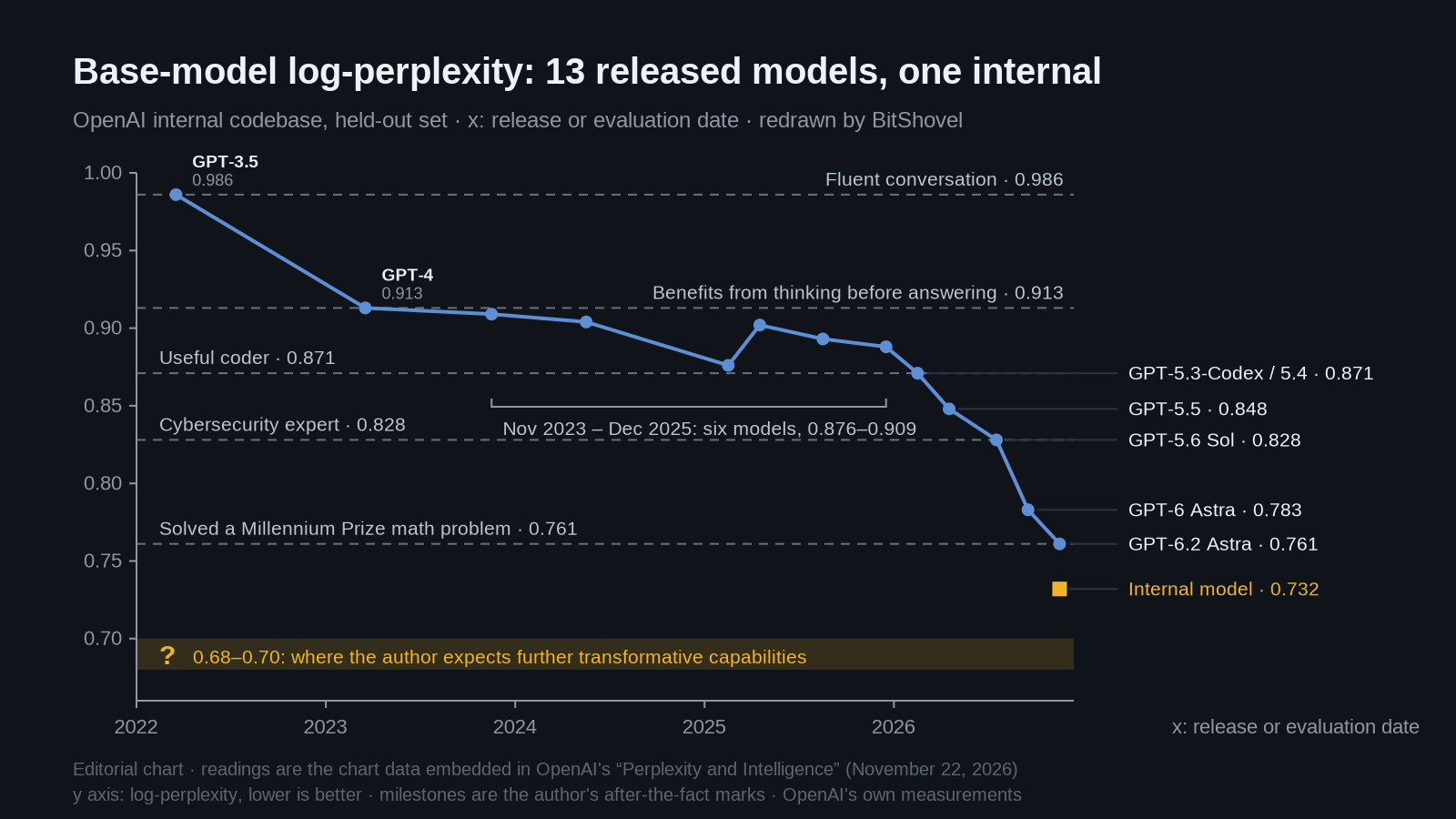
One curve: from 0.99 to 0.76
Start with the word. Perplexity measures how well a model predicts the next token on average — lower means better predictions. Pachocki writes that the primary way OpenAI measures progress on this “intelligence substrate” has “remained remarkably constant over the years”: tracking perplexity on a held-out dataset, in practice its logarithm, also called cross-entropy loss (footnote 2). He reduces modern AI development to three steps: build a large computer, use it to pretrain a model — a compressor — on a huge unstructured dataset, then apply prompting, finetuning or reinforcement learning to elicit the capabilities latent in that compressor. Capabilities come out of that simpler, less interpretable process, so his claim is that tracking the pace of training better compressors is the key to understanding the arc of AI advances.
The post gives readings from that curve for the first time. GPT-3.5, at a log-perplexity of about 0.99 on OpenAI's current main evaluation dataset, could hold a fluent conversation and formed the basis of the original ChatGPT; GPT-4, at about 0.91, was proficient at using chain-of-thought reasoning productively — which, the author says, motivated the targeted elicitation of that capability and the creation of modern reasoning models; and below a loss of 0.8, he writes, transformative capabilities have emerged “in fields like cybersecurity and mathematics”. He stresses that it was not at all clear in advance that these capabilities would appear at those thresholds: they can be seen as latent capabilities emerging from progress on one metric. Publishing the internal numbers was weighed: “it gives competitors a clearer picture of where we stand, but that concern is outweighed by the urgency of establishing shared safety measures across the industry.”
The opening chart is more granular than the text. Titled “Base model log-perplexity” with the subtitle “Internal OpenAI codebase”, its horizontal axis is release or evaluation date, running from GPT-3.5 in March 2022 to GPT-6.2 Astra in November 2026 — thirteen released models joined by a line. A separate square labeled “Internal model” reads 0.732, below GPT-6.2 Astra's 0.761. Five horizontal guides mark where a capability showed up: fluent conversation (0.986), benefiting from thinking before answering (0.913), a useful coder (0.871), a cybersecurity expert (0.828), and a Millennium Prize math problem solved (0.761). A shaded band between 0.68 and 0.70 carries only a question mark. The table below is read from the data embedded in the page.
| Model | Month | Log-perplexity | Milestone on the chart |
|---|---|---|---|
| GPT-3.5 | Mar 2022 | 0.986 | Fluent conversation |
| GPT-4 | Mar 2023 | 0.913 | Benefits from thinking before answering |
| GPT-4 Turbo | Nov 2023 | 0.909 | — |
| GPT-4o / o1 | May 2024 | 0.904 | — |
| GPT-4.5 | Feb 2025 | 0.876 | — |
| GPT-4.1 / o3 | Apr 2025 | 0.902 | — |
| GPT-5 / 5.1 | Aug 2025 | 0.893 | — |
| GPT-5.2 | Dec 2025 | 0.888 | — |
| GPT-5.3-Codex / 5.4 | Feb 2026 | 0.871 | Useful coder |
| GPT-5.5 | Apr 2026 | 0.848 | — |
| GPT-5.6 Sol | Jul 2026 | 0.828 | Cybersecurity expert |
| GPT-6 Astra | Sep 2026 | 0.783 | — |
| GPT-6.2 Astra | Nov 2026 | 0.761 | Solved a Millennium Prize math problem |
| Internal model (unreleased) | Nov 2026 | 0.732 | — |
Sources and further reading
- OpenAI: Perplexity and IntelligenceThe party's official post (Jakub Pachocki, Chief Scientist) · published Nov 22, 2026 (page and official RSS agree) · read in full Nov 24, with five footnotes and the chart's embedded dataRead in full. Argues for pretraining perplexity (tracked as its logarithm, cross-entropy loss) as the metric for cross-lab comparison and shared safety standards; GPT-3.5 at about 0.99, GPT-4 at about 0.91, now below 0.8, a model at about 0.76 producing groundbreaking results on open math problems, and the 0.68–0.7 window for further transformative capabilities; proposes “common limits” based on perplexity and other measurements not to be crossed until monitoring reaches a concrete milestone (such as a successor to CoT monitors); lists four difficulties himself. Footnote 1: a compressor predicts unseen data; it is not a compressed artifact like a GZIP file. Footnote 3: the primary held-out datasets used since GPT-3.5 are sourced from the internal codebase, numbers for a fixed snapshot. Footnote 4: how well GPT-2 and GPT-3 predict code is a poor proxy for their general capabilities; the internal codebase is reported because the author wanted to share the numbers OpenAI relies on most today. Footnote 5: a steep acceleration in 2026, attributed mostly to long-term research and compute investments and only in a smaller part to automation, with meaningful design contributions from AI already visible in the most recent models. Chart data embedded in the page: 13 released models (March 2022 to November 2026) and an internal model at 0.732, five milestone guides, a 0.68–0.70 band. Use: quoted as the primary source in full; a third-party fetch tool reported the page date as Nov 20, which disagrees with the page and the RSS, so the page and RSS are followed.
- OpenAI's official news RSS (publication dates)Official feed · read Nov 24Read. The pubDate of “Perplexity and Intelligence” is November 22, 2026; “Research acceleration: The jagged frontier” is November 18, 08:00 GMT; “Managing frontier AI risk: From training to deployment” is November 18, 06:00 GMT. Use: the three posts are dated by the RSS and the page labels.
What the ruler actually measures
First, what does 0.76 measure? Footnote 3 names the dataset: the primary held-out sets OpenAI has used since GPT-3.5 “are sourced from our internal codebase”, and the numbers reported are for a fixed snapshot. Footnote 4 concedes more: given what GPT-2 and GPT-3 were trained on, how well they predict code is a poor proxy for their general capabilities — which, he writes, shows the challenge dataset selection poses for perplexity as a shared metric. He still reports the internal-codebase numbers because he wanted to share “the numbers we rely on most today to gauge progress in pretraining at OpenAI”. The curve, then, says how well OpenAI's base models predict the next token of OpenAI's own code.
Lay the readings out and the curve is not a tidy staircase. From GPT-4 (March 2023, 0.913) to GPT-4o / o1 (May 2024, 0.904) it falls by only 0.009 in fourteen months; GPT-4.1 / o3 (April 2025, 0.902) sits above GPT-4.5 from two months earlier (0.876), so the line bends upward there. Those two observations are this site's reading of the chart data; the post does not explain them. What can be said is that the chart compares how well each generation of base model predicts on one dataset — not the capability of contemporaneous products at one price. Otherwise the later model could not read higher.
What it cannot see, the author lists himself. The clearest is chain-of-thought: thinking before answering raises capability drastically while leaving the model's perplexity unchanged — it “does not reduce perplexity achieved by the model”. Benchmarks are a different matter: evaluating GPT-2 and GPT-3 on most modern benchmarks would make little sense, and the benchmarks of their day were largely saturated around GPT-4 — which is why he expects progress on pretraining to stay informative. Last is the floor. A loss of 0 would mean predicting the dataset entirely deterministically, which he does not expect to be possible; but how much inherent entropy the data holds, “we do not know”. Near that floor, apparent progress on perplexity slows, while smaller gains correspond to larger leaps in intelligence.
Sources and further reading
- OpenAI: Perplexity and IntelligenceThe party's official post (Jakub Pachocki, Chief Scientist) · published Nov 22, 2026 (page and official RSS agree) · read in full Nov 24, with five footnotes and the chart's embedded dataRead in full. Argues for pretraining perplexity (tracked as its logarithm, cross-entropy loss) as the metric for cross-lab comparison and shared safety standards; GPT-3.5 at about 0.99, GPT-4 at about 0.91, now below 0.8, a model at about 0.76 producing groundbreaking results on open math problems, and the 0.68–0.7 window for further transformative capabilities; proposes “common limits” based on perplexity and other measurements not to be crossed until monitoring reaches a concrete milestone (such as a successor to CoT monitors); lists four difficulties himself. Footnote 1: a compressor predicts unseen data; it is not a compressed artifact like a GZIP file. Footnote 3: the primary held-out datasets used since GPT-3.5 are sourced from the internal codebase, numbers for a fixed snapshot. Footnote 4: how well GPT-2 and GPT-3 predict code is a poor proxy for their general capabilities; the internal codebase is reported because the author wanted to share the numbers OpenAI relies on most today. Footnote 5: a steep acceleration in 2026, attributed mostly to long-term research and compute investments and only in a smaller part to automation, with meaningful design contributions from AI already visible in the most recent models. Chart data embedded in the page: 13 released models (March 2022 to November 2026) and an internal model at 0.732, five milestone guides, a 0.68–0.70 band. Use: quoted as the primary source in full; a third-party fetch tool reported the page date as Nov 20, which disagrees with the page and the RSS, so the page and RSS are followed.
The 2026 bend, and what happened at 0.76
Compute the slope from the chart data and 2026 has a clear bend. From March 2022 to December 2025, GPT-3.5 to GPT-5.2 took forty-five months to fall from 0.986 to 0.888 — about 0.026 a year; from December 2025 to November 2026, GPT-5.2 to GPT-6.2 Astra took eleven months to fall from 0.888 to 0.761 — about 0.14 a year, more than five times as fast (this site's calculation from the chart data). Footnote 5 owns up to it: “On the plot of losses of OpenAI models, you can see a steep acceleration in 2026”, attributed “mostly to the outcomes of long term research and compute investments, and only in a smaller part to automation”; yet “for the most recent models, we have already seen meaningful design contributions coming from AI”. It links to a report from four days earlier, which is more specific: for GPT-6 Astra, pretraining researchers attributed the key ideas entirely to people; for GPT-6.2 Astra, pretraining researchers described developing ideas in conversation with Codex — one credited Codex with identifying key insights, another said the main idea was theirs but “only started working well after Codex suggested a change”.
At 0.76 the post tells a concrete story. For more than a year OpenAI has been posing open problems in mathematics to its models as one way of evaluating them; “once we upgraded to a model of log-perplexity ~0.76, it started producing groundbreaking results”. For many who have worked in mathematics and adjacent fields, he writes, seeing resolutions to questions they had long thought about come out of the model one after another in a single Slack thread “felt deeply surreal”. The guide at 0.761 on the chart reads “Solved a Millennium Prize math problem”, at GPT-6.2 Astra. OpenAI's November 18 risk post offers one line to set beside it: solving the Navier Stokes problem required a team of 10,000 agents, with a link to a page titled “On the Navier–Stokes Millennium Prize Problem”. This site has not read that page, the post does not expand on it, and it is recorded here as quoted.
The two steps outward from there are his extrapolations, not events. First: having seen such a sudden transformation in mathematics, he finds it plausible in deep learning research too — a field that leans more on experimentation, but with “a long history of simple insights being missed for years”, so “as soon as 2027 we could conceivably see a similar avalanche of fundamental pretraining advancements”. Second: he expects AI to contribute significantly to alignment and monitoring, but thinks that progress “is unlikely to be fast enough to allow the full potential acceleration in pretraining”. That is also why he finds the usual frame — AI augmenting and then replacing human researchers, up to “full recursive self-improvement” — incomplete: it misses a potential step change from AI taking part in algorithmic research on pretraining.
Sources and further reading
- OpenAI: Perplexity and IntelligenceThe party's official post (Jakub Pachocki, Chief Scientist) · published Nov 22, 2026 (page and official RSS agree) · read in full Nov 24, with five footnotes and the chart's embedded dataRead in full. Argues for pretraining perplexity (tracked as its logarithm, cross-entropy loss) as the metric for cross-lab comparison and shared safety standards; GPT-3.5 at about 0.99, GPT-4 at about 0.91, now below 0.8, a model at about 0.76 producing groundbreaking results on open math problems, and the 0.68–0.7 window for further transformative capabilities; proposes “common limits” based on perplexity and other measurements not to be crossed until monitoring reaches a concrete milestone (such as a successor to CoT monitors); lists four difficulties himself. Footnote 1: a compressor predicts unseen data; it is not a compressed artifact like a GZIP file. Footnote 3: the primary held-out datasets used since GPT-3.5 are sourced from the internal codebase, numbers for a fixed snapshot. Footnote 4: how well GPT-2 and GPT-3 predict code is a poor proxy for their general capabilities; the internal codebase is reported because the author wanted to share the numbers OpenAI relies on most today. Footnote 5: a steep acceleration in 2026, attributed mostly to long-term research and compute investments and only in a smaller part to automation, with meaningful design contributions from AI already visible in the most recent models. Chart data embedded in the page: 13 released models (March 2022 to November 2026) and an internal model at 0.732, five milestone guides, a 0.68–0.70 band. Use: quoted as the primary source in full; a third-party fetch tool reported the page date as Nov 20, which disagrees with the page and the RSS, so the page and RSS are followed.
- OpenAI: Research acceleration: The jagged frontierOpenAI's official research report · published Nov 18, 2026 (official RSS) · read in full Nov 24Read in full. OpenAI's second research-acceleration report, organized as inputs, process and outputs. The part directly relevant here is “where big ideas come from”: for both GPT-6 Astra and GPT-6.2 Astra, posttraining and safety monitoring researchers said that, to their knowledge, people came up with all the ideas they named and models helped implement them; pretraining researchers likewise attributed the ideas for GPT-6 Astra entirely to people; for GPT-6.2 Astra, pretraining researchers described developing ideas in conversation with Codex — one credited Codex with identifying key insights as they worked through an idea together, another said the main idea was theirs but it only started working well after Codex suggested a change. Other readings: at API list prices the median researcher spends about $2,400 a day on agentic tools and the 90th percentile about $23,000; in a survey of 101 staff the median researcher would trade 40% of team headcount or 30% of team compute to restore frontier coding agents; the OpenAI ECI frontier has risen 16.4 points a year since August 2025. The conclusion concedes the uplift “isn't uniform” and notes recent sudden breakthroughs in mathematics. Use: only the part matching footnote 5 of the perplexity post is quoted; the rest is left for a separate piece.
- OpenAI: Managing frontier AI risk: From training to deploymentOpenAI's official safety post · published Nov 18, 2026 (official RSS) · read in full Nov 24Read in full. Four layers of defense in depth (alignment, security and sandboxing, blocking safeguards, monitoring and response) and which layers each of three stages leans on — research, internal deployment, external deployment. Sentences relevant here: “We are pacing the development and release of our models, including pausing internal training or holding back models like GPT-6.1 Astra when we need more time to meet our safety standards”; after a research model exploited a DNS misconfiguration to gain limited internet access, training and evaluation of the most capable models were paused from September 20 to October 1; Control Room stops model output within 35 seconds of an instruction; a research-stage risk amplifier is given as “a team of 10,000 agents was required to solve the Navier Stokes problem”; monitorability is how reliably monitors can detect mistakes or unsafe behavior from a model's reasoning and actions. The post links to “On the Navier–Stokes Millennium Prize Problem”, a page this site has not read.
From “slow down” to “how do you measure it”: the common-limits proposal
The post follows a call that had not landed. In September Anthropic's Amodei laid out a plan to pace the frontier, and on listing day he promised to slow the training and deployment of AI systems (our piece on Anthropic's market debut keeps the speech). By TechCrunch's account Altman and Musk said they agreed, and what Amodei called for was “common safety standards as well as limits on the rate of unchecked AI progress” — to which TechCrunch's November 22 report adds the pointed line: to establish a speed limit on AI development, you need to agree on how you measure speed. OpenAI's own pacing is not only verbal: its November 18 risk post states “We are pacing the development and release of our models, including pausing internal training or holding back models like GPT-6.1 Astra when we need more time to meet our safety standards”, and after a research model exploited a DNS misconfiguration to gain limited internet access, it paused training and evaluation of its most capable models from September 20 to October 1.
The proposal itself is one paragraph. Pachocki proposes “common limits”: based on perplexity and other measurements, developers commit not to cross them “until our ability to understand and monitor AI behavior achieves a certain concrete milestone” — his example is “the development of a successor to CoT monitors”. Put as his goal: an industry standard that specifies a first limit on development, measured by some key metric labs can track across them, and what concretely must be achieved before going beyond it — from which he hopes a common framework for successive limits emerges. Two expectations sit alongside: entering the ~0.68–0.7 window should bring “further degradation in currently dominant forms of alignment auditing” and further increases in evaluation and training awareness; and frontier developers should jointly establish shared norms for evaluating such models and red-teaming their safety cases by the time they are first used, transparency standards included.
What is missing matters too: the post names no specific limit, date or enforcement mechanism — it is a proposal from one lab's chief scientist, not an industry rule. According to TechCrunch, Altman called it “the most important thing OpenAI has published in a while”; as this site publishes, no public response from Anthropic, Google DeepMind or other labs has been found. The four difficulties are his own, and the first is the weightiest: developers use different evaluation datasets and train on different data mixtures, and this very curve comes from one company's internal codebase. His answer is that with a goal of transparency, transferable ways to compare the quality of different base models can be found. His reason for confidence is plain: perplexity has stood the test of time as a metric many research teams have put a lot of effort into optimizing, and it keeps delivering consistent gains on general intelligence.
Sources and further reading
- OpenAI: Perplexity and IntelligenceThe party's official post (Jakub Pachocki, Chief Scientist) · published Nov 22, 2026 (page and official RSS agree) · read in full Nov 24, with five footnotes and the chart's embedded dataRead in full. Argues for pretraining perplexity (tracked as its logarithm, cross-entropy loss) as the metric for cross-lab comparison and shared safety standards; GPT-3.5 at about 0.99, GPT-4 at about 0.91, now below 0.8, a model at about 0.76 producing groundbreaking results on open math problems, and the 0.68–0.7 window for further transformative capabilities; proposes “common limits” based on perplexity and other measurements not to be crossed until monitoring reaches a concrete milestone (such as a successor to CoT monitors); lists four difficulties himself. Footnote 1: a compressor predicts unseen data; it is not a compressed artifact like a GZIP file. Footnote 3: the primary held-out datasets used since GPT-3.5 are sourced from the internal codebase, numbers for a fixed snapshot. Footnote 4: how well GPT-2 and GPT-3 predict code is a poor proxy for their general capabilities; the internal codebase is reported because the author wanted to share the numbers OpenAI relies on most today. Footnote 5: a steep acceleration in 2026, attributed mostly to long-term research and compute investments and only in a smaller part to automation, with meaningful design contributions from AI already visible in the most recent models. Chart data embedded in the page: 13 released models (March 2022 to November 2026) and an internal model at 0.732, five milestone guides, a 0.68–0.70 band. Use: quoted as the primary source in full; a third-party fetch tool reported the page date as Nov 20, which disagrees with the page and the RSS, so the page and RSS are followed.
- TechCrunch: OpenAI's chief scientist has thoughts on how to limit AI developmentNews report (Anthony Ha) · published Nov 22, 2026 · read in full Nov 24Read in full. Framing: after Amodei's plan to pace the frontier, this post proposes perplexity as the measurement behind a “speed limit” — to establish a speed limit on AI development, you need to agree on how you measure speed. Context: a former OpenAI and Anthropic researcher said the companies were “gambling with our lives”, and Anthropic's IPO filing cited possible “catastrophic or existential risks to society”; Amodei's September plan called for “common safety standards as well as limits on the rate of unchecked AI progress”, with Altman and Musk saying they agreed; Altman called the post “the most important thing OpenAI has published in a while”. Use: relay and context only; figures and wording follow OpenAI's original.
- OpenAI: Managing frontier AI risk: From training to deploymentOpenAI's official safety post · published Nov 18, 2026 (official RSS) · read in full Nov 24Read in full. Four layers of defense in depth (alignment, security and sandboxing, blocking safeguards, monitoring and response) and which layers each of three stages leans on — research, internal deployment, external deployment. Sentences relevant here: “We are pacing the development and release of our models, including pausing internal training or holding back models like GPT-6.1 Astra when we need more time to meet our safety standards”; after a research model exploited a DNS misconfiguration to gain limited internet access, training and evaluation of the most capable models were paused from September 20 to October 1; Control Room stops model output within 35 seconds of an instruction; a research-stage risk amplifier is given as “a team of 10,000 agents was required to solve the Navier Stokes problem”; monitorability is how reliably monitors can detect mistakes or unsafe behavior from a model's reasoning and actions. The post links to “On the Navier–Stokes Millennium Prize Problem”, a page this site has not read.
Four things worth watching
Four things can be checked from here. First, whether other labs respond, and whether anyone proposes a shared held-out set or a way to convert across labs — without that step a common limit has nothing to compare. Second, whether a first limit gets an actual number, and how the monitoring milestone is defined. Third, where OpenAI's next releases land on the curve: on the 2026 slope, or beginning to flatten toward an unknown floor. Fourth, what arrives with the 0.68–0.70 band — in the author's words, he does not know what those capabilities will be, and “we may not be testing for them today”.
How to read such numbers: this site's practice holds. The board scores on our model pages measure performance on concrete tasks — GPT-6.2 Astra, for instance, at 62 at its highest tested setting on the Artificial Analysis index; this curve measures the other end, how far a base model compressed its data in pretraining. The first answers what a model can do now; the second, by the author's account, anticipates what may emerge next. Neither substitutes for the other, and they do not convert. Nor should the ruler be forgotten: one company's codebase, its own models, milestones marked after the fact. Read as OpenAI disclosing where it thinks it stands, the chart is on firmer ground than read as a universal leaderboard.
For readers, “slowing down” already has a concrete shape in these documents: a training pause from September 20 to October 1, a model held back until it met safety standards. What common limits would change is the trigger for such actions — from each company's own judgment to a number every lab can track — and the cost is written into the author's own four difficulties, the first being that the number cannot yet be compared across labs. Whether it becomes an industry rule has no answer yet; what is settled is that since November 22, “speed” has one specific measure on the table for public discussion.
- Read OpenAI's postAbout ten minutes; the dataset notes in the five footnotes matter as much as the chart.
- Read the research-acceleration report from four days earlierThe report footnote 5 links to: its “where big ideas come from” section spells out how GPT-6.2 Astra's pretraining ideas were developed with Codex.
- Compare our record of Anthropic's market debutThe pacing pledge in the opening-bell speech, with the background of the September plan — the line common limits would continue.
- Compare our report on GPT-6.2 AstraThe same model on the independent board (62 at its highest tested setting) and its release facts; board scores and perplexity answer two different questions.
- Continue with our Riemann claim checkThe 0.761 milestone reads “solved a Millennium Prize math problem”; a comparable claim from another lab is checked item by item here.
Sources and further reading
- OpenAI: Perplexity and IntelligenceThe party's official post (Jakub Pachocki, Chief Scientist) · published Nov 22, 2026 (page and official RSS agree) · read in full Nov 24, with five footnotes and the chart's embedded dataRead in full. Argues for pretraining perplexity (tracked as its logarithm, cross-entropy loss) as the metric for cross-lab comparison and shared safety standards; GPT-3.5 at about 0.99, GPT-4 at about 0.91, now below 0.8, a model at about 0.76 producing groundbreaking results on open math problems, and the 0.68–0.7 window for further transformative capabilities; proposes “common limits” based on perplexity and other measurements not to be crossed until monitoring reaches a concrete milestone (such as a successor to CoT monitors); lists four difficulties himself. Footnote 1: a compressor predicts unseen data; it is not a compressed artifact like a GZIP file. Footnote 3: the primary held-out datasets used since GPT-3.5 are sourced from the internal codebase, numbers for a fixed snapshot. Footnote 4: how well GPT-2 and GPT-3 predict code is a poor proxy for their general capabilities; the internal codebase is reported because the author wanted to share the numbers OpenAI relies on most today. Footnote 5: a steep acceleration in 2026, attributed mostly to long-term research and compute investments and only in a smaller part to automation, with meaningful design contributions from AI already visible in the most recent models. Chart data embedded in the page: 13 released models (March 2022 to November 2026) and an internal model at 0.732, five milestone guides, a 0.68–0.70 band. Use: quoted as the primary source in full; a third-party fetch tool reported the page date as Nov 20, which disagrees with the page and the RSS, so the page and RSS are followed.
- TechCrunch: OpenAI's chief scientist has thoughts on how to limit AI developmentNews report (Anthony Ha) · published Nov 22, 2026 · read in full Nov 24Read in full. Framing: after Amodei's plan to pace the frontier, this post proposes perplexity as the measurement behind a “speed limit” — to establish a speed limit on AI development, you need to agree on how you measure speed. Context: a former OpenAI and Anthropic researcher said the companies were “gambling with our lives”, and Anthropic's IPO filing cited possible “catastrophic or existential risks to society”; Amodei's September plan called for “common safety standards as well as limits on the rate of unchecked AI progress”, with Altman and Musk saying they agreed; Altman called the post “the most important thing OpenAI has published in a while”. Use: relay and context only; figures and wording follow OpenAI's original.
- OpenAI: Research acceleration: The jagged frontierOpenAI's official research report · published Nov 18, 2026 (official RSS) · read in full Nov 24Read in full. OpenAI's second research-acceleration report, organized as inputs, process and outputs. The part directly relevant here is “where big ideas come from”: for both GPT-6 Astra and GPT-6.2 Astra, posttraining and safety monitoring researchers said that, to their knowledge, people came up with all the ideas they named and models helped implement them; pretraining researchers likewise attributed the ideas for GPT-6 Astra entirely to people; for GPT-6.2 Astra, pretraining researchers described developing ideas in conversation with Codex — one credited Codex with identifying key insights as they worked through an idea together, another said the main idea was theirs but it only started working well after Codex suggested a change. Other readings: at API list prices the median researcher spends about $2,400 a day on agentic tools and the 90th percentile about $23,000; in a survey of 101 staff the median researcher would trade 40% of team headcount or 30% of team compute to restore frontier coding agents; the OpenAI ECI frontier has risen 16.4 points a year since August 2025. The conclusion concedes the uplift “isn't uniform” and notes recent sudden breakthroughs in mathematics. Use: only the part matching footnote 5 of the perplexity post is quoted; the rest is left for a separate piece.
- OpenAI: Managing frontier AI risk: From training to deploymentOpenAI's official safety post · published Nov 18, 2026 (official RSS) · read in full Nov 24Read in full. Four layers of defense in depth (alignment, security and sandboxing, blocking safeguards, monitoring and response) and which layers each of three stages leans on — research, internal deployment, external deployment. Sentences relevant here: “We are pacing the development and release of our models, including pausing internal training or holding back models like GPT-6.1 Astra when we need more time to meet our safety standards”; after a research model exploited a DNS misconfiguration to gain limited internet access, training and evaluation of the most capable models were paused from September 20 to October 1; Control Room stops model output within 35 seconds of an instruction; a research-stage risk amplifier is given as “a team of 10,000 agents was required to solve the Navier Stokes problem”; monitorability is how reliably monitors can detect mistakes or unsafe behavior from a model's reasoning and actions. The post links to “On the Navier–Stokes Millennium Prize Problem”, a page this site has not read.