Models and verification
A Riemann claim arrives: 17.4 million lines of Lean to check, and the independent verdict isn't in yet
On November 20 Anthropic mathematician Levent Alpöge published a four-page statement: he believes he has, working with Claude, discovered a proof of the Riemann Hypothesis, in a method that extends to the Generalized Riemann Hypothesis (GRH) and, with more time, the Extended Riemann Hypothesis. Unlike past "the AI says it did it" moments, this one ships with a Lean formalization — 14 archive parts of about 1.03GB of source, 175,187 files, 17.37 million lines (15.53 million non-blank), a static scan finding no axiom, no sorry and no unsafe constructs; several independent parties completed builds, one reporting a full pass in 2.4 hours on a 480-core machine, and MIT's Andrew Sutherland published a checksum manifest of all 175,187 compiled files. The Lean community then set up an independent verification repository with a four-step comparator pipeline (build and export on v4.33.1, judged by an independent kernel on v4.36.0, in a network-isolated sandbox) — at our check on the morning of November 22 the repository's Results section still reads "build in progress"; the correspondence of the top-level statement was read by hand (Mathlib's RiemannHypothesis definition, excluding trivial zeros and s=1; Dedekind zeta out of scope). The same day, Terence Tao listed three AI-involved results in decreasing order of digestion: an Euler blowup proof (human-readable plus Lean), a Navier-Stokes blowup proof (Lean formalized, writing to be polished), and this GRH; Stanford postdoc Alessandro Masullo also released an all-human GRH draft the same day via a post by Ravi Vakil (Brian Conrad has examined it for months; an eight-hour update already lists issues found). Background: Anthropic's own August post disclosed that an unreleased research Claude raised the lower bound on the share of zeros on the critical line from 41.6% to 67.2% — explicitly not a proof — and Alpöge was one of its reviewers. Boundaries: a claim is not a proof and not a completed verification; compiling is not the independent verdict; Anthropic has issued no separate public statement on this claim; this site compiled and verified nothing.
This account draws on Alpöge's own statement PDF (4 pages, downloaded and read in full on November 22, its sha256 matching the anchor recorded in the Lean community's verification repository), the verification repo's README and verification/NOTES.md (read the morning of November 22, latest commit 00:05Z that day), Terence Tao's November 20 post, Scientific American and TechCrunch reporting, Vakil's relay of Masullo's announcement, and Anthropic's official August 10 post — all read in full. Claim, compile reports and verdict status are different layers, kept apart throughout; this site compiled and verified nothing.
A four-page statement, and the way it chose to arrive
On November 20, Anthropic mathematician Levent Alpöge posted a four-page PDF on his personal site whose first sentences are the conclusion: "I believe I have, working with Claude, discovered a proof of the Riemann Hypothesis." The method, he writes, "easily extends much further", already resolving the Generalized Riemann Hypothesis (GRH), and he expects it to reach the Extended Riemann Hypothesis with more time; he and Claude "have also formalized the arguments without assumptions". Conjectured in 1859, the Riemann Hypothesis asks whether a hidden structure governs the primes; it is one of the Clay Institute's million-dollar Millennium Problems, and GRH covers Dirichlet L-functions, whose truth would validate a vast body of conditional mathematics. This is not the first AI math claim, but what ships with it is different: a 14-part Lean formalization, not a paper.
The way it was released is itself information. Alpöge writes that he is handing the world a complete argument "before having mastered a massive neighbourhood around its mathematics" — a true write-up would run about 250,000 pages, which he calls an unreadable "slop", "obviously inappropriate to attempt to post, so I decided to only present Lean". He calls the timing, in his own words, horrible: late Sunday he messaged CEO Dario Amodei ("Hypothetically, if I were to have …"), the leadership and a few trusted mathematicians agreed, and he admits he "could not live" if he waited longer — the same week Anthropic became the first publicly traded frontier AI lab. He anticipates the obvious cynical reading and calls it false, "and I am pleased that I am in circumstances where it is obviously false". These are the author's own words and motives cannot be verified from outside — but the release process itself (internal consultation, the Lean-only choice, the openly downloadable PDF) is all on the record.
Sources and further reading
- Alpöge's own statement: remark.pdf (4 pages)Primary statement · published November 20, 2026 · downloaded and read in full November 22Read in full; sha256 3fc97784…feb8d matches the value recorded in the Lean community's verification repo. Core sentences: "I believe I have, working with Claude, discovered a proof of the Riemann Hypothesis. In fact, the method easily extends much further, resolving the so-called Generalized Riemann Hypothesis, and I expect, with more time, the Extended Riemann Hypothesis too. Claude and I have also formalized the arguments without assumptions." Process narrative: decades of planning since student days, months of working with Claude recently, "Claude flew, and danced, and sparkled near that finish line"; the worked example is the multiplicity in Stepanov's argument over function fields, where Claude suggested a theta-lift chain of length √X. The release decision: a late-Sunday message to Dario ("Hypothetically, if I were to have …"), leadership and a few trusted mathematicians in agreement, and his own admission that he "could not live" if he waited longer; explicitly "presenting the world with a complete argument before having mastered a massive neighbourhood around its mathematics", and because posting a 250,000-page unreadable "slop" would be inappropriate, Lean only. The Lean formalization is 14 tarball parts (alpo.ge/lean.tar.gz.part01–14). A 20-item timeline from October 6 to November 16 is appended (the November 16 entry is GRH); thanks and praise for the taste of OpenAI's math people (the Erhart conjecture, the Stegel argument) share the page.
- Scientific American: Anthropic Mathematician Claims to Prove Riemann Hypothesis…Press report · November 20–21, 2026 · read in full November 22Read in full. Before compiling, Sutherland's old line: "An AI that can prove the Riemann hypothesis is not one I'd want to meet." After the independent build: "This is indeed an historic moment… The world has changed.", calling it "a human triumph, and a day for celebration", with the most important step "building a machine that can think", and processing the milestone "is going to take some time". The report threads this year together: OpenAI's October math dump, Alpöge's July Claude-generated Jacobian conjecture solution, and September's Navier-Stokes contest with OpenAI. Other reactions: Chilean mathematician Hector Pasten likens the proof to a "Rosetta Stone" connecting branches of math; Carlo Pagano (Concordia/DeepMind) expects the new ideas to open brand-new avenues in number theory. The piece carries no Clay Mathematics Institute statement, only the $1M bounty, and no Anthropic company statement — the only source is Alpöge's personal statement.
- TechCrunch: AI claimed a solution to the 167-year-old Riemann hypothesis — and a human did, tooPress report · published November 20, 2026 19:32Z · updated 22:51Z · read in full November 22Read in full. The update note: "updated to include that Alpöge's Lean proof has been checked by independent sources." Context and people: Alpöge works at Anthropic, the same week it became the first publicly traded frontier AI lab; "the precise timing is horrible" is his own line. The community portrait: a technical Zulip comment by Chris Birkbeck, a number theorist at the University of East Anglia (an automorphy-lifting argument and a chain of names — Galois representations, base change, Clozel's purity, the main theorem of CM), drew twenty 🤯 reactions; MIT's Andrew Sutherland and several others say they confirmed Alpöge's solution compiles; "most appear confident that the formalized Lean result will hold". It also records the other important proof Alpöge released with NYU's Tristan Buckmaster related to the Navier-Stokes equations. The sentence most useful for readers: whether it holds "will take a while before the mathematics community feels like it has a handle on the proof" — and Alpöge has committed to pursuing that understanding.
- IT Home: AI cracks the Riemann hypothesis? Anthropic mathematician claims proof with ClaudePress report (Chinese reference) · November 20, 2026 · read in full November 22Read in full as the Chinese entry point: relays the Scientific American caliber, carrying the translated core sentence "I believe that I, working with Claude, have found a proof of the Riemann Hypothesis", the 1859 background, the October OpenAI math-results prelude (one proof described as a major step on prime distribution), an explanation of Lean, the GRH extension claim, and the closing quotes about losing "an important guiding light" and glimpsing "the miracles of the future". The relay adds no new factual checkpoints and is read alongside the English primaries.
What machines have checked: the static scan, independent builds, and a verdict in progress
The Lean library's size earns the word enormous first: by the Lean community repo's count, the 14 parts join into about 1.03GB of source across 175,187 .lean files and 17.37 million lines (15.53 million non-blank), with not a single comment line; 818,755 theorem/lemma declarations and 242,067 definition-class declarations, every file inside Main's import closure. The static scan is the first rung: the whole tree contains no axiom, sorry, admit, native_decide, unsafe, opaque or skipKernelTC — no shortcut channel of any kind — and no file I/O, process spawning or environment reads. "A text search is not a proof", says NOTES verbatim, but the crudest openings are ruled out first.
The second rung is independent compilation — Lean's kernel checks every declaration, so a passing build is machine-checked. Several independent parties completed builds: HN user hafeoz reports 2.4 hours on a 480-core Xeon producing 89GB of compilation output, all 175,187 modules passing on Lean 4.33.1 with no errors and no sorry (about 460k linter warnings, mostly style; he self-notes that he "hasn't checked the actual axiom being proved"); another user finished in under a day on one DGX Spark; MIT's Andrew Sutherland published a checksum manifest of all 175,187 compiled files, and two third-party builds plus sampled recompiles all match it. One detail deserves honesty: the library's metaprogramming tactics kexactB/kcopy assign terms to goals without the elaborator checking the type match — NOTES judges this "still sound, because the kernel checks every declaration", and "it is the reason this repository re-checks the exported proof with independent kernels".
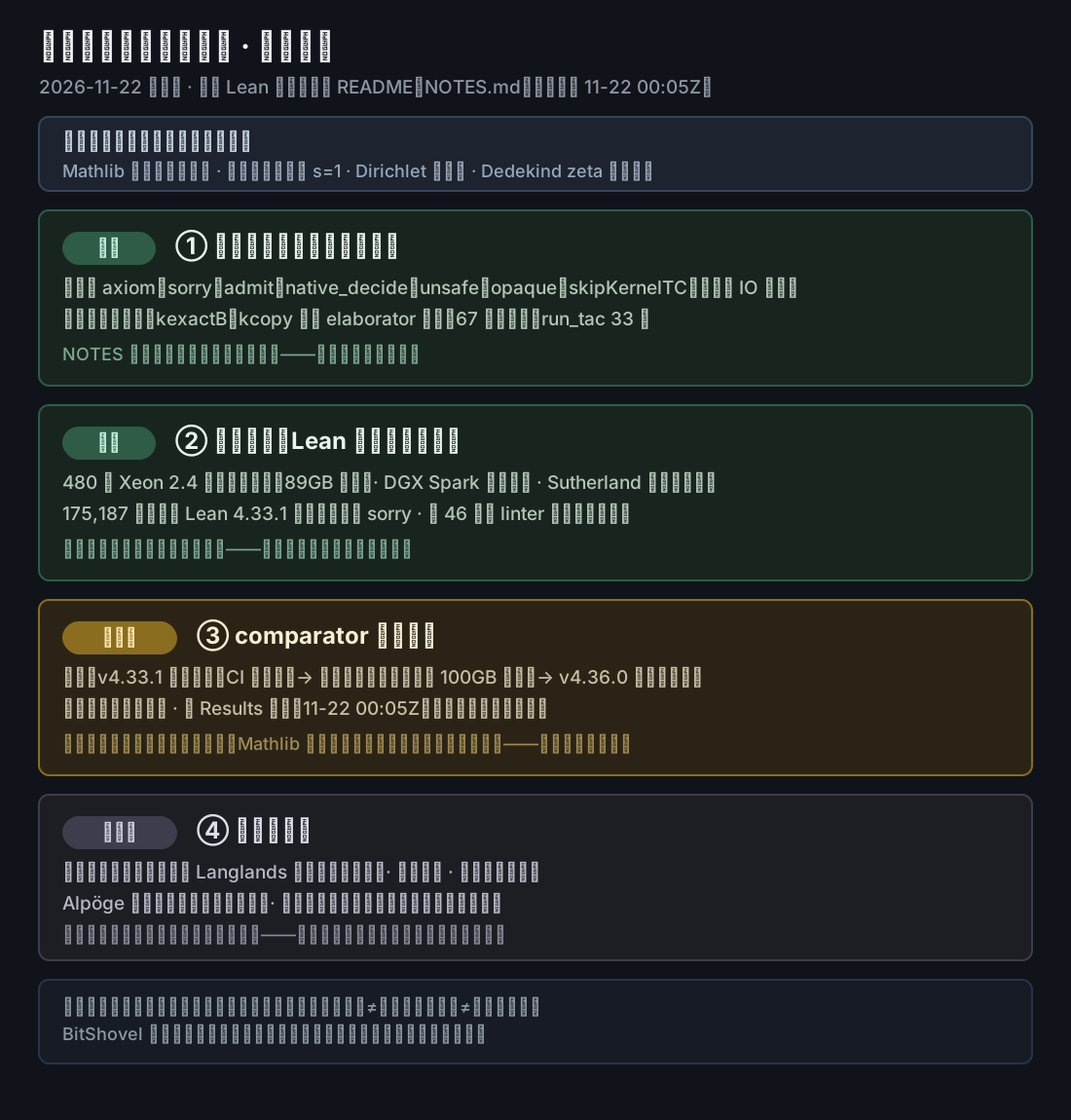
The third rung is the verdict that has not landed. On GitHub, the Lean community built the verification repo riemann-hypothesis: the official submission mirrored unmodified, "for verification only", with a README that never claims the proof is verified. Its comparator pipeline has four steps — export the "challenge" (known mathematics, pinned to official Mathlib v4.33.1) from a clean clone, build the submitted solution inside a network-isolated sandbox ("takes hours"), export the solution, then judge the two with an independent kernel updated to 4.36.0 (hours on a large machine, about 100GB of disk). The challenge export is already reproduced on GitHub CI (exports from two directories share one sha256), and the solution export has been reproduced once; but at this site's read on the morning of November 22 (latest commit 00:05Z), the Results section still reads: "The build is in progress. The exports' checksums, Comparator's output, the exact command lines and the machine details will be added to this folder." Until that lands, "it compiles" and "the claim has been independently judged to correspond" remain two different things.
Sources and further reading
- The Lean community's independent verification repo: riemann-hypothesisCommunity verification record · established from November 20, 2026 · read the morning of November 22 (README plus verification/NOTES.md; latest commit 00:05Z)README and NOTES.md read in full. Positioning: an unmodified mirror of the official submission, "for verification only", and the README never claims the proof is verified. Size: 175,187 .lean files, 1,030,531,854 bytes, 17,374,215 lines (15,531,759 non-blank), no comments; 818,755 theorem/lemma declarations and 242,067 def/abbrev/structure/class/instance/inductive. Static scan: no axiom, sorry, admit, native_decide, implemented_by, extern, unsafe, opaque, debug option or skipKernelTC; all notation local/scoped; no file reads/writes, processes or environment access. But there is metaprogramming: kexactB and kcopy assign terms to goals without the elaborator checking the type match (used across 67 files and elsewhere), and run_tac appears 33 times — "for proofs made this way the elaborator has not checked the term against the goal, so the kernel is the only check. That is sound, because the kernel checks every declaration, and it is the reason this repository re-checks the exported proof with independent kernels." Statements: Main.lean proves riemannHypothesis as Formalism.VW.rh_of_every allChi, where allChi says no Dirichlet L-function vanishes for Re s > 1/2, with the standard functional-equation argument through Mathlib's lemmas reaching the critical line; the statements were read by hand — Mathlib's RiemannHypothesis excludes the trivial zeros −2(n+1) and s=1; the Dirichlet statements quantify over every modulus and character, imprimitive included; every 1/2 is compared with s.re (real division); Dedekind zeta and other L-functions are not covered. Compile checks: Sutherland's project-oleans.sha256 manifest can be compared in full only by a build at the same path; ishaan2006's complete build differs on 98,219 of 175,187 files, every differing file containing that build's own path, with 76,968 identical and Main.olean identical; recompiles at Sutherland's path all match the manifest. Exports: the challenge export is reproduced on GitHub CI (Ticobit's exports from two directories share the README's sha256); the solution export has been reproduced once; none of these builds was sandboxed. The Limits section, verbatim in substance: the comparator checks challenge and solution against the same Mathlib so it cannot detect a modified Mathlib (this repo pins the official v4.33.1 tag); exports are made by 4.33.1 and judged by 4.36.0 (listed as an intended use, same format version 3.1.0, but not the common path); "a passing run still trusts the checkers, Mathlib's definitions, Mathlib's official build cache, the exporter, and the sandboxes". The Results section, verbatim: "The build is in progress. The exports' checksums, Comparator's output, the exact command lines and the machine details will be added to this folder."
- Anthropic's official research post (background): Learning more about Claude's mathematical capabilitiesCompany post · August 10, 2026 · read in full November 22Read in full as background. An unreleased research version of Claude, challenged to attack the Riemann hypothesis head-on, produced an unintended byproduct: it raised the lower bound on the share of zeros on the critical line from 41.6% to 67.2% (combining recent work — Aryan; Baluyot, Goldston, Suriajaya, Turnage-Butterbaugh — that lets Montgomery's 1973 pair-correlation techniques run without assuming RH, plus Bombieri's 2000 paper). The company's explicit caliber: "We don't expect that the techniques Claude used will lead to proving the Riemann hypothesis." Process: staff member Jarred Sumner (not a mathematician) issued the challenge; Claude tried 650 ideas unsuccessfully, then spent a day and a half coordinating about 60 subagents, running 2,400 shell commands across two Claude Code sessions for a total of 31 million output tokens, with human input "mostly limited to sending Claude messages of encouragement". Validation: Anthropic mathematicians Levent Alpöge and Ralph Furman reviewed the paper, with external experts Brian Conrey and Dan Goldston examining it; Claude produced a Lean formalization passing the standard validation tool comparator and checked novelty against 54 arXiv papers. August's result and November's claim share one problem area and one reviewer — in three months the work moved from improving a bound to claiming a proof, while the company's public material still stops at the August post.
What is not yet verified: the top-level statement, the trust boundary, and the million dollars
For "the Riemann Hypothesis is proven" to hold, a big compilable library is not enough; two things must still be checked: whether the library's top-level statement is the Riemann Hypothesis itself, and whether the verdict passes. The first now has a manual answer: the verification repo read each top-level statement against Mathlib's definitions — Main.lean proves riemannHypothesis as rh_of_every allChi, where allChi says no Dirichlet L-function vanishes for Re s > 1/2, with the standard functional-equation argument through Mathlib's lemmas reaching the critical line; Mathlib's RiemannHypothesis excludes the trivial zeros −2(n+1) and the s=1 exception; the statements quantify over every modulus and character, imprimitive included; "every 1/2 is compared with s.re" (real division); Dedekind zeta and other L-functions are out of scope. The HN thread's worry — check the top-level statement first — and the reply that it uses Mathlib's human-reviewed definitions correspond exactly to this step.
The second has no answer yet, and NOTES is unambiguous about what remains even after a pass: the comparator checks the challenge and solution against the same Mathlib, so it cannot detect a modified Mathlib (this repo pins the official v4.33.1 tag, and the challenge export is reproduced on GitHub CI); exports are made by 4.33.1 and judged by 4.36.0 — listed as an intended use with the same format version, "but this is not the common path"; and "a passing run still trusts the checkers, Mathlib's definitions, Mathlib's official build cache, the exporter, and the sandboxes." That is not cold water; it is the trust chain of verification laid out — every link can be independently re-checked, and every link needs someone to check it. Terence Tao frames the bigger picture: initial analysis suggests the proof "appears to use the full power of modern developments on the Langlands program and arithmetic geometry"; the moderators have focused the Zulip discussion on Lean-related aspects only, and "I imagine the digestion process will take some time, though in this case at least we have a human author to communicate with".
The million dollars is not on today's horizon. By Scientific American's caliber, even if everything holds, claiming the Clay prize still takes "years" — the rules require the result to be published and accepted by the community for over two years, and this Lean-only form has not even entered traditional publication. What Alpöge promises at the end of his statement is exactly the missing middle: he will do his best "to understand and impart understanding of this argument and its certain simplifications, to speak about it, to write it properly". Sutherland's words after compiling echo it: "This is indeed an historic moment… The world has changed", calling it "a human triumph, and a day for celebration" — while his pre-compile line sits in the same report: "An AI that can prove the Riemann hypothesis is not one I'd want to meet."
- The Clay Institute's official problem description
- Read Tao's ordering and framing of the three results
Sources and further reading
- The Lean community's independent verification repo: riemann-hypothesisCommunity verification record · established from November 20, 2026 · read the morning of November 22 (README plus verification/NOTES.md; latest commit 00:05Z)README and NOTES.md read in full. Positioning: an unmodified mirror of the official submission, "for verification only", and the README never claims the proof is verified. Size: 175,187 .lean files, 1,030,531,854 bytes, 17,374,215 lines (15,531,759 non-blank), no comments; 818,755 theorem/lemma declarations and 242,067 def/abbrev/structure/class/instance/inductive. Static scan: no axiom, sorry, admit, native_decide, implemented_by, extern, unsafe, opaque, debug option or skipKernelTC; all notation local/scoped; no file reads/writes, processes or environment access. But there is metaprogramming: kexactB and kcopy assign terms to goals without the elaborator checking the type match (used across 67 files and elsewhere), and run_tac appears 33 times — "for proofs made this way the elaborator has not checked the term against the goal, so the kernel is the only check. That is sound, because the kernel checks every declaration, and it is the reason this repository re-checks the exported proof with independent kernels." Statements: Main.lean proves riemannHypothesis as Formalism.VW.rh_of_every allChi, where allChi says no Dirichlet L-function vanishes for Re s > 1/2, with the standard functional-equation argument through Mathlib's lemmas reaching the critical line; the statements were read by hand — Mathlib's RiemannHypothesis excludes the trivial zeros −2(n+1) and s=1; the Dirichlet statements quantify over every modulus and character, imprimitive included; every 1/2 is compared with s.re (real division); Dedekind zeta and other L-functions are not covered. Compile checks: Sutherland's project-oleans.sha256 manifest can be compared in full only by a build at the same path; ishaan2006's complete build differs on 98,219 of 175,187 files, every differing file containing that build's own path, with 76,968 identical and Main.olean identical; recompiles at Sutherland's path all match the manifest. Exports: the challenge export is reproduced on GitHub CI (Ticobit's exports from two directories share the README's sha256); the solution export has been reproduced once; none of these builds was sandboxed. The Limits section, verbatim in substance: the comparator checks challenge and solution against the same Mathlib so it cannot detect a modified Mathlib (this repo pins the official v4.33.1 tag); exports are made by 4.33.1 and judged by 4.36.0 (listed as an intended use, same format version 3.1.0, but not the common path); "a passing run still trusts the checkers, Mathlib's definitions, Mathlib's official build cache, the exporter, and the sandboxes". The Results section, verbatim: "The build is in progress. The exports' checksums, Comparator's output, the exact command lines and the machine details will be added to this folder."
- Terence Tao's post: Unforced Euler singularity, unforced Navier-Stokes singularity, and the Generalized Riemann HypothesisFirst-hand mathematician's post · November 20, 2026 · read in full November 22Read in full. Three results in decreasing order of digestion: (1) Alpöge, Buckmaster and Coiculescu, with heavy AI assistance, wrote a human-readable proof of finite-time blowup for the unforced incompressible Euler equations in three dimensions, formalized in Lean on GitHub (mcoiculescu/EulerBlowupPublic); (2) Alpöge and Buckmaster, again with heavy AI usage, generated a proof of finite-time blowup for the unforced incompressible Navier-Stokes equations with a Lean formalization (tristanbuckmaster/navier-stokes) — "technically human-readable and the general strategy of proof is broadly clear (following the expected path of numerically building an approximate discretely self-similar solution and then using rigorous perturbation theory to convert it to an exact solution), but more work needs to be done to create a proper, professionally written proof"; (3) "Levent Alpöge, using an internal AI model, has generated an (enormous) Lean-only proof of the Generalized Riemann Hypothesis" — verification and strategy extraction are best followed on the Lean Zulip thread, and "from very initial analysis, appears to use the full power of modern developments on the Langlands program and arithmetic geometry"; the moderators now focus the discussion on Lean-related aspects only, and "I imagine the digestion process will take some time, though in this case at least we have a human author to communicate with to assist with this task". Note the caliber gap: Alpöge writes "working with Claude", Tao writes "an internal AI model" — both are kept side by side without being merged; Alpöge's statement PDF itself admits some names in his acknowledgments were accidentally omitted (including Sarnak).
- Scientific American: Anthropic Mathematician Claims to Prove Riemann Hypothesis…Press report · November 20–21, 2026 · read in full November 22Read in full. Before compiling, Sutherland's old line: "An AI that can prove the Riemann hypothesis is not one I'd want to meet." After the independent build: "This is indeed an historic moment… The world has changed.", calling it "a human triumph, and a day for celebration", with the most important step "building a machine that can think", and processing the milestone "is going to take some time". The report threads this year together: OpenAI's October math dump, Alpöge's July Claude-generated Jacobian conjecture solution, and September's Navier-Stokes contest with OpenAI. Other reactions: Chilean mathematician Hector Pasten likens the proof to a "Rosetta Stone" connecting branches of math; Carlo Pagano (Concordia/DeepMind) expects the new ideas to open brand-new avenues in number theory. The piece carries no Clay Mathematics Institute statement, only the $1M bounty, and no Anthropic company statement — the only source is Alpöge's personal statement.
The same week: two blowup proofs, and an all-human GRH draft
GRH is not the only heavyweight this week. Terence Tao's November 20 post orders three results by how digested they are: finite-time blowup for the unforced incompressible Euler equations in 3D, human-readable and formalized in Lean (Alpöge, Buckmaster, Coiculescu); finite-time blowup for the unforced incompressible Navier-Stokes equations, also with a Lean formalization, "technically human-readable and the general strategy broadly clear", though "more work needs to be done to create a proper, professionally written proof"; and only then this Lean-only GRH — explicitly the least digested of the three. A Navier-Stokes blowup, if it holds, is Millennium-Problem-class in its own right; Tao's visibly higher confidence in the first two is itself information.
The same day brought a claim in the opposite direction. Ravi Vakil, Stanford professor and AMS president, relayed on his blog a draft proof of GRH by postdoc Alessandro Masullo — "all human, with no AI", twelve years of work; the plan had been to polish it for another year and announce after enough review, but "now it seems best to put out the current draft". Brian Conrad "has been looking closely at it for months", his feedback being incorporated; Vakil wrote hastily from an AMS meeting, and eight hours later updated: several people flagged issues, "all issues need to be resolved to the satisfaction of the community before this proof would be accepted as true", with the explicit disclaimer "I make no claim as to the correctness of the proof strategy". The most telling detail: the problems found were "identified with the assistance of different AI models". Two claims, opposite directions — and AI present in both: one has the machine produce a proof humans have not yet read; the other has a human produce a proof while machines help find the flaws.
That the two GRH drafts landed the same day is no coincidence — Vakil's title "Hurried Announcement" admits the rush, and TechCrunch's headline frames it as "AI claimed a solution — and a human did, too". The more practical contrast for readers is the order of checking: Masullo's draft has no Lean formalization yet (formalization is raised only as a hope), so its fate rests with human readers; Alpöge's library has already cleared the machine's first two rungs and is stuck at the third, the verdict. One passes the machines first and waits for humans; the other waits for humans before machines can even start — the same hard problem, two complementary verification paths, unfolding in the same week.
- Read Vakil's relay of Masullo's announcement
- See the Euler blowup Lean formalization (the most digested of the three)
Sources and further reading
- The Lean community's independent verification repo: riemann-hypothesisCommunity verification record · established from November 20, 2026 · read the morning of November 22 (README plus verification/NOTES.md; latest commit 00:05Z)README and NOTES.md read in full. Positioning: an unmodified mirror of the official submission, "for verification only", and the README never claims the proof is verified. Size: 175,187 .lean files, 1,030,531,854 bytes, 17,374,215 lines (15,531,759 non-blank), no comments; 818,755 theorem/lemma declarations and 242,067 def/abbrev/structure/class/instance/inductive. Static scan: no axiom, sorry, admit, native_decide, implemented_by, extern, unsafe, opaque, debug option or skipKernelTC; all notation local/scoped; no file reads/writes, processes or environment access. But there is metaprogramming: kexactB and kcopy assign terms to goals without the elaborator checking the type match (used across 67 files and elsewhere), and run_tac appears 33 times — "for proofs made this way the elaborator has not checked the term against the goal, so the kernel is the only check. That is sound, because the kernel checks every declaration, and it is the reason this repository re-checks the exported proof with independent kernels." Statements: Main.lean proves riemannHypothesis as Formalism.VW.rh_of_every allChi, where allChi says no Dirichlet L-function vanishes for Re s > 1/2, with the standard functional-equation argument through Mathlib's lemmas reaching the critical line; the statements were read by hand — Mathlib's RiemannHypothesis excludes the trivial zeros −2(n+1) and s=1; the Dirichlet statements quantify over every modulus and character, imprimitive included; every 1/2 is compared with s.re (real division); Dedekind zeta and other L-functions are not covered. Compile checks: Sutherland's project-oleans.sha256 manifest can be compared in full only by a build at the same path; ishaan2006's complete build differs on 98,219 of 175,187 files, every differing file containing that build's own path, with 76,968 identical and Main.olean identical; recompiles at Sutherland's path all match the manifest. Exports: the challenge export is reproduced on GitHub CI (Ticobit's exports from two directories share the README's sha256); the solution export has been reproduced once; none of these builds was sandboxed. The Limits section, verbatim in substance: the comparator checks challenge and solution against the same Mathlib so it cannot detect a modified Mathlib (this repo pins the official v4.33.1 tag); exports are made by 4.33.1 and judged by 4.36.0 (listed as an intended use, same format version 3.1.0, but not the common path); "a passing run still trusts the checkers, Mathlib's definitions, Mathlib's official build cache, the exporter, and the sandboxes". The Results section, verbatim: "The build is in progress. The exports' checksums, Comparator's output, the exact command lines and the machine details will be added to this folder."
- Terence Tao's post: Unforced Euler singularity, unforced Navier-Stokes singularity, and the Generalized Riemann HypothesisFirst-hand mathematician's post · November 20, 2026 · read in full November 22Read in full. Three results in decreasing order of digestion: (1) Alpöge, Buckmaster and Coiculescu, with heavy AI assistance, wrote a human-readable proof of finite-time blowup for the unforced incompressible Euler equations in three dimensions, formalized in Lean on GitHub (mcoiculescu/EulerBlowupPublic); (2) Alpöge and Buckmaster, again with heavy AI usage, generated a proof of finite-time blowup for the unforced incompressible Navier-Stokes equations with a Lean formalization (tristanbuckmaster/navier-stokes) — "technically human-readable and the general strategy of proof is broadly clear (following the expected path of numerically building an approximate discretely self-similar solution and then using rigorous perturbation theory to convert it to an exact solution), but more work needs to be done to create a proper, professionally written proof"; (3) "Levent Alpöge, using an internal AI model, has generated an (enormous) Lean-only proof of the Generalized Riemann Hypothesis" — verification and strategy extraction are best followed on the Lean Zulip thread, and "from very initial analysis, appears to use the full power of modern developments on the Langlands program and arithmetic geometry"; the moderators now focus the discussion on Lean-related aspects only, and "I imagine the digestion process will take some time, though in this case at least we have a human author to communicate with to assist with this task". Note the caliber gap: Alpöge writes "working with Claude", Tao writes "an internal AI model" — both are kept side by side without being merged; Alpöge's statement PDF itself admits some names in his acknowledgments were accidentally omitted (including Sarnak).
- TechCrunch: AI claimed a solution to the 167-year-old Riemann hypothesis — and a human did, tooPress report · published November 20, 2026 19:32Z · updated 22:51Z · read in full November 22Read in full. The update note: "updated to include that Alpöge's Lean proof has been checked by independent sources." Context and people: Alpöge works at Anthropic, the same week it became the first publicly traded frontier AI lab; "the precise timing is horrible" is his own line. The community portrait: a technical Zulip comment by Chris Birkbeck, a number theorist at the University of East Anglia (an automorphy-lifting argument and a chain of names — Galois representations, base change, Clozel's purity, the main theorem of CM), drew twenty 🤯 reactions; MIT's Andrew Sutherland and several others say they confirmed Alpöge's solution compiles; "most appear confident that the formalized Lean result will hold". It also records the other important proof Alpöge released with NYU's Tristan Buckmaster related to the Navier-Stokes equations. The sentence most useful for readers: whether it holds "will take a while before the mathematics community feels like it has a handle on the proof" — and Alpöge has committed to pursuing that understanding.
- Vakil (Math 216 blog): Hurried Announcement — relaying Masullo's GRH draftFirst-hand mathematician's post (relay) · November 20, 2026 · read in full November 22Read in full. Authored by Ravi Vakil (Stanford professor and AMS president), relaying Stanford postdoc Alessandro Maria Masullo's GRH proof draft. Key points: Brian Conrad "has been looking closely at it for months" with extensive feedback being incorporated; the plan was to polish the writing privately for another year, but "now it seems best to put out the current draft", asking the community to "quickly check it, formalize, fill any small gaps if they occur"; Vakil wrote hastily from the AMS Executive Committee and Board of Trustees meeting. The explicit caliber: the proof "is all human, with no AI" — while the update notes the problems found were "identified with the assistance of different AI models". The eight-hour update: several people flagged issues, "all issues need to be resolved to the satisfaction of the community before this proof would be accepted as true", and "I make no claim as to the correctness of the proof strategy". TechCrunch records Masullo calling this 12 years of work and quoting his message to discouraged mathematicians: "we are still here. We are very much alive. We are not going anywhere."
From a zeta bound to today's claim: a three-month line inside one company
Anthropic's own August 10 research post completes the line. An unreleased research Claude, challenged to attack the Riemann hypothesis head-on, produced an unintended byproduct: raising the lower bound on the share of zeros on the critical line from 41.6% to 67.2% (pairing recent work that frees Montgomery's pair-correlation techniques from assuming RH with Bombieri's 2000 paper). The company was explicit: "We don't expect that the techniques Claude used will lead to proving the Riemann hypothesis." The process reads like a rehearsal today: 650 failed ideas first, then a day and a half coordinating about 60 subagents, 2,400 shell commands and 31 million output tokens across two sessions, with human input "mostly encouragement"; the reviewers were Anthropic mathematicians Levent Alpöge and Ralph Furman, with external experts Brian Conrey and Dan Goldston checking. Three months later, the claim comes from one of those reviewers.
It also joins the verification line this site already follows. On November 11 we wrote about AlphaProof Code: Google DeepMind's framework of "humans decide what to prove, agents prove it, Lean checks every step" verifying the Signal protocol's implementation down to machine instructions — this time the object moves from code back to a conjecture, but the structure is identical: models write proofs, Lean checks them, and the anchor of trust is machine checking, not the model's own word. The difference is the order of verification. AlphaProof Code shipped an official framework diagram and artifacts promised open; this one is Lean itself, and the community bypassed any official channel, building its own verification repository on public infrastructure — from "company publishes, press relays" to "a company employee publishes, the community takes over checking". For readers, that is the layer worth remembering: whenever a "AI cracks X" headline appears, ask three questions — where is the Lean library, who has compiled it, and has the verdict landed. When all three have answers, it is worth reading further.
Boundaries, in full: this site compiled and verified nothing — compile figures come from the community repo and independent builders' public reports; the Zulip thread requires login and was not read in full, so community reaction rests on TechCrunch/SciAm relays and public HN threads; Alpöge says "working with Claude" while Tao says "an internal AI model", both calibers kept side by side without merging; Anthropic has issued no separate public statement on this claim (its public material stops at the August post), and whether the company was informed rests on Alpöge's own account of internal consultation; aggregate reports saying the community "certified" the proof disagree with the repo's Results line "build in progress" — the repo governs. The verdict landing, the statement-correspondence record, and the appearance of a human-readable version are the three things worth coming back to check.
- Compare: AlphaProof Code verifying Signal down to machine instructions (our Nov 11 piece)
- Background: Anthropic's August zeta-bound post
Sources and further reading
- Alpöge's own statement: remark.pdf (4 pages)Primary statement · published November 20, 2026 · downloaded and read in full November 22Read in full; sha256 3fc97784…feb8d matches the value recorded in the Lean community's verification repo. Core sentences: "I believe I have, working with Claude, discovered a proof of the Riemann Hypothesis. In fact, the method easily extends much further, resolving the so-called Generalized Riemann Hypothesis, and I expect, with more time, the Extended Riemann Hypothesis too. Claude and I have also formalized the arguments without assumptions." Process narrative: decades of planning since student days, months of working with Claude recently, "Claude flew, and danced, and sparkled near that finish line"; the worked example is the multiplicity in Stepanov's argument over function fields, where Claude suggested a theta-lift chain of length √X. The release decision: a late-Sunday message to Dario ("Hypothetically, if I were to have …"), leadership and a few trusted mathematicians in agreement, and his own admission that he "could not live" if he waited longer; explicitly "presenting the world with a complete argument before having mastered a massive neighbourhood around its mathematics", and because posting a 250,000-page unreadable "slop" would be inappropriate, Lean only. The Lean formalization is 14 tarball parts (alpo.ge/lean.tar.gz.part01–14). A 20-item timeline from October 6 to November 16 is appended (the November 16 entry is GRH); thanks and praise for the taste of OpenAI's math people (the Erhart conjecture, the Stegel argument) share the page.
- Scientific American: Anthropic Mathematician Claims to Prove Riemann Hypothesis…Press report · November 20–21, 2026 · read in full November 22Read in full. Before compiling, Sutherland's old line: "An AI that can prove the Riemann hypothesis is not one I'd want to meet." After the independent build: "This is indeed an historic moment… The world has changed.", calling it "a human triumph, and a day for celebration", with the most important step "building a machine that can think", and processing the milestone "is going to take some time". The report threads this year together: OpenAI's October math dump, Alpöge's July Claude-generated Jacobian conjecture solution, and September's Navier-Stokes contest with OpenAI. Other reactions: Chilean mathematician Hector Pasten likens the proof to a "Rosetta Stone" connecting branches of math; Carlo Pagano (Concordia/DeepMind) expects the new ideas to open brand-new avenues in number theory. The piece carries no Clay Mathematics Institute statement, only the $1M bounty, and no Anthropic company statement — the only source is Alpöge's personal statement.
- Anthropic's official research post (background): Learning more about Claude's mathematical capabilitiesCompany post · August 10, 2026 · read in full November 22Read in full as background. An unreleased research version of Claude, challenged to attack the Riemann hypothesis head-on, produced an unintended byproduct: it raised the lower bound on the share of zeros on the critical line from 41.6% to 67.2% (combining recent work — Aryan; Baluyot, Goldston, Suriajaya, Turnage-Butterbaugh — that lets Montgomery's 1973 pair-correlation techniques run without assuming RH, plus Bombieri's 2000 paper). The company's explicit caliber: "We don't expect that the techniques Claude used will lead to proving the Riemann hypothesis." Process: staff member Jarred Sumner (not a mathematician) issued the challenge; Claude tried 650 ideas unsuccessfully, then spent a day and a half coordinating about 60 subagents, running 2,400 shell commands across two Claude Code sessions for a total of 31 million output tokens, with human input "mostly limited to sending Claude messages of encouragement". Validation: Anthropic mathematicians Levent Alpöge and Ralph Furman reviewed the paper, with external experts Brian Conrey and Dan Goldston examining it; Claude produced a Lean formalization passing the standard validation tool comparator and checked novelty against 54 arXiv papers. August's result and November's claim share one problem area and one reviewer — in three months the work moved from improving a bound to claiming a proof, while the company's public material still stops at the August post.
The verdict lands: what got certified, and what still runs
Added the evening of November 22, Beijing time: the verdict has a new layer. The Lean and Mathlib communities published a joint statement on the community blog (page timestamp November 21, 13:55, endorsed by the Lean FRO and the Mathlib Initiative), and two sentences set its tone: "We have full confidence that Alpöge's proof of the Riemann Hypothesis is correct", and "We hereby certify that both the statement and the proof of the Riemann Hypothesis are correct". The grounds follow the four criteria laid out in the Xena blog's November 12 post "…and the proof is checked in Lean", each recorded as satisfied: the statement is correct — Mathlib's RiemannHypothesis, vetted by experts in Lean and number theory; the library compiles correctly — "dozens of people have reported correct compilation of the codebase, reproducing the same raw proof export file", with no errors and no build failures; the code proves the correct statement — the community added a file importing only Mathlib that isolates the statement, and two independent tools, comparator and con-leche --compare, each confirmed the theorem proved in the library is exactly Mathlib's statement; and the proof is valid — the exported raw proof has been checked by several proof checkers, including Lean's official kernel, the con-leche and con-ron checkers, and several independent third-party checkers implemented in different programming languages, where con-leche and con-ron come with a formal proof, relative to set theory, that they cannot accept a false proof, addressing the concern that Lean's logic itself might have flaws the proof could exploit; every check ran on an inert export of the proof, out of reach of hypothetical malicious code in the Lean sources.
The fullest public ledger behind the certification is the verification overview Andrew Sutherland keeps at MIT (the page self-describes as "checks run with Claude Code", updated 04:35Z November 22, to be refreshed as the remaining checks finish). The passed column is specific: all 175,187 modules compile with zero errors; the five theorems depend only on the three standard axioms (propext, Classical.choice, Quot.sound); Mathlib files are byte-identical to the official cache; a sandboxed lake build on a separate machine — no network, read-only source — exits 0, with its export byte-identical to the published one (61,570,595,788 bytes, sha256 5ea74b91…244e); the leanchecker kernel replay passes 175,187 of 175,187 modules; the independent Rust kernel nanoda accepts the full export (27 minutes 42 seconds on 80 threads); con-leche accepts all 1,468,418 declarations in --verified mode (3 minutes 15 seconds on 64 threads), and the --compare modes of con-leche and its Rust port con-ron each confirm all five theorems "justified by the solution"; lean4lean (built with 4.33.1) replays all 175,187 modules, five of them past a default step limit that a raised limit clears. The still-running column is equally specific: the Lean default and paranoid kernels' single-threaded replays of the export have "no verdict yet", and the end-to-end lake comparator shows "statement comparison and axiom check already passed in one run; kernels in progress"; the community repo's own Results line still read "build in progress" at this site's evening re-check. This also corrects one conclusion from this article's morning round: the aggregates' "community certified" pointed at this real joint statement — this site had not located it then and judged the aggregates against the repo's Results line alone; both layers are now verified — the certification is real, and so is the unfinished state of the repo's four-step run and the two single-threaded kernel verdicts, and neither can finish the other's work.
The mathematics community's condition for acceptance gains a Fields-medal voice. Per a Daily Economic News interview relayed by IT Home (November 22, 17:35 Beijing), James Maynard, 2022 Fields medalist and professor of mathematics at Oxford, says that because the result carries formal verification that was independently verified, and Alpöge has a reliable record with major claims, the two together give him high confidence the result is correct; but he stresses that "understanding why a theorem is true matters far more than merely proving it is true", and only when someone truly understands the result and can explain it to others can the proof gain the mathematics community's full acceptance. Before the ideas and overall framework are understood, he says, the result "is unlikely to deliver the transformation people hope for" — while he believes the understanding will come with time, "and it will surely transform how we think about the relevant mathematics". This lands on the same rung as Tao's "the digestion process will take some time" and Sutherland's "processing this milestone is going to take some time": the fourth rung of this article's morning ladder is unchanged — machines have checked most of what machines can check, and the remaining checking is human work. The watch list therefore updates to: the two single-threaded kernels' verdicts on the main export, the repo comparator's full output, and the appearance of a human-readable version.
Sources and further reading
- Joint Lean and Mathlib communities statement: Lean verification of the Riemann HypothesisCommunity statement · page timestamp November 21, 2026 13:55 · read in full the evening of November 22Read in full. Signed "Lean and Mathlib communities", endorsed by the Lean FRO and the Mathlib Initiative; key sentences verbatim: "We have full confidence that Alpöge's proof of the Riemann Hypothesis is correct" and "We hereby certify that both the statement and the proof of the Riemann Hypothesis are correct". The four criteria cite the Xena blog's November 12, 2026 post "…and the proof is checked in Lean" — which uses OpenAI's October theorem dump to lay out the four questions an AI-generated Lean repository must answer first: does the statement match the informal one, does the code compile, does the code prove the theorem as stated, and does it exploit a bug in Lean's official kernel; the statement records all four as satisfied with itemized grounds (see body). The extensive overview is linked at math.mit.edu/~drew/grh/; it closes by thanking the community members who provided resources and looking forward to "the activity in the mathematical community that will help explain the new ideas in this proof".
- Andrew Sutherland (MIT): RH Lean proof — verification filesVerification overview page · updated November 22, 2026 04:35Z · read in full the evening of November 22Read in full. The page self-describes as "checks run with Claude Code" and notes it "will be updated as the remaining checks finish". The results table matches the body's citations; three additions: the original build ran on cloud machines without a sandbox, compiling each file by calling lean directly with the inputs lake would supply, not through lake build — the sandboxed lake build on a separate machine reproduced a byte-identical export, so "every check on the published export applies to it"; the per-file .olean manifest depends on the build path and one module compiles non-deterministically (a 38-byte difference in a bound-variable name of an auto-generated equation lemma, logically equivalent, the race fixed in v4.36.0) — this affects manifest-level comparison only, not the export; Caveats, verbatim in substance: "A passing check shows that the formal statements, as written in Lean against Mathlib's definitions, follow from the three standard axioms according to the kernels used. It relies on those kernels and on Mathlib's definitions being what they are intended to be."
- IT Home relaying Daily Economic News: Fields medalist James Maynard on the AI Riemann claimPress relay (interview originally at Daily Economic News) · November 22, 2026 17:35 Beijing · read in full the evening of November 22Read in full. Maynard's position and quotes are cited in the body; this site has not read the Daily Economic News interview itself, so the relay rests on IT Home and is not treated as a primary quote.