Models and verification
Signal's implementation, proven: AI agents write millions of lines of Lean, taking protocol verification down to machine code
On November 10 Google DeepMind unveiled AlphaProof Code, a multi-model agentic framework that splits formal verification the way a research team would: humans decide what to prove, AI agents prove it, and Lean checks every step. The researchers used it to verify the real implementation of the Signal protocol — security goals became mathematical specifications, agents powered by Gemini Carbon generated over six million lines of Lean (the page's own summary line says "over three million lines of machine-checked proof"; both calibers live on the same page), and after the agents audited their work only 1% of the code needed human review. The whole verification took four weeks by Google's count, where such efforts historically take expert teams years; because compiled code is matched against a Lean model of the processor, the proofs reach down to machine instructions. Google calls it the first time the implementation of a widely deployed cryptographic protocol has been formally verified — with or without AI. Boundaries: everything is Google's caliber; the subject is the protocol implementation, not the Signal app as a whole; the compute budget is undisclosed. The formal-verification artifacts and paper will be opened.
This account draws on DeepMind's official post "Introducing AlphaProof Code" (page dated November 10, 2026; read in full by this site on November 11), the same-day "Gemini 4 Carbon is now available" announcement, and the GitHub Copilot changelog; IT Home's November 10 report (relaying Wired) serves as the Chinese reference. Everything here is Google's caliber; this site verified no proof, ran no Lean, and has not read the artifacts (not yet public at writing time).
Four weeks, and two "firsts"
On November 10 Google DeepMind unveiled AlphaProof Code and its first complete record: the real implementation of the Signal protocol has been formally verified — not the protocol's design documents but "the exact code running on devices". The Signal protocol carries end-to-end encryption for the Signal app and Google Messages (IT Home adds that WhatsApp uses it too), protecting "billions of private conversations" by Google's description. The announcement carries two "firsts": AI has verified a widely deployed cryptographic protocol at this depth for the first time, and the implementation of such a protocol has been verified for the first time — "with or without AI". Most protocol verification until now stopped at the design layer; a correct design does not preclude implementation flaws, and real-world vulnerabilities often live in exactly that gap.
The numbers and their calibers: the verification took about four weeks by Google's count against "years for expert teams" historically — no quantified baseline is given, so the comparison is a vendor framing. The agents generated "over six million lines of Lean" (body text), while the same page's summary line says "over three million lines of machine-checked proof" — both figures stand side by side and we do not reconcile them; what is certain is that the end product is machine-checked: Lean verifies it line by line, rather than the model vouching for itself. Proven properties include messages staying protected before and after a device is temporarily compromised. The control experiment is in the announcement too: the researchers reintroduced two previously fixed real bugs into an isolated copy of Signal's code, and both times the system produced a machine-checked proof that the version was insecure — it can tell right from wrong rather than proving everything correct.
Sources and further reading
- DeepMind's official post: Introducing AlphaProof Code — a breakthrough in verifying complex software at depthOfficial blog · page dated November 10, 2026 · read in full November 11Read in full. Checked the key claims: AlphaProof Code is a multi-LLM agentic framework splitting work as "humans decide what to prove, agents prove it"; Signal's security goals first become mathematical specifications reviewed by humans, then agents powered by Gemini Carbon generate "over six million lines of Lean"; the agents audit the proof and flag about 1% for human review; verification reaches "the exact code running on devices", covering properties such as messages staying protected before and after a device is temporarily compromised; about four weeks total (officially, historically years); the page's own summary line says "over three million lines of machine-checked proof" alongside the body's six million; as a control, two previously fixed real bugs reintroduced into an isolated version both drew machine-checked insecure verdicts; formal-verification artifacts are being open-sourced with a technical paper; authors include Swarat Chaudhuri, Jonathan Katz and Pushmeet Kohli, with Signal's Rolfe Schmidt, Michael Rosenberg and Ehren Kret giving methodology feedback. The page also links back to AlphaProof's 2024 IMO-silver result.
- IT Home: Google DeepMind uses AI to formally verify the Signal protocol, mathematically proving its end-to-end encryption reliabilityPress report · November 10, 2026 · read November 11Read in full as the Chinese reference and supplementary caliber: the protocol also ships in WhatsApp and Google Messages; Google told Wired that feasibility at wider scale is undetermined; DeepMind's Swarat Chaudhuri says there is "a long road" to scaling the technique to all software; the verification covers the protocol, not the whole Signal app; the work builds on prior formal-verification results, some not AI-assisted; about four weeks, with the compute budget undisclosed.
The division of labor: humans decide what to prove, agents prove it, Lean checks
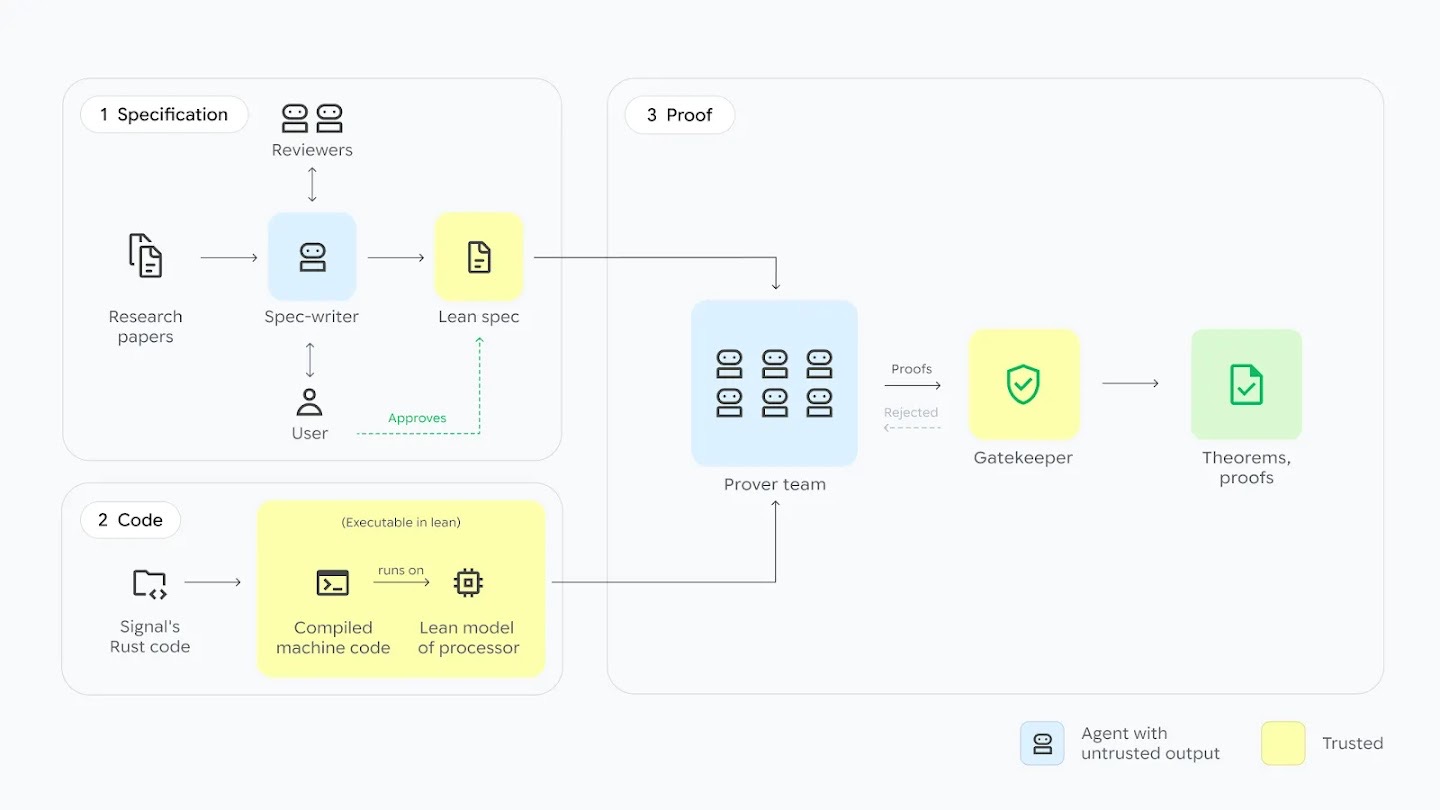
The official framework diagram splits the work into three stages, the way a research team would. Specification: researchers work with a mix of models to translate Signal's security goals into a mathematical (Lean) specification, with human experts reviewing every one — the "what to prove" step is never delegated. Code: Signal's Rust code is compiled to machine code while a Lean model of the processor is built alongside, and matching the two is what lets proofs descend from "the algorithm is right" to "this instruction sequence is right". Proof: a prover team of agents powered by Gemini Carbon writes the proofs; everything passes a gatekeeper first — rejected proofs loop back for rewriting, accepted ones become theorems checked automatically by Lean.
The trust split in the diagram's legend deserves its own look: agent output is labeled untrusted throughout; what is trusted is the Lean checker and the theorems that pass. This mirrors the verification-chain question in our November 8 PSI piece — machines check logic, humans check direction — except PSI proved a mathematical conjecture while this proves consistency between code and specification. The agents also take part in quality control: they audit the whole proof and flag the parts needing a human second look — officially about 1% of the code, "focusing expert judgment where it matters most". Like the six million lines, that 1% is Google's caliber; what the human-reviewed portion contained or found, the announcement does not say.
Sources and further reading
- DeepMind's official post: Introducing AlphaProof Code — a breakthrough in verifying complex software at depthOfficial blog · page dated November 10, 2026 · read in full November 11Read in full. Checked the key claims: AlphaProof Code is a multi-LLM agentic framework splitting work as "humans decide what to prove, agents prove it"; Signal's security goals first become mathematical specifications reviewed by humans, then agents powered by Gemini Carbon generate "over six million lines of Lean"; the agents audit the proof and flag about 1% for human review; verification reaches "the exact code running on devices", covering properties such as messages staying protected before and after a device is temporarily compromised; about four weeks total (officially, historically years); the page's own summary line says "over three million lines of machine-checked proof" alongside the body's six million; as a control, two previously fixed real bugs reintroduced into an isolated version both drew machine-checked insecure verdicts; formal-verification artifacts are being open-sourced with a technical paper; authors include Swarat Chaudhuri, Jonathan Katz and Pushmeet Kohli, with Signal's Rolfe Schmidt, Michael Rosenberg and Ehren Kret giving methodology feedback. The page also links back to AlphaProof's 2024 IMO-silver result.
Three Lean moments on this site: theorem, conjecture, code
Lining this up with the site's two earlier Lean records makes the shift of object clear. The September 9 Fermat formalization: the proof already existed, and the work was translating hundreds of pages of human mathematics into Lean-checkable form — about 11 days for the research version, compressed to 30 hours by Anthropic's 1,000-agent run on November 9. The November 8 PSI announcement: the object was an open conjecture, with a "new proof" on day three of the run and Lean accepting the final version. Today: the object is code — what must be proven is no longer "this mathematical statement is true" but "this implementation meets its security specification". All three share the same referee (Lean's machine checking); what gets examined has moved from mathematics into software.
It is also a complementary answer to "cybersecurity models": GPT-6 Cyber's ExploitGym at 48.5% measures finding and validating vulnerabilities — hunting for what is wrong; formal verification measures proving properties hold — establishing what is right. The same day Carbon went generally available, Google named AlphaProof Code as a flagship use for it: agents powered by Gemini Carbon, "alongside other models", translating security goals into theorems. Keep the verifier and the verified apart: agents wrote the proofs, Lean checked them; Carbon's claimed contribution is the speed of generating massive amounts of quality Lean, not the trustworthiness of its own output — the framework's legend marks agent output as untrusted exactly for that reason.
- Compare: the Fermat formalization (September 9 research version)
- Next: Carbon's same-day general availability (our supplement)
- Compare: GPT-6 Cyber's ExploitGym caliber
Sources and further reading
- DeepMind's official post: Introducing AlphaProof Code — a breakthrough in verifying complex software at depthOfficial blog · page dated November 10, 2026 · read in full November 11Read in full. Checked the key claims: AlphaProof Code is a multi-LLM agentic framework splitting work as "humans decide what to prove, agents prove it"; Signal's security goals first become mathematical specifications reviewed by humans, then agents powered by Gemini Carbon generate "over six million lines of Lean"; the agents audit the proof and flag about 1% for human review; verification reaches "the exact code running on devices", covering properties such as messages staying protected before and after a device is temporarily compromised; about four weeks total (officially, historically years); the page's own summary line says "over three million lines of machine-checked proof" alongside the body's six million; as a control, two previously fixed real bugs reintroduced into an isolated version both drew machine-checked insecure verdicts; formal-verification artifacts are being open-sourced with a technical paper; authors include Swarat Chaudhuri, Jonathan Katz and Pushmeet Kohli, with Signal's Rolfe Schmidt, Michael Rosenberg and Ehren Kret giving methodology feedback. The page also links back to AlphaProof's 2024 IMO-silver result.
- DeepMind's same-day post: Gemini 4 Carbon is now availableOfficial announcement · November 10, 2026 · read in full November 11Read in full. The GA caliber: paying developers and enterprises via the AI Studio / Gemini for business APIs, AI Ultra subscribers via Antigravity, the Gemini app and AI Mode in Search, at the same introductory $2/$10 per million tokens; the scientists program expands to Carbon. The same page names AlphaProof Code and the Signal verification as a flagship Carbon use: "using Carbon alongside other models" to translate security goals into theorems, with agents generating millions of lines of Lean and proving key properties "in weeks — a task that historically takes expert teams years". Our companion chapter: /notes/gemini-4-carbon#ga-general-availability.
Boundaries, and what to watch next
The boundaries, plainly: every figure is Google's own caliber; "four weeks versus years" carries no quantified baseline; the compute consumed is undisclosed — Google told Wired that feasibility at wider scale remains undetermined (relayed by IT Home); the work builds on prior formal-verification results, some not AI-assisted; what was verified is the protocol implementation, not a security review of the whole Signal app; and the six-million and three-million line counts stand side by side on one page. The named authors include several DeepMind researchers and University of Maryland professor Jonathan Katz; Signal's Rolfe Schmidt, Michael Rosenberg and Ehren Kret gave feedback on the methodology — a methodology consultation, not an independent audit.
The real independent check comes later: Google is open-sourcing the formal-verification artifacts and publishing a technical paper — whether the community can rebuild the proofs from those artifacts, and whether the Lean version and dependencies reproduce, is what to wait for next. DeepMind's own Swarat Chaudhuri says it first: "a long road" to scaling the technique to all software. The practical meaning for readers can be stated calmly: Signal messages send as usual today; what changed is how the security guarantee is demonstrated — one more step from "testing found nothing" toward "properties proven by machine" — not anything you need to do differently. Those who want to go deeper can read the specification files once the artifacts open: how security goals become mathematical theorems is a learnable example in itself.
- Watch for the artifacts: keep the announcement page
- Next: Gemini 4 Carbon goes generally available the same day
Sources and further reading
- DeepMind's official post: Introducing AlphaProof Code — a breakthrough in verifying complex software at depthOfficial blog · page dated November 10, 2026 · read in full November 11Read in full. Checked the key claims: AlphaProof Code is a multi-LLM agentic framework splitting work as "humans decide what to prove, agents prove it"; Signal's security goals first become mathematical specifications reviewed by humans, then agents powered by Gemini Carbon generate "over six million lines of Lean"; the agents audit the proof and flag about 1% for human review; verification reaches "the exact code running on devices", covering properties such as messages staying protected before and after a device is temporarily compromised; about four weeks total (officially, historically years); the page's own summary line says "over three million lines of machine-checked proof" alongside the body's six million; as a control, two previously fixed real bugs reintroduced into an isolated version both drew machine-checked insecure verdicts; formal-verification artifacts are being open-sourced with a technical paper; authors include Swarat Chaudhuri, Jonathan Katz and Pushmeet Kohli, with Signal's Rolfe Schmidt, Michael Rosenberg and Ehren Kret giving methodology feedback. The page also links back to AlphaProof's 2024 IMO-silver result.
- GitHub changelog: Gemini 4 Carbon in GitHub CopilotPlatform changelog · November 10, 2026 · read November 11Read in full. Carbon reached general availability in GitHub Copilot the same day: Pro+ / Max / Business and Enterprise plans across VS Code, Visual Studio, Copilot CLI, the coding agent, JetBrains, Xcode, Eclipse and mobile, billed at provider list pricing under usage-based billing, with model-policy controls for administrators and a gradual rollout. Recorded here and in the Carbon supplement as third-party platform evidence on GA day.
- IT Home: Google DeepMind uses AI to formally verify the Signal protocol, mathematically proving its end-to-end encryption reliabilityPress report · November 10, 2026 · read November 11Read in full as the Chinese reference and supplementary caliber: the protocol also ships in WhatsApp and Google Messages; Google told Wired that feasibility at wider scale is undetermined; DeepMind's Swarat Chaudhuri says there is "a long road" to scaling the technique to all software; the verification covers the protocol, not the whole Signal app; the work builds on prior formal-verification results, some not AI-assisted; about four weeks, with the compute budget undisclosed.