Models and verification
An undisclosed Anthropic model, three days, and a complete proof of a 2008 conjecture
PSI's AI research system had a complete proof of the 2008 Aaronson–Ambainis conjecture on the third day of its run, and the Lean proof assistant accepted the final formalization; but the auditors are PSI's own employees, the model's name is undisclosed, and the conjecture saw a proof retracted a decade ago — “expert validation in progress” is the accurate reading of this announcement.
This account draws on PSI's research announcement (page dated November 6, 2026; read by this site on November 8), the Lean formalization repository (API-checked November 8) and Scott Aaronson's 2019 retrospective on the conjecture (read November 8); press retellings (IT Home via Business Insider, November 7) serve only as timeline references. PSI is the publisher's own account, not an independent review verdict; this site verified no proof, ran no model and read no Lean code line by line.
Three days, and Lean accepts
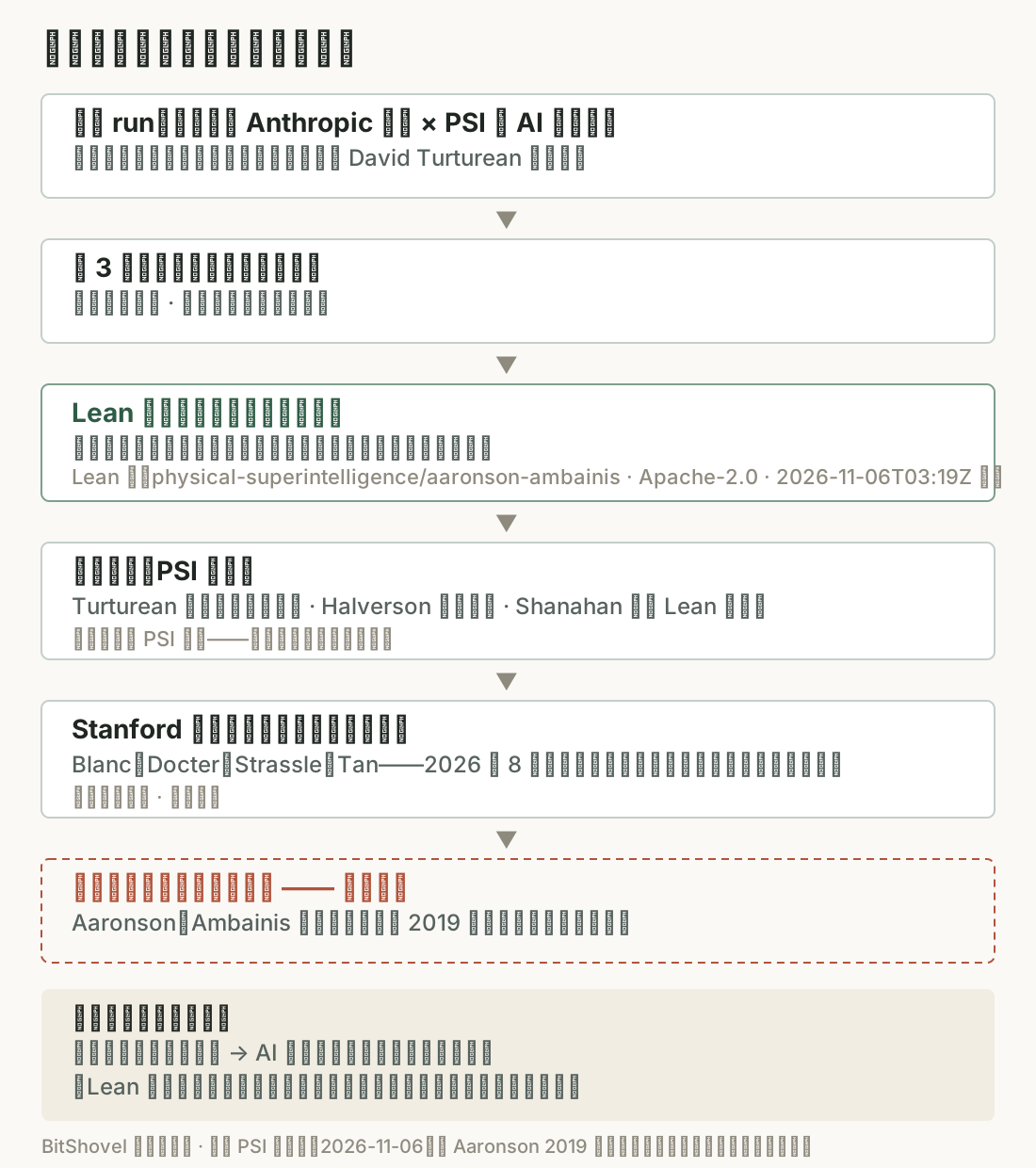
On November 6 the research organization Physical Superintelligence (PSI) announced on its research page that its AI research system had produced a complete proof of an open problem from 2008 — the Aaronson–Ambainis conjecture — with the Lean proof assistant accepting the system's formalization. The companion repository went up the same day (our November 8 API check: created 2026-11-06T03:19Z, a single push, Apache-2.0, paper PDF inside). The announcement also names what ran: “Instances of a non-public Anthropic model were used in the run” — an undisclosed Anthropic model, with no name, version or size. Anthropic itself has published no confirmation.
The timeline is concrete in the announcement: on the third day of the run the system “had a complete proof,” followed by two more improvements, with Lean accepting the final version. The roles are spelled out too: David Turturean led the work and answers for the proof's correctness; Jim Halverson audited the proof; Phiala Shanahan commented on the Lean formalization. On November 7, Business Insider's report and IT Home's retelling carried “an undisclosed Anthropic model” to a wider audience — and the retelling's line that “which model PSI used is still unknown” is exactly the footnote this story deserves.
This is not Anthropic models' first touch of Lean mathematics. Our September 9 article recorded Anthropic formalizing Fermat's Last Theorem — a theorem with a human proof — into Lean in about 11 days, using an internal research model around Fable 5.1 plus multiple agents. The difference between September and November is worth keeping: September moved an existing proof into a checker; November, if expert validation holds, is a new proof of an open problem. The difficulty and the verification burden differ, and this site verified no proof and ran no model — the two kinds of information are kept separate.
Sources and further reading
- PSI: A proof of the Aaronson-Ambainis conjecture (research announcement)Publisher announcement · page dated November 6, 2026 (read November 8)Read in full: the run used instances of a non-public Anthropic model; per the announcement a complete proof existed on day 3, followed by two improvements with Lean accepting the final version; David Turturean led the work and answers for the proof's correctness, Jim Halverson audited the proof and Phiala Shanahan commented on the Lean formalization; the Stanford group that proved a special case in August 2026 (Blanc, Docter, Strassle, Tan) is reading the full proof and writing a shorter expert exposition. The theorem is stated as Infi(f) ≥ c·v^(5/2)/d⁶ ≥ (v/d)⁷ with c = 815/(125π⁴) ≈ 0.0025. The page also scopes the quantum-computing implication to Boolean-output questions on random inputs. All auditors are PSI employees; the page claims no independent peer review or journal acceptance.
- GitHub: physical-superintelligence/aaronson-ambainis (Lean formalization and paper)Machine-checkable formalization · API-checked November 8The repository was created 2026-11-06T03:19:45Z and pushed 03:19:52Z (a single push), under the Apache-2.0 license, with 41 stars at observation; the citation_pdf_url points to paper/aaronson_ambainis_paper.pdf inside the repo. This site checked out no proof and ran no Lean.
What the conjecture says: quantum speedups need structure
Posed in 2008, the Aaronson–Ambainis conjecture is an influence lower bound for low-degree polynomials: for a bounded degree-d polynomial f with values in [0,1] and variance v, some variable's influence must be at least a fixed power of v/d. PSI's announcement puts constants to it: Infi(f) ≥ c·v^(5/2)/d⁶ ≥ (v/d)⁷, where c = 815/(125π⁴) ≈ 0.0025 (the announcement's own statement). Why it matters: the 2011 Aaronson–Ambainis paper “The Need for Structure in Quantum Speedups” reduced a chain of questions about when quantum computing truly speeds things up to this conjecture — if it holds, quantum computers gain at most polynomial speedups on random inputs with no promised structure, and exponential speedups like Shor's need structure in the problem itself.
The conjecture is not untouched ground. Aaronson's 2019 retrospective records a decade of attacks: O'Donnell, Kindler, even Terence Tao. In November 2019, Nathan Keller and Ohad Klein posted a preprint claiming a proof; Aaronson initially called it “great.” The two authors then retracted it — a then-apparently-fatal flaw in Lemma 5.3, found by Paata Ivanishvili. The retraction explains this field's default posture toward any new claim: ask first where the formalization lives and who can re-verify it, then talk conclusions.
The step closest to this announcement came in August 2026: Stanford's Blanc, Docter, Strassle and Tan proved a special case of the conjecture. PSI's announcement states that this group is reading the full proof and writing a shorter expert exposition — in progress, unpublished. In other words, the researchers closest to this problem have not yet given their reading, and that is the single most worth-waiting-for signal in weighing this announcement.
Sources and further reading
- PSI: A proof of the Aaronson-Ambainis conjecture (research announcement)Publisher announcement · page dated November 6, 2026 (read November 8)Read in full: the run used instances of a non-public Anthropic model; per the announcement a complete proof existed on day 3, followed by two improvements with Lean accepting the final version; David Turturean led the work and answers for the proof's correctness, Jim Halverson audited the proof and Phiala Shanahan commented on the Lean formalization; the Stanford group that proved a special case in August 2026 (Blanc, Docter, Strassle, Tan) is reading the full proof and writing a shorter expert exposition. The theorem is stated as Infi(f) ≥ c·v^(5/2)/d⁶ ≥ (v/d)⁷ with c = 815/(125π⁴) ≈ 0.0025. The page also scopes the quantum-computing implication to Boolean-output questions on random inputs. All auditors are PSI employees; the page claims no independent peer review or journal acceptance.
- Scott Aaronson: The Aaronson-Ambainis Conjecture (2008-2019) (blog retrospective)Retrospective by the conjecture's co-namer · November 17, 2019 (with later updates) · read November 8History check: Aaronson pondered random-oracle questions from about 1999 along the Fortnow–Rogers path; the influence conjecture took shape in 2008; the 2011 joint paper with Ambainis, “The Need for Structure in Quantum Speedups,” reduced a chain of quantum-speedup questions to it; and over the decade O'Donnell, Kindler and Tao attacked it. In November 2019 the Keller–Klein preprint claimed a proof and Aaronson initially called it “great”; the pinned update records the two authors retracting it — a then-apparently-fatal flaw in Lemma 5.3, found by Paata Ivanishvili. That history is why caution stays on when reading PSI's announcement.
The verification chain: machines check logic, people check direction
The credibility of this announcement does not live in the sentence “AI proved a hard problem in three days”; it lives in what each layer of the verification chain checks. Machine layer: the Lean proof assistant checks step by step under formal rules, and Lean's acceptance means every step derives from the axioms with no gaps — a layer done by machine, re-verifiable by anyone against the public repo, where the cost of verification drops from “read hundreds of pages” to “run the checker.” Human layer: Turturean answers for correctness, Halverson audited, Shanahan reviewed the formalization — a layer checking what the machine layer cannot: whether the proof's direction is meaningful and whether the formal statement matches the original conjecture.
A key detail from the Fermat formalization applies here too: Lean guarantees only internal consistency of the formalization, and whether the formal statement matches the original problem needs its own check — axiom checks and Mathlib statement comparison carry part of that. The same holds now: Lean's acceptance is not an endpoint, and PSI's page claims no independent peer review has happened; the auditors it names are all PSI's own employees. The other gap is the model: with name, version and size undisclosed, the split between AI and human contribution cannot be independently assessed — how much of “a proof in three days” is model capability versus harness and human design is currently unreadable.
One more boundary deserves its own paragraph: this site verified no proof, ran no Lean and read no repository line by line — every fact here rests on the announcement page, repository metadata and Aaronson's retrospective. Readers likewise need not understand the proof themselves to follow along: wait for two signals — the Stanford group's expert exposition, and word from Aaronson and Ambainis themselves. Until those arrive, the correct reading of “Lean accepted” is “the formalization is internally consistent and publicly checkable,” not “mathematics has confirmed it.”
Sources and further reading
- PSI: A proof of the Aaronson-Ambainis conjecture (research announcement)Publisher announcement · page dated November 6, 2026 (read November 8)Read in full: the run used instances of a non-public Anthropic model; per the announcement a complete proof existed on day 3, followed by two improvements with Lean accepting the final version; David Turturean led the work and answers for the proof's correctness, Jim Halverson audited the proof and Phiala Shanahan commented on the Lean formalization; the Stanford group that proved a special case in August 2026 (Blanc, Docter, Strassle, Tan) is reading the full proof and writing a shorter expert exposition. The theorem is stated as Infi(f) ≥ c·v^(5/2)/d⁶ ≥ (v/d)⁷ with c = 815/(125π⁴) ≈ 0.0025. The page also scopes the quantum-computing implication to Boolean-output questions on random inputs. All auditors are PSI employees; the page claims no independent peer review or journal acceptance.
- GitHub: physical-superintelligence/aaronson-ambainis (Lean formalization and paper)Machine-checkable formalization · API-checked November 8The repository was created 2026-11-06T03:19:45Z and pushed 03:19:52Z (a single push), under the Apache-2.0 license, with 41 stars at observation; the citation_pdf_url points to paper/aaronson_ambainis_paper.pdf inside the repo. This site checked out no proof and ran no Lean.
How to read the announcement: keep the capability story and the verification story apart
Keep the capability story and the verification story apart — that is the right posture. Capability story: an undisclosed frontier model, inside a research harness, reached a complete proof of an open problem in three days. Verification story: Lean's machine acceptance plus PSI's internal audit plus the Stanford group's in-progress reading, with independent review not yet happening. Both stories are true today, but only the first travels well; the second decides where this eventually sits in the history of mathematics — the 2019 proof once called “great” ended in retraction, proof that the second story can overturn the first.
In the larger picture, this is the third shape of the “AI solving open problems” line. Tencent's Hyra 1.0 used open models plus self-built tools on an additive-combinatorics open problem (recorded in our Hy4 article); the Fermat formalization was “existing human proof + AI formalization”; PSI's run is “open problem + new AI proof + Lean as the closer.” Verification requirements rise across the three, and PSI's chain is the most complete public record of the three — the machine-checkable layer is done, while the human layer still lacks independent review. Our October 31 piece “Aligned to whom?” covered AI's pull on expert judgment; this announcement moves “models as research participants” one notch further, and how the human layer of the verification chain gets filled is what to watch in the coming months.
Three actionable readings: first, to check, the Lean repo is public (Apache-2.0) — machine-checkable does not mean everyone understands it, but “has anyone re-verified this” now has a definite place to look; second, to follow, wait for the Stanford group's exposition and the two namers' verdicts — either is worth rereading this article for; third, to parse such announcements, remember this one's structure — undisclosed model, internal audit, machine layer closed: capability ceiling and verification progress are two independent lines, and neither should speak for the other.
- Compare: Aligned to whom? (AI's pull on expert judgment)
- Compare: Hyra 1.0 and open problems (our Hy4 article)
Sources and further reading
- PSI: A proof of the Aaronson-Ambainis conjecture (research announcement)Publisher announcement · page dated November 6, 2026 (read November 8)Read in full: the run used instances of a non-public Anthropic model; per the announcement a complete proof existed on day 3, followed by two improvements with Lean accepting the final version; David Turturean led the work and answers for the proof's correctness, Jim Halverson audited the proof and Phiala Shanahan commented on the Lean formalization; the Stanford group that proved a special case in August 2026 (Blanc, Docter, Strassle, Tan) is reading the full proof and writing a shorter expert exposition. The theorem is stated as Infi(f) ≥ c·v^(5/2)/d⁶ ≥ (v/d)⁷ with c = 815/(125π⁴) ≈ 0.0025. The page also scopes the quantum-computing implication to Boolean-output questions on random inputs. All auditors are PSI employees; the page claims no independent peer review or journal acceptance.
- Scott Aaronson: The Aaronson-Ambainis Conjecture (2008-2019) (blog retrospective)Retrospective by the conjecture's co-namer · November 17, 2019 (with later updates) · read November 8History check: Aaronson pondered random-oracle questions from about 1999 along the Fortnow–Rogers path; the influence conjecture took shape in 2008; the 2011 joint paper with Ambainis, “The Need for Structure in Quantum Speedups,” reduced a chain of quantum-speedup questions to it; and over the decade O'Donnell, Kindler and Tao attacked it. In November 2019 the Keller–Klein preprint claimed a proof and Aaronson initially called it “great”; the pinned update records the two authors retracting it — a then-apparently-fatal flaw in Lemma 5.3, found by Paata Ivanishvili. That history is why caution stays on when reading PSI's announcement.
- Anthropic: Formalizing Fermat's Last Theorem (formalization announcement)Official announcement · September 4, 2026 (read November 8)The Fermat formalization announcement is the primary source behind our September 9 article (which separately records: about 11 days using an internal research model around Fable 5.1, multiple agents and Prove2Me; formalization must still check the formal statement matches the original problem, with FinalCheck, axiom checks and Mathlib statement comparison carrying that check). The contrast here: September formalized an existing proof; November's PSI run produced a new proof of an open problem.