Models · source capability
Hy4 official version is live: numbers, promises and gaps
On November 4, Tencent Hunyuan shipped the official Hy4: the API is live on Tencent Cloud and OpenRouter at preview prices (¥6 input, ¥0.3 cached, ¥18 output per million tokens), with the official line that Hy has entered the ranks of the strongest open models for the first time. But the weights are still inside a promise — GitHub and Hugging Face carried only preview weights as of the evening of November 4 (this site re-checked), and the Artificial Analysis board this site tracks had no Hy4 row on an evening re-check either. “Strongest open models” currently rests on the official characterization alone; third-party public scores are still missing.
This account draws on Tencent Hunyuan's official research page (November 4, 2026; read in full via browser on the evening of November 4, including the appendix score table and the safety-audit notes), the official benchmark charts and same-day coverage by IT之家. All appendix-table and chart numbers are official figures; partner testimonials are each company's own reports; this site ran no model, called no API and reproduced no evaluation. The weights and system card remain unpublished as of this writing; public scores and rankings cite official phrasing with its caliber noted.
Release facts: the API is live, the weights are still a promise
On November 4, Tencent Hunyuan shipped the official Hy4. The official page opens: “Today we release the official Hy4. With another comprehensive leap in model capability, Hy enters the ranks of the strongest open models for the first time.” What actually went live that day: the API (Tencent Cloud, OpenRouter) and product entry points (WorkBuddy/CodeBuddy, Yuanbao, ima). The official price table: ¥6 input, ¥0.3 cached, ¥18 output per million tokens, officially the same as Hy4 preview. Compared with the August 28 preview (770B total, 49B active, 1M context), the official account claims a marked expansion of pre- and post-training, first-time vision and computer use (CLI plus GUI), and specialized training on Blender, CAD and cross-app long-horizon tasks.
“Strongest open models” has to be read apart for now. The weights are not open: the GitHub Tencent-Hunyuan org carries only the Hy4-preview repo (last code commit August 28); Hugging Face's tencent org carries only Hy4-preview and Hy4-preview-FP8 — re-checked by this site on the evening of November 4 via the GitHub and HF APIs. The official phrasing is “we plan to open-source the model weights”, with the system card to follow “in due course” — a plan and a due-course are promises, not today's facts. OpenRouter lists tencent/hy4 (1M context, observed at $0.417/$1.2505 per million tokens, inconsistent with the official table converted; platform pricing is independent).
Third-party calibration is absent too: an evening re-check of the Artificial Analysis board found no Hy4 row, with Tencent holding a single unscored Hy3 row. So on release day the “strongest open models” claim has no third-party public score to check against. That does not refute the official claim — it puts the sentence where it belongs: an official characterization, waiting for the weights, the system card and third-party boards to supply numbers.
Sources and further reading
- Tencent Hunyuan: Hy4 official release (research page)Official release · November 4, 2026 · read in full November 4The source for the official statement, five productivity scenarios, the appendix score table (8 categories, 35 benchmark rows × 7 models, with per-benchmark harness notes), responsible open-source and safety-audit text, the price table, limitations and the flash plan: larger pre-/post-training than preview, first vision and computer use, specialized training on Blender/CAD and cross-app long-horizon tasks; finance crowdtest 579 real tasks at 3.04/4 first among open models (DeepSeek-V4.1-Flash-1017 2.97/4, Kimi K3.1 Pro and GLM-5.3 at 2.68/4); Xuntu IRAB 61.63, +12.03 over preview; GameDev/GameLogic +19.1%/+9.8% over preview; hallucination rate 15.76%→5.45% on internal tests; training kept only defensive security data, with the Xuanwu+Keen audit finding “no prominent risk” on offensive capability and Hy-BioExperimentBench at 30.4/100 below the high-risk threshold; weights and system card promised “in due course”, flash “soon”.
- IT之家: Tencent Hunyuan ships official Hy4 (secondary coverage)Media coverage · November 4, 2026 · read in full November 4Secondary coverage matching the official page: first time among strongest open models, first vision and computer use, preview prices, weights and system card coming soon, a stated gap to closed flagships, flash planned soon; its related-links row also flags Hy4 flash and Hyra 2.0 as separate threads.
- GitHub Tencent-Hunyuan org and the Hy4-preview repoOfficial repos · evening re-check November 4The source for the weights check: the Tencent-Hunyuan org holds only the Hy4-preview repo (last code commit August 28, 2026), no official-version repo; Hugging Face's tencent org carries only Hy4-preview and Hy4-preview-FP8 weights (re-checked via the HF API); OpenRouter lists tencent/hy4 (1M context, $0.417 input/$1.2505 output per million tokens as observed November 4 — inconsistent with the official price table converted, and platform pricing is independent).
Official numbers and calibers: which table is talking
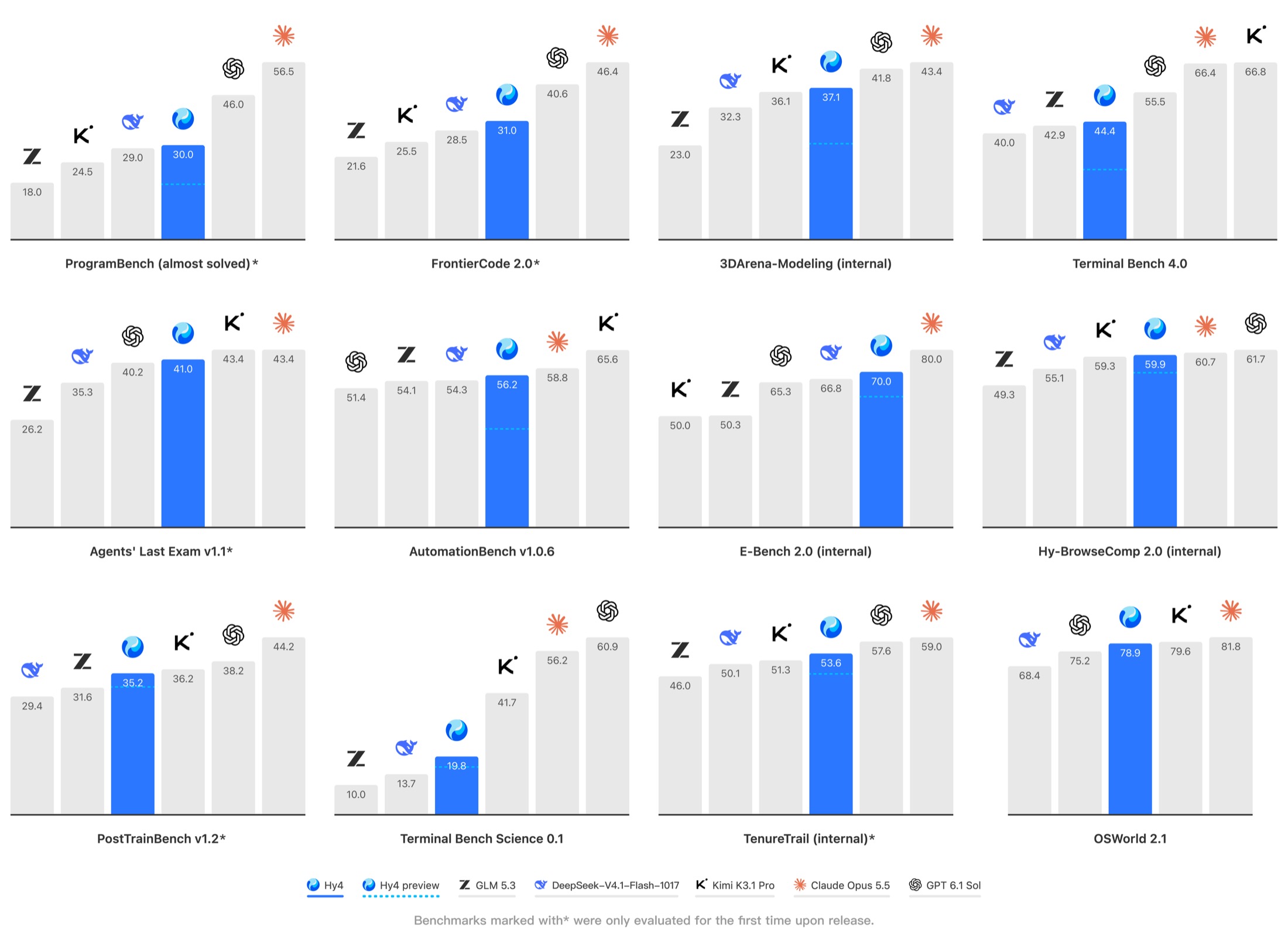
The official appendix table lists 7 models across 8 categories and 35 benchmark rows (Hy4, Hy4 preview, GLM 5.3, DeepSeek-V4.1-Flash-1017, Kimi K3.1 Pro, GPT-6.1 Sol, Claude Opus 5.5), with per-row harness notes: most models run the Claude Code harness, GPT-series run Codex, and agent tasks like OSWorld cap at 500 rounds and 13 hours in a sandbox. A few rows show the shape: DeepSWE v1.1 rises from preview 64.3 to 74.9; Terminal-Bench 4.0 from 28.3 to 44.4; OSWorld 2.1 (Full, partial score) at 78.9 — all three first among the open side, while Opus 5.5 sits at 72.6+, 66.4+ and 81.8, with GPT-6.1 Sol ahead on several rows.
Two table notes are worth keeping: starred benchmarks (ProgramBench, FrontierCode 2.0, Goal2Repo and others) were “first evaluated at release”, so preview has no comparable old scores; and one rare honesty note — “certain Hy4-preview scores may differ from previously reported results following updates to the evaluation harness, judge model and anti-hacking mechanisms”. The finance numbers form their own set: 213 experts (153 from outside financial institutions, 70% with 5+ years) crowdtested 579 real tasks — Hy4 3.04/4, DeepSeek-V4.1-Flash-1017 2.97/4, Kimi K3.1 Pro and GLM-5.3 at 2.68/4; GameDev/GameLogic +19.1%/+9.8% over preview; hallucination rate 15.76%→5.45% on internal tests. All official or partner-reported; nothing reproduced here.
Sources and further reading
- Tencent Hunyuan: Hy4 official release (research page)Official release · November 4, 2026 · read in full November 4The source for the official statement, five productivity scenarios, the appendix score table (8 categories, 35 benchmark rows × 7 models, with per-benchmark harness notes), responsible open-source and safety-audit text, the price table, limitations and the flash plan: larger pre-/post-training than preview, first vision and computer use, specialized training on Blender/CAD and cross-app long-horizon tasks; finance crowdtest 579 real tasks at 3.04/4 first among open models (DeepSeek-V4.1-Flash-1017 2.97/4, Kimi K3.1 Pro and GLM-5.3 at 2.68/4); Xuntu IRAB 61.63, +12.03 over preview; GameDev/GameLogic +19.1%/+9.8% over preview; hallucination rate 15.76%→5.45% on internal tests; training kept only defensive security data, with the Xuanwu+Keen audit finding “no prominent risk” on offensive capability and Hy-BioExperimentBench at 30.4/100 below the high-risk threshold; weights and system card promised “in due course”, flash “soon”.
Safety filtering, audits and “in due course” promises
The official account places safety under “responsible open-sourcing and release”: training kept only defensive security data (PoC generation and vulnerability fixing), removing exploitation, reverse engineering and penetration content; internal experts from Tencent Xuanwu and Keen Security Labs audited cryptanalysis, reverse engineering and exploitation, with the official verdict of “no prominent risk” on offensive capability; on the bio side, Hy-BioExperimentBench at 30.4/100 is judged “below the high-risk threshold”, with the caveat that base biology knowledge is solid but converting knowledge into executable protocols remains limited. All figures and verdicts are official claims.
The promises belong next to on-site precedent. Kimi K3.1 Pro promised its full weights “by November 4”; the deadline passed with no release, users still route through the API — this site closed that follow-up on the morning of November 4. The official Hy4 is now the same shape of promise: “plan to open-source the weights”, “system card in due course”, plus flash “soon”. There is no fixed length for the window between promise and fact; this site holds it with observation records — when the weights repo, system card or a third-party board row appears, the catalog, the version row and this article get updated, with no old-date edits. As a reference from the same family, Hyra 2.0 (official page, November 2) shows how this family turns research scaffolding into checkable results: the Overall/Mission/Worker harness, HyInv, HyPLM-Flash, HyQEC and the spiral-staircase hand in the hyra-results repo; the Hy4 page says Hy4 used that scaffold to auto-train “Jev models better than the official ones”.
Sources and further reading
- Tencent Hunyuan: Hy4 official release (research page)Official release · November 4, 2026 · read in full November 4The source for the official statement, five productivity scenarios, the appendix score table (8 categories, 35 benchmark rows × 7 models, with per-benchmark harness notes), responsible open-source and safety-audit text, the price table, limitations and the flash plan: larger pre-/post-training than preview, first vision and computer use, specialized training on Blender/CAD and cross-app long-horizon tasks; finance crowdtest 579 real tasks at 3.04/4 first among open models (DeepSeek-V4.1-Flash-1017 2.97/4, Kimi K3.1 Pro and GLM-5.3 at 2.68/4); Xuntu IRAB 61.63, +12.03 over preview; GameDev/GameLogic +19.1%/+9.8% over preview; hallucination rate 15.76%→5.45% on internal tests; training kept only defensive security data, with the Xuanwu+Keen audit finding “no prominent risk” on offensive capability and Hy-BioExperimentBench at 30.4/100 below the high-risk threshold; weights and system card promised “in due course”, flash “soon”.
- Tencent Hunyuan: Hyra 2.0 (official research page)Official release · November 2, 2026 · read November 4The source for the scaffold relationship: Hyra 2.0 is a harness “built for upgrading tools” (Overall/Mission/Worker tiers, layered agent memory and shared Books); public results include HyInv (1.96M-parameter protein inverse folding), HyPLM-Flash (650M parameters trained from scratch on 726B tokens), HyQEC (qLDPC construction and verification) and a “spiral-staircase hand” robot structure, with results in the GitHub hyra-results repo. The Hy4 page says Hy4 used the Hyra 2.0 scaffold to optimize pre-training infrastructure for same-architecture smaller models and auto-trained “Jev models better than the official ones”, alongside open-sourced HyCell and HyPDE.
Gaps, the scaffold, and the next signals
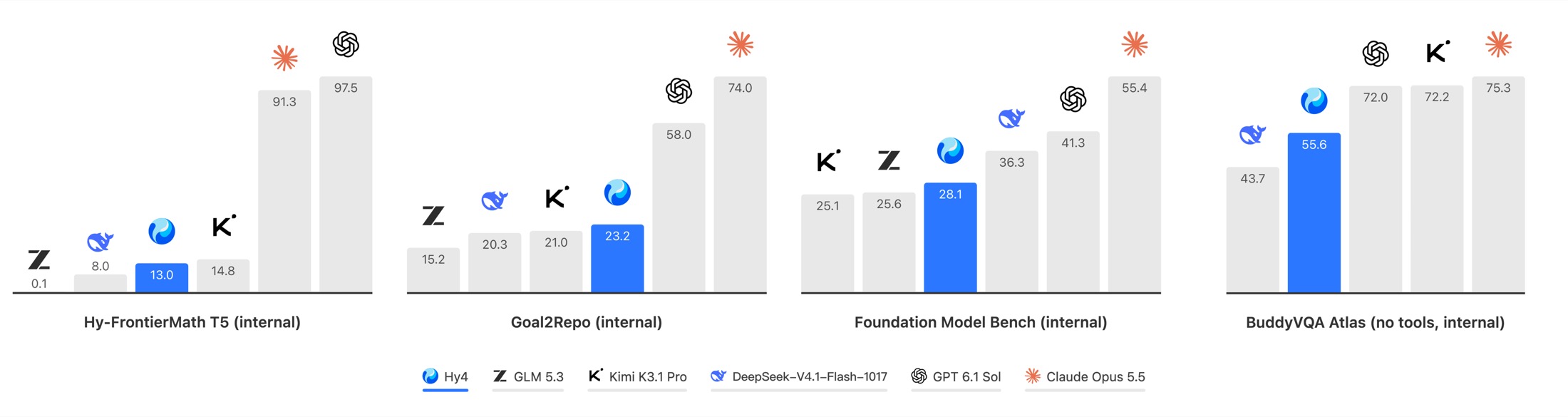
The official “limitations and outlook” is blunt: “although Hy4 is already among the strongest open models today, a considerable gap remains to top closed models”, naming internally built hard tests in frontier math, long-horizon development, model iteration and visual QA. The official limitations chart gives four same-caliber tests: Hy-FrontierMath T5 13.0 (GPT-6.1 Sol 97.5, Opus 5.5 91.3), Goal2Repo 23.2 (Opus 5.5 74.0), Foundation Model Bench 28.1 (Opus 5.5 55.4), BuddyVQA Atlas without tools 55.6 (Opus 5.5 75.3) — Hy4 leads the open side on all four, with multipliers-to-orders-of-magnitude gaps to the closed flagships. These are official internal test sets, official caliber; this site keeps no ranking, only the shape from the source: open-side order is tabulated, the closed-model gap is officially acknowledged.
Watch four signals next: the weights repo appearing (the “plan to open-source” honored), the system card publishing (with fuller safety evaluation), Hy4 flash shipping (the price-performance line), and a Hy4 row on a third-party board such as AA. Whichever appears, the catalog entry, the Tencent version row and this article get updated the same round; until then, the price table and product entry points are the full set of facts this site can verify, with the rest staying in official claims and observation records. Jev 1.14 Preview already has a site entry; the official “auto-trained Jev models better than the official ones” adds an official-provenance footnote to it.
Sources and further reading
- Tencent Hunyuan: Hy4 official release (research page)Official release · November 4, 2026 · read in full November 4The source for the official statement, five productivity scenarios, the appendix score table (8 categories, 35 benchmark rows × 7 models, with per-benchmark harness notes), responsible open-source and safety-audit text, the price table, limitations and the flash plan: larger pre-/post-training than preview, first vision and computer use, specialized training on Blender/CAD and cross-app long-horizon tasks; finance crowdtest 579 real tasks at 3.04/4 first among open models (DeepSeek-V4.1-Flash-1017 2.97/4, Kimi K3.1 Pro and GLM-5.3 at 2.68/4); Xuntu IRAB 61.63, +12.03 over preview; GameDev/GameLogic +19.1%/+9.8% over preview; hallucination rate 15.76%→5.45% on internal tests; training kept only defensive security data, with the Xuanwu+Keen audit finding “no prominent risk” on offensive capability and Hy-BioExperimentBench at 30.4/100 below the high-risk threshold; weights and system card promised “in due course”, flash “soon”.
- Tencent Hunyuan: Hyra 2.0 (official research page)Official release · November 2, 2026 · read November 4The source for the scaffold relationship: Hyra 2.0 is a harness “built for upgrading tools” (Overall/Mission/Worker tiers, layered agent memory and shared Books); public results include HyInv (1.96M-parameter protein inverse folding), HyPLM-Flash (650M parameters trained from scratch on 726B tokens), HyQEC (qLDPC construction and verification) and a “spiral-staircase hand” robot structure, with results in the GitHub hyra-results repo. The Hy4 page says Hy4 used the Hyra 2.0 scaffold to optimize pre-training infrastructure for same-architecture smaller models and auto-trained “Jev models better than the official ones”, alongside open-sourced HyCell and HyPDE.