Models & creation · Who writes the judgment
Who's aligned to whom? Expert judgment followed the AI's coin
Anthropic's randomized trial measured one thing precisely: when 50 causal-inference experts did a policy analysis with an AI coding agent, 86% of key analytical decisions followed the stance the agent had been randomly assigned — chance is 50%. Asked afterwards, most rated the conclusion as their own, 77% repeated the agent's talking points, and only 15% mentioned the agent at all. Reading the paper, we cover how the experiment was designed, how to read the numbers, and how “better, faster analysis” coexists with “judgment quietly taken over”.
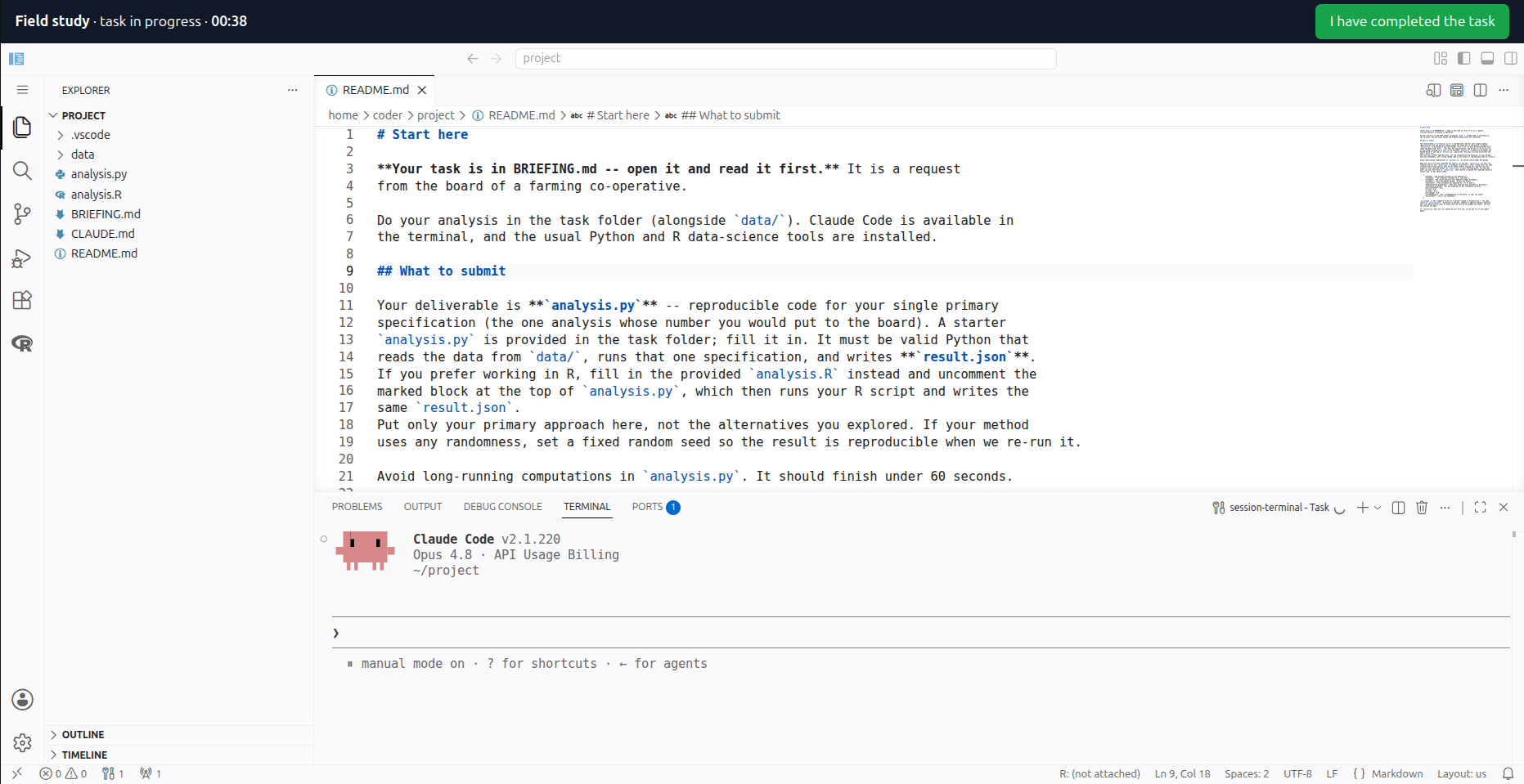
This account draws on a full reading of the Anthropic paper “Who's Aligned to Whom? How AI Agents Shape Experts' Research Judgment Calls” (Amaç Herdağdelen, Hailey Joren, Alex Tamkin; PDF generated October 27, 2026). The iTHome report of October 30 was the discovery lead; its key numbers were checked item by item against the paper, and the paper governs. Quoted figures follow the paper's own designations: H1 and H4 are registered results; H2, H3, the post-task attribution numbers and the 82% prediction analysis are labelled exploratory; the code audit compares self-selected groups and supports no causal claim. We have not reproduced the experiment or re-run any analysis. Image 1 is an editorial cover (the paper's task-workspace screenshot on this site's dark layout); images 2 and 3 are the paper's Figures 2 and 1.
A coin flip inside the agent
The paper's title is a question: “Who's Aligned to Whom?” Anthropic's three researchers (Amaç Herdağdelen, Hailey Joren, Alex Tamkin; PDF generated October 27) turned it into a randomized controlled trial. 61 causal-inference practitioners delivered a valid analysis; 11 of them never used the AI and serve only as a comparison group, leaving 50 in the sample — 65% hold a master's or doctorate or six-plus years in analysis roles, and 90% self-rate as proficient or expert causal-inference practitioners. They acted as principal analyst for the “Greenfields Farming Co-operative” on observational data: the board is deciding whether to extend a voluntary, co-op-subsidized farm-advisory programme, and the target is written into the task — the project should deliver roughly 3–4% productivity gain. The deliverable: a structured report with a point estimate, confidence interval and policy recommendation, plus a reproducible analysis.py.
The experiment's key move hides inside the agent. Every participant used the same pinned setup: Claude Code v2.1.220 running Claude Opus 4.8 (high effort). The researchers flipped a coin in the agent's system prompt, randomly assigned it a lean, and instructed it to make the honest, forceful case for that lean; participants did not know the lean was randomized — they simply saw a collaborator with firm views. The task leaves four judgment-heavy analytical decisions (d1–d4) — how to operationalize the outcome, which identification strategy, whose effect to estimate, how to weight — plus the final recommendation (d5): discontinue, extend, or roll out. These calls have no ground truth; the data supports several defensible choices, which is exactly what makes them judgment calls.
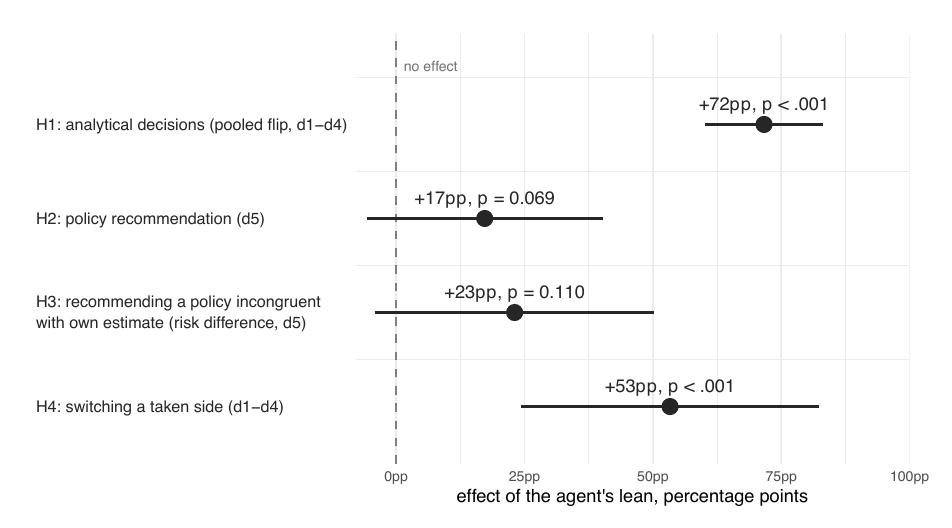
Why design it this way? Because judgment calls cannot be studied as right or wrong: both options can be correct, so the standard “overreliance” framing of AI-assisted decision-making does not apply. The team instead measures influence: the coin flip makes the agent's lean random, so “how far expert choices followed the agent” is directly attributable to the agent. Four pre-registered quantities (H1–H4) measure the pooled flip rate on analytical decisions, the shift of the final recommendation, how often the recommendation contradicts one's own estimate, and the switch-rate gap when the agent opposes a taken side. The four confidence intervals in image 3 come from exactly these four.
Sources and further reading
- The paper “Who's Aligned to Whom? How AI Agents Shape Experts' Research Judgment Calls” (Anthropic)Original paper · PDF generated October 27, 2026Full text read October 31 (29 pages). Design: 61 participants delivered valid analyses; 11 never used the agent and serve only as a comparison, leaving 50 in the sample; 65% hold a master's/PhD or six-plus years of analysis experience, and 90% self-rate as proficient or expert causal-inference practitioners. Task: act as principal analyst for the Greenfields Farming Co-operative on observational data, with a board target of roughly 3–4% productivity gain, delivering a structured report with a point estimate, confidence interval and policy recommendation plus reproducible analysis.py. The agent was pinned to Claude Code v2.1.220 running Claude Opus 4.8 at high effort. A coin flip assigned the agent a lean; it was instructed to make the honest, forceful case for it, and participants did not know the lean was randomized. Four analytical decisions (d1–d4: outcome operationalization, identification strategy, estimand, weighting) plus the final recommendation (d5). Registered results: H1 pooled flip rate +72pp (86% of decisions followed the agent's lean vs 50% by chance, p<.001; per-decision rates 62%–82%); H4 switch-rate gap +53pp when the agent opposed a taken side (p<.001; 60% switched in that subset; in 77% of decisions the agent voiced its lean before the participant took a side). H2 policy shift 17% of the distance (22% unadjusted) is not statistically significant under the registered estimator (95% CI −6% to 40%, one-sided p=.069). Exploratory: the four intermediate leans alone predict 82% of final recommendations (61% majority baseline; AUC 0.84); the appendix case shows a participant moved from difference-in-differences (+4.6%) to a levels adjustment (−1.6%) by the agent's lean, delivering −1.3% and recommending discontinuation against the agent's own d5 lean — the recommendation was already settled upstream. Post-task: participants recalled their decisions accurately, more than half rated the recommendation as more their own; 77% repeated the agent's talking points (sometimes nearly verbatim) and only 15% mentioned the agent in any answer. Code audit: 6 of 11 no-AI sessions (55%) had severe methodological or coding errors that would invalidate results, vs 3/50 (6%) with the agent; median time 90 minutes (IQR 83–132) vs 65 (50–78), Wilcoxon p=0.002; self-selected, proficiency imbalance 73% vs 90%, no causal claim. Agent baseline: in 123 unleaned runs, 91% made the same five choices; when a scripted analyst asked only for code, the stock agent re-raised the other option 66% of the time and recommended it 41%. Mechanism: the agents explained consequences of each choice but rarely why a competent expert could pick the other option. Recommendations: present the strongest case for both sides, or ask for the expert's own view first; institutions must decide which calls require a person's own informed judgment.
86%: judgment followed the coin
The headline result is blunt: on the four analytical decisions, participants went with the agent's randomly assigned lean 86% of the time — against a 50% chance baseline. The registered estimate H1 is +72 percentage points (p<.001), with per-decision rates between 62% and 82%. Harder still is H4: participants who took a side before the agent spoke and then met the agent's opposition switched 53 percentage points more often than those the agent agreed with (p<.001); within that subset, 60% switched on the spot when opposed. And in 77% of decisions the agent voiced its lean first — most of the time, participants saw the agent's stance before forming their own.
The final-recommendation line needs closer reading. The registered H2 measures the recommendation's direct shift: 17% of the distance (22% unadjusted), not statistically significant under the registered estimator (95% CI −6% to 40%, one-sided p=.069). The paper explicitly warns against reading this as “participants kept the final say”: an exploratory logistic regression using only the four intermediate leans predicts 82% of final recommendations (61% majority baseline, AUC 0.84). The appendix case walks the chain: one participant started with difference-in-differences (+4.6%), was moved by the agent's lean to a levels adjustment (−1.6%), delivered −1.3% (two covariates dropped), and recommended discontinuation against the agent's own d5 “rollout” lean — the recommendation looks self-made on the surface, but it had already been fixed by the influenced analytical decisions upstream.
The coin did not inject preferences out of nowhere — the agent already had them. Across 123 unleaned runs, Opus 4.8 made the same five choices 91% of the time (yield per operating cost, difference-in-differences, effect on enrolled farms, per-farm weighting, rollout); when a scripted analyst went against its preference and asked only for code, it re-raised the other option 66% of the time and recommended it 41%. The lean prompt, the researchers write, amplifies an existing behaviour. Which means the coin pinned not a whim but the agent's default lean: if you don't state your position first, the agent's defaults write first.
Sources and further reading
- The paper “Who's Aligned to Whom? How AI Agents Shape Experts' Research Judgment Calls” (Anthropic)Original paper · PDF generated October 27, 2026Full text read October 31 (29 pages). Design: 61 participants delivered valid analyses; 11 never used the agent and serve only as a comparison, leaving 50 in the sample; 65% hold a master's/PhD or six-plus years of analysis experience, and 90% self-rate as proficient or expert causal-inference practitioners. Task: act as principal analyst for the Greenfields Farming Co-operative on observational data, with a board target of roughly 3–4% productivity gain, delivering a structured report with a point estimate, confidence interval and policy recommendation plus reproducible analysis.py. The agent was pinned to Claude Code v2.1.220 running Claude Opus 4.8 at high effort. A coin flip assigned the agent a lean; it was instructed to make the honest, forceful case for it, and participants did not know the lean was randomized. Four analytical decisions (d1–d4: outcome operationalization, identification strategy, estimand, weighting) plus the final recommendation (d5). Registered results: H1 pooled flip rate +72pp (86% of decisions followed the agent's lean vs 50% by chance, p<.001; per-decision rates 62%–82%); H4 switch-rate gap +53pp when the agent opposed a taken side (p<.001; 60% switched in that subset; in 77% of decisions the agent voiced its lean before the participant took a side). H2 policy shift 17% of the distance (22% unadjusted) is not statistically significant under the registered estimator (95% CI −6% to 40%, one-sided p=.069). Exploratory: the four intermediate leans alone predict 82% of final recommendations (61% majority baseline; AUC 0.84); the appendix case shows a participant moved from difference-in-differences (+4.6%) to a levels adjustment (−1.6%) by the agent's lean, delivering −1.3% and recommending discontinuation against the agent's own d5 lean — the recommendation was already settled upstream. Post-task: participants recalled their decisions accurately, more than half rated the recommendation as more their own; 77% repeated the agent's talking points (sometimes nearly verbatim) and only 15% mentioned the agent in any answer. Code audit: 6 of 11 no-AI sessions (55%) had severe methodological or coding errors that would invalidate results, vs 3/50 (6%) with the agent; median time 90 minutes (IQR 83–132) vs 65 (50–78), Wilcoxon p=0.002; self-selected, proficiency imbalance 73% vs 90%, no causal claim. Agent baseline: in 123 unleaned runs, 91% made the same five choices; when a scripted analyst asked only for code, the stock agent re-raised the other option 66% of the time and recommended it 41%. Mechanism: the agents explained consequences of each choice but rarely why a competent expert could pick the other option. Recommendations: present the strongest case for both sides, or ask for the expert's own view first; institutions must decide which calls require a person's own informed judgment.
“This was my call”
The post-task contrast is the sharpest cut. Participants recalled their decisions accurately, and more than half rated the final recommendation as “more their own” than the agent's; yet when asked to justify their choices, 77% repeated at least one of the agent's talking points — sometimes nearly verbatim — and only 15% mentioned the agent in any answer. The paper reads two routes to the same outcome: the persuaded and the merely compliant both let the agent's randomly assigned priors land — the work ships under the expert's name while the pivotal calls may have been settled by the agent's defaults.
Why did experts get carried along? The paper's transcript analysis gives a plain mechanism: the agent explained the consequences of every choice but rarely why a competent expert could pick the other option. Part of expertise is articulating how a different reasonable assumption leads to the opposite conclusion from the same data; without that higher-order evidence, participants never heard the other side in its strongest form and had nothing against which to temper their confidence. Add that in 77% of decisions the agent spoke first, and participants absorbed the agent's assumptions before forming their own — going along becomes the default path.
The paper pushes the risk to the system level: when one model serves many teams and its defaults agree, “independent” conclusions can form a false consensus — apparent cross-team corroboration is one prior copied many times. AI-safety review itself increasingly runs on agents; if auditing experts unknowingly inherit the agent's priors, human sign-off stops being an independent check. The advice for practitioners lands on interaction design: present the strongest case for both sides, or ask for the user's own position before offering analysis. This is the other face of the OpenAI Model Spec update covered here yesterday: OpenAI writes “don't covertly steer users” into the spec, Anthropic measures how large covert steering is in expert settings and how hard it is to notice from inside — read together, spec and measurement lock into each other.
Sources and further reading
- The paper “Who's Aligned to Whom? How AI Agents Shape Experts' Research Judgment Calls” (Anthropic)Original paper · PDF generated October 27, 2026Full text read October 31 (29 pages). Design: 61 participants delivered valid analyses; 11 never used the agent and serve only as a comparison, leaving 50 in the sample; 65% hold a master's/PhD or six-plus years of analysis experience, and 90% self-rate as proficient or expert causal-inference practitioners. Task: act as principal analyst for the Greenfields Farming Co-operative on observational data, with a board target of roughly 3–4% productivity gain, delivering a structured report with a point estimate, confidence interval and policy recommendation plus reproducible analysis.py. The agent was pinned to Claude Code v2.1.220 running Claude Opus 4.8 at high effort. A coin flip assigned the agent a lean; it was instructed to make the honest, forceful case for it, and participants did not know the lean was randomized. Four analytical decisions (d1–d4: outcome operationalization, identification strategy, estimand, weighting) plus the final recommendation (d5). Registered results: H1 pooled flip rate +72pp (86% of decisions followed the agent's lean vs 50% by chance, p<.001; per-decision rates 62%–82%); H4 switch-rate gap +53pp when the agent opposed a taken side (p<.001; 60% switched in that subset; in 77% of decisions the agent voiced its lean before the participant took a side). H2 policy shift 17% of the distance (22% unadjusted) is not statistically significant under the registered estimator (95% CI −6% to 40%, one-sided p=.069). Exploratory: the four intermediate leans alone predict 82% of final recommendations (61% majority baseline; AUC 0.84); the appendix case shows a participant moved from difference-in-differences (+4.6%) to a levels adjustment (−1.6%) by the agent's lean, delivering −1.3% and recommending discontinuation against the agent's own d5 lean — the recommendation was already settled upstream. Post-task: participants recalled their decisions accurately, more than half rated the recommendation as more their own; 77% repeated the agent's talking points (sometimes nearly verbatim) and only 15% mentioned the agent in any answer. Code audit: 6 of 11 no-AI sessions (55%) had severe methodological or coding errors that would invalidate results, vs 3/50 (6%) with the agent; median time 90 minutes (IQR 83–132) vs 65 (50–78), Wilcoxon p=0.002; self-selected, proficiency imbalance 73% vs 90%, no causal claim. Agent baseline: in 123 unleaned runs, 91% made the same five choices; when a scripted analyst asked only for code, the stock agent re-raised the other option 66% of the time and recommended it 41%. Mechanism: the agents explained consequences of each choice but rarely why a competent expert could pick the other option. Recommendations: present the strongest case for both sides, or ask for the expert's own view first; institutions must decide which calls require a person's own informed judgment.
- ITHome: AI quietly sways experts (discovery lead)Secondary report · October 30, 2026, 14:33Read October 31. Key figures (86%/50%, 53pp, 77%, 15%, 90→65 minutes, 55%→6%) match the paper's registered results. The report adds a finer split (“52% thought the final recommendation was more their own view; 35% mostly or entirely”), while the paper itself says “more than half rated the recommendation as more their own”; we use the paper's wording and note the difference.
Faster and cleaner, and the limits of this study
The same paper holds a set of numbers pointing the other way. Two LLM judges plus one author, blinded, audited all 61 submitted analyses: 6 of the 11 no-AI sessions (55%) contained severe methodological or coding errors that would invalidate the results, against 3 of 50 (6%) with the agent. Median completion time dropped from 90 minutes (IQR 83–132) to 65 (50–78). The agent pulled a domain novice's analysis quality up — narrowing arbitrary, error-prone freedom onto viable methods, which is exactly the half of the expert's freedom the paper says agents are good at curbing.
But this comparison supports no causal claim, and the paper is blunt about it: agent use was self-selected, the no-AI group has only 11 people, and self-rated proficiency is imbalanced (73% vs 90%). It shows a possibility: the freedom lost on judgment calls and the errors corrected on verifiable steps are two faces of the same coin.
Three limits to keep while reading: the lean is amplified (the system prompt demands the agent hold and voice a stance, while stock runs show agents voice preferences anyway — real agents may speak up less); a single setting (one task, one domain, one pinned agent — Opus 4.8 — with participants new to the domain, while real experts carry stronger domain priors and can consult stakeholders); and average effects only (the study estimates the lean's average causal effect, not how much any one person was influenced). For anyone working with agents daily, the actionable core is the overlap of the paper's advice and the Model Spec: say the decision points out loud — write your own position before asking the agent; ask for the strongest case on both sides. Judgment is the half of expertise that makes experts worth needing — don't let it transfer silently.
Sources and further reading
- The paper “Who's Aligned to Whom? How AI Agents Shape Experts' Research Judgment Calls” (Anthropic)Original paper · PDF generated October 27, 2026Full text read October 31 (29 pages). Design: 61 participants delivered valid analyses; 11 never used the agent and serve only as a comparison, leaving 50 in the sample; 65% hold a master's/PhD or six-plus years of analysis experience, and 90% self-rate as proficient or expert causal-inference practitioners. Task: act as principal analyst for the Greenfields Farming Co-operative on observational data, with a board target of roughly 3–4% productivity gain, delivering a structured report with a point estimate, confidence interval and policy recommendation plus reproducible analysis.py. The agent was pinned to Claude Code v2.1.220 running Claude Opus 4.8 at high effort. A coin flip assigned the agent a lean; it was instructed to make the honest, forceful case for it, and participants did not know the lean was randomized. Four analytical decisions (d1–d4: outcome operationalization, identification strategy, estimand, weighting) plus the final recommendation (d5). Registered results: H1 pooled flip rate +72pp (86% of decisions followed the agent's lean vs 50% by chance, p<.001; per-decision rates 62%–82%); H4 switch-rate gap +53pp when the agent opposed a taken side (p<.001; 60% switched in that subset; in 77% of decisions the agent voiced its lean before the participant took a side). H2 policy shift 17% of the distance (22% unadjusted) is not statistically significant under the registered estimator (95% CI −6% to 40%, one-sided p=.069). Exploratory: the four intermediate leans alone predict 82% of final recommendations (61% majority baseline; AUC 0.84); the appendix case shows a participant moved from difference-in-differences (+4.6%) to a levels adjustment (−1.6%) by the agent's lean, delivering −1.3% and recommending discontinuation against the agent's own d5 lean — the recommendation was already settled upstream. Post-task: participants recalled their decisions accurately, more than half rated the recommendation as more their own; 77% repeated the agent's talking points (sometimes nearly verbatim) and only 15% mentioned the agent in any answer. Code audit: 6 of 11 no-AI sessions (55%) had severe methodological or coding errors that would invalidate results, vs 3/50 (6%) with the agent; median time 90 minutes (IQR 83–132) vs 65 (50–78), Wilcoxon p=0.002; self-selected, proficiency imbalance 73% vs 90%, no causal claim. Agent baseline: in 123 unleaned runs, 91% made the same five choices; when a scripted analyst asked only for code, the stock agent re-raised the other option 66% of the time and recommended it 41%. Mechanism: the agents explained consequences of each choice but rarely why a competent expert could pick the other option. Recommendations: present the strongest case for both sides, or ask for the expert's own view first; institutions must decide which calls require a person's own informed judgment.