Companies and markets
Anthropic's first day on the market: where the record IPO money comes from — and where it goes
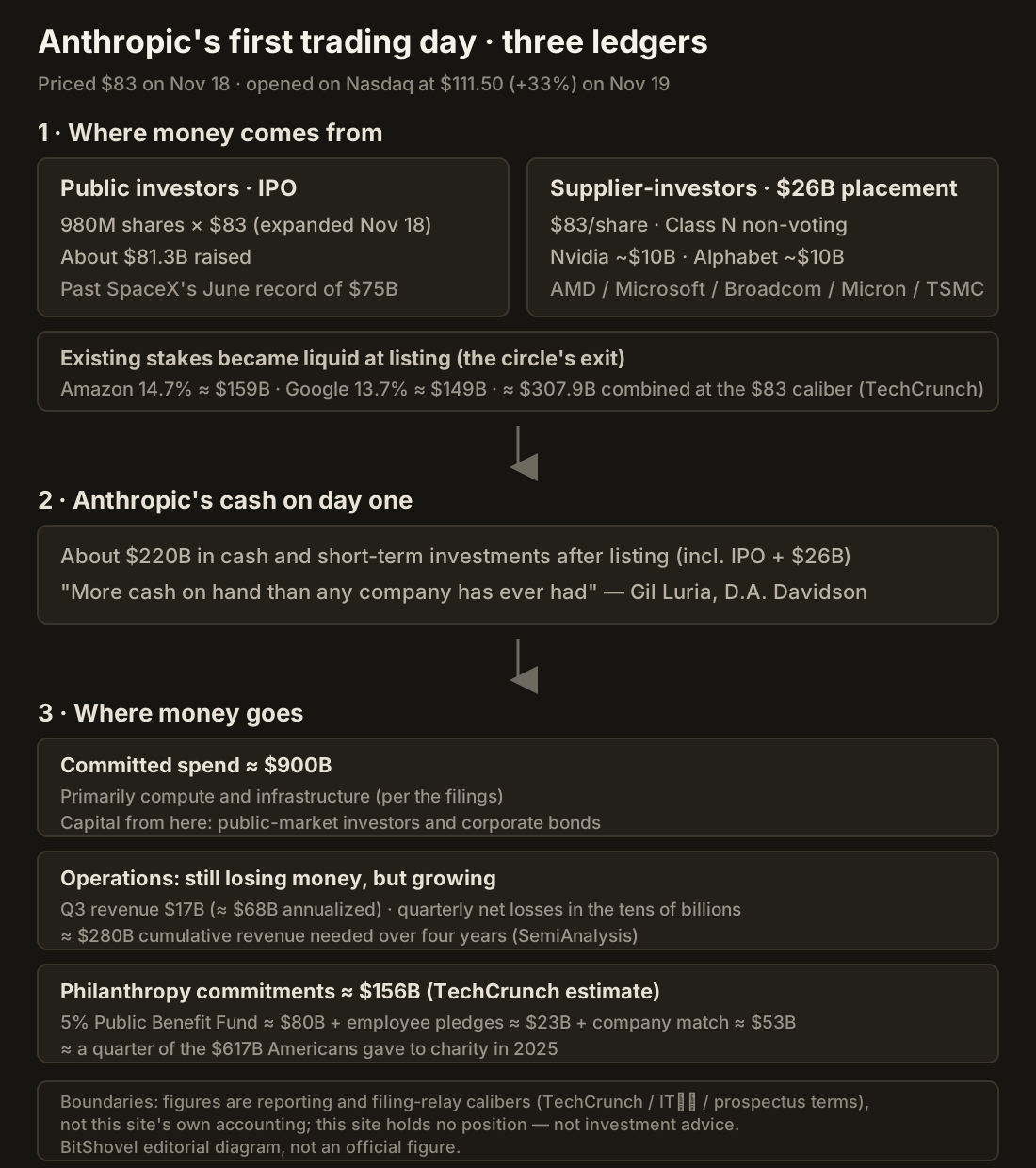
On November 19, Eastern time, Anthropic landed on Nasdaq — the first frontier AI lab to go public. The $83 IPO price was set on November 18, above the projected $70–78 range; 980 million shares went to underwriters, raising about $81.3 billion and passing SpaceX's June record of $75 billion; shares opened at $111.50 (a 33% premium), which would put the market cap above $2 trillion — behind only Apple, Microsoft, Nvidia, Alphabet and Amazon — while the fully diluted figure at the IPO price reads about $1.5 trillion. This account splits day one into three ledgers. Where the money comes from: the $81.3 billion subscribed by public investors, plus a concurrent $26 billion private placement at the IPO price (per the prospectus as relayed: roughly $10 billion each from Nvidia and Alphabet in non-voting shares, with AMD, Microsoft, Broadcom, Micron and TSMC taking part). Where it goes: about $220 billion in expected cash and short-term investments after listing — "more cash on hand than any company has ever had", in one analyst's words — against about $900 billion of committed spend disclosed in filings (primarily for compute), while Q3 2026 revenue ran $17 billion (about $68 billion annualized) and quarterly net losses still count in the tens of billions. And who is watching: this site's standing checkpoint from "Nvidia's first week after Jensen" — whether Nvidia's planned ~$10 billion placement goes through — was contingent on the IPO's completion and settled immediately after listing under the prospectus terms, the first public data point for "does Nvidia under Kress still write big checks". At the opening bell, Amodei wrote a pacing commitment into the listing narrative: "we will pace the training and deployment of AI systems, taking as long as is necessary to have confidence that they are safe and will remain under human control — we will not bend to either business nor political pressure". TechCrunch also tallies a philanthropy ledger — the 5% Public Benefit Fund plus employee pledges with company match, about $156 billion combined, near a quarter of all US charitable giving in a year. Every figure is a cross-checked, same-day caliber (four TechCrunch pieces read in full, IT之家's relay, and prospectus terms as relayed); this site holds no position and this is not investment advice.
This account rests on four TechCrunch pieces of November 19, Eastern time, read in full (the opening brief, the full opening-bell speech text, the circular-financing analysis and the philanthropy-structure breakdown), IT之家's relay of 23:50 on November 19 (including S-1 financial figures), and the prospectus placement terms as relayed on November 18 via Yahoo Finance / Insider Monkey; checked by this site on the morning of November 20. This site holds no position and took part in no transaction; all market figures are reporting and filing-relay calibers; the speech quotes come from the full text TechCrunch published.
Three opening numbers: $81.3B, +33%, $2T
On the morning of November 19, Eastern time, Anthropic's shares began trading on Nasdaq — the first frontier AI lab to go public. The $83 IPO price was set the day before (November 18), above the company's own projected range of $70–78; per IT之家's relay, the company expanded the offering to 980 million shares sold to underwriters on the 18th, raising about $81.3 billion — past SpaceX's $75 billion IPO record from this June, the largest in history. TechCrunch's opening brief adds the other half of the caliber: that money flows "to a combination of employees and the company's own coffers".
The stock opened at $111.50, a 33% premium. The brief's wording is worth quoting exactly: at the opening price, the market cap would top $2 trillion — more valuable than Meta, Tesla, or Walmart, with only five companies above it: Apple, Amazon, Alphabet, Nvidia and Microsoft. Note the two calibers: $2 trillion is the market-cap figure at the opening price; the fully diluted figure at the $83 IPO price reads about $1.5 trillion (both IT之家 and analyst Gil Luria's "trillion and a half" refer to that layer). Both numbers moved within hours of the open, and this article labels each where it is used.
More striking than the price is the cash: per TechCrunch, the IPO funding together with existing fundraising and the concurrent private offerings leaves Anthropic with an expected $220 billion in cash reserves after listing — "Anthropic's going to have more cash on hand than any company has ever had", as one analyst put it. That line is the doorway to the other two ledgers of this piece: whose pockets the money comes from (next section), and where it flows (the one after).
Sources and further reading
- TechCrunch: Anthropic hits Nasdaq exchanges at $111, 33% above IPO priceOpening brief · posted 8:59 AM ET, November 19 · read in full by this site on November 20Open at $111.50 (+33%), $83 IPO price (above the $70–78 range), over $81B raised, about $220B expected cash reserves, market cap above $2T at the open (ahead of Meta, Tesla and Walmart; behind Apple, Amazon, Alphabet, Nvidia and Microsoft).
- IT之家: Anthropic completes the largest IPO ever, with a listing valuation of $1.5 trillionRelay (including S-1 financial figures) · posted 23:50 Beijing time, November 19 · read in full by this site on November 20$81.3B raised on 980 million shares (offering expanded November 18), SpaceX's June record of $75B, about $1.5T fully diluted; per the S-1: H1 2026 revenue $16.2B (2025 full year $4.6B), H1 loss $80B (mainly a one-time charge), first-nine-months cumulative loss $104B, first-nine-months compute spend about $18.8B; the "first frontier AI lab to go public" phrasing comes from this piece.
Ledger one: the supplier-investor circle reaches its public-market stop
The prospectus's shareholder table explains why "circular financing" keeps circling Anthropic: Amazon put in $18 billion over time and held 14.7% before listing — about $159 billion at the $83 IPO price; Google has invested $12.3 billion since 2023 with another $30 billion promised against performance milestones, and its 13.7% stake reads about $149 billion. The two together: about $307.9 billion (TechCrunch, at the IPO price). These are not just investments — Amazon and Google are also Anthropic's largest compute suppliers; in TechCrunch's words: "From afar, it looks like unprecedented revenue growth for cloud companies and unprecedented fundraising from Anthropic — but it's just the same money passing from one pocket to another."
On IPO day the circle changed structurally, twice. First, the existing stakes became sellable public shares; second, new money arrived: Nvidia, AMD, Microsoft, Broadcom, Micron and TSMC joined Google in a $26 billion private placement at the IPO price — and every one of them except TSMC runs multi-billion-dollar purchasing partnerships with Anthropic. TechCrunch's reading is that the listing may make this financing system "self-sustaining": the earlier investments have paid off and are now liquid, and Anthropic's capital from here comes mainly from public-market investors and corporate bonds — "neither of which have the conflicts-of-interest that caused concerns before".
Both sides of the ledger belong on the table. Spending: the filings disclose about $900 billion of committed spend, primarily for compute and infrastructure; Joey Brookhart of SemiAnalysis's Tokenomics team estimates roughly $280 billion in cumulative revenue over the next four years to cover the compute bill — "achievable given where they will be next year from a revenue perspective", he said. Revenue: Q3 2026 brought $17 billion, about $68 billion annualized; yet quarterly net losses still count in the tens of billions (IT之家's S-1 relay: an $80B H1 2026 loss, mostly a one-time charge, and $104B cumulative for the first nine months). Gil Luria of D.A. Davidson offers the totals: about $141 billion of capital raised and about $91.7 billion in net proceeds at $83 a share — "they're not burning cash. They're just going to have a war chest." Both analysts give the same biggest risk: losing the frontier race — in Luria's words, "If we're all using other people's models, then Anthropic's not worth a trillion and a half dollars. It's worth nothing."
The reader-facing meaning sits in the competitive structure, not the stock price: Amazon and Google "don't need to prop it up anymore", and revenue will come from other customers; even if the frontier changes hands, compute suppliers likely keep getting paid — training and inference always run in somebody's data center. That is TechCrunch's quoted judgment, not this site's forecast — but it is a useful frame for model pricing and availability over the next year or two: whose model wins and whose infrastructure collects rent are becoming two different questions.
Sources and further reading
- TechCrunch: Anthropic's IPO puts AI's circular financing boom to the testFinancing-structure analysis · posted November 19, 14:54 UTC · read in full by this site on November 20Amazon's 14.7% stake worth about $159B ($18B invested in total) and Google's 13.7% about $149B ($12.3B invested plus $30B promised on milestones); Nvidia, AMD, Microsoft, Broadcom, Micron and TSMC joined Google in the $26B placement at the IPO price; about $900B committed spend per the filings; calibers of SemiAnalysis's Brookhart and D.A. Davidson's Luria noted separately.
- IT之家: Anthropic completes the largest IPO ever, with a listing valuation of $1.5 trillionRelay (including S-1 financial figures) · posted 23:50 Beijing time, November 19 · read in full by this site on November 20$81.3B raised on 980 million shares (offering expanded November 18), SpaceX's June record of $75B, about $1.5T fully diluted; per the S-1: H1 2026 revenue $16.2B (2025 full year $4.6B), H1 loss $80B (mainly a one-time charge), first-nine-months cumulative loss $104B, first-nine-months compute spend about $18.8B; the "first frontier AI lab to go public" phrasing comes from this piece.
The checkpoint lands: Nvidia's $10 billion went as planned
This site's November 15 piece "Nvidia's first week after Jensen" left an explicit checkpoint: per Bloomberg's November 13 report (relayed by IT之家), Nvidia planned, per the filings, to subscribe about $10 billion of Anthropic's $26 billion private placement — "whether that $10 billion goes as planned is the first public data point for 'does Nvidia under Kress still write big checks'." The first layer can now be checked: the prospectus terms (as relayed by Yahoo Finance / Insider Monkey on November 18) state Nvidia agreed to buy about $10 billion of non-voting shares (Class N), at the IPO price, contingent on the offering's completion, settling immediately after listing; Alphabet committed about $10 billion in the same batch. TechCrunch's listing-day coverage lists Nvidia among the participants of the $26 billion placement.
The boundary, stated as-is: what this site read confirms that the placement executed at the IPO price, that Nvidia is on the participant list, and that the terms were contingent on the IPO's completion — but not a post-settlement disclosure from Nvidia or Anthropic naming the individual settlement; the checkpoint paragraph inside "Nvidia's first week after Jensen" stays as that day's record, and this piece carries the check's result. Under that article's three channels: money — the first data point has landed (the big check was written); models — Nemotron's next open-weights release is still pending; compute — the delivery rhythm of Korea's 260,000 GPUs and other national projects stays on the watch list.
Sources and further reading
- TechCrunch: Anthropic's IPO puts AI's circular financing boom to the testFinancing-structure analysis · posted November 19, 14:54 UTC · read in full by this site on November 20Amazon's 14.7% stake worth about $159B ($18B invested in total) and Google's 13.7% about $149B ($12.3B invested plus $30B promised on milestones); Nvidia, AMD, Microsoft, Broadcom, Micron and TSMC joined Google in the $26B placement at the IPO price; about $900B committed spend per the filings; calibers of SemiAnalysis's Brookhart and D.A. Davidson's Luria noted separately.
- Yahoo Finance (relaying Insider Monkey): the terms of Nvidia's planned $10 billion placementProspectus terms as relayed · posted 10:24 AM ET, November 18 · read in full by this site on November 20Nvidia agreed to buy about $10 billion of non-voting shares (Class N) at the IPO price, contingent on completion of the offering, to settle immediately after listing; Reuters reported orders of roughly six times the shares on offer; the placement had not closed when the piece was published.
Ledger two: the opening-bell speech writes pacing into the listing narrative
Before the bell, Amodei read from a printout, and TechCrunch published the speech in full — several sentences deserve to travel verbatim. On safety and pace: "And to state it unequivocally, we will pace the training and deployment of AI systems, taking as long as is necessary to have confidence that they are safe and will remain under human control — we will not bend to either business nor political pressure." On the listing and resolve: "Today puts the company in a stronger financial position, and in doing so, only strengthens our resolve to do the right thing." On competition: "When the race to the top is working properly, it doesn't matter which company has the best models. Everyone wins because everyone is building safely."
The speech starts from a private story: Amodei and co-founder Daniela lost their father to a disease that "became curable just a few years later"; he trained in biology, and the speech positions AI as working in concert with humans to "compress a century of scientific and medical progress into a decade" — while conceding "at this point, all we have are early results". The risk list is read out too: misuse by individuals or nation-states, economic disruption, losing control of AI systems; "the most difficult safety work lies ahead of us". TechCrunch adds context: Amodei outlined a pacing plan in September (coordinating safety standards among leading companies, embedding third-party evaluators); Altman, Hassabis and Musk said they agreed, "although few concrete commitments have been made".
Placed in the context of listing day, this stops being a generic safety statement and becomes a publicly checkable promise: from this day Anthropic is a public company explaining revenue and spending every quarter, and its CEO used the opening bell to promise "taking as long as is necessary". The first collision of those two forces has not happened yet — the next flagship's training timetable, the rhythm of corporate-bond issuance, and the pace at which the $900 billion of committed spend moves will all be checkpoints. The prospectus risk disclosures relayed by IT之家 (including that models could be used for biological weapons) rhyme with the speech: the risk narrative is written into the listing documents as well as the opening bell.
Sources and further reading
- TechCrunch: At Nasdaq opening bell, Anthropic CEO recommits to pacing AI developmentOpening-bell report with the full speech text · posted November 19, 16:19 UTC · read in full by this site on November 20The speech runs in full: the pacing-commitment sentence verbatim, the whole race-to-the-top passage, the father-and-medicine origin, the September pacing plan context (Altman/Hassabis/Musk voiced agreement, few concrete commitments), and Daniela Amodei's CNBC interview.
- IT之家: Anthropic completes the largest IPO ever, with a listing valuation of $1.5 trillionRelay (including S-1 financial figures) · posted 23:50 Beijing time, November 19 · read in full by this site on November 20$81.3B raised on 980 million shares (offering expanded November 18), SpaceX's June record of $75B, about $1.5T fully diluted; per the S-1: H1 2026 revenue $16.2B (2025 full year $4.6B), H1 loss $80B (mainly a one-time charge), first-nine-months cumulative loss $104B, first-nine-months compute spend about $18.8B; the "first frontier AI lab to go public" phrasing comes from this piece.
Ledger three: where about $156 billion of philanthropy promises come from
TechCrunch's Tim Fernholz adds up the philanthropy promises the listing creates. Layer one is the Public Benefit Fund (analogous to OpenAI's foundation), allotted 5% of the company's shares — about 850 million, roughly $80 billion at the $95 trading price the piece uses — plus a ratchet: every time the valuation grows more than 50% over the $83 IPO price, the fund's share grows another 2% (the next threshold sits near $124.50). The fund's first commitment is $200 million to study AI's impact on workers; the disclosure also says it may consider "direct distributions to specific populations" — TechCrunch flags that as a possible hint of future UBI-style experiments. A separate $50 million gift to the city of San Francisco last week did not come from the fund, a spokesperson confirmed.
Layer two is employees: shares pledged to charities of their choice, matched by the company at 3:1 for longer-tenured staff and 1:1 for newer ones; the S-1 shows more than 550 million shares reserved to honor pledges made before September 30. Working backward from those disclosures, TechCrunch estimates about $23 billion in employee pledges and about $53 billion in company match. The two layers total about $155–156 billion — against the $617 billion Americans gave to charity in all of 2025, roughly a quarter. The caveats travel with them: employees must actually honor the pledges; the match's value depends on the share price when delivered; shares may land in donor-advised funds, which would slow the initial impact; and the likely recipients run through Longview Philanthropy, GiveWell, Coefficient Giving, Foresight Institute and Giving What We Can, with AI safety research expected to take the largest share.
This is the ledger closest to readers: it answers what the money finally becomes. If honored, AI safety research, worker-impact studies and effective-philanthropy causes gain a tens-of-billions-scale annual tier of funding in the years ahead — what may change is the direction of research agendas, not just the ranking of rich lists. To be clear, about $156 billion is a promises-and-estimates caliber, not cash in the bank; this piece keeps TechCrunch's estimation method and every boundary as stated.
Sources and further reading
- TechCrunch: Anthropic's IPO could deliver $156 billion to charityPhilanthropy-structure breakdown · posted November 19, 19:10 UTC · read in full by this site on November 20The Public Benefit Fund was allotted 5% of shares (about 850 million, about $80B at $95) with a ratchet of +2% each time valuation passes 50% over the $83 IPO price (next threshold about $124.50); 550 million-plus employee-pledged shares with 3:1 / 1:1 company match; about $155–156B total ≈ a quarter of the $617B Americans gave in 2025; a spokesperson confirmed last week's $50M gift to San Francisco did not come from the fund.
The first close, and the crowd outside headquarters
Added the evening of November 20, Beijing time: the first trading day closed with ANT at $97.17, up 17% from the $83 IPO price (Business Insider's caliber, read in full that night), about 14 dollars below the $111.50 open; BI's phrasing is that after the initial pop the rally "pared to about 20%", settling at 17%. The premium that survived to the close is roughly half the one priced at the open. The market-cap calibers from section two still disagree after the close: "above $2 trillion" was the opening-price reading; a closing market cap depends on the share-count basis, with sources differing — this piece adopts no single closing figure. The shape of day one is itself information: the market paid an opening premium, then handed back about half of it before the bell.
That same day, another crowd gathered outside the San Francisco headquarters. Dozens of protesters carried "Ban RSI" signs — RSI meaning recursive self-improvement, having advanced AI systems help train the next generation. Speakers included Jacob Coxon, the former Anthropic researcher who left in September over AI-risk concerns, ex-OpenAI researcher Daniel Kokotajlo and YouTuber Rob Miles; members of the Stop AI organization arrived later and blocked the office entrance. In an interview, Coxon cut the stock loose from the issue: "It literally doesn't matter whether they invest. We have to stop RSI." In his speech he said "at this point, the companies are the problem", and that by 2027 only a few places worldwide will be able to run RSI — Anthropic's office among them. Kokotajlo's description: it is something "a comic book supervillain mad scientist would be doing".
The protest is not noise outside the listing narrative — it stands on two already-checkable points. First: a recent independent report from the safety organization METR finds AI is already speeding up Anthropic's own research and development — "AI training the next AI" is not a thought experiment here but an ongoing process. Second: Anthropic's own prospectus states it would not be safe to let AI fully design its next generation without oversight, and that the company is weighing policy updates to keep humans in control — the same filing behind this piece's three ledgers. Coxon asks for more: he calls on Anthropic to lobby governments and coordinate with other firms toward a full RSI ban. Oliver Habryka of LessWrong welcomes the disclosure duties of listing but fears competitive pressure will push the company toward RSI, especially on biology; David Krueger of Evitable thinks most people would call RSI "insane" if they understood it, and says people at Anthropic "have really drunk the Kool-Aid". Business Insider notes members of Congress have begun suggesting RSI restrictions; Anthropic did not respond to a request for comment. In this piece's frame: the opening-bell speech promised "taking as long as is necessary", the street wants the line drawn in law, and the METR report names the mechanism. Two checkpoints join the list: whether congressional RSI-restriction proposals become bills, and METR's follow-up reports on Anthropic's internal acceleration.
Sources and further reading
- Business Insider: Jacob Coxon and the "Ban RSI" protest on Anthropic's IPO dayOn-the-ground report · November 19, 2026 (ET) · read in full by this site on the evening of November 20Dozens protested outside the San Francisco HQ under "Ban RSI"; speakers Coxon, Kokotajlo and Rob Miles, with Sydney Von Arx photographed rallying the crowd and Stop AI blocking the entrance; Coxon's lines "It literally doesn't matter whether they invest. We have to stop RSI." and "At this point, the companies are the problem", plus the claim that by 2027 only a few places worldwide will manage RSI; a METR report finds AI already speeding Anthropic's R&D; the prospectus admits fully autonomous next-gen design without oversight would be unsafe, with policy updates under consideration; comment from Habryka and Krueger; Congress members beginning to suggest RSI restrictions; Anthropic did not respond to a request for comment.
- Business Insider: ANT closed its debut at $97.17, up 17%Closing-markets report · November 19, 2026 (ET) · read in full by this site on the evening of November 20Closed at $97.17, up 17% from the IPO price; opened at $111.50 (the piece rounds to +34%, the same $111.50/83 fact this article records as TechCrunch's +33% — a rounding difference); the rally "pared to about 20%" after the initial pop; its valuation caliber is "a debut valuation above $2 trillion" (opening-price basis); no closing market cap given.
What to check next
This piece forecasts no stock price. The checkable items: Nvidia's and Alphabet's own settlement disclosures (confirmation of the two roughly $10 billion checks at the filing level); the pace at which the $900 billion of committed spend moves and the corporate-bond issuance — a listed company is a more credible borrower; the next flagship's training timetable — the first meeting of "taking as long as is necessary" with market expectations; and the Public Benefit Fund's spending after its $200 million first commitment. Each of "Nvidia's first week after Jensen"'s three channels gains a line: money — the $10 billion placement settled with the IPO (section three above); models — Nemotron's next release, pending; compute — Korea's 260,000 GPUs and other national deliveries, pending.
For everyday readers, one plain sentence to close: a model company going public changes nothing about what Claude can do today; it changes who can afford to build compute over the next few years, on what rhythm the next models train, and which research the money finally reaches. Those three things are worth returning to, whatever the first-day ticker did.
Sources and further reading
- TechCrunch: Anthropic hits Nasdaq exchanges at $111, 33% above IPO priceOpening brief · posted 8:59 AM ET, November 19 · read in full by this site on November 20Open at $111.50 (+33%), $83 IPO price (above the $70–78 range), over $81B raised, about $220B expected cash reserves, market cap above $2T at the open (ahead of Meta, Tesla and Walmart; behind Apple, Amazon, Alphabet, Nvidia and Microsoft).
- TechCrunch: Anthropic's IPO puts AI's circular financing boom to the testFinancing-structure analysis · posted November 19, 14:54 UTC · read in full by this site on November 20Amazon's 14.7% stake worth about $159B ($18B invested in total) and Google's 13.7% about $149B ($12.3B invested plus $30B promised on milestones); Nvidia, AMD, Microsoft, Broadcom, Micron and TSMC joined Google in the $26B placement at the IPO price; about $900B committed spend per the filings; calibers of SemiAnalysis's Brookhart and D.A. Davidson's Luria noted separately.
- TechCrunch: Anthropic's IPO could deliver $156 billion to charityPhilanthropy-structure breakdown · posted November 19, 19:10 UTC · read in full by this site on November 20The Public Benefit Fund was allotted 5% of shares (about 850 million, about $80B at $95) with a ratchet of +2% each time valuation passes 50% over the $83 IPO price (next threshold about $124.50); 550 million-plus employee-pledged shares with 3:1 / 1:1 company match; about $155–156B total ≈ a quarter of the $617B Americans gave in 2025; a spokesperson confirmed last week's $50M gift to San Francisco did not come from the fund.