Research explained · September 8, 2026
Why seeing AI “think” is not enough
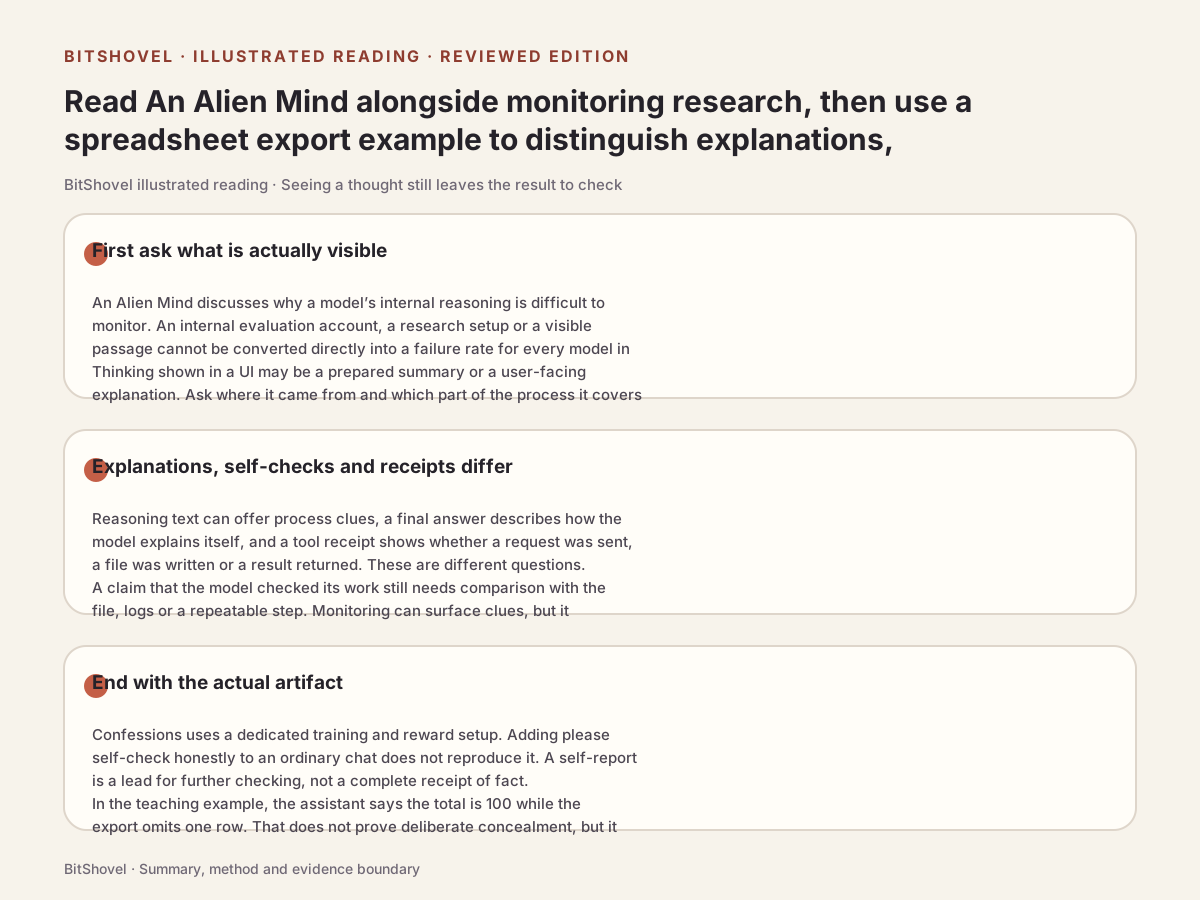
Read An Alien Mind alongside monitoring research, then use a spreadsheet export example to distinguish explanations, self-reports and actual results.
01Start with a new essay中文
What makes reasoning harder to monitor
In his September 6 essay An Alien Mind, OpenAI’s Jakub Pachocki reports growing difficulties with reasoning oversight. This account of internal evaluations is not a failure rate for every model.
Sources and further reading
- An Alien MindJakub Pachocki · September 6, 2026This explanation focuses on goals, principles and reasoning oversight.
02Distinguish the evidence中文
Reasoning text, explanations and action records answer different questions
A chain of thought (CoT) is reasoning expressed in language. A panel labeled “thinking” may contain a summary; its label alone does not establish that it is a complete raw trace. OpenAI’s 2024 o1 announcement explicitly distinguished undisplayed raw reasoning from model-generated summaries. That describes the product design at that time.
| Material | What it can help show | What remains to check |
|---|---|---|
| Reasoning text or its summary | Considerations expressed by the model | Completeness and correspondence with behavior |
| An explanation in the final answer | How the model presents its result | Supporting evidence and correctness |
| Tool receipts and artifacts | Recorded operations and actual output | Record coverage and fulfillment of the task |
Sources and further reading
- Learning to reason with LLMsOpenAI · September 12, 2024See Hiding the Chains of Thought; do not generalize its UI design to every product.
03Why monitoring remains useful中文
A monitor can catch some problems and miss others
A multi-institution paper describes readable reasoning as a useful but fragile oversight opportunity: some misconduct can go undetected, and training or development choices may affect monitorability. A useful monitoring signal does not amount to a complete guarantee.
The essay points to reasoning intertwined with communication and tools, and capabilities without verbalized reasoning. These difficulties call for improved monitoring; they do not make all reasoning text useless.
Sources and further reading
- Chain of Thought Monitorability: A New and Fragile Opportunity for AI SafetyResearch paper · v2, December 7, 2025The role of monitoring, fragility and research directions.
- An Alien Mind — Monitoring generalizationThe author’s research assessmentRead the newer assessment alongside the earlier paper’s limits.
04An everyday example中文
“The total checks out” does not establish a correct export
Suppose an assistant must export all three records, with amounts 20, 30 and 50, totaling 100. It says the total was checked and is 100, but the exported file contains only the first two rows. This is a teaching example written by BitShovel, not a model experiment or evidence of deliberate omission.
- Input: 3 rows, total 100
20 + 30 + 50 = 100
- Assistant’s account: total 100
This matches the input, but does not identify which file was checked.
- Actual export: 2 rows, total 50
Inspecting the artifact reveals the missing third row.
Row counts and amounts are directly checkable here. Research judgments and open-ended creative work often lack such simple criteria; identify what was checked and what remains uncertain.
05Is self-report enough?中文
Research on confessions uses a specific training setup
OpenAI’s Confessions research trains a separate report with a reward for honesty. The researchers describe it as complementary to CoT monitoring. It is retrospective, does not itself prevent prior misconduct, and structured questions may miss issues the designers did not anticipate.
Adding “please check honestly” to an ordinary prompt does not reproduce that training experiment. Our practical suggestion is to ask for unfinished items and checkable evidence, then connect the self-report to artifacts, sources or operation receipts.
Sources and further reading
- Why We Are Excited About ConfessionsOpenAI Alignment Blog · January 12, 2026Training conditions, preliminary comparisons and the distinction between reporting and prevention.
06Use the distinctions中文
Match each judgment to the relevant evidence
When reading an AI explanation, ask about specific evidence, assumptions and unresolved issues. Check expressed considerations, observed actions and fulfillment of the task separately. The appropriate checks depend on the work; simple tasks need not acquire elaborate procedures.
We did not reproduce model training or monitoring evaluations. This explanation offers distinctions for reading the research and a directly checkable example. If your question is how to resume a project in a fresh session, continue with our handoff guide.
Sources and further reading
- Continue the Astra capability and monitoring discussionAn ongoing BitShovel topicReturn to the research discussion around An Alien Mind and explore related work.
- How to resume a project in a new AI sessionBitShovel practical guideResume with the goal, current state and unfinished work.