Model and creation · The next image edit
Four references, one room corner: Qwen-Image-2.1 Turbo edits in eight steps
See furniture references come together in an empty room, then understand the eight-step checkpoint and hosted API. Transparent assets, prices and the weights license each have their own conditions.
Qwen released Turbo on October 9. Images are official eight-step examples. This reading uses the model card, API documentation and evaluations checked October 10; we did not run generation or call a paid API.
See the furniture enter an empty room
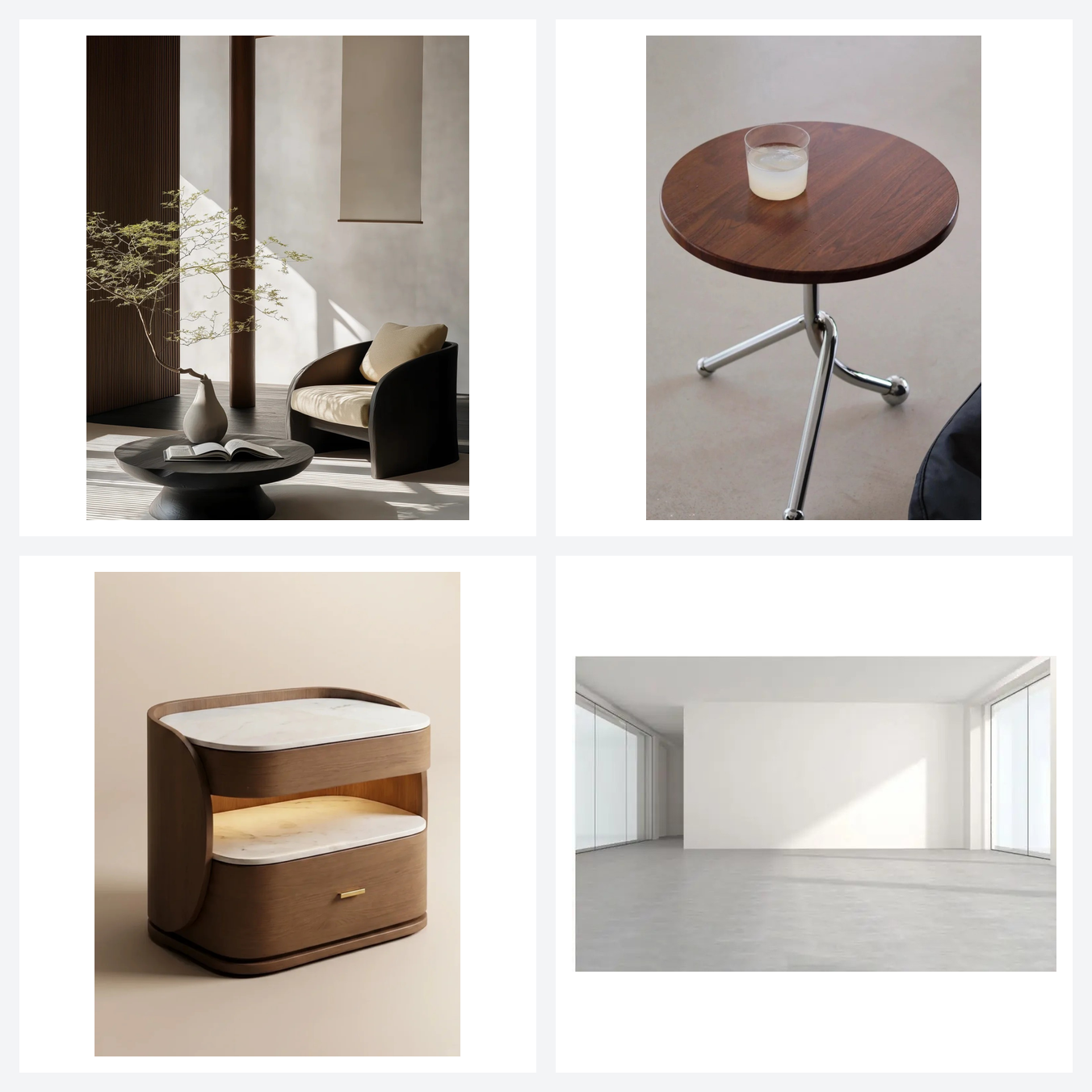
Four inputs provide an armchair scene, a round table, a cabinet and an empty room. The official output brings the furniture together with the room's perspective and light. Existing images can express a visual idea that would otherwise need separate descriptions of each item's style.
It remains a composed image. The cup in the table reference is absent, and physical dimensions cannot be verified from the result. It can help imagine a combination or communicate an idea; buying or arranging furniture still requires measurements. We have not reproduced this example.

Sources and further reading
- Qwen-Image-2.1-Turbo · Original model cardOfficial checkpoint · Pinned revisionEight steps, the same 7B visual architecture, caching and original examples.
The result can continue as a transparent asset
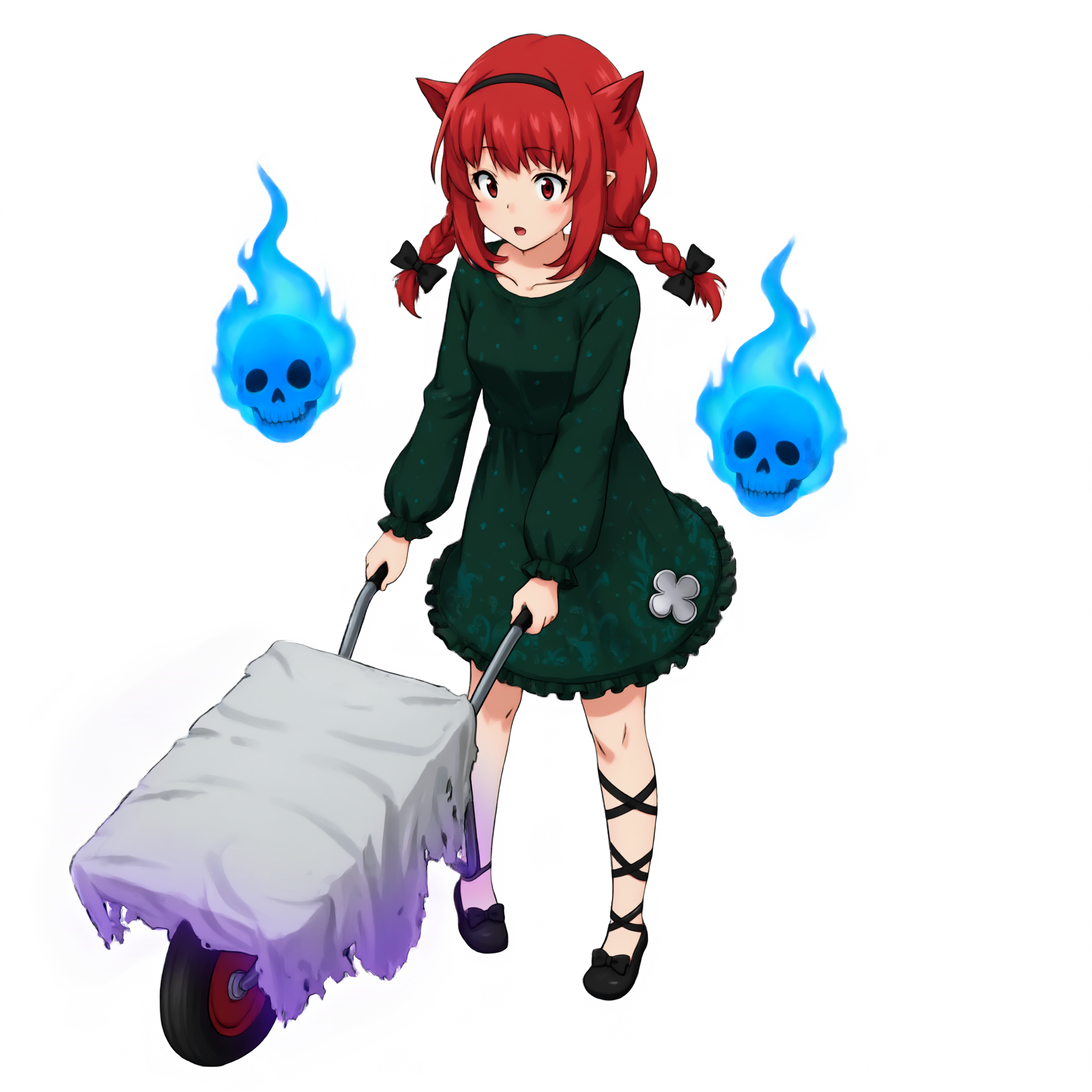
Another eight-step example provides a character, cart and flames as an alpha-channel PNG. We checked the original file and found transparent and partially transparent pixels. That is a file check, not a generation test. Alpha allows a background to show through when the asset is placed in another composition.
Transparency and multi-image editing already existed in base 2.1. The new showcase demonstrates those tasks with Turbo's eight-step checkpoint, without a matched quality comparison against the base. Inspect fine edges, partial transparency and colors after placing an asset over a different background.
Sources and further reading
- Qwen-Image-2.1-Turbo · Original model cardOfficial checkpoint · Pinned revisionEight steps, the same 7B visual architecture, caching and original examples.
- Qwen-Image-2.1 · Base model cardOfficial documentation · Read October 10The base examples use 40 steps; this is not a matched timing comparison with Turbo.
Eight steps shorten the process; elapsed time needs testing
Turbo is an accelerated checkpoint using the same 7B visual-generation architecture. The base model card's generation and editing examples use 40 steps; Turbo saves a recommended eight-step schedule. The reduction concerns repeated denoising, rather than shrinking the model to one-fifth of its size.
The card describes KV-cache reuse for text and reference-image context and loads the sampling schedule with the checkpoint. These explain the acceleration design. Without timing on the same hardware, inputs and output size, 40 versus eight does not establish fivefold speed or identical image quality.
Sources and further reading
- Qwen-Image-2.1-Turbo · Original model cardOfficial checkpoint · Pinned revisionEight steps, the same 7B visual architecture, caching and original examples.
- Qwen-Image-2.1 · Base model cardOfficial documentation · Read October 10The base examples use 40 steps; this is not a matched timing comparison with Turbo.
Local weights and a hosted API have different starting conditions
The weights load in Diffusers; official examples use CUDA and BF16 and require source support for the saved schedule. The Qwen Research License limits the materials to non-commercial research or evaluation. Commercial use requires a separate license; downloading the checkpoint alone does not grant that permission.
Alibaba Cloud runs the hosted API. Its Singapore International lifecycle table dates Pro to October 2 and Turbo to October 9. Output prices checked October 10 are $0.04 and $0.016 per image, respectively. Model, endpoint and API key must match regions. These are developer access conditions; we did not call the service or verify availability in consumer chat interfaces.
- Check hosted regions, access and reference-image requirements
- Check current regional prices
- Read the original weights license
Sources and further reading
- Qwen · Release record and hosted accessOfficial source · Pinned revisionOctober 9 Turbo release and links to Pro/Turbo APIs.
- Alibaba Cloud · Model release datesOfficial documentation · Checked October 10The Singapore International table lists Pro on October 2 and Turbo on October 9.
- Alibaba Cloud · Unified image generation and editing APIOfficial API documentation · Checked October 10Reference images, alpha output, region and API-key requirements; documentation access is not a successful call.
- Alibaba Cloud · Model pricingOfficial pricing · Checked October 10This reading quotes only Singapore International output prices, without mixing regions or free quotas.
- Qwen Research License · Weights licenseOriginal license text · Pinned revisionThe materials are limited to non-commercial research or evaluation; commercial use requires a separate license.
Keep the base model's scores separate from Turbo
Artificial Analysis read October 10 lists base Qwen-Image-2.1 at Elo 1035 for text-to-image v2.0, with a 95% interval of 1026–1044 and 5,489 samples. Editing v2.0 is 1075, with an interval of 1066–1084 and 5,965 samples. It is listed first on both open-weights boards; editing's rank interval is 1–2.
These Elo scores reflect paired human image preferences. No separate Turbo row was found in this check, so the base scores do not establish the eight-step model's position. They provide context for base 2.1; Turbo needs its own task results. Image scores are separate from the text Intelligence Index.
Sources and further reading
- Artificial Analysis · Open-weights text-to-image boardIndependent evaluation · Read October 10The base 2.1 model's AA-Image-T2I v2.0 score; no separate Turbo row was found.
- Artificial Analysis · Open-weights image-editing boardIndependent evaluation · Read October 10The base 2.1 model's AA-Image-Editing v2.0 score, interval and sample count.
Return to the room: another way to continue the idea
Our September 22 reading showed ten furnishing references combined into a room, then explained transparency and local edits. The new development is an eight-step checkpoint and access choices with regional, price and license conditions. This four-image showcase is new material, not a repeated test of the earlier ten-image task.
If you already use an editor, keep the same room image and requested change. Compare furniture shapes, omissions and subsequent revisions. Consider waiting time alongside whether the first result is usable. Fewer steps give a reason to compare; the delivered image determines whether the tool fits your work.
Sources and further reading
- Qwen · Release record and hosted accessOfficial source · Pinned revisionOctober 9 Turbo release and links to Pro/Turbo APIs.
- Qwen-Image-2.1-Turbo · Original model cardOfficial checkpoint · Pinned revisionEight steps, the same 7B visual architecture, caching and original examples.