Model capability, from readings to the wet lab
35 of 322 minibinders bound: GPT-6 designs proteins with reasoning and code alone, and the lab agrees
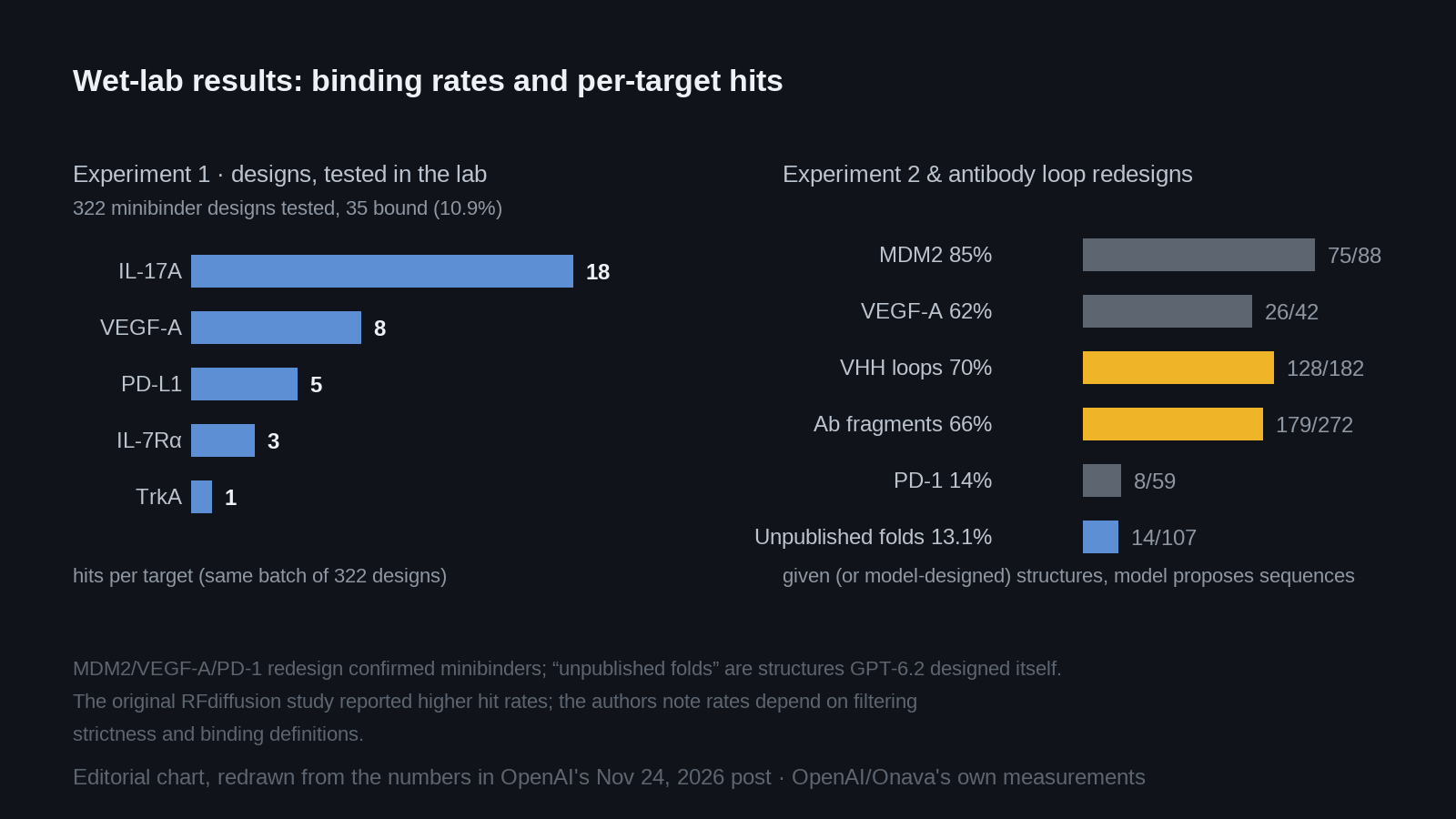
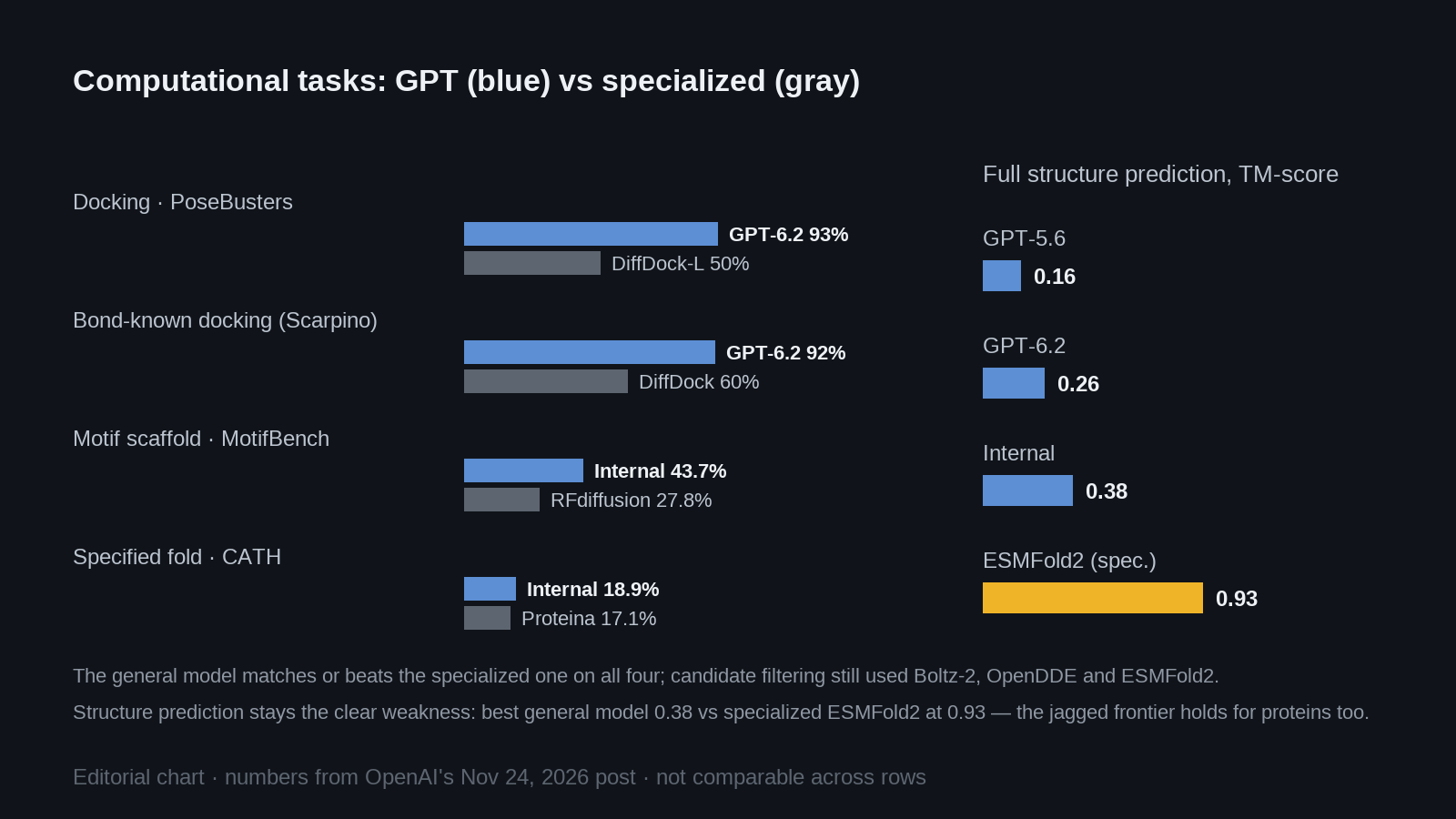
On November 24 OpenAI published the official post accompanying the preprint “GPT-6 as a Universal Foundation Model for Protein Biology: Beyond Specialized Models”: the GPT-6 family can design new protein structures and amino-acid sequences using only reasoning and general-purpose coding tools — no specialized biology model generates the designs. In wet-lab tests with research partner Onava, proteins built from GPT-6.2's (pre-release) designs — 322 minibinders — were screened, and 35 (10.9%) showed evidence of binding on at least one of five targets (PD-L1, IL-7Rα, TrkA, VEGF-A, IL-17A) — every target had at least one hit. Asked to redesign sequences for existing minibinder structures, the model's new sequences bound in 85% of MDM2, 62% of VEGF-A and 14% of PD-1 screens; on structures it had designed itself but never published, 14 of 107 proteins (13.1%) bound — and for one PD-L1 structure two of its sequences differed from the original at 52 and 58 of 90 positions, and from each other at 44, evidence the capability goes beyond memorization. On antibodies, 70% of 182 redesigned VHH loops and 66% of 272 therapeutic-antibody fragments retained binding. Computationally, GPT-6.2 hit 93% on PoseBusters docking (DiffDock-L: 50%) and the internal model 43.7% on MotifBench scaffolding versus RFdiffusion's 27.8%; but full structure prediction remains the clear weakness — TM-score 0.38 against specialized ESMFold2's 0.93. The authors draw the boundaries themselves: candidate filtering still runs on specialized models (Boltz-2, OpenDDE, ESMFold2), zero-shot end-to-end design is not established, and binding is only one step toward a usable molecule. This site read the post in full and checked the publication time against the official RSS; the data repository the post links returned 404 at read time and the preprint text was not retrievable, so all numbers follow the post's own text.
This piece rests on the full text of OpenAI's November 24, 2026 post “GPT-6 models demonstrate intrinsic protein-design capabilities” (official RSS pubDate November 24, 13:00 GMT, 21:00 Beijing; read in full by this site on the morning of November 25), with AlphaSignal's November 24 write-up and partner Onava's website read in the same round. Five boundaries: every number comes from OpenAI's own post and its experiments with Onava, reproduced by no second party and not verified by this site; the post accompanies a preprint that has not been peer-reviewed, and this site could not retrieve the preprint itself (no working link appears in the post's HTML); the data repository the post links (github.com/openai/protein_paper) returned 404 at read time, so chart and per-task details could not be checked against primary artifacts and all numbers follow the post's text; the “internal model” is unnamed and unspecified, recorded here only as the internal model; and hit rates depend on filtering strictness and the definition of binding — the authors say so themselves, and the rates are not comparable across experiments.
What was announced: what “intrinsic” means here
At 21:00 Beijing time on November 24, OpenAI published “GPT-6 models demonstrate intrinsic protein-design capabilities”, accompanying a preprint titled “GPT-6 as a Universal Foundation Model for Protein Biology: Beyond Specialized Models” (official RSS pubDate 13:00 GMT). The claim in one sentence: the GPT-6 family of models can design new protein shapes and sequences using only reasoning and code — no specialized biology model generates those designs; an internal research model matched or beat specialized models on many protein design tasks; and in wet-lab tests with research partner Onava, minibinders built from GPT-6.2's designs and screened against five targets showed binding evidence on every target. “Intrinsic” names exactly this: the generation step did not borrow a specialized model — the preprint title's Beyond Specialized Models says the same thing.
Why this used to need specialized models is worth quoting. Proteins are chains of amino acids that fold into 3D shapes, and the shape decides the function; scientists often know what they want a protein to do — say, block the signal cancer cells use to evade immunity — and the hard part is working backward to what structure would do it and what sequence folds into that structure. Specialized biology models made the route practical, but the post names two costs: each takes particular inputs and cannot easily accept new kinds of information without software changes or retraining, while a general model that can do several jobs “can switch between these tasks simply by changing the prompt”. The concrete examples given: ask GPT-6.2 to predict where and how a small molecule binds a protein; when two atoms forming a bond are already known, give it that and ask how the rest fits — switching tasks is a prompt change, not a retrain. When designing minibinders, prompts can mark where the binder should attach and how many coils or strands it should contain, and the internal model followed such instructions “with near-perfect fidelity” in its 3D designs.
The reasoning and code are visible here, not rhetorical. The post shows the design trace for IL-7Rα: the model first proposed how the two proteins might interact, then wrote and executed code exploring which shapes and amino-acid choices could support that interaction — examining the target's surface, arranging five coiled sections into a shape, checking how the two could fit together. On this site's line from the source to life, this is a concrete new landing: the same company published three documents in one week — the November 22 perplexity curve gave a rising capability baseline, the November 18 report conceded the uplift “isn't uniform”, and this one decomposes the jaggedness to the task level — most protein-design tasks match specialized models, while one task, full structure prediction, lags far behind (the next two sections).
Sources and further reading
- OpenAI: GPT-6 models demonstrate intrinsic protein-design capabilitiesThe party's official post · published Nov 24, 2026 (official RSS pubDate 13:00 GMT) · read in full Nov 25Read in full. Claims: the GPT-6 family designs new protein structures and sequences using only reasoning and code, with no specialized biology model generating the designs; an internal research model matched or beat specialized models on many protein design tasks; with Onava, lab tests showed binding evidence on all five targets. Numbers: experiment 1 — 322 minibinders, 35 bound (PD-L1 5, IL-7Rα 3, TrkA 1, VEGF-A 8, IL-17A 18); experiment 2 — MDM2 75/88, VEGF-A 26/42, PD-1 8/59, unpublished folds 14/107, one PD-L1 case with two sequences differing from the original at 52 and 58 of 90 and from each other at 44; antibodies — VHH 128/182, therapeutic fragments 179/272; computational — PoseBusters 93% (internal 96%, DiffDock-L 50%), Scarpino 92% (internal 97%, DiffDock 60%), MotifBench scaffolding internal 43.7% vs RFdiffusion 27.8%, CATH folds internal 18.9% vs Proteina 17.1%, antibody-docking DockQ 0.05→0.28→0.57→0.81, mutation-ranking stability study 0.41→0.52→0.57→0.66, full structure prediction TM 0.16→0.26→0.38 (ESMFold2 0.93). The limitations section states: candidate filtering relied on Boltz-2, OpenDDE and ESMFold2; intrinsic capability matches specialized models at two workflow stages (backbone generation and sequence redesign); zero-shot end-to-end design is not established; full structure prediction remains the clear weakness; binding is one step. Next: harder targets, post-binding effects, more molecule types (multi-target, RNA, small molecules, PROTACs). Biosecurity handled under the Preparedness Framework. The accompanying preprint is titled “GPT-6 as a Universal Foundation Model for Protein Biology: Beyond Specialized Models”; the linked repository github.com/openai/protein_paper returned 404 at this site's read time, so chart data could not be checked against primary artifacts.
- OpenAI's official news RSS (publication dates)Official feed · read Nov 25Read. The pubDate of “GPT-6 models demonstrate intrinsic protein-design capabilities” is Tue, 24 Nov 2026 13:00:00 GMT (21:00 Beijing); the same day's 11:00 GMT entry is “Searching for distant planets with Astra” (also read this round); November 20 also lists “Can AI help scientists identify promising drug candidates?”. Use: publication time follows the RSS; where the page metadata's 11:00 disagrees with the RSS's 13:00, the RSS is recorded.
The wet-lab numbers: five batches of designs, and what bound
Experiment 1 tested structure design. OpenAI gave GPT-6.2 the 3D structures of five target proteins and marked where a minibinder should attach; the model wrote code to generate candidate 3D designs without using any specialized protein AI model. Turning designs into testable proteins still needs amino-acid sequences — the specialized model SolubleMPNN proposed them, and other specialized models helped select candidates worth making and testing. In the wet lab, 322 minibinders were screened and 35 (10.9%) tested positive for binding their intended target. By target: PD-L1 five, IL-7Rα three, TrkA one, VEGF-A eight, IL-17A eighteen — every target had at least one positive. On the computational quality check, GPT-6.2's 3D designs scored slightly lower than the specialized RFdiffusion, while the latest internal models scored higher; the original RFdiffusion study reported higher hit rates, and the post itself notes that rates depend heavily on how strictly designs are filtered before lab validation and on the definition of binding.
Experiment 2 tested sequence design, and it is the strongest evidence in the piece. The model was handed confirmed minibinder–target complex structures with the original amino-acid sequences withheld and asked for new ones: on MDM2, 75 of 88 designs bound (85%); VEGF-A, 26 of 42 (62%); PD-1, 8 of 59 (14%); the new sequences' median divergence from the originals was 43% for MDM2, 50% for VEGF-A and 15% for PD-1. The step further: three unpublished structures — two PD-L1, one IL-7Rα, shapes the model had designed itself earlier — got fresh sequences, and 14 of 107 proteins (13.1%) showed binding. One case is unfolded in detail: for a single 90-amino-acid PD-L1 minibinder structure, GPT-6.2 produced two sequences differing from the original at 52 and 58 of 90 positions — and from each other at 44, nearly half. The post states the inference plainly: unpublished structures plus substantially different sequences are strong evidence the capability extends beyond memorization — the structure is the model's own, the sequences are two different answers, and both paths worked.
The antibody side tests two things closer to the existing drug pipeline. One is a first step of affinity maturation: six small antibodies (VHHs) binding IL-4Rα, with the three target-gripping loops' sequences withheld for the model to redesign — 128 of 182 designs (70%) retained binding. The other is directed rework of therapeutic antibodies: given the original sequences, the model was asked to change about half the amino acids in each of three binding loops while keeping the rest intact — 179 of 272 fragments from five therapeutic antibodies (66%) kept binding their original targets, PD-1 or PD-L1. These two groups mean something different from the minibinders: the objects being changed already bind, so the test is “redesign without breaking”, and 70% and 66% read as redesign capability under constraint.
| Experiment | What is tested | Reading | The post's note |
|---|---|---|---|
| 1 · structure → binding | GPT-6.2-designed minibinders screened against five targets | 35/322 (10.9%) | The RFdiffusion study reported higher rates; rates depend on filtering and the binding definition |
| 2 · sequences (confirmed folds) | new sequences for known minibinder structures, originals withheld | MDM2 75/88 · VEGF-A 26/42 · PD-1 8/59 | median sequence divergence 43% / 50% / 15% |
| 2 · sequences (unpublished folds) | sequences for three structures the model designed itself | 14/107 (13.1%) | one PD-L1 case: two sequences differ from the original at 52 and 58, from each other at 44 |
| Antibody · VHH loops | three binding loops withheld, redesigned | 128/182 (70%) | against IL-4Rα |
| Antibody · therapeutic fragments | about half of each of three binding loops changed | 179/272 (66%) | five therapeutic antibodies, targets PD-1 or PD-L1 |
Sources and further reading
- OpenAI: GPT-6 models demonstrate intrinsic protein-design capabilitiesThe party's official post · published Nov 24, 2026 (official RSS pubDate 13:00 GMT) · read in full Nov 25Read in full. Claims: the GPT-6 family designs new protein structures and sequences using only reasoning and code, with no specialized biology model generating the designs; an internal research model matched or beat specialized models on many protein design tasks; with Onava, lab tests showed binding evidence on all five targets. Numbers: experiment 1 — 322 minibinders, 35 bound (PD-L1 5, IL-7Rα 3, TrkA 1, VEGF-A 8, IL-17A 18); experiment 2 — MDM2 75/88, VEGF-A 26/42, PD-1 8/59, unpublished folds 14/107, one PD-L1 case with two sequences differing from the original at 52 and 58 of 90 and from each other at 44; antibodies — VHH 128/182, therapeutic fragments 179/272; computational — PoseBusters 93% (internal 96%, DiffDock-L 50%), Scarpino 92% (internal 97%, DiffDock 60%), MotifBench scaffolding internal 43.7% vs RFdiffusion 27.8%, CATH folds internal 18.9% vs Proteina 17.1%, antibody-docking DockQ 0.05→0.28→0.57→0.81, mutation-ranking stability study 0.41→0.52→0.57→0.66, full structure prediction TM 0.16→0.26→0.38 (ESMFold2 0.93). The limitations section states: candidate filtering relied on Boltz-2, OpenDDE and ESMFold2; intrinsic capability matches specialized models at two workflow stages (backbone generation and sequence redesign); zero-shot end-to-end design is not established; full structure prediction remains the clear weakness; binding is one step. Next: harder targets, post-binding effects, more molecule types (multi-target, RNA, small molecules, PROTACs). Biosecurity handled under the Preparedness Framework. The accompanying preprint is titled “GPT-6 as a Universal Foundation Model for Protein Biology: Beyond Specialized Models”; the linked repository github.com/openai/protein_paper returned 404 at this site's read time, so chart data could not be checked against primary artifacts.
The computational frontier: where it matches, where it lags
The post's computational evaluation covers 14 protein tasks, concluding the models were “comparable to or better than specialized models on most” — but taken apart, the gaps point in completely different directions, which is the part most worth recording beyond the headline. The strongest group is molecular docking: on the PoseBusters dataset, given only a protein structure and a SMILES string describing the small molecule's atom connectivity, with no hint where the molecule originally bound, GPT-6.2's predictions closely matched the experimental structure in 93% of scored cases, the internal model 96%, and the specialized docking model DiffDock-L 50%. On the Scarpino dataset (179 structures where the small molecule forms a chemical bond with the protein, with the two bonding atoms told to the model), GPT-6.2 reached 92% and the internal model 97%, against DiffDock's 60%. The post calls out the general model's structural advantage here: extra information “can be given directly in the prompt” — conditions like known bonding atoms either do not fit a specialized model or require software changes.
On the two “build to spec” tasks, the internal model leads the specialized ones narrowly. Motif scaffolding: given a small cluster of amino acids whose shape must hold (30 challenges from MotifBench, drawn from enzymes and protein–protein interfaces), the model designs the rest of the protein with code; scoring runs eight candidate sequences through ProteinMPNN and folds each with ESMFold, counting a success when at least one preserves the motif and matches the designed structure — the internal model 43.7%, RFdiffusion 27.8%. Specified fold: given a chain length and a CATH classification code, the internal model passed 18.9% of 200 challenges against Proteina's 17.1% — the hard part, the post says, is getting the chain to follow the right path through the layout. Mutation-effect prediction is the generational group: on four public datasets, asked to rank 50 mutated variants without seeing the results, the stability study's 265 sets show rank correlation rising from 0.41 (GPT-5.6) to 0.52 (GPT-6), 0.57 (GPT-6.2) and 0.66 (internal model), beating the specialized protein model ESM2-650M on all four. Antibody-to-protein docking shows the generational climb most directly: with all side chains hidden, mean DockQ rises from about 0.05 (GPT-5.6) to 0.28 (GPT-6), 0.57 (GPT-6.2) and 0.81 (internal model) — with the post adding that these structures are public, and the models “may have seen” the same antibody-target pairs in training.
The weakness is stated just as clearly. Full structure prediction — given the amino-acid sequence, predict how the whole chain folds using only basic coding tools — averages a TM-score of 0.16 for GPT-5.6, 0.26 for GPT-6.2 and 0.38 for the internal model, against 0.93 for the specialized structure-prediction model ESMFold2. The post's verdict: “a substantial gap” — scores above 0.5 generally capture the overall fold, so 0.38 means missing it in most cases. The fill-in-the-gap variant does better but does not flip: given an antibody fragment's sequence and surrounding structure and asked to predict the six missing loops, the internal model often got shape and position quite accurate, yet ESMFold2 was still more accurate working from the sequence alone. The Limitations section names the shape of this frontier itself — “a jagged capability frontier” — the same word the November 18 research-acceleration report used in its title when it conceded the uplift “isn't uniform”; this post lands that jaggedness on protein tasks one by one.
Sources and further reading
- OpenAI: GPT-6 models demonstrate intrinsic protein-design capabilitiesThe party's official post · published Nov 24, 2026 (official RSS pubDate 13:00 GMT) · read in full Nov 25Read in full. Claims: the GPT-6 family designs new protein structures and sequences using only reasoning and code, with no specialized biology model generating the designs; an internal research model matched or beat specialized models on many protein design tasks; with Onava, lab tests showed binding evidence on all five targets. Numbers: experiment 1 — 322 minibinders, 35 bound (PD-L1 5, IL-7Rα 3, TrkA 1, VEGF-A 8, IL-17A 18); experiment 2 — MDM2 75/88, VEGF-A 26/42, PD-1 8/59, unpublished folds 14/107, one PD-L1 case with two sequences differing from the original at 52 and 58 of 90 and from each other at 44; antibodies — VHH 128/182, therapeutic fragments 179/272; computational — PoseBusters 93% (internal 96%, DiffDock-L 50%), Scarpino 92% (internal 97%, DiffDock 60%), MotifBench scaffolding internal 43.7% vs RFdiffusion 27.8%, CATH folds internal 18.9% vs Proteina 17.1%, antibody-docking DockQ 0.05→0.28→0.57→0.81, mutation-ranking stability study 0.41→0.52→0.57→0.66, full structure prediction TM 0.16→0.26→0.38 (ESMFold2 0.93). The limitations section states: candidate filtering relied on Boltz-2, OpenDDE and ESMFold2; intrinsic capability matches specialized models at two workflow stages (backbone generation and sequence redesign); zero-shot end-to-end design is not established; full structure prediction remains the clear weakness; binding is one step. Next: harder targets, post-binding effects, more molecule types (multi-target, RNA, small molecules, PROTACs). Biosecurity handled under the Preparedness Framework. The accompanying preprint is titled “GPT-6 as a Universal Foundation Model for Protein Biology: Beyond Specialized Models”; the linked repository github.com/openai/protein_paper returned 404 at this site's read time, so chart data could not be checked against primary artifacts.
What this replaces in the workflow, and what it does not
Read the Limitations section in full and the boundary of replacement is drawn more concretely than the headline. The post states the campaign “relied on specialized structure prediction models such as Boltz-2, OpenDDE, and ESMFold2 to filter candidates”; the GPT models' intrinsic capability matches specialized models at two workflow stages — backbone generation (where researchers commonly use RFdiffusion) and sequence redesign (commonly ProteinMPNN). The authors' own negation follows: “Our results therefore do not yet establish that our models can generate de novo minibinders end-to-end in a zero-shot setting without help from specialized models.” In workflow terms: what is saved today is the cost of switching tools, not the specialized models themselves — GPT designs shapes, specialized models supply and filter sequences, Onava makes and assays them; every batch of the wet lab ran on that chain.
The second boundary is about evidence grade. What the wet lab tested is binding — the post's words are “evidence of binding” — and it states plainly that binding is only one step toward a useful research tool or medicine: specificity (whether the molecule also grabs other proteins), stability, biological activity, and safety and efficacy for therapeutic use all remain to be established. The computational tests carry a self-doubt of their own: on tasks that infer sequences from structures, unusually high accuracy may partly reflect memorization or patterns left by the process used to generate those structures — those results alone “do not establish reliable performance on unfamiliar proteins”. Read together: 35 binding minibinders are evidence a design can reach the lab and show a binding signal, not evidence the model can design a drug.
The third boundary is provenance and verifiability. The preprint is not peer-reviewed; this site found no working preprint link in the post's HTML, and the data repository the post links (a fixed commit under github.com/openai/protein_paper) returned 404 at read time — meaning chart details and per-task numbers cannot, for now, be checked against primary artifacts, and every number on this page follows the post's text. On biosecurity the post offers a commitment framework rather than a result: the same capabilities could be misused, and risk evaluation with safeguards runs under OpenAI's Preparedness Framework — a statement, not something this site can verify. The Onava side has a gap too: as of this read, Onava's own site does not mention the collaboration; who supplied which targets, who ran the screens, and the money and IP are, for now, known only through OpenAI's retelling.
Sources and further reading
- OpenAI: GPT-6 models demonstrate intrinsic protein-design capabilitiesThe party's official post · published Nov 24, 2026 (official RSS pubDate 13:00 GMT) · read in full Nov 25Read in full. Claims: the GPT-6 family designs new protein structures and sequences using only reasoning and code, with no specialized biology model generating the designs; an internal research model matched or beat specialized models on many protein design tasks; with Onava, lab tests showed binding evidence on all five targets. Numbers: experiment 1 — 322 minibinders, 35 bound (PD-L1 5, IL-7Rα 3, TrkA 1, VEGF-A 8, IL-17A 18); experiment 2 — MDM2 75/88, VEGF-A 26/42, PD-1 8/59, unpublished folds 14/107, one PD-L1 case with two sequences differing from the original at 52 and 58 of 90 and from each other at 44; antibodies — VHH 128/182, therapeutic fragments 179/272; computational — PoseBusters 93% (internal 96%, DiffDock-L 50%), Scarpino 92% (internal 97%, DiffDock 60%), MotifBench scaffolding internal 43.7% vs RFdiffusion 27.8%, CATH folds internal 18.9% vs Proteina 17.1%, antibody-docking DockQ 0.05→0.28→0.57→0.81, mutation-ranking stability study 0.41→0.52→0.57→0.66, full structure prediction TM 0.16→0.26→0.38 (ESMFold2 0.93). The limitations section states: candidate filtering relied on Boltz-2, OpenDDE and ESMFold2; intrinsic capability matches specialized models at two workflow stages (backbone generation and sequence redesign); zero-shot end-to-end design is not established; full structure prediction remains the clear weakness; binding is one step. Next: harder targets, post-binding effects, more molecule types (multi-target, RNA, small molecules, PROTACs). Biosecurity handled under the Preparedness Framework. The accompanying preprint is titled “GPT-6 as a Universal Foundation Model for Protein Biology: Beyond Specialized Models”; the linked repository github.com/openai/protein_paper returned 404 at this site's read time, so chart data could not be checked against primary artifacts.
- AlphaSignal: OpenAI's GPT-6.2 Designs Real Proteins That Bind Drug Targets in the LabThird-party write-up · published Nov 24, 2026 · read in full Nov 25Read in full and cross-checked by this site: 322/35, the per-target spread, 14/107, 128/182, 179/272, MotifBench 43.7% vs 27.8%, PoseBusters 93% vs 50%, Scarpino 92% vs 60%, TM 0.38 vs 0.93, DockQ 0.05→0.81 and the PD-L1 52/58/44 case all match OpenAI's original; no transcription errors found. The write-up adds two points this site adopts as boundaries: the hit rates reflect a hybrid system (GPT designs, SolubleMPNN supplies sequences, specialized models filter), not the language model alone; and binding is not function or drug candidacy. Use: cross-check and boundary reference only; numbers follow OpenAI's original.
- Onava's website (the wet-lab partner)Partner's official website · read Nov 25Read. Onava describes itself as an AI-driven biotech platform: agentic drug discovery, AI-native protein engineering and high-throughput functional screening (thousands to hundreds of billions of variants per campaign); a five-person founding team is listed (CEO Ido Calman, CSO Sharrol Bachas and others), copyright 2026. As of this read, Onava's own site does not mention the OpenAI collaboration — the partnership currently rests on OpenAI's side of the story.
What to watch, and where this line joins the site's record
Five checkable things. First, whether the preprint and data become publicly retrievable: the 404 repository and the missing preprint link are the current verification gap — once retrievable, whether the chart data matches the post's numbers is the first check. Second, independent readings from the field: AlphaSignal's write-up matched this site's cross-check with no numerical errors found, but no second party has replicated any wet experiment — responses from other labs or the structural-biology community are worth waiting for. Third, the next batch of “intrinsic” results: the post lists three directions — harder targets, post-binding biological effects (such as killing a cancer cell), and more molecule types (multi-target, RNA, small molecules, PROTACs) — each new reading can be checked against this piece's caliber. Fourth, the internal model: the 0.732 perplexity reading (November 22) and the 0.81 DockQ and 96% docking (November 24) come from the same unreleased model; when and in what form it ships decides whether outsiders can use these readings. Fifth, Onava's side of the story: the collaboration's details and whether its own site acknowledges it.
On this site's record the line has three joints. With the perplexity-curve piece: that post recorded, as the author's own first difficulty, that labs' datasets differ and “the number cannot be compared yet”; the protein tasks here are likewise OpenAI's own-caliber self-measurements, with the same fresh cross-lab gap. With the research-acceleration report: that report's title was “the jagged frontier”, and this piece is its finest task-level decomposition so far — one lab, in one week, produced a baseline, a ledger and a task table. With the site's wet-lab coverage: our two November 10 pieces — Google's agentic wet labs and the BioBasicsBench benchmark — recorded the “model plus automated lab” collaboration route; this post adds a different shape: the design step done by the general model itself, with the lab only synthesizing and testing. The two shapes compete on the same metric: how many design–build–test cycles a useful molecule takes, and how many days each cycle runs.
One last honest sentence for readers: none of these numbers describe a product capability today — 35 of 322 designs binding is the reading of a research advance, not of a service one can order; binding is not a cure, the preprint is unreviewed, and the numbers come from the interested party. The reason to record it sits one level up: the shape of the threshold for designing proteins has changed — where each class of tasks used to need a specialized model and an integration effort, one general model now matches most specialized tools across a dozen task classes with prompts and code, and only one class still lags. The changing shape of the threshold is what deserves continued tracking, more than any single score.
- Read OpenAI's postAbout fifteen minutes; the Limitations section matters as much as the body, and the chart data repository linked there was unreachable at this site's read time.
- Compare our perplexity-curve pieceThe same unreleased internal model's other reading (0.732), and where the difficulty that labs' numbers cannot yet be compared comes from.
- Compare our piece on Google's agentic wet labsThe binder-design section of the “model plus automated lab” route; contrast it with this post's general-model-designs-itself shape.
- Compare our BioBasicsBench benchmark pieceThe other record of benchmarking routine wet-lab work: Astra's 66.7% and the failure-mode analysis.
Sources and further reading
- OpenAI: GPT-6 models demonstrate intrinsic protein-design capabilitiesThe party's official post · published Nov 24, 2026 (official RSS pubDate 13:00 GMT) · read in full Nov 25Read in full. Claims: the GPT-6 family designs new protein structures and sequences using only reasoning and code, with no specialized biology model generating the designs; an internal research model matched or beat specialized models on many protein design tasks; with Onava, lab tests showed binding evidence on all five targets. Numbers: experiment 1 — 322 minibinders, 35 bound (PD-L1 5, IL-7Rα 3, TrkA 1, VEGF-A 8, IL-17A 18); experiment 2 — MDM2 75/88, VEGF-A 26/42, PD-1 8/59, unpublished folds 14/107, one PD-L1 case with two sequences differing from the original at 52 and 58 of 90 and from each other at 44; antibodies — VHH 128/182, therapeutic fragments 179/272; computational — PoseBusters 93% (internal 96%, DiffDock-L 50%), Scarpino 92% (internal 97%, DiffDock 60%), MotifBench scaffolding internal 43.7% vs RFdiffusion 27.8%, CATH folds internal 18.9% vs Proteina 17.1%, antibody-docking DockQ 0.05→0.28→0.57→0.81, mutation-ranking stability study 0.41→0.52→0.57→0.66, full structure prediction TM 0.16→0.26→0.38 (ESMFold2 0.93). The limitations section states: candidate filtering relied on Boltz-2, OpenDDE and ESMFold2; intrinsic capability matches specialized models at two workflow stages (backbone generation and sequence redesign); zero-shot end-to-end design is not established; full structure prediction remains the clear weakness; binding is one step. Next: harder targets, post-binding effects, more molecule types (multi-target, RNA, small molecules, PROTACs). Biosecurity handled under the Preparedness Framework. The accompanying preprint is titled “GPT-6 as a Universal Foundation Model for Protein Biology: Beyond Specialized Models”; the linked repository github.com/openai/protein_paper returned 404 at this site's read time, so chart data could not be checked against primary artifacts.
- OpenAI's official news RSS (publication dates)Official feed · read Nov 25Read. The pubDate of “GPT-6 models demonstrate intrinsic protein-design capabilities” is Tue, 24 Nov 2026 13:00:00 GMT (21:00 Beijing); the same day's 11:00 GMT entry is “Searching for distant planets with Astra” (also read this round); November 20 also lists “Can AI help scientists identify promising drug candidates?”. Use: publication time follows the RSS; where the page metadata's 11:00 disagrees with the RSS's 13:00, the RSS is recorded.
- AlphaSignal: OpenAI's GPT-6.2 Designs Real Proteins That Bind Drug Targets in the LabThird-party write-up · published Nov 24, 2026 · read in full Nov 25Read in full and cross-checked by this site: 322/35, the per-target spread, 14/107, 128/182, 179/272, MotifBench 43.7% vs 27.8%, PoseBusters 93% vs 50%, Scarpino 92% vs 60%, TM 0.38 vs 0.93, DockQ 0.05→0.81 and the PD-L1 52/58/44 case all match OpenAI's original; no transcription errors found. The write-up adds two points this site adopts as boundaries: the hit rates reflect a hybrid system (GPT designs, SolubleMPNN supplies sequences, specialized models filter), not the language model alone; and binding is not function or drug candidacy. Use: cross-check and boundary reference only; numbers follow OpenAI's original.