Source to life · science
From exam to bench: Google wires the wet lab into AI agents' closed loop
This morning BitShovel covered BioBasicsBench — everyday wet-lab work as an exam for AI. A Google Research blog post (page dated October 16, 2026; read in full on November 10 through our recovered collection) supplies the half of the same question closer to the bench: VERID gives liquid-handling robots a "digital twin", dry-running every agent command in simulation and blocking physically impossible moves with hardware safety checks before real reagents are touched; an aptamer sandbox lets agents push α-thrombin hit rates from 0% to 42.1% over three design-synthesize-sequence rounds, recognizing from the round-two readout that G-quadruplex "sticky binder" artifacts had dragged specificity down to 19.1% — then rewriting their own design rules to bring it back to 72.4%; and protein-binder design accelerates each folding run 8.6× (59.3 s → 6.9 s) by "excising the epitope", reaching Kd 3–10 nM binders to FAP within a few experimental runs, with the human-agent hybrid roughly doubling the scientist-alone hit rate at equal compute. All numbers are the Google research teams' caliber; both papers are preprints; this site ran no robot, synthesized no sequence and reproduced no experiment.
This account draws on the Google Research blog post "Grounding AI agents in biological reality" (page dated October 16, 2026; first seen in this site's collection on November 10 and read in full the same day) and the two arXiv preprints it links; all numbers are the Google research teams' caliber — this site ran no robot and reproduced no experiment.
From exam to bench: the two missing steps
Two halves of one line. This morning BitShovel wrote about OpenAI and Ligo's BioBasicsBench: 100 tasks testing whether AI can read gels, check controls and count colonies — an exam of judgment. The Google Research blog covers the other half: not just having agents read data and flag errors, but design experiments, drive liquid-handling robots, read the results and revise the next round. The blog states the long-term vision in one line: AI agents will not only ideate and analyze but also run lab experiments to test their hypotheses, learn from the results and self-improve — all driven by human scientific agency.
The blog names two intertwined problems. First, frontier models still do not reason reliably about three-dimensional geometry and physical state — yet wet-lab automation means commanding specialized liquid-handling robots that move reagents, track volumes and execute molecular-biology protocols: a syntactically valid command can be physically impossible (lowering an eight-channel pipette into a trough too narrow for it), logistically invalid (aspirating from a depleted well), or compromised by unmodeled fluidic effects. Second, agentic hypothesis generation and in-silico design are advancing fast, and the faster they go the more they need real-world feedback to validate proposals and navigate vast search spaces — wet labs have not kept pace, making experimental readouts more of a bottleneck than ever. This morning's exam and these building blocks each hold half of that problem.
- Read the Google Research blog post
- Compare: this morning's BioBasicsBench examOn this site, published November 10, 2026
Sources and further reading
- Google Research blog: Grounding AI agents in biological reality — Building blocks for autonomous wet labs (official blog)Official blog · page dated October 16, 2026 · first collected November 10, read in full the same dayRead in full. Three projects: VERID (a semantic digital twin of the lab workcell on open-source PyLabRobot — live 3D state tracking, second-scale virtual dry runs, hardware safety checks, synchronized video and action logs; cases include video review catching uneven dye stratification and a revised mixing strategy, mid-run recovery from a plate-reader failure using the twin's persistent state, the simulator rejecting an eight-channel aspiration that would not fit a narrow trough after which the agent replanned and designed a factorial diagnostic isolating residual tip-wall carryover bias, and a closed-loop self-play campaign reconstructing blinded dye mixtures from overhead camera images with accuracy improving more than fivefold); the aptamer sandbox (two targets, three rounds: α-thrombin 0%→26.0%→42.1% at 98.5% specificity, the round-one failure being fixed primer overhangs disrupting folding in 48% of sequences; myoglobin round two enriched G-quadruplex motifs in 63% of designs, specificity 75.0%→19.1%, bead-corrected hit rate 10.2%→3.7%, and after the agents recognized the artifact and rewrote their rules, round three recovered 72.4% specificity with a ninefold hit rate of 33.5%; one cycle takes 7–10 days); protein binders (FAP target, epitope excision cutting each folding run from 59.3 s to 6.9 s — 8.6× faster — with top designs reaching Kd 3–10 nM within a few experimental runs; at equal compute the human-agent hybrid reached 9.33% in-silico hit rate versus 5.06% scientist-alone and 6.18% agent-alone; wet-lab screening via yeast surface display plus FACS). Safety: non-infectious, no-gain-of-function testbeds, biosecurity screening for every designed sequence, dry-run-before-execution, human authorization and supervision. Stated boundary: everything is the Google research teams' caliber; both papers are preprints.
VERID: simulate first, touch reagents later
The first building block is VERID (VERified Infrastructure for Discovery Laboratories): a semantic digital twin of the laboratory workcell — a live, stateful 3D volumetric entity tree that tracks everything from robotic-arm geometry to individual well volumes, reagent identities and pipette-tip inventory. Built on the open-source PyLabRobot framework, it provides four capabilities: live 3D state tracking, so agents check deck layout, well volumes and available tips before acting; fast virtual dry runs that simulate protocols in seconds to catch collisions or empty wells; hardware safety checks that block invalid commands before they reach the robot; and synchronized video and action logs capturing a complete record of every run for rigor, reproducibility and debugging.
Three cases show this safety layer is not decoration. Case one: synchronized video and execution traces caught uneven dye stratification caused by dispensing too close to the well floor, and the agent refined its mixing strategy; in the same campaign, the twin's persistent state let the agent recover mid-run from a plate-reader failure without re-pipetting. Case two: the simulator rejected an eight-channel aspiration that physically would not fit a narrow trough; the agent replanned on the fly and designed a targeted factorial diagnostic that isolated a subtle bias from residual tip-wall carryover — something replication alone would have missed. Case three was closed-loop self-play: the agent iteratively designed and ran robot experiments to reconstruct blinded dye mixtures from overhead camera images, identifying its own optical and fluidic artifacts across runs and improving reconstruction accuracy more than fivefold.
The point of this reproducible execution and full trace logging — dwell times, evaporation, plate layout all recorded — lies ahead: when agents explore many candidates in parallel across rounds, they must be able to separate biological signal from experimental noise. It is also where the exam meets the bench: the error-spotting tested in this morning's article becomes, here, a run record with a complete evidence chain.
Sources and further reading
- Google Research blog: Grounding AI agents in biological reality — Building blocks for autonomous wet labs (official blog)Official blog · page dated October 16, 2026 · first collected November 10, read in full the same dayRead in full. Three projects: VERID (a semantic digital twin of the lab workcell on open-source PyLabRobot — live 3D state tracking, second-scale virtual dry runs, hardware safety checks, synchronized video and action logs; cases include video review catching uneven dye stratification and a revised mixing strategy, mid-run recovery from a plate-reader failure using the twin's persistent state, the simulator rejecting an eight-channel aspiration that would not fit a narrow trough after which the agent replanned and designed a factorial diagnostic isolating residual tip-wall carryover bias, and a closed-loop self-play campaign reconstructing blinded dye mixtures from overhead camera images with accuracy improving more than fivefold); the aptamer sandbox (two targets, three rounds: α-thrombin 0%→26.0%→42.1% at 98.5% specificity, the round-one failure being fixed primer overhangs disrupting folding in 48% of sequences; myoglobin round two enriched G-quadruplex motifs in 63% of designs, specificity 75.0%→19.1%, bead-corrected hit rate 10.2%→3.7%, and after the agents recognized the artifact and rewrote their rules, round three recovered 72.4% specificity with a ninefold hit rate of 33.5%; one cycle takes 7–10 days); protein binders (FAP target, epitope excision cutting each folding run from 59.3 s to 6.9 s — 8.6× faster — with top designs reaching Kd 3–10 nM within a few experimental runs; at equal compute the human-agent hybrid reached 9.33% in-silico hit rate versus 5.06% scientist-alone and 6.18% agent-alone; wet-lab screening via yeast surface display plus FACS). Safety: non-infectious, no-gain-of-function testbeds, biosecurity screening for every designed sequence, dry-run-before-execution, human authorization and supervision. Stated boundary: everything is the Google research teams' caliber; both papers are preprints.
The aptamer sandbox: three rounds to learn "don't stick to the beads"
The second building block answers "where do agents get real feedback". The paper picks protein-binding DNA aptamers as the sandbox: DNA can be chemically synthesized as pooled libraries and read out directly by sequencing, so one complete design-test-analyze cycle takes just 7–10 days — among the cheapest real systems for putting agents in the loop. Aptamer discovery is itself a routine experiment in clinical biomarker research. Each round divides the work: agents design candidate sequences; candidates are screened against target proteins on magnetic beads to isolate functional binders; sequencing returns rich quantitative data to feed the next round.
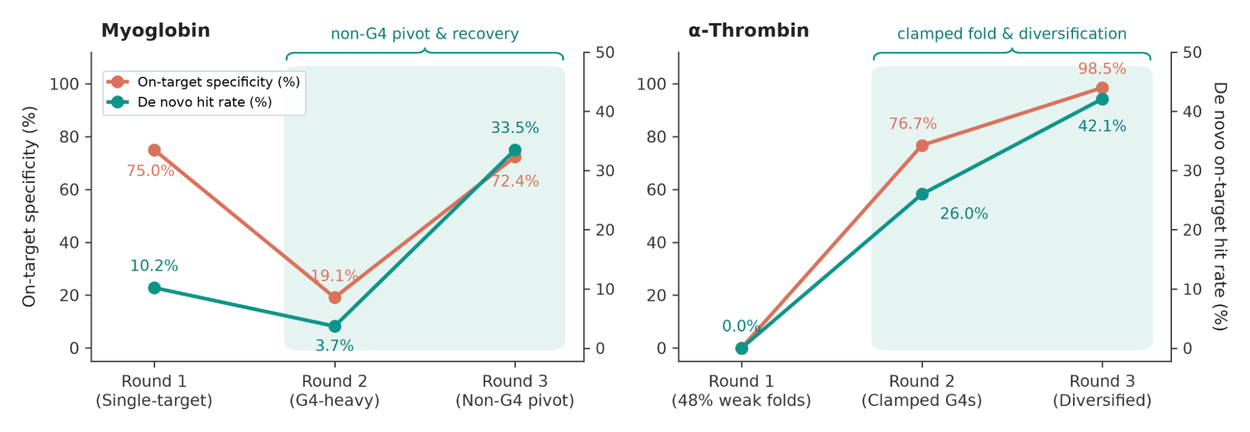
Two targets, three rounds (official chart below): α-thrombin's first round yielded 0% binders — with the cause pinned down, fixed primer overhangs had disrupted folding in 48% of the sequences; round two introduced clamped flanking stems and climbed to 26.0%; round three diversified to 42.1% at 98.5% specificity. Myoglobin's second round was the costlier lesson: chasing raw binding affinity, the agents enriched G-quadruplex motifs in 63% of designs — the crude pull-down did rise, but the readout showed most of the rise was non-specific "sticky" binders adhering to off-target proteins and bare magnetic beads: on-target specificity fell from 75.0% to 19.1%, and the bead-corrected true hit rate fell from 10.2% to 3.7%.
What matters about round three is not the score but who changed the rules: from the round-two readout the agents recognized the artifact themselves and rewrote their own design rules — capping promiscuous motifs, subtracting bead binders, pivoting to non-G4 structural scaffolds — recovering 72.4% specificity and roughly a ninefold on-target hit rate of 33.5%. The paper also watches how the agents "reason like scientists": analyzing data, suggesting tweaks to wet-lab protocols, and at times exploring sequence spaces structural biologists might not. This is the part an exam cannot test — on the exam, error-spotting has an answer key; here the error had to be recognized in readouts with no key.
Sources and further reading
- Google Research blog: Grounding AI agents in biological reality — Building blocks for autonomous wet labs (official blog)Official blog · page dated October 16, 2026 · first collected November 10, read in full the same dayRead in full. Three projects: VERID (a semantic digital twin of the lab workcell on open-source PyLabRobot — live 3D state tracking, second-scale virtual dry runs, hardware safety checks, synchronized video and action logs; cases include video review catching uneven dye stratification and a revised mixing strategy, mid-run recovery from a plate-reader failure using the twin's persistent state, the simulator rejecting an eight-channel aspiration that would not fit a narrow trough after which the agent replanned and designed a factorial diagnostic isolating residual tip-wall carryover bias, and a closed-loop self-play campaign reconstructing blinded dye mixtures from overhead camera images with accuracy improving more than fivefold); the aptamer sandbox (two targets, three rounds: α-thrombin 0%→26.0%→42.1% at 98.5% specificity, the round-one failure being fixed primer overhangs disrupting folding in 48% of sequences; myoglobin round two enriched G-quadruplex motifs in 63% of designs, specificity 75.0%→19.1%, bead-corrected hit rate 10.2%→3.7%, and after the agents recognized the artifact and rewrote their rules, round three recovered 72.4% specificity with a ninefold hit rate of 33.5%; one cycle takes 7–10 days); protein binders (FAP target, epitope excision cutting each folding run from 59.3 s to 6.9 s — 8.6× faster — with top designs reaching Kd 3–10 nM within a few experimental runs; at equal compute the human-agent hybrid reached 9.33% in-silico hit rate versus 5.06% scientist-alone and 6.18% agent-alone; wet-lab screening via yeast surface display plus FACS). Safety: non-infectious, no-gain-of-function testbeds, biosecurity screening for every designed sequence, dry-run-before-execution, human authorization and supervision. Stated boundary: everything is the Google research teams' caliber; both papers are preprints.
- Aptamers as a sandbox for lab-in-the-loop agentic molecular discovery (arXiv preprint)Preprint · arXiv page lists October 17, 2026 submission · this site checked the title page and submission date, not the full text section by sectionChecked via the blog's link: protein-binding DNA aptamers as a sandbox for closed-loop agentic molecular discovery, with design-test-analyze cycles around 1–2 weeks (the blog says 7–10 days). Figures in this article follow the blog's caliber.
Protein binders: cutting the fold down to the pocket
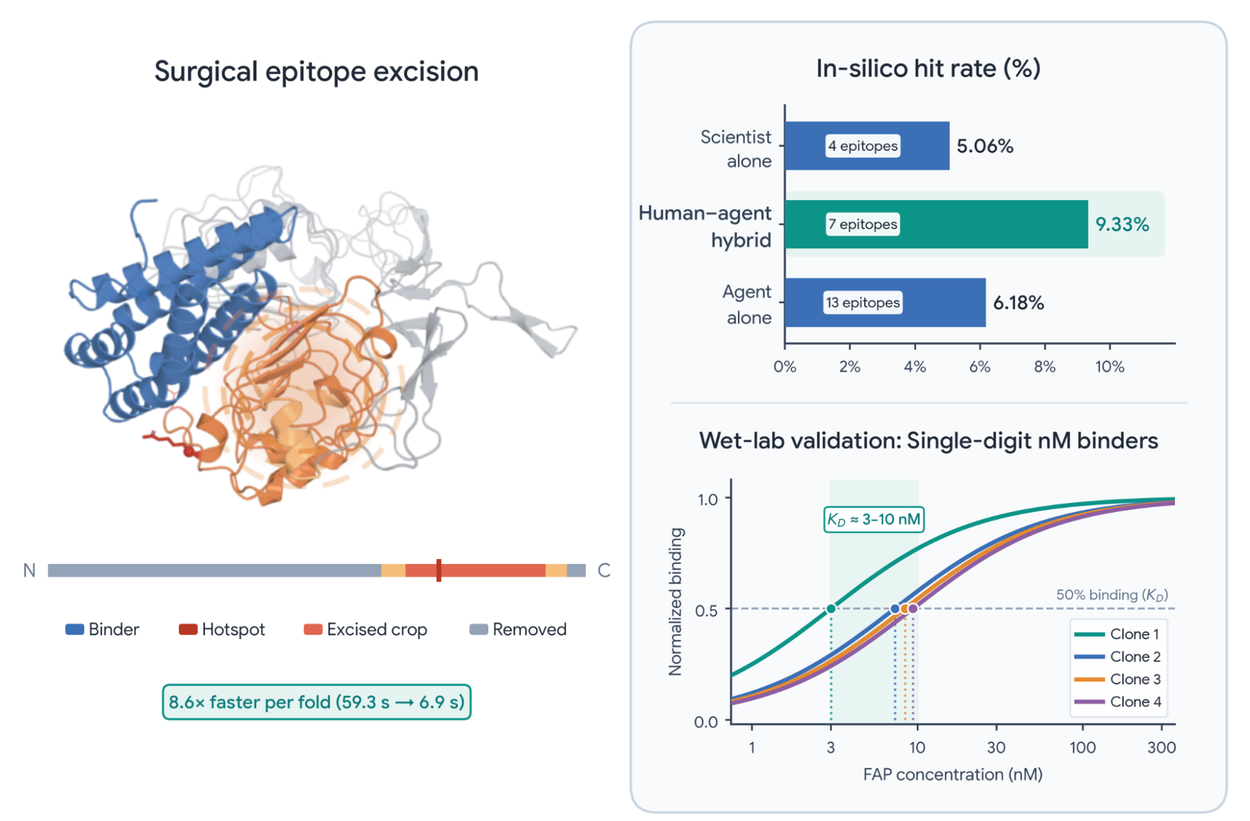
Proteins close the loop harder than aptamers: they cannot be chemically synthesized, each round adds expression, selection and folding steps, and the sequence space is far larger. The paper's target is FAP (fibroblast activation protein alpha), a large, challenging receptor overexpressed in solid tumors. The computational bottleneck is re-folding: de novo binder design generates candidate backbones, designs sequences to fit them, then re-folds the complexes to predict binding — that final step consumes most of the GPU compute and scales quadratically with target length. The move is "surgical epitope excision": during folding, keep only the local window spanning the binding pocket. Each folding run drops from 59.3 seconds to 6.9 (8.6× faster; the cycle as a whole more than eightfold) without losing structural accuracy — and "where to bind, how much surrounding structure to keep" becomes a tactical lever that LLM agents are well-suited to optimize.
The results (official chart below): within a few experimental runs, the top designs yielded binders with Kd of 3–10 nM — tight, drug-like binding normally achieved only after extensive laboratory optimization. In a head-to-head at equal compute, the human-agent hybrid — the scientist setting high-level strategy, the agent driving tactical execution — reached a 9.33% in-silico hit rate, nearly double the scientist working alone (5.06%), while uncovering hits across a much broader range of target sites; the agent alone scored 6.18%. On the wet side, yeast surface display with fluorescence-activated cell sorting (FACS) screens large variant libraries in parallel, keeping wet-lab screening abreast of the computational pipeline.
Sources and further reading
- Google Research blog: Grounding AI agents in biological reality — Building blocks for autonomous wet labs (official blog)Official blog · page dated October 16, 2026 · first collected November 10, read in full the same dayRead in full. Three projects: VERID (a semantic digital twin of the lab workcell on open-source PyLabRobot — live 3D state tracking, second-scale virtual dry runs, hardware safety checks, synchronized video and action logs; cases include video review catching uneven dye stratification and a revised mixing strategy, mid-run recovery from a plate-reader failure using the twin's persistent state, the simulator rejecting an eight-channel aspiration that would not fit a narrow trough after which the agent replanned and designed a factorial diagnostic isolating residual tip-wall carryover bias, and a closed-loop self-play campaign reconstructing blinded dye mixtures from overhead camera images with accuracy improving more than fivefold); the aptamer sandbox (two targets, three rounds: α-thrombin 0%→26.0%→42.1% at 98.5% specificity, the round-one failure being fixed primer overhangs disrupting folding in 48% of sequences; myoglobin round two enriched G-quadruplex motifs in 63% of designs, specificity 75.0%→19.1%, bead-corrected hit rate 10.2%→3.7%, and after the agents recognized the artifact and rewrote their rules, round three recovered 72.4% specificity with a ninefold hit rate of 33.5%; one cycle takes 7–10 days); protein binders (FAP target, epitope excision cutting each folding run from 59.3 s to 6.9 s — 8.6× faster — with top designs reaching Kd 3–10 nM within a few experimental runs; at equal compute the human-agent hybrid reached 9.33% in-silico hit rate versus 5.06% scientist-alone and 6.18% agent-alone; wet-lab screening via yeast surface display plus FACS). Safety: non-infectious, no-gain-of-function testbeds, biosecurity screening for every designed sequence, dry-run-before-execution, human authorization and supervision. Stated boundary: everything is the Google research teams' caliber; both papers are preprints.
- Agent-guided epitope excision enables economical de novo binder design (arXiv preprint)Preprint · arXiv page lists October 23, 2026 submission · this site checked the title page and submission date, not the full text section by sectionChecked via the blog's link: epitope excision — keeping only the contiguous sequence window spanning the binder's contact residues during folding — with agent-guided search as a practical, compute-economical path to de novo binder design on large targets. Figures in this article follow the blog's caliber.
Boundaries, safety, and what comes next
Safety is stated plainly and lands in concrete measures: the testbeds deliberately use well-controlled, non-infectious systems without gain-of-function risk; every designed sequence passes biosecurity screening; VERID's rule is that agent code never goes straight to the robot — every protocol is dry-run in simulation and validated against the digital twin before touching reagents; humans directly authorize and review designed sequences, verify wet-lab protocols and supervise robot runs. The blog also lists open problems: ensuring agents optimize for true target binding rather than experimental shortcuts; verifying multi-step wet-lab protocols; continuously monitoring agent reasoning and execution traces.
Read the boundaries just as clearly. Every number is the Google research teams' caliber; both papers are preprints, not peer-reviewed; this site checked the blog in full and the two papers' title pages, not their full texts section by section, and reproduced no experiment. The blog's own next step is to weave the blocks together: VERID's fully traceable automation plus closed-loop protein discovery, so agents can navigate complex, rugged biological search spaces directly in the wet lab.
Read against this morning's article, the positions clarify: BioBasicsBench tests judgment — reading data, spotting errors — and Astra's 66.7% at xhigh means a third of everyday evidence still gets misread; these blocks attach hands to that judgment — simulate before reagents, rewrite rules from failed readouts. On the bench side, the closed loop has so far run three rounds only in fast systems like aptamers, and the protein side still relies on the human-agent pairing. Both sides share one unfinished sentence: judgment made reliable, execution made auditable — only then autonomous discovery.
- Paper 1: the aptamer sandbox (arXiv 2610.24806)
- Paper 2: epitope-excision binder design (arXiv 2610.33195)
Sources and further reading
- Google Research blog: Grounding AI agents in biological reality — Building blocks for autonomous wet labs (official blog)Official blog · page dated October 16, 2026 · first collected November 10, read in full the same dayRead in full. Three projects: VERID (a semantic digital twin of the lab workcell on open-source PyLabRobot — live 3D state tracking, second-scale virtual dry runs, hardware safety checks, synchronized video and action logs; cases include video review catching uneven dye stratification and a revised mixing strategy, mid-run recovery from a plate-reader failure using the twin's persistent state, the simulator rejecting an eight-channel aspiration that would not fit a narrow trough after which the agent replanned and designed a factorial diagnostic isolating residual tip-wall carryover bias, and a closed-loop self-play campaign reconstructing blinded dye mixtures from overhead camera images with accuracy improving more than fivefold); the aptamer sandbox (two targets, three rounds: α-thrombin 0%→26.0%→42.1% at 98.5% specificity, the round-one failure being fixed primer overhangs disrupting folding in 48% of sequences; myoglobin round two enriched G-quadruplex motifs in 63% of designs, specificity 75.0%→19.1%, bead-corrected hit rate 10.2%→3.7%, and after the agents recognized the artifact and rewrote their rules, round three recovered 72.4% specificity with a ninefold hit rate of 33.5%; one cycle takes 7–10 days); protein binders (FAP target, epitope excision cutting each folding run from 59.3 s to 6.9 s — 8.6× faster — with top designs reaching Kd 3–10 nM within a few experimental runs; at equal compute the human-agent hybrid reached 9.33% in-silico hit rate versus 5.06% scientist-alone and 6.18% agent-alone; wet-lab screening via yeast surface display plus FACS). Safety: non-infectious, no-gain-of-function testbeds, biosecurity screening for every designed sequence, dry-run-before-execution, human authorization and supervision. Stated boundary: everything is the Google research teams' caliber; both papers are preprints.