Models and robotics
Robots rehearse in simulation, then join the Mercedes line: Gemini Robotics 2.5
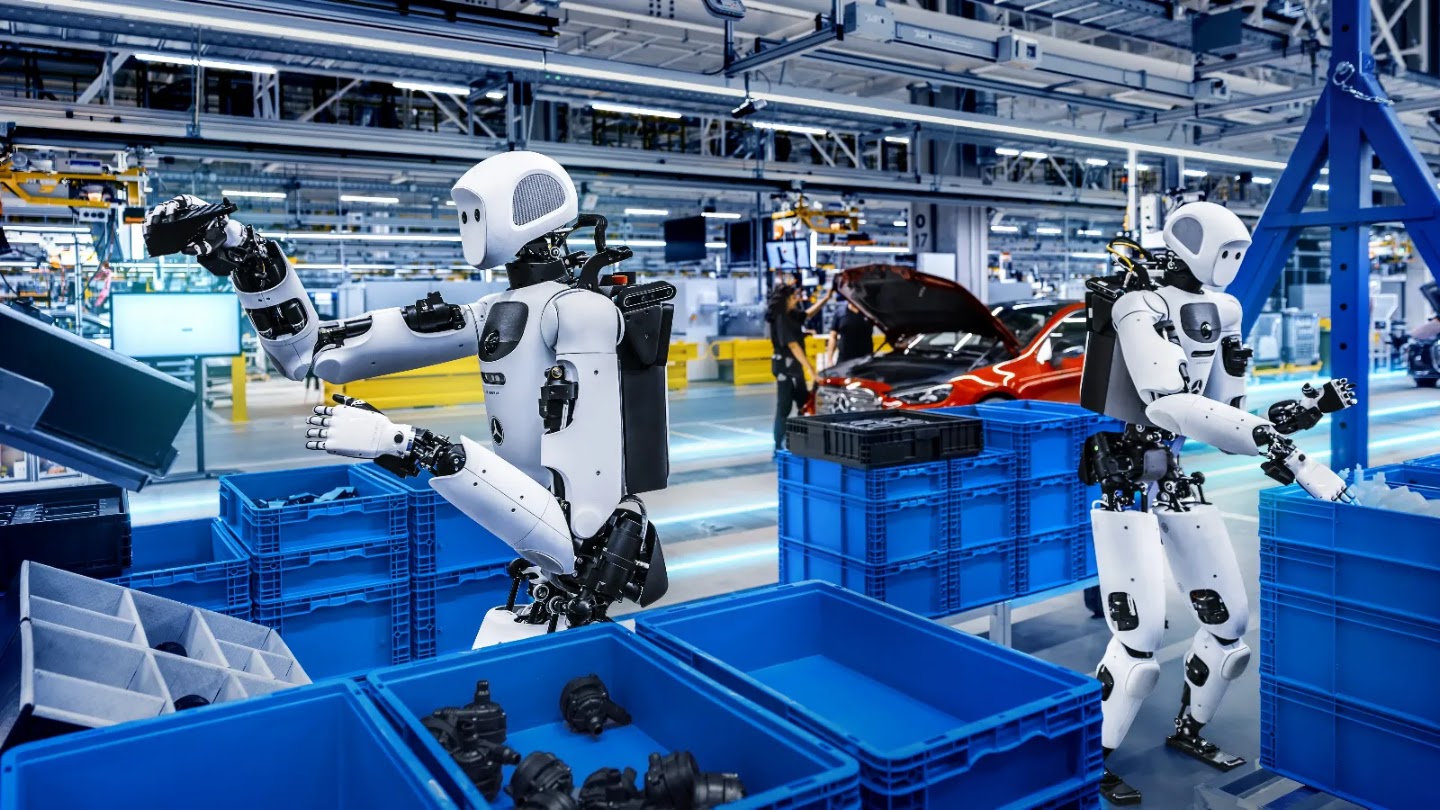
On November 10 Google DeepMind introduced Gemini Robotics 2.5, a vision-language-action model: on two active Mercedes-Benz lines in Hungary and Germany, Apptronik's Apollo 2 humanoid used it to perform automotive kitting — sorting loose parts into sequencing trays in the exact order each vehicle needs — with a 96% success rate at proof-of-concept caliber. Official evaluations span 200 tasks with success rates 30–100% higher than the previous baseline and tasks finished 20–30% faster; the official chart shows packing pastries with tongs going from 5% to 100%, and several tasks where the previous generation scored zero. On safety it adds inference-time guidance to steer around obstacles and people, and the new open-source ASIMOV-Jailbreak benchmark: Gemini 4 Argon resists 99.5% versus 82% for the previous baseline, Gemini Robotics ER 2. The most instructive part is the training loop: the general model Argon acts as a simulation engine, generating thousands of simulated practice runs from a single real camera scene, building a realistic digital twin, and merging them with real demonstrations to train the actions model. Boundaries: everything is Google's caliber; the robot platform and the pilot results cannot stand in for each other; the model rolls out to robotics partners only, with no public access and no third-party benchmark yet.
This account draws on DeepMind's official post "Gemini Robotics 2.5 accelerates real-world general dexterity" (page dated November 10, 2026, bylined Carolina Parada; read in full by this site on November 11); the charts are that post's own images. Every figure is Google's official caliber: this site has no robot, ran and re-tested nothing, and has read no third-party benchmark.
The kitting test on the line, at pilot caliber
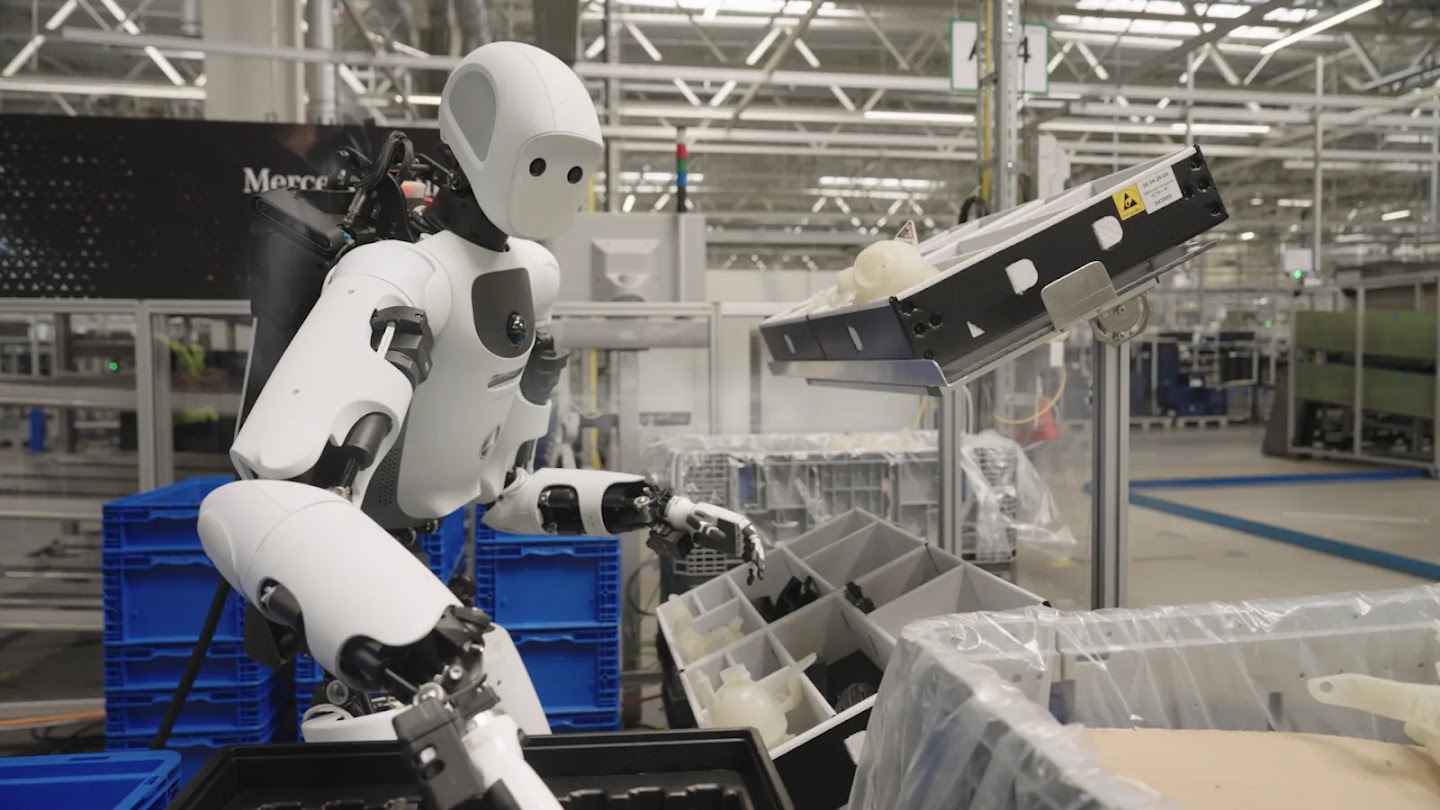
Google treats "can it work dependably in an active workplace" as the real test for a robotics model. This pilot joins three parties — DeepMind, Apptronik and Mercedes-Benz: on active automotive lines in Kecskemét, Hungary and Sindelfingen, Germany, the Apollo 2 humanoid performs automotive kitting, taking metal brackets one by one from bulk bins into sequencing containers in the exact order each vehicle on the line needs. Not a lab demo cell — a line that is still running.
The division of labor is explicit: the embodied reasoning model Gemini Robotics ER tracks the workflow, the actions model Gemini Robotics 2.5 controls hands and arms, and the robot corrects gaps and misplacements as it goes. The reported success rate is 96% — with the caliber stated: a proof-of-concept figure from specified tasks on two named lines, not a plant-wide rate, and the post attaches no timeline for scaling.
For readers, the interesting part is not how dexterous the robot looks but how the task was chosen: kitting is repetitive, physically taxing and labor-binding, while the cost of an error stays local. Google frames handing this prep work to robots as freeing technicians for complex assembly — a concrete shift in factory work allocation, still at pilot stage.
Sources and further reading
- DeepMind's official post: Gemini Robotics 2.5 accelerates real-world general dexterityOfficial blog · page dated November 10, 2026 · read in full November 11Read in full. Checked the key claims: Gemini Robotics 2.5 is billed as the most capable vision-language-action model to date, rolling out to robotics partners; evaluations span 200 distinct tasks (serving food with tongs, tying a bow, pipetting) with success rates 30–100% higher than previous baselines depending on task type and tasks finished 20–30% faster; the Mercedes pilot ran on active lines in Kecskemét (Hungary) and Sindelfingen (Germany), with Apptronik's Apollo 2 (five-finger, 22-DoF SharpaWave hand) performing automotive kitting while Gemini Robotics ER tracks the workflow and GR-2.5 controls hands and arms, at a 96% success rate (proof-of-concept caliber); native support spans Apollo 2 and the Franka Duo with two-fingered parallel grippers; inference-time reasoning guidance lifted safe task completion around obstacles by 33% and around nearby people by 43% (official evaluations); the open-source ASIMOV-Jailbreak benchmark packs hundreds of prompts disguising unsafe requests across dozens of scenes, where Argon resists 99.5% versus 82% for the previous baseline, Gemini Robotics ER 2; Argon acts as a simulation engine — thousands of varied simulated practice runs from one real camera scene, a realistic digital twin, failure hypotheses from video tested in simulation and on real robots; the post frames itself as continuing this year's "whole-body intelligence" work from Gemini Robotics 2. Byline Carolina Parada; acknowledgements include Apptronik, Mercedes-Benz and Agile teams.
Two hundred tasks: read the baseline first
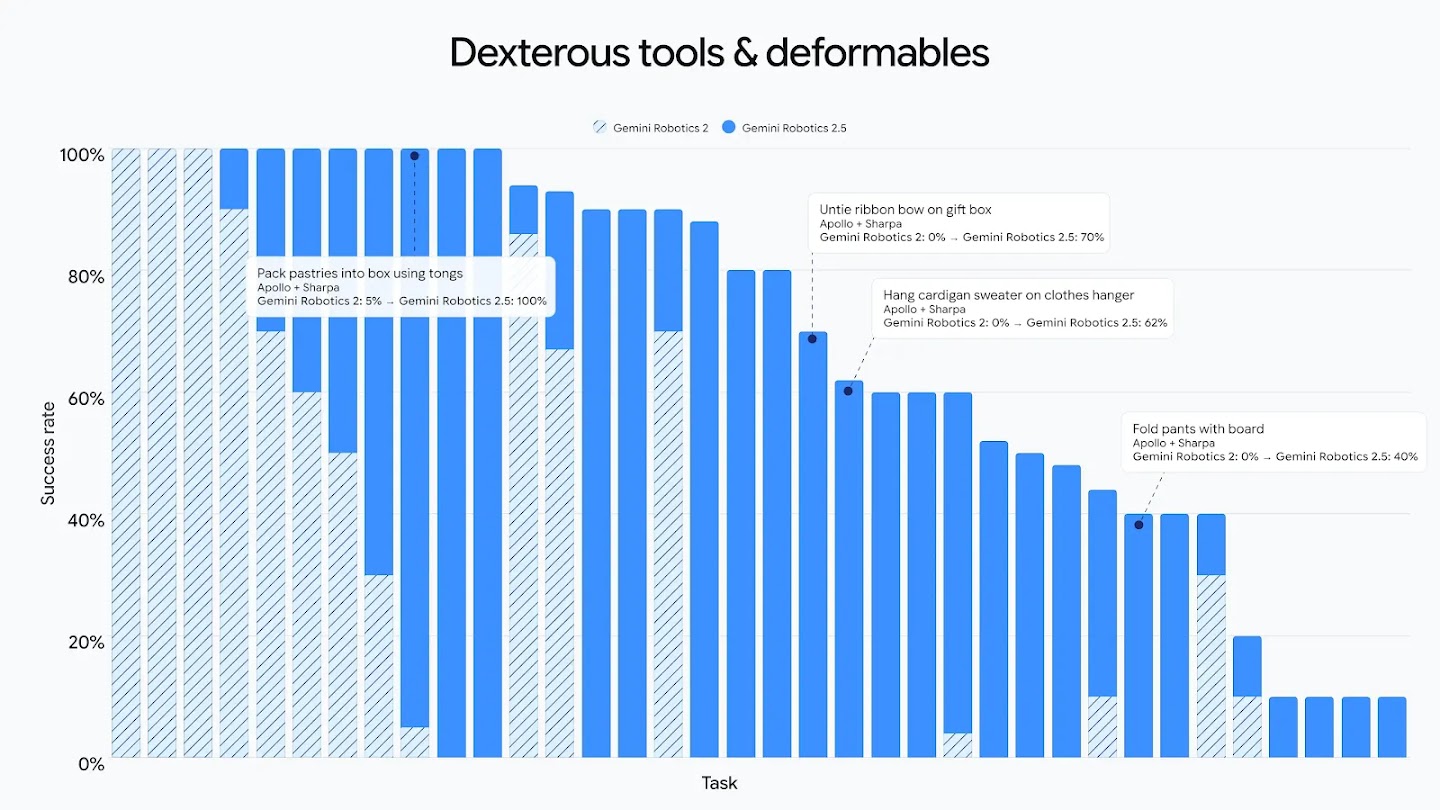
Capability evaluations span 200 distinct tasks: serving food with tongs, tying a bow on a gift box, pipetting liquid. What they share is the need to combine tool use, deformable-object handling and a light touch. The official caliber: success rates 30–100% higher than previous baselines depending on task type (relative values), with tasks finished 20–30% faster.
The official chart makes the before-and-after blunt: packing pastries into a box with tongs goes from 5% to 100%, untying a ribbon bow from 0 to 70%, hanging a cardigan on a hanger from 0 to 62%, folding pants with a board from 0 to 40% (Apollo + Sharpa setup). What deserves attention is not the size of the gains but the baseline column — several tasks scored zero with the previous generation, which means not "done badly before" but "not doable before." Those zero-to-something rows are the actual evidence of task breadth expanding.
The same model natively works across different bodies: the Apollo 2 humanoid (five-finger, 22-degree-of-freedom SharpaWave hand) and the Franka Duo platform with two-fingered parallel grippers are both on its adaptation list. Keeping the actions model and the robot platform separate matters — the same success rate cannot be carried from one body to another.
Sources and further reading
- DeepMind's official post: Gemini Robotics 2.5 accelerates real-world general dexterityOfficial blog · page dated November 10, 2026 · read in full November 11Read in full. Checked the key claims: Gemini Robotics 2.5 is billed as the most capable vision-language-action model to date, rolling out to robotics partners; evaluations span 200 distinct tasks (serving food with tongs, tying a bow, pipetting) with success rates 30–100% higher than previous baselines depending on task type and tasks finished 20–30% faster; the Mercedes pilot ran on active lines in Kecskemét (Hungary) and Sindelfingen (Germany), with Apptronik's Apollo 2 (five-finger, 22-DoF SharpaWave hand) performing automotive kitting while Gemini Robotics ER tracks the workflow and GR-2.5 controls hands and arms, at a 96% success rate (proof-of-concept caliber); native support spans Apollo 2 and the Franka Duo with two-fingered parallel grippers; inference-time reasoning guidance lifted safe task completion around obstacles by 33% and around nearby people by 43% (official evaluations); the open-source ASIMOV-Jailbreak benchmark packs hundreds of prompts disguising unsafe requests across dozens of scenes, where Argon resists 99.5% versus 82% for the previous baseline, Gemini Robotics ER 2; Argon acts as a simulation engine — thousands of varied simulated practice runs from one real camera scene, a realistic digital twin, failure hypotheses from video tested in simulation and on real robots; the post frames itself as continuing this year's "whole-body intelligence" work from Gemini Robotics 2. Byline Carolina Parada; acknowledgements include Apptronik, Mercedes-Benz and Agile teams.
Safety: steering around obstacles and people, then a jailbreak exam
Once a robot leaves the lab, safety stops being a model property and becomes a physical one. Gemini Robotics 2.5 applies inference-time reasoning guidance to steer around physical hazards in real time — analogous to the safety classifiers wrapped around language models, this layer lets the robot reroute in messy environments. The official evaluation figures: safe task completion around obstacles up 33%, and up 43% around nearby people.
Safety for long-horizon agentic tasks gets a new benchmark: ASIMOV-Jailbreak ships open-source with hundreds of prompts disguising unsafe requests across dozens of scenes. The scorecard: Gemini 4 Argon resists 99.5% of jailbreak attempts, versus 82% for the previous baseline, Gemini Robotics ER 2. Two calibers to keep apart — Argon is being evaluated here as the embodied reasoning layer, and this is still Google's own exam; the point of open-sourcing is that others can now run the same questions against different models.
Sources and further reading
- DeepMind's official post: Gemini Robotics 2.5 accelerates real-world general dexterityOfficial blog · page dated November 10, 2026 · read in full November 11Read in full. Checked the key claims: Gemini Robotics 2.5 is billed as the most capable vision-language-action model to date, rolling out to robotics partners; evaluations span 200 distinct tasks (serving food with tongs, tying a bow, pipetting) with success rates 30–100% higher than previous baselines depending on task type and tasks finished 20–30% faster; the Mercedes pilot ran on active lines in Kecskemét (Hungary) and Sindelfingen (Germany), with Apptronik's Apollo 2 (five-finger, 22-DoF SharpaWave hand) performing automotive kitting while Gemini Robotics ER tracks the workflow and GR-2.5 controls hands and arms, at a 96% success rate (proof-of-concept caliber); native support spans Apollo 2 and the Franka Duo with two-fingered parallel grippers; inference-time reasoning guidance lifted safe task completion around obstacles by 33% and around nearby people by 43% (official evaluations); the open-source ASIMOV-Jailbreak benchmark packs hundreds of prompts disguising unsafe requests across dozens of scenes, where Argon resists 99.5% versus 82% for the previous baseline, Gemini Robotics ER 2; Argon acts as a simulation engine — thousands of varied simulated practice runs from one real camera scene, a realistic digital twin, failure hypotheses from video tested in simulation and on real robots; the post frames itself as continuing this year's "whole-body intelligence" work from Gemini Robotics 2. Byline Carolina Parada; acknowledgements include Apptronik, Mercedes-Benz and Agile teams.
The loop back to the source: a general model as the practice floor
The most instructive thing in this announcement is not any single percentage but the structure of the training loop. The old bottleneck in teaching robots new skills is scarce, expensive physical data. Google's answer is to cast Gemini 4 Argon as a simulation engine: from one real camera scene it generates thousands of varied simulated practice runs and builds a realistic digital twin; merged with real demonstrations, that data speeds the robot's generalization to new scenes and objects.
Argon also does the debugging: it hypothesizes why a task failed from video footage, trials improvements in simulation first, then verifies on real robots. Source-level general capability and the specialized actions model divide the work — the general model supplies data and diagnosis, the actions model supplies stable execution. The official Spot demonstration this site recorded in October (camera in, pedal practice in simulation, execution on hardware) was the previous scene of the same pattern; this time it comes with a dedicated actions model, two factories and a quantified success rate.
The coordinates are clearer side by side: on the general-model side, Argon (high) sits at 50 on the AA leaderboard this site records, with independent evaluation; the Robotics 2.5 model it helped train has only Google's own figures — no third-party benchmark yet. Our physical video-continuation board (Physics-IQ) tracks understanding physical outcomes; this piece tracks producing physical actions — the lines meet at physical intelligence but cannot substitute for each other. Worth waiting for next: third-party runs of the open-source ASIMOV-Jailbreak, and the first independent measurement that does not rest on a partner narrative.
- Read DeepMind's original announcementThe official blog post, page dated November 10, 2026; source of all figures and images.
- See the previous scene: Argon's robot-practice chapterPublished here in October: the official Spot demonstration's rehearse-in-simulation pattern and hardware roles.
Sources and further reading
- DeepMind's official post: Gemini Robotics 2.5 accelerates real-world general dexterityOfficial blog · page dated November 10, 2026 · read in full November 11Read in full. Checked the key claims: Gemini Robotics 2.5 is billed as the most capable vision-language-action model to date, rolling out to robotics partners; evaluations span 200 distinct tasks (serving food with tongs, tying a bow, pipetting) with success rates 30–100% higher than previous baselines depending on task type and tasks finished 20–30% faster; the Mercedes pilot ran on active lines in Kecskemét (Hungary) and Sindelfingen (Germany), with Apptronik's Apollo 2 (five-finger, 22-DoF SharpaWave hand) performing automotive kitting while Gemini Robotics ER tracks the workflow and GR-2.5 controls hands and arms, at a 96% success rate (proof-of-concept caliber); native support spans Apollo 2 and the Franka Duo with two-fingered parallel grippers; inference-time reasoning guidance lifted safe task completion around obstacles by 33% and around nearby people by 43% (official evaluations); the open-source ASIMOV-Jailbreak benchmark packs hundreds of prompts disguising unsafe requests across dozens of scenes, where Argon resists 99.5% versus 82% for the previous baseline, Gemini Robotics ER 2; Argon acts as a simulation engine — thousands of varied simulated practice runs from one real camera scene, a realistic digital twin, failure hypotheses from video tested in simulation and on real robots; the post frames itself as continuing this year's "whole-body intelligence" work from Gemini Robotics 2. Byline Carolina Parada; acknowledgements include Apptronik, Mercedes-Benz and Agile teams.
- Artificial Analysis leaderboard: Gemini 4 Argon (high) at 50Independent evaluation · board observed by this site November 11, 2026Recorded in this site's same-day full-board reread: Argon (high) at 50. Used to place the source-side general model — it already has independent evaluation on language and agentic work, while the Robotics 2.5 model it helped train has only Google's own figures. Board scores and robot task success rates cannot be converted into each other.