Models · source capability
Gemini 4 Hydrogen arrives: Google fills in the everyday tier of its frontier family
On November 12 Google introduced Gemini 4 Hydrogen, filling in the everyday-execution tier of the Gemini 4 family: while Carbon and Argon handle deep, long-horizon reasoning, Hydrogen is built for fast coding and agentic workflows — and it is available to everyone from day one, across all tiers of AI Studio, the Gemini API, business surfaces, the Gemini app and Google Search, with paid Google AI Pro/Ultra subscribers getting it in Antigravity and Google Sheets as well. Pricing is flat across the 1M-token context window: $1.50 per million input tokens and $7.50 per million output tokens, with 1M-token input, up to 1M-token output, and four thinking levels — low, medium, high (default) and a new xhigh. The scores are the checkable part of this story: Artificial Analysis' live board already lists four tiers — xhigh 54, high 51 (above Argon's high of 50), medium 41 and low 27 — matching Google's own claims, and the high tier runs about $1.87 per task versus $4.97 for Argon, taking 8.3 minutes against 30.1. Google also turned multi-model division of labor into a product: Antigravity gains Orchestrator, which switches between Carbon and Hydrogen within one session, reaching near-full-Carbon success on Terminal-Bench 4.0 with 24% less quota and 19% faster completion. The official comparison table is not a clean sweep — against Claude Sonnet 5.5, Hydrogen trails on Terminal-Bench 4.1 (63.9% versus 57.0%), OSWorld-2.1 (83.9% versus 77.6%) and Terminal-Bench-Science (59.9% versus 51.4%). The boundaries, quoted as given: apart from AA's independent board, the benchmark tables, cost curves and safety-behavior figures are vendor-run; this site has run none of them.
This account draws on two sources: Google's official blog (dated November 12 on the page; read in full by this site on November 13) and Artificial Analysis' live leaderboard (re-read in full via direct fetch on November 13). Hydrogen's four effort tiers already appear on the independent board, matching the official page's claims; the benchmark comparison table, cost curves and safety-behavior figures beyond that are vendor-run, and this site has run none of them.
Available to everyone from day one
Google's third Gemini 4 name is introduced plainly: Carbon and Argon handle deep, long-horizon reasoning on the hardest problems, while Hydrogen is built for rapid execution across diverse agentic workflows — the official social copy calls it the daily driver. The announcement is dated November 12 (the small hours of November 13, Beijing time), signed by DeepMind's Koray Kavukcuoglu. A family division of labor is not a new idea; what is new this time is that the everyday tier ships scores and prices you can check item by item, and it is open to everyone on day one.
The surfaces cover Google's main entries: every tier of AI Studio, the Gemini API, Gemini for business, the Gemini app and Google Search for all users, plus Antigravity and Google Sheets for paid Google AI Pro/Ultra subscribers, with Android Studio supported as well. Set that against Carbon's cadence in the same family — launched October 28 to a small group of cyber defenders and only generally available on November 10 — and Hydrogen is the first model here that is usable the day it ships.
Pricing and window are flat-rate: $1.50 per million input tokens and $7.50 per million output tokens across the entire 1M-token context window, with native 1M-token input and up to 1M-token output. There are four thinking levels — low, medium, high (default) and a new xhigh — in Google's words, so you only wait and pay for the reasoning depth a task requires. Placed next to Carbon's introductory $2/$10 (later $4/$20), Hydrogen's role is plain: the cheap, fast, always-adjustable member of the family.
Sources and further reading
- Google's official blog post "Introducing Gemini 4 Hydrogen"Official announcement · page dated November 12, 2026 · read in full by this site on November 13Read in full. Checked the key claims: family positioning (Carbon/Argon for deep long-horizon reasoning, Hydrogen for rapid execution); availability (all AI Studio tiers, the Gemini API, Gemini for business, the Gemini app, Google Search for all users, Antigravity for paid Pro/Ultra, Android Studio); pricing of $1.50/$7.50 per million tokens flat across the 1M-token context, 1M-token input and up to 1M-token output; four thinking levels including the new xhigh; the official claim of AA high 51 versus Argon's 50 and 54 at xhigh; Orchestrator reaching near-full-Carbon success on Terminal-Bench 4.0 with 24% less quota on average and 19% faster completion; versus 3.8 Flash, 2.5× faster at high, Terminal-Bench 4.1 at 57% versus 18.2%, and over 5× fewer fabricated claims; the comparison table against Sonnet 5.5 and Terra with both wins and losses; the safety figures (overreach down up to 81%, under-service up to 79%, misaligned actions and shortcutting down 12×, 96.7% on the internal honesty evaluation, 99.9% chain-of-thought legibility across 200,000+ audited turns, 2.3× resilience on Gray Swan's IPI benchmark, sub-0.4% false refusals on HealthBench Pro); and the official evals-methodology page at deepmind.google/models/evals-methodology/gemini-4-hydrogen.
A checkable entry point: 54 and $1.87 a task
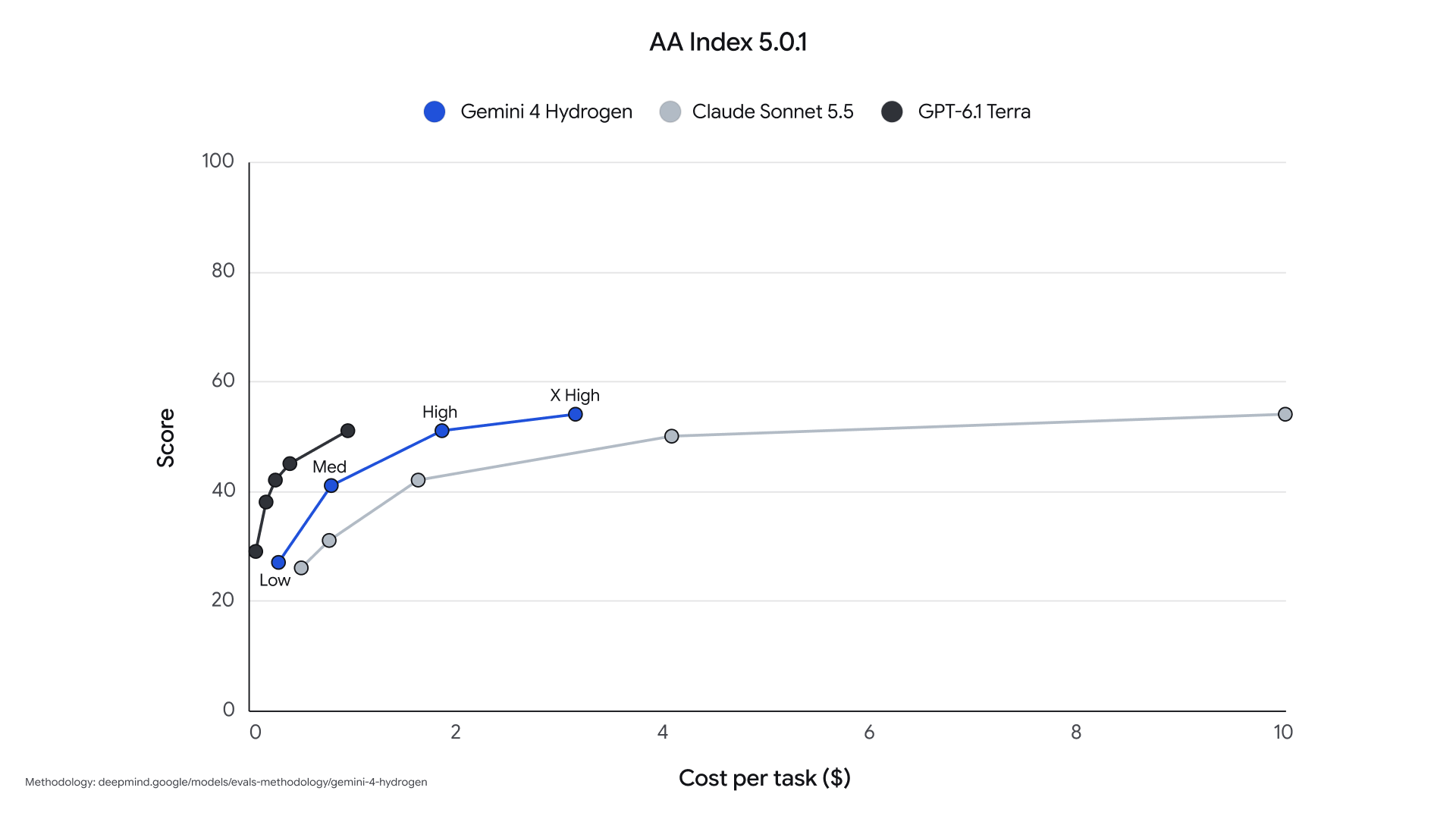
The scores are the checkable part of this story. Artificial Analysis' live board already lists Hydrogen's four tiers — xhigh 54, high 51, medium 41 and low 27 — exactly matching the official page's claim of 51 at high, above Argon's 50, and 54 at xhigh. Slotted into this site's full-board re-read of November 13, Hydrogen (xhigh 54) lands after Sonnet 5.5 (max 55) and before Terra (max 51); within the family it sits below Fable 5.2 (max 65) and Carbon (high 60), above Argon (high 50) and the previous everyday tier, 3.8 Flash (high 31).
Score next to bill makes the positioning clearer: the high tier runs about $1.87 per task in 8.3 minutes, xhigh about $3.16 in 13.5 minutes, while Argon high costs $4.97 and takes 30.1 minutes — one point above the previous deep-reasoning model, for roughly a third of the money and under half the time. Google's own cost-quality curve draws the same picture: through the $1–3 range, Hydrogen's curve sits below Claude Sonnet 5.5's, reaching a similar 50-point grade at a cost point Sonnet only passes beyond $4. The chart is labelled AA Index 5.0.1; the version history on Artificial Analysis' methodology page says 5.0.1 (November 2026 to current) only incorporated grading robustness improvements from the CritPt authors and regraded all models on CritPt v2, and every catalogued row in today's full re-read matches the November 11 read exactly.
Against 3.8 Flash, the everyday-tier predecessor it formally replaces, the official claims come as multiples: 2.5× faster task completion at high, Terminal-Bench 4.1 rising from 18.2% to 57%, and over 5× fewer fabricated claims; in partners' early use, complex graphs, SQL and data-heavy workflows ran 2–2.8× faster with 12–23% fewer tokens. These are vendor figures — but they point at named benchmarks with public board positions, not vague claims of being faster and smarter.
Sources and further reading
- Google's official blog post "Introducing Gemini 4 Hydrogen"Official announcement · page dated November 12, 2026 · read in full by this site on November 13Read in full. Checked the key claims: family positioning (Carbon/Argon for deep long-horizon reasoning, Hydrogen for rapid execution); availability (all AI Studio tiers, the Gemini API, Gemini for business, the Gemini app, Google Search for all users, Antigravity for paid Pro/Ultra, Android Studio); pricing of $1.50/$7.50 per million tokens flat across the 1M-token context, 1M-token input and up to 1M-token output; four thinking levels including the new xhigh; the official claim of AA high 51 versus Argon's 50 and 54 at xhigh; Orchestrator reaching near-full-Carbon success on Terminal-Bench 4.0 with 24% less quota on average and 19% faster completion; versus 3.8 Flash, 2.5× faster at high, Terminal-Bench 4.1 at 57% versus 18.2%, and over 5× fewer fabricated claims; the comparison table against Sonnet 5.5 and Terra with both wins and losses; the safety figures (overreach down up to 81%, under-service up to 79%, misaligned actions and shortcutting down 12×, 96.7% on the internal honesty evaluation, 99.9% chain-of-thought legibility across 200,000+ audited turns, 2.3× resilience on Gray Swan's IPI benchmark, sub-0.4% false refusals on HealthBench Pro); and the official evals-methodology page at deepmind.google/models/evals-methodology/gemini-4-hydrogen.
- Artificial Analysis model leaderboard and methodology pageIndependent evaluator's live board · full-board re-read via direct fetch on November 13 (web_reader returned a cached copy without Hydrogen; verified via direct fetch)Full-board re-read. Hydrogen's four tiers: xhigh 54 ($3.16 per task, 13.5 minutes), high 51 ($1.87, 8.3 minutes), medium 41 ($0.80, 3.7 minutes) and low 27 ($0.29, 1.3 minutes), against Argon high 50 ($4.97, 30.1 minutes) and Gemini 3.8 Flash high 31 ($7.77, 14.8 minutes). The methodology page now labels the Intelligence Index v5.0.1; its version history states 5.0.1 (November 2026 to current) only "incorporated grading robustness improvements from the CritPt authors and regraded all models on CritPt v2"; every catalogued row's displayed score matches our November 11 full read.
Orchestrator: multi-model division of labor becomes a switch
The part of this launch that touches working form most directly is not the model itself but Orchestrator, new in Antigravity: within a single session the orchestrator switches dynamically between Carbon and Hydrogen rather than running one model start to finish. The official numbers: on Terminal-Bench 4.0 it reaches near-full-Carbon success rates while consuming 24% less quota on average and finishing 19% faster. For parallel work, Carbon acts as coordinator while Hydrogen powers worker and verifier agents building and testing changes simultaneously across isolated workspaces.
Until now, multi-model division of labor was mostly something users assembled themselves: among this site's own samples, klad plugged a top-board model into a narrow-command painting tool, DeepSeek's dsh-superagent split a Router that talks from Workers that work, and Meta officially suggests Wonder plans while Ember handles the volume. Google has now built the split into its own developer tool as a default capability and quantified the savings on a third-party benchmark — division of labor moves from a user's manual combination to a switch inside a vendor's product. The boundary, quoted as given: the 24% and 19% figures are official numbers on one benchmark, Terminal-Bench 4.0, not a general promise; how well Orchestrator actually switches has to be checked inside each workload.
Sources and further reading
- Google's official blog post "Introducing Gemini 4 Hydrogen"Official announcement · page dated November 12, 2026 · read in full by this site on November 13Read in full. Checked the key claims: family positioning (Carbon/Argon for deep long-horizon reasoning, Hydrogen for rapid execution); availability (all AI Studio tiers, the Gemini API, Gemini for business, the Gemini app, Google Search for all users, Antigravity for paid Pro/Ultra, Android Studio); pricing of $1.50/$7.50 per million tokens flat across the 1M-token context, 1M-token input and up to 1M-token output; four thinking levels including the new xhigh; the official claim of AA high 51 versus Argon's 50 and 54 at xhigh; Orchestrator reaching near-full-Carbon success on Terminal-Bench 4.0 with 24% less quota on average and 19% faster completion; versus 3.8 Flash, 2.5× faster at high, Terminal-Bench 4.1 at 57% versus 18.2%, and over 5× fewer fabricated claims; the comparison table against Sonnet 5.5 and Terra with both wins and losses; the safety figures (overreach down up to 81%, under-service up to 79%, misaligned actions and shortcutting down 12×, 96.7% on the internal honesty evaluation, 99.9% chain-of-thought legibility across 200,000+ audited turns, 2.3× resilience on Gray Swan's IPI benchmark, sub-0.4% false refusals on HealthBench Pro); and the official evals-methodology page at deepmind.google/models/evals-methodology/gemini-4-hydrogen.
Wins and losses in the official comparison table
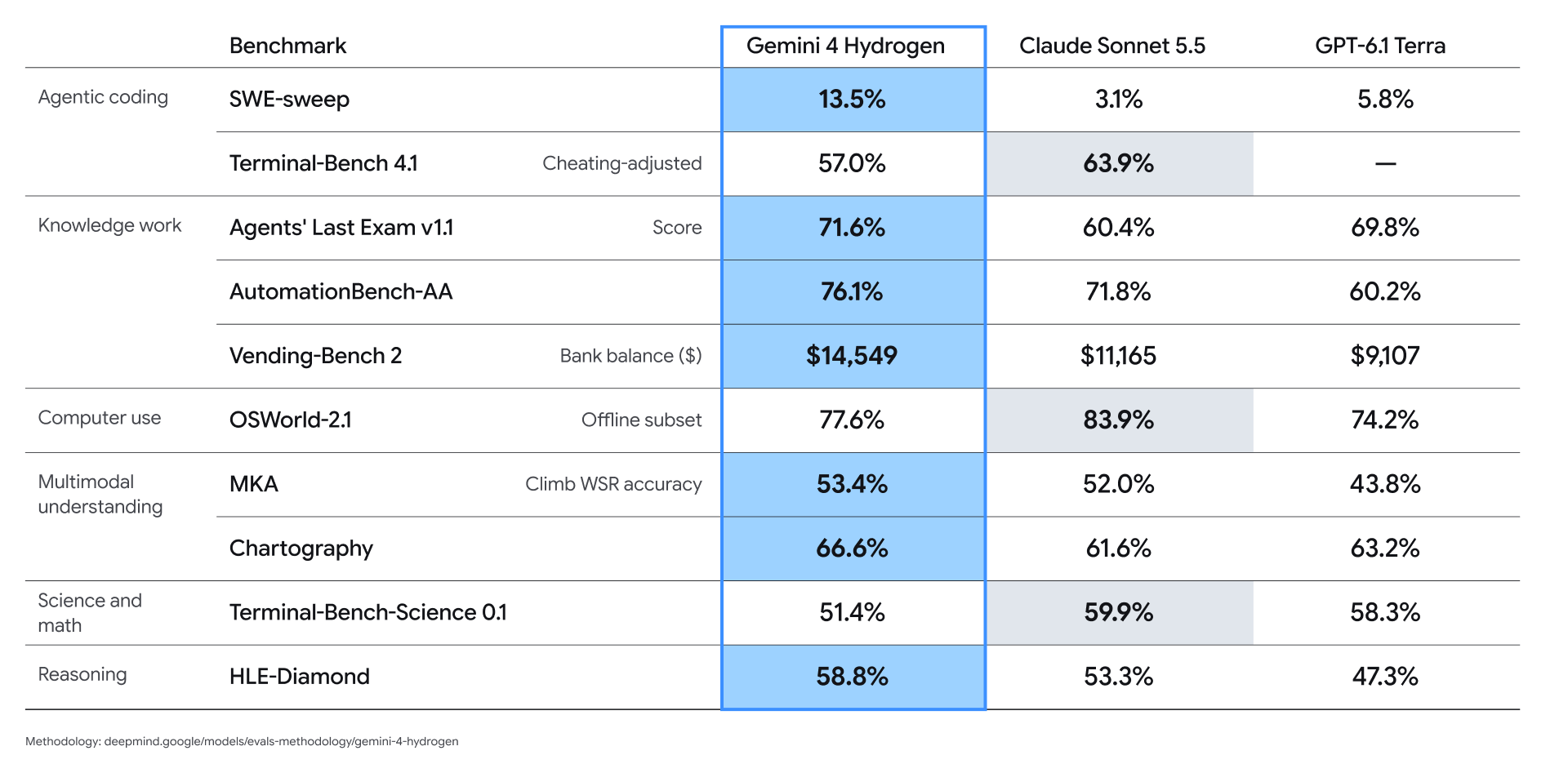
Google's benchmark table picks two same-class opponents: Claude Sonnet 5.5 and GPT-6.1 Terra. Where Hydrogen wins: SWE-sweep at 13.5% (against 3.1% and 5.8% — the task, per Google, is finding and fixing bugs without breaking existing code); Agents' Last Exam v1.1 at 71.6% (versus 60.4% and 69.8%); AutomationBench-AA at 76.1% (versus 71.8% and 60.2%); Vending-Bench 2 bank balance of $14,549 (versus $11,165 and $9,107); multimodal MKA at 53.4% and Chartography at 66.6%; and reasoning's HLE-Diamond at 58.8% (versus 53.3% and 47.3%).
The losses sit on the same page: Terminal-Bench 4.1 (cheating-adjusted) at 57.0%, below Sonnet 5.5's 63.9%; OSWorld-2.1 offline subset at 77.6%, below Sonnet's 83.9%; and Terminal-Bench-Science 0.1 at 51.4%, below both Sonnet's 59.9% and Terra's 58.3%. The blog text stresses the threefold gain over 3.8 Flash, but the same-class comparison in the table is not a clean sweep — "leads its class" has to be read task by task. Printing both sides in the official material at least saves readers the assembly work.
Beyond the table sit several vendor-cited results: fifth on arena.ai's live Agent Arena, first on Vals' Tax Agent Bench (52.3%), tied first on Vals' Legal Research Bench (55.8%), and leading its class on AutomationBench-AA. The evaluators, tasks and settings all differ; this site lists them as given and mixes none of them. Google's evals methodology page is public at deepmind.google/models/evals-methodology/gemini-4-hydrogen.
Sources and further reading
- Google's official blog post "Introducing Gemini 4 Hydrogen"Official announcement · page dated November 12, 2026 · read in full by this site on November 13Read in full. Checked the key claims: family positioning (Carbon/Argon for deep long-horizon reasoning, Hydrogen for rapid execution); availability (all AI Studio tiers, the Gemini API, Gemini for business, the Gemini app, Google Search for all users, Antigravity for paid Pro/Ultra, Android Studio); pricing of $1.50/$7.50 per million tokens flat across the 1M-token context, 1M-token input and up to 1M-token output; four thinking levels including the new xhigh; the official claim of AA high 51 versus Argon's 50 and 54 at xhigh; Orchestrator reaching near-full-Carbon success on Terminal-Bench 4.0 with 24% less quota on average and 19% faster completion; versus 3.8 Flash, 2.5× faster at high, Terminal-Bench 4.1 at 57% versus 18.2%, and over 5× fewer fabricated claims; the comparison table against Sonnet 5.5 and Terra with both wins and losses; the safety figures (overreach down up to 81%, under-service up to 79%, misaligned actions and shortcutting down 12×, 96.7% on the internal honesty evaluation, 99.9% chain-of-thought legibility across 200,000+ audited turns, 2.3× resilience on Gray Swan's IPI benchmark, sub-0.4% false refusals on HealthBench Pro); and the official evals-methodology page at deepmind.google/models/evals-methodology/gemini-4-hydrogen.
Safety figures, the Search rollout, and the boundaries
The safety and behavior figures are all vendor-run: overreach in agentic tasks down up to 81% and under-service up to 79%, misaligned actions and task shortcutting down 12× across tool-use and coding evaluations; up to 2× less likely to bypass permission boundaries when facing impossible or blocked tasks; 96.7% on the internal agent honesty evaluation; 99.9% chain-of-thought legibility with zero deceptive reasoning edits across more than 200,000 audited turns; 2.3× more resilient on Gray Swan's indirect prompt injection benchmark; and sub-0.4% false refusals on HealthBench Pro, with Google noting the guardrails must tell real biosecurity risks from legitimate medical and scientific questions.
On the product side the upgrades land in the Gemini app and Google Search: Search rolls out globally, understanding colloquial, multi-part and typo-ridden queries and widening the query fan-out that pulls back a broader range of relevant links; the Gemini app pitch is drafts that follow your tone, format and rules on the first try. These are integration claims — what you actually see in your own interface is the product's to prove.
The boundaries, summed up: Artificial Analysis' independent board confirms the four effort scores match Google's claims — the only number here checked against an independent source; the official comparison table is vendor-run (with the methodology page public); the safety-behavior figures come from Google's own evaluations; and the Search and app integration effects cannot be independently verified. This site has not called the API and has rerun no benchmark. Our overall board records Hydrogen at xhigh 54 under its highest-tested-setting rule, visible on the same ladder as Argon's high 50 and 3.8 Flash's high 31 — three generations of the everyday tier, finally on one ruler.
- Read the official announcement blog postThe source of every fact and figure here; the official evals methodology page is linked inside.
- Try it in Google AI StudioAvailable on every tier; switch the four thinking levels in the model settings.
- Our Gemini 4 Carbon explainer and its GA updateThe family's other cadence: two weeks of defenders-first access, against Hydrogen's day-one availability for everyone.
Sources and further reading
- Google's official blog post "Introducing Gemini 4 Hydrogen"Official announcement · page dated November 12, 2026 · read in full by this site on November 13Read in full. Checked the key claims: family positioning (Carbon/Argon for deep long-horizon reasoning, Hydrogen for rapid execution); availability (all AI Studio tiers, the Gemini API, Gemini for business, the Gemini app, Google Search for all users, Antigravity for paid Pro/Ultra, Android Studio); pricing of $1.50/$7.50 per million tokens flat across the 1M-token context, 1M-token input and up to 1M-token output; four thinking levels including the new xhigh; the official claim of AA high 51 versus Argon's 50 and 54 at xhigh; Orchestrator reaching near-full-Carbon success on Terminal-Bench 4.0 with 24% less quota on average and 19% faster completion; versus 3.8 Flash, 2.5× faster at high, Terminal-Bench 4.1 at 57% versus 18.2%, and over 5× fewer fabricated claims; the comparison table against Sonnet 5.5 and Terra with both wins and losses; the safety figures (overreach down up to 81%, under-service up to 79%, misaligned actions and shortcutting down 12×, 96.7% on the internal honesty evaluation, 99.9% chain-of-thought legibility across 200,000+ audited turns, 2.3× resilience on Gray Swan's IPI benchmark, sub-0.4% false refusals on HealthBench Pro); and the official evals-methodology page at deepmind.google/models/evals-methodology/gemini-4-hydrogen.
- Artificial Analysis model leaderboard and methodology pageIndependent evaluator's live board · full-board re-read via direct fetch on November 13 (web_reader returned a cached copy without Hydrogen; verified via direct fetch)Full-board re-read. Hydrogen's four tiers: xhigh 54 ($3.16 per task, 13.5 minutes), high 51 ($1.87, 8.3 minutes), medium 41 ($0.80, 3.7 minutes) and low 27 ($0.29, 1.3 minutes), against Argon high 50 ($4.97, 30.1 minutes) and Gemini 3.8 Flash high 31 ($7.77, 14.8 minutes). The methodology page now labels the Intelligence Index v5.0.1; its version history states 5.0.1 (November 2026 to current) only "incorporated grading robustness improvements from the CritPt authors and regraded all models on CritPt v2"; every catalogued row's displayed score matches our November 11 full read.