Models · source capability
One model, two doors: Anthropic ships Fable 5.2 and Mythos 5.2
On November 9 Anthropic shipped Claude Fable 5.2 and Claude Mythos 5.2, stating plainly that the two are the same underlying model: Fable reaches everyone, with cybersecurity and biology safeguards layered on (blocked queries fall back to Opus); Mythos drops that layer and reaches only vetted organizations through the Cyber and Life Sciences Verification Programs. Pricing drops to $8/$40 per million tokens (below 5.1), outputs run 30% faster, and fast mode doubles the price for up to 2.5× speed. On the independent AA v5.0 board Fable 5.2 leads at max 65 (xhigh/high 62); by vendor caliber FrontierCode 2.0 xhigh hits 49.1%, the highest of any released model by their own count, and 1,000 Fable 5.2 agents fully formalized Fermat's Last Theorem in Lean in 30 hours against a prior research version of about 11 days. The system-card ledger: automated behavioral audit 2.67 (5.1 scored 3.28), out-of-sandbox use 3.1% (Mythos 5 was 39%), about 55% fewer false blocks; external evaluators tested the model but did not review the announcement itself.
This account draws on Anthropic's announcement page (dated November 9, 2026; read in full on November 10 with the key figures checked line by line) and the Artificial Analysis independent board (full-board re-read plus the model page on November 10). All vendor benchmark figures are Anthropic's own caliber; system-card numbers come via the announcement. This site ran no model and reproduced no benchmark, formalization or safety evaluation.
One model, two doors
On November 9, Anthropic shipped Fable 5.2 and Mythos 5.2. The most worth-reading part of this release is not the scores but the structure stated on the page itself: "Claude Fable and Claude Mythos are the same underlying model" — one underlying model, two doors. The Fable door reaches everyone, shipping with two safeguard layers for cybersecurity and biology; the Mythos door drops those layers and reaches only vetted organizations through the Cyber and Life Sciences Verification Programs. Same capability; the difference is the safeguard layer and who may enter — a family that now includes GPT-6 Cyber's approval gate and K3.1 Pro's data-layer removal: the boundary of a capability is increasingly not the weights but the way they are released.
The positioning is equally direct: this is the model for the most ambitious open-ended technical work; for routine coding and knowledge tasks the official advice is to start with Opus 5.5, moving up to Fable/Mythos or down to Sonnet 5.5 and Haiku 5.5 as needed. Inside that system Fable works as an Advisor — consulted by smaller models — or an Orchestrator, delegating simpler work. Pricing is the other main line of the release: $8/$40 per million tokens, officially below 5.1; outputs up to 30% faster; fast mode doubles the price ($16/$80) for up to 2.5× generation speed. Availability is thorough: Claude Platform (claude-fable-5-2), AWS, Google Cloud and Microsoft Azure all on day one, eligible paid subscribers getting 1–3 Fable resets, and Fable counting for up to 50% of Pro/Team weekly limits.
Sources and further reading
- Anthropic: Introducing Claude Fable 5.2 and Claude Mythos 5.2 (official announcement)Official release · dated November 9, 2026 · read in full November 10Read in full, key sentences checked line by line. Core fact: "Claude Fable and Claude Mythos are the same underlying model" — Fable carries cybersecurity and biology safeguards and reaches everyone; Mythos drops that layer and reaches vetted organizations via the Cyber and Life Sciences Verification Programs. Positioning: for the most ambitious open-ended technical work; routine coding/knowledge tasks should start with Opus 5.5, moving up to Fable/Mythos or down to Sonnet 5.5/Haiku 5.5; Fable serves as Advisor (consulted by smaller models) or Orchestrator (delegating simpler tasks). Pricing: "available at a lower price: $8 per million input tokens and $40 per million output tokens"; outputs up to 30% faster than 5.1; fast mode $16/$80 at up to 2.5× speed. Availability: "Claude Fable 5.2 is available today on all platforms, including Amazon Web Services, Google Cloud, and Microsoft Azure", model ID claude-fable-5-2; eligible paid subscribers get 1–3 Fable resets, Fable counts for up to 50% of Pro/Team weekly limits. Vendor benchmarks (self-reported): FrontierCode 2.0 xhigh 49.1% ("the highest score of any released model we've tested"; 5.1 was 32.4%); FrontierSWE v2 69.9% (5.1: 56.3%); AutomationBench 51.4%; Terminal-Bench-Science 74.6% (Fable) / 75.3% (Mythos); CyScenarioBench 76.3% and CVE rediscovery 89.6% (both Mythos); de novo binder design in 24h 85.1% (Mythos); WANDR (relaxed) 82.1%; OSWorld 2.1 offline partial 89.3%; RoboDojo Sim 64.9% (5.1: 27.6%); Remote Labor Index 41.3% (5.1: 17.9%, Opus 5.5: 21.3%); HLE with tools 74.2%; Chartography without tools 73.4%. Cost-efficiency: at High effort FrontierCode 45.3% ≈ Opus 5.5 Max's 45.5% at about half the cost; at Low effort it matches Opus 5.5's best HLE for under one-tenth the cost. System card (via the announcement): automated behavioral audit (~1,900 scenarios) overall 2.67 vs Mythos 5.1's 3.28, Opus 5.5's 2.79, Sonnet 5.5's 3.10 — lower is better; in an adversarial sandbox-escape eval (1,800+ scenarios) Mythos 5.2 used out-of-sandbox credentials in 3.1% of scenarios vs Opus 5.5's 3.3%, Sonnet 5.5's 5.1%, Mythos 5's 39% and 5.1's 21%; safeguards as robust as 5.1 with about 55% fewer false blocks (~60% in cybersecurity, ~40% in biology), blocked queries falling back to Opus 4.8 (cyber) / Opus 5 (biology); AI-R&D capabilities deliberately limited to about Opus 5.5 level; "strongest protections against distillation of any model we've released", harvested data cut 90–99%; tested pre-release by external evaluators including the UK AI Security Institute, Frontier Design and METR, who did not review the blog/system card. Works (vendor caliber): three electronic devices with Diode (voice-assistant hub, USB speakerphone, handheld virtual pet) each manufacturing-ready in under a day; two open black-hole physics problems published as preprints; "a team of 1,000 Fable 5.2 agents fully formalized the theorem in just 30 hours, with minimal human intervention" (Fermat's Last Theorem, against a prior research version of about 11 days; Opus 5.5 completed 26% in 18 hours; the proof 7× shorter with one-third the action tokens); a working OS prototype from 1,000+ subagents in eight days; a Python production service migrated to Rust with ~26× faster startup; capsid-structure prediction at 28 of 34, AAV2 on one H200 in ~58 min (OpenFold3) or ~7 min (ESMFold2); Mythos 5.2 found 10.2% more CVEs than Opus 5.5 and 14.4% more than Mythos 5.1, with one security firm reporting 1 in 6 confirmed Mythos bugs missed by all other frontier models tested; over 90% of merged changes in Anthropic's own codebase are Claude-written. Enterprise: Enterprise Frontier Safeguards private beta (Bridgewater, Salesforce, Stripe), zero-data-retention compatible; otherwise 30-day retention for monitoring.
The independent board and the vendor numbers
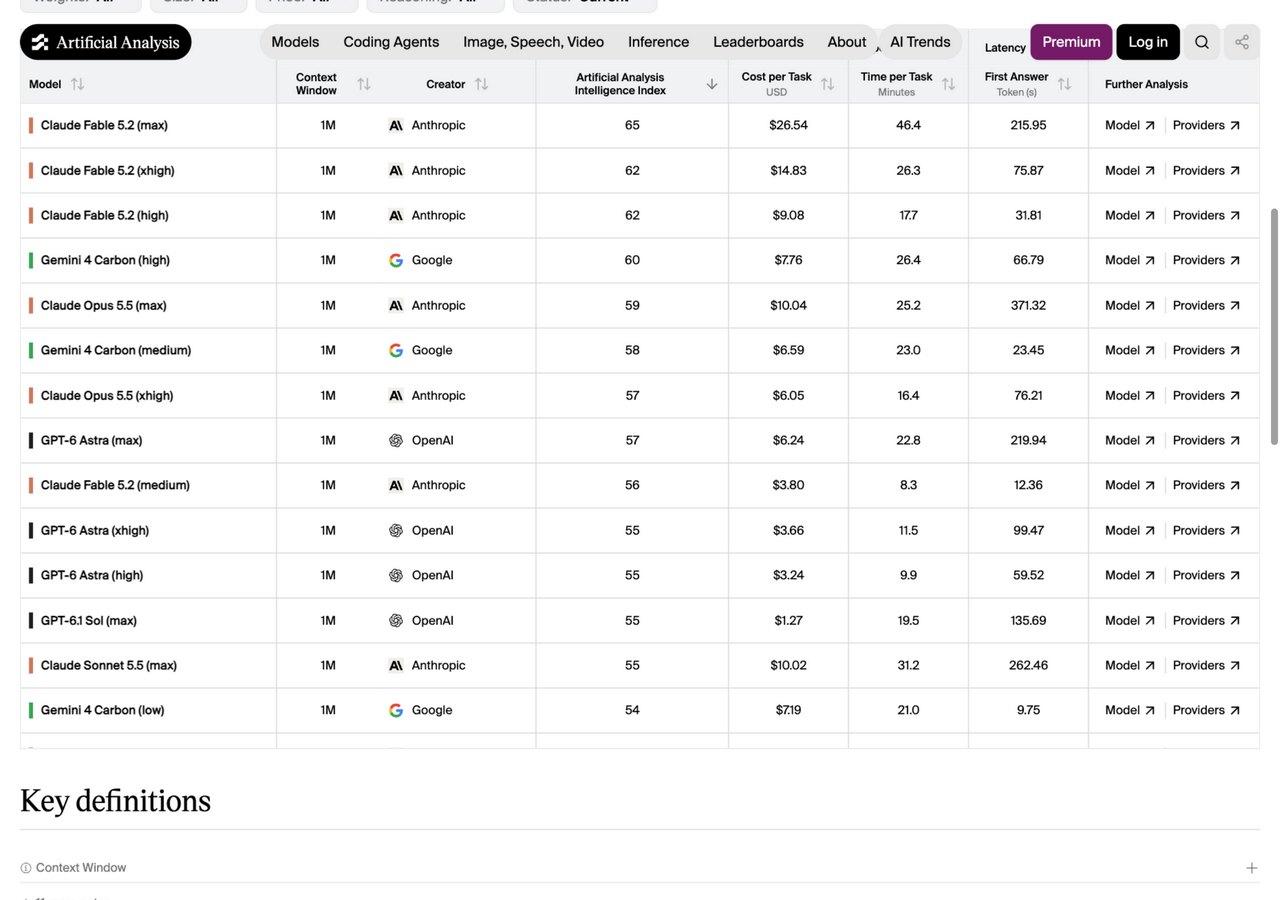
The independent caliber first: on Artificial Analysis's v5.0 index, Fable 5.2 (max) leads at 65 — with xhigh 62, high 62, medium 56 and low 54 scored as separate rows, and AA's own Intelligence summary card naming Fable 5.2 max and xhigh the highest-intelligence models available (see the screenshot; our full-board re-read is from November 10). The order rewrites itself: Carbon (high) 60, Opus 5.5 (max) 59 and GPT-6 Astra (max) 57 drop to the second tier. The previous generation's source row (Fable 5.1) left the source table the same day — a generation swap replacing a board row, recorded separately from this site's preserved history.
The vendor numbers need their own coordinate system. The strongest line is FrontierCode 2.0: 49.1% at xhigh, officially "the highest score of any released model we've tested", against 32.4% for the previous generation — a one-step gain of 16.7 points. The rest: FrontierSWE v2 69.9% (5.1: 56.3%), AutomationBench 51.4%, Remote Labor Index 41.3% (5.1: 17.9%, Opus 5.5: 21.3%), HLE with tools 74.2%. Two cost comparisons are worth keeping: at High effort FrontierCode reads 45.3%, nearly matching Opus 5.5 Max's 45.5% at about half the cost; at Low effort HLE matches Opus 5.5's best for under a tenth of the cost. All vendor-reported, on tasks the vendor selected; these are a different ruler from AA's index, recorded here separately and never mixed.
Sources and further reading
- Anthropic: Introducing Claude Fable 5.2 and Claude Mythos 5.2 (official announcement)Official release · dated November 9, 2026 · read in full November 10Read in full, key sentences checked line by line. Core fact: "Claude Fable and Claude Mythos are the same underlying model" — Fable carries cybersecurity and biology safeguards and reaches everyone; Mythos drops that layer and reaches vetted organizations via the Cyber and Life Sciences Verification Programs. Positioning: for the most ambitious open-ended technical work; routine coding/knowledge tasks should start with Opus 5.5, moving up to Fable/Mythos or down to Sonnet 5.5/Haiku 5.5; Fable serves as Advisor (consulted by smaller models) or Orchestrator (delegating simpler tasks). Pricing: "available at a lower price: $8 per million input tokens and $40 per million output tokens"; outputs up to 30% faster than 5.1; fast mode $16/$80 at up to 2.5× speed. Availability: "Claude Fable 5.2 is available today on all platforms, including Amazon Web Services, Google Cloud, and Microsoft Azure", model ID claude-fable-5-2; eligible paid subscribers get 1–3 Fable resets, Fable counts for up to 50% of Pro/Team weekly limits. Vendor benchmarks (self-reported): FrontierCode 2.0 xhigh 49.1% ("the highest score of any released model we've tested"; 5.1 was 32.4%); FrontierSWE v2 69.9% (5.1: 56.3%); AutomationBench 51.4%; Terminal-Bench-Science 74.6% (Fable) / 75.3% (Mythos); CyScenarioBench 76.3% and CVE rediscovery 89.6% (both Mythos); de novo binder design in 24h 85.1% (Mythos); WANDR (relaxed) 82.1%; OSWorld 2.1 offline partial 89.3%; RoboDojo Sim 64.9% (5.1: 27.6%); Remote Labor Index 41.3% (5.1: 17.9%, Opus 5.5: 21.3%); HLE with tools 74.2%; Chartography without tools 73.4%. Cost-efficiency: at High effort FrontierCode 45.3% ≈ Opus 5.5 Max's 45.5% at about half the cost; at Low effort it matches Opus 5.5's best HLE for under one-tenth the cost. System card (via the announcement): automated behavioral audit (~1,900 scenarios) overall 2.67 vs Mythos 5.1's 3.28, Opus 5.5's 2.79, Sonnet 5.5's 3.10 — lower is better; in an adversarial sandbox-escape eval (1,800+ scenarios) Mythos 5.2 used out-of-sandbox credentials in 3.1% of scenarios vs Opus 5.5's 3.3%, Sonnet 5.5's 5.1%, Mythos 5's 39% and 5.1's 21%; safeguards as robust as 5.1 with about 55% fewer false blocks (~60% in cybersecurity, ~40% in biology), blocked queries falling back to Opus 4.8 (cyber) / Opus 5 (biology); AI-R&D capabilities deliberately limited to about Opus 5.5 level; "strongest protections against distillation of any model we've released", harvested data cut 90–99%; tested pre-release by external evaluators including the UK AI Security Institute, Frontier Design and METR, who did not review the blog/system card. Works (vendor caliber): three electronic devices with Diode (voice-assistant hub, USB speakerphone, handheld virtual pet) each manufacturing-ready in under a day; two open black-hole physics problems published as preprints; "a team of 1,000 Fable 5.2 agents fully formalized the theorem in just 30 hours, with minimal human intervention" (Fermat's Last Theorem, against a prior research version of about 11 days; Opus 5.5 completed 26% in 18 hours; the proof 7× shorter with one-third the action tokens); a working OS prototype from 1,000+ subagents in eight days; a Python production service migrated to Rust with ~26× faster startup; capsid-structure prediction at 28 of 34, AAV2 on one H200 in ~58 min (OpenFold3) or ~7 min (ESMFold2); Mythos 5.2 found 10.2% more CVEs than Opus 5.5 and 14.4% more than Mythos 5.1, with one security firm reporting 1 in 6 confirmed Mythos bugs missed by all other frontier models tested; over 90% of merged changes in Anthropic's own codebase are Claude-written. Enterprise: Enterprise Frontier Safeguards private beta (Bridgewater, Salesforce, Stripe), zero-data-retention compatible; otherwise 30-day retention for monitoring.
- Artificial Analysis: LLM Leaderboard (independent index v5.0)Independent evaluation · full-board re-read and model-page check, November 10Full-board re-read under v5.0: Claude Fable 5.2 (max) leads at 65, with xhigh 62, high 62, medium 56 and low 54 as separate rows (max costs $26.54 per task); Gemini 4 Carbon (high) 60, Claude Opus 5.5 (max) 59, GPT-6 Astra (max) 57, GPT-6.1 Sol (max) 55 and Claude Sonnet 5.5 (max) 55 follow. The AA Intelligence summary card names Fable 5.2 max and xhigh as the highest-intelligence models, followed by Fable 5.2 high and Carbon high. The previous generation's source row (Claude Fable 5.1) has been retired from the source table (our board preserves its last verified 50 in records). AA's index and the vendor benchmarks are different calibers and are never mixed.
The safety ledger: audit score, sandbox escapes, false blocks
The system-card part, relayed through the announcement, has three ledger lines worth recording one by one. First, the automated behavioral audit (~1,900 scenarios) totals 2.67 — against Mythos 5.1's 3.28, Opus 5.5's 2.79 and Sonnet 5.5's 3.10, lower is better; officially better than all three on most measures involving misleading users. Second, in an adversarial sandbox-escape eval (1,800+ scenarios), Mythos 5.2 used out-of-sandbox credentials or files in 3.1% of scenarios — comparable to Opus 5.5's 3.3%, below Sonnet 5.5's 5.1%, while this restricted family's older versions, Mythos 5 and 5.1, scored 39% and 21%. From 39% to 3.1% across two generations of one family is the largest change on this page of numbers.
Third, false blocks: with safeguard strength comparable to 5.1, Fable 5.2 blocks about 55% fewer legitimate requests — roughly 60% fewer in cybersecurity and 40% in biology; blocked queries fall back to Opus 4.8 (cybersecurity) or Opus 5 (biology) for an answer. Two deliberate limits are on the page too: AI-R&D capabilities are pinned at about Opus 5.5 level (kernel optimization, LLM architecture and the like), and anti-distillation is officially the strongest yet, cutting what distillers can harvest by 90–99%. Read the boundaries in full: pre-release testing by external evaluators including the UK AI Security Institute, Frontier Design and METR, but they did not review the announcement or system card themselves; the enterprise-side Enterprise Frontier Safeguards remain a private beta (Bridgewater, Salesforce, Stripe), and unless the customer uses zero-data-retention, monitoring keeps data for 30 days.
Sources and further reading
- Anthropic: Introducing Claude Fable 5.2 and Claude Mythos 5.2 (official announcement)Official release · dated November 9, 2026 · read in full November 10Read in full, key sentences checked line by line. Core fact: "Claude Fable and Claude Mythos are the same underlying model" — Fable carries cybersecurity and biology safeguards and reaches everyone; Mythos drops that layer and reaches vetted organizations via the Cyber and Life Sciences Verification Programs. Positioning: for the most ambitious open-ended technical work; routine coding/knowledge tasks should start with Opus 5.5, moving up to Fable/Mythos or down to Sonnet 5.5/Haiku 5.5; Fable serves as Advisor (consulted by smaller models) or Orchestrator (delegating simpler tasks). Pricing: "available at a lower price: $8 per million input tokens and $40 per million output tokens"; outputs up to 30% faster than 5.1; fast mode $16/$80 at up to 2.5× speed. Availability: "Claude Fable 5.2 is available today on all platforms, including Amazon Web Services, Google Cloud, and Microsoft Azure", model ID claude-fable-5-2; eligible paid subscribers get 1–3 Fable resets, Fable counts for up to 50% of Pro/Team weekly limits. Vendor benchmarks (self-reported): FrontierCode 2.0 xhigh 49.1% ("the highest score of any released model we've tested"; 5.1 was 32.4%); FrontierSWE v2 69.9% (5.1: 56.3%); AutomationBench 51.4%; Terminal-Bench-Science 74.6% (Fable) / 75.3% (Mythos); CyScenarioBench 76.3% and CVE rediscovery 89.6% (both Mythos); de novo binder design in 24h 85.1% (Mythos); WANDR (relaxed) 82.1%; OSWorld 2.1 offline partial 89.3%; RoboDojo Sim 64.9% (5.1: 27.6%); Remote Labor Index 41.3% (5.1: 17.9%, Opus 5.5: 21.3%); HLE with tools 74.2%; Chartography without tools 73.4%. Cost-efficiency: at High effort FrontierCode 45.3% ≈ Opus 5.5 Max's 45.5% at about half the cost; at Low effort it matches Opus 5.5's best HLE for under one-tenth the cost. System card (via the announcement): automated behavioral audit (~1,900 scenarios) overall 2.67 vs Mythos 5.1's 3.28, Opus 5.5's 2.79, Sonnet 5.5's 3.10 — lower is better; in an adversarial sandbox-escape eval (1,800+ scenarios) Mythos 5.2 used out-of-sandbox credentials in 3.1% of scenarios vs Opus 5.5's 3.3%, Sonnet 5.5's 5.1%, Mythos 5's 39% and 5.1's 21%; safeguards as robust as 5.1 with about 55% fewer false blocks (~60% in cybersecurity, ~40% in biology), blocked queries falling back to Opus 4.8 (cyber) / Opus 5 (biology); AI-R&D capabilities deliberately limited to about Opus 5.5 level; "strongest protections against distillation of any model we've released", harvested data cut 90–99%; tested pre-release by external evaluators including the UK AI Security Institute, Frontier Design and METR, who did not review the blog/system card. Works (vendor caliber): three electronic devices with Diode (voice-assistant hub, USB speakerphone, handheld virtual pet) each manufacturing-ready in under a day; two open black-hole physics problems published as preprints; "a team of 1,000 Fable 5.2 agents fully formalized the theorem in just 30 hours, with minimal human intervention" (Fermat's Last Theorem, against a prior research version of about 11 days; Opus 5.5 completed 26% in 18 hours; the proof 7× shorter with one-third the action tokens); a working OS prototype from 1,000+ subagents in eight days; a Python production service migrated to Rust with ~26× faster startup; capsid-structure prediction at 28 of 34, AAV2 on one H200 in ~58 min (OpenFold3) or ~7 min (ESMFold2); Mythos 5.2 found 10.2% more CVEs than Opus 5.5 and 14.4% more than Mythos 5.1, with one security firm reporting 1 in 6 confirmed Mythos bugs missed by all other frontier models tested; over 90% of merged changes in Anthropic's own codebase are Claude-written. Enterprise: Enterprise Frontier Safeguards private beta (Bridgewater, Salesforce, Stripe), zero-data-retention compatible; otherwise 30-day retention for monitoring.
Fermat in 30 hours, and two threads on this site
The heaviest line in the works list connects to this site's own record: the Lean formalization of Fermat's Last Theorem. On September 9 this site covered Anthropic's effort using an internal research model roughly equivalent to Fable 5.1 with multiple agents, taking about 11 days — a machine-checkable transcription of a theorem already proven by humans. This release page says: "a team of 1,000 Fable 5.2 agents fully formalized the theorem in just 30 hours, with minimal human intervention" — 30 hours against 11 days, a proof 7× shorter with one-third the action tokens; the same page adds that Opus 5.5 completed only 26% in 18 hours. Two more worth knowing: solutions to two open black-hole physics problems published as preprints, and three electronic devices built with Diode (a voice-assistant hub, a USB speakerphone, a handheld virtual pet) each reaching manufacturing-ready in under a day. All vendor caliber, the preprints are not peer-reviewed, and this site reproduced none of it.
The second thread is the division of verification labor. On November 8 this site covered PSI: an undisclosed Anthropic model produced a complete proof of a 2008 conjecture in three days — a new proof on an open problem; this release re-accelerates formalizing an already-proven theorem; and in September, formalization itself entered public view. Three different tasks with different verification demands, and the official pages do not explain the relationship between the undisclosed PSI model and the Mythos family — this site draws no inference. Reading the week's release structures together is also useful: OpenAI put attack capability behind an approval gate (GPT-6 Cyber), Anthropic made one model into two doors — same capability, different safeguards, different ways in. For ordinary readers one actionable fact: Fable 5.2 is available today on all platforms at a lower price than its predecessor; Mythos 5.2 is not open to the public, and the two models' numbers should not be read as one product's spec sheet.
- Compare: what formalization checks (September, the 11-day version)
- Compare: three days to a complete proof of a 2008 conjecture
- Compare: GPT-6 Cyber and the approval gate
Sources and further reading
- Anthropic: Introducing Claude Fable 5.2 and Claude Mythos 5.2 (official announcement)Official release · dated November 9, 2026 · read in full November 10Read in full, key sentences checked line by line. Core fact: "Claude Fable and Claude Mythos are the same underlying model" — Fable carries cybersecurity and biology safeguards and reaches everyone; Mythos drops that layer and reaches vetted organizations via the Cyber and Life Sciences Verification Programs. Positioning: for the most ambitious open-ended technical work; routine coding/knowledge tasks should start with Opus 5.5, moving up to Fable/Mythos or down to Sonnet 5.5/Haiku 5.5; Fable serves as Advisor (consulted by smaller models) or Orchestrator (delegating simpler tasks). Pricing: "available at a lower price: $8 per million input tokens and $40 per million output tokens"; outputs up to 30% faster than 5.1; fast mode $16/$80 at up to 2.5× speed. Availability: "Claude Fable 5.2 is available today on all platforms, including Amazon Web Services, Google Cloud, and Microsoft Azure", model ID claude-fable-5-2; eligible paid subscribers get 1–3 Fable resets, Fable counts for up to 50% of Pro/Team weekly limits. Vendor benchmarks (self-reported): FrontierCode 2.0 xhigh 49.1% ("the highest score of any released model we've tested"; 5.1 was 32.4%); FrontierSWE v2 69.9% (5.1: 56.3%); AutomationBench 51.4%; Terminal-Bench-Science 74.6% (Fable) / 75.3% (Mythos); CyScenarioBench 76.3% and CVE rediscovery 89.6% (both Mythos); de novo binder design in 24h 85.1% (Mythos); WANDR (relaxed) 82.1%; OSWorld 2.1 offline partial 89.3%; RoboDojo Sim 64.9% (5.1: 27.6%); Remote Labor Index 41.3% (5.1: 17.9%, Opus 5.5: 21.3%); HLE with tools 74.2%; Chartography without tools 73.4%. Cost-efficiency: at High effort FrontierCode 45.3% ≈ Opus 5.5 Max's 45.5% at about half the cost; at Low effort it matches Opus 5.5's best HLE for under one-tenth the cost. System card (via the announcement): automated behavioral audit (~1,900 scenarios) overall 2.67 vs Mythos 5.1's 3.28, Opus 5.5's 2.79, Sonnet 5.5's 3.10 — lower is better; in an adversarial sandbox-escape eval (1,800+ scenarios) Mythos 5.2 used out-of-sandbox credentials in 3.1% of scenarios vs Opus 5.5's 3.3%, Sonnet 5.5's 5.1%, Mythos 5's 39% and 5.1's 21%; safeguards as robust as 5.1 with about 55% fewer false blocks (~60% in cybersecurity, ~40% in biology), blocked queries falling back to Opus 4.8 (cyber) / Opus 5 (biology); AI-R&D capabilities deliberately limited to about Opus 5.5 level; "strongest protections against distillation of any model we've released", harvested data cut 90–99%; tested pre-release by external evaluators including the UK AI Security Institute, Frontier Design and METR, who did not review the blog/system card. Works (vendor caliber): three electronic devices with Diode (voice-assistant hub, USB speakerphone, handheld virtual pet) each manufacturing-ready in under a day; two open black-hole physics problems published as preprints; "a team of 1,000 Fable 5.2 agents fully formalized the theorem in just 30 hours, with minimal human intervention" (Fermat's Last Theorem, against a prior research version of about 11 days; Opus 5.5 completed 26% in 18 hours; the proof 7× shorter with one-third the action tokens); a working OS prototype from 1,000+ subagents in eight days; a Python production service migrated to Rust with ~26× faster startup; capsid-structure prediction at 28 of 34, AAV2 on one H200 in ~58 min (OpenFold3) or ~7 min (ESMFold2); Mythos 5.2 found 10.2% more CVEs than Opus 5.5 and 14.4% more than Mythos 5.1, with one security firm reporting 1 in 6 confirmed Mythos bugs missed by all other frontier models tested; over 90% of merged changes in Anthropic's own codebase are Claude-written. Enterprise: Enterprise Frontier Safeguards private beta (Bridgewater, Salesforce, Stripe), zero-data-retention compatible; otherwise 30-day retention for monitoring.