Source to life · agents and commerce
OpenAI gave agents a wallet; United showed agents the door
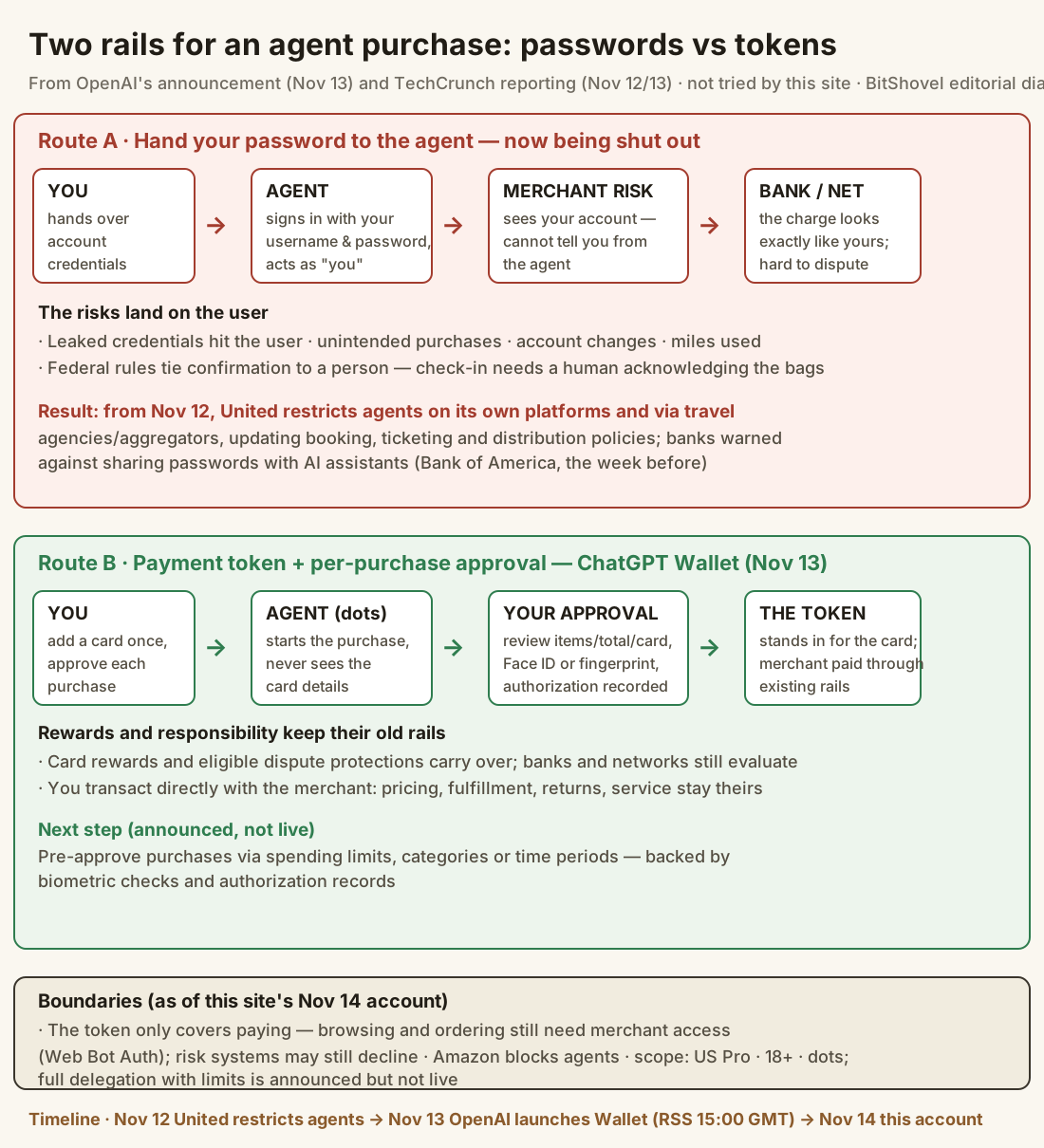
In one week, agent shopping was both opened and closed. On November 13 OpenAI launched ChatGPT Wallet — described as the first wallet that lets agents pay without ever touching your actual card details and that requires a security check on every purchase — built with American Express, Mastercard and Visa, initially reaching US Pro subscribers through dots. On November 12, United Airlines said it would restrict third-party personal AI agents from booking flights and managing reservations, citing cybersecurity risks from shared account credentials and federal rules that place duties on a human; the week before, Bank of America urged customers not to share passwords with AI assistants. The two routes differ not in intent but in how identity is proven: one hands your login password to the agent, where a merchant cannot tell whether it is you or it; the other shares no credentials — the card network issues the agent a payment token, you approve each purchase with Face ID or a fingerprint, and your card's existing rewards and dispute protections carry over. This article maps how far each route has come and what is missing: Wallet today solves only the paying step; browsing and ordering still need merchants to let agents in (the Commerce Partner Playbook OpenAI published the same day teaches them how), risk systems may still decline legitimate agent purchases, Amazon blocks agents outright, and full delegation with spending limits remains a plan. All figures and flows are vendor statements and press accounts; this site has not signed up or tried it.
This account draws on three documents: OpenAI's official announcement (the official RSS dates it November 13, 15:00 GMT; read in full by this site on November 14; the page's own metadata says November 10, which disagrees with the RSS and same-day press coverage, so this article follows the RSS and press dating) and two TechCrunch reports — the Wallet launch (dated November 13; read November 14) and United's restrictions on agents (dated November 12; read November 14; United's position is known through the statement it gave the press). Every flow, figure and quote traces back to those three documents; OpenAI's Commerce Partner Playbook was not read page by page here, so playbook details follow the announcement's summary. Boundaries: this site holds no ChatGPT Pro subscription, has not tried Wallet, and has not attempted to book flights through any agent; nothing here is a first-hand test.
One week, one opening and one closing
On November 12, TechCrunch reported United's statement: the airline will restrict third-party personal AI agents from booking flights and managing reservations for users — covering access "directly within our digital platforms" and, indirectly, through travel agencies and aggregators, with companion "updates to our booking, ticketing and distribution policies". Two reasons were given. Cybersecurity: "sharing account credentials with personal, third-party, AI assistants can expose sensitive information, and actions taken by these tools may result in unintended purchases, account changes, or use of MileagePlus miles." And federal rules: the report's example is check-in, which must be completed by a human acknowledging that bags contain no banned items. The report also places the move: United is the latest American corporate giant to do this, and the week before, banks including Bank of America urged customers not to share passwords with AI assistants.
On November 13, OpenAI launched ChatGPT Wallet. The official announcement's self-description is specific: "the first wallet that lets agents pay without access to users' actual card details and that requires a security check for every purchase", while preserving existing card rewards and protections for eligible disputes. It is built with American Express, Mastercard and Visa, launching for ChatGPT Pro subscribers in the US, first through dots — the personal agent inside ChatGPT. TechCrunch fills in eligibility: 18 or older, with a US-issued Visa, Mastercard or American Express card. The scale claim is recorded as claimed: OpenAI says 1.2 billion people use ChatGPT each week, and "many of them turn to it to research products, compare options, and decide what to buy".
The two moves point in opposite directions yet answer the same question: when an agent acts for a person, what makes a merchant trust it? United is closing the route that exists today — an agent signing in as "you" with your credentials; OpenAI is opening a different one — the agent never touches your credentials and every purchase is approved by you on the spot. The seam does not run only between an airline and a chatbot: banks are warning about passwords, Amazon is blocking agents, Meta's Muse is placing phone calls, and the shopping agent Instinct already checks out on your behalf. Both sides of agentic commerce — the capability side and the accepting side — are under construction at once.
Sources and further reading
- TechCrunch: United Airlines blocks AI agents from booking flights, citing cybersecurity risksPress report · dated November 12 UTC (early November 13 Beijing time) · read by this site on November 14 · United's position per its statement as quoted in pressRead in full. Checked the key contents: United will restrict AI agents from booking flights and managing reservations on users' behalf — both "directly within our digital platforms" and indirectly via travel agencies and aggregators; the reasons given — sharing account credentials "can expose sensitive information, and actions taken by these tools may result in unintended purchases, account changes, or use of MileagePlus miles"; the federal-aviation layer (for example, check-ins must be completed by a human acknowledging that bags contain no banned items); the companion step of "updates to our booking, ticketing and distribution policies"; and the report's notes that United is the latest American corporate giant to take this step and that banks including Bank of America urged customers last week not to share passwords with AI assistants.
- OpenAI announcement: Introducing ChatGPT WalletVendor announcement · official RSS dates it Nov 13, 15:00 GMT · read in full Nov 14 (page metadata says Nov 10; the RSS and same-day press dating are followed)Read in full. Checked the key contents: the positioning ("the first wallet that lets agents pay without access to users' actual card details and that requires a security check for every purchase", while preserving existing card rewards and protections for eligible disputes); the partnerships with American Express, Mastercard and Visa; the launch scope (through dots for US ChatGPT Pro subscribers); the purchase flow (add a card once; review items, total and card; approve each purchase with Face ID or a fingerprint, creating an authorization record; the card network issues a payment token substituting for the real card details; the charge lands on the selected card); the roles of merchants and banks (users transact directly with businesses, which keep customer relationships, pricing, fulfillment, returns and service; banks and networks evaluate transactions); the future direction (pre-approved delegation via spending limits, categories and time periods); the business-side kit (Commerce Partner Playbook: claim your business and upload a product feed; Web Bot Auth signed requests so CDNs and firewalls recognize agents; working with Forter/Riskified/Sardine/Signifyd and Adyen/Checkout.com/Stripe to reduce unnecessary declines; plugins and WebMCP tools); the scale claim (1.2B weekly ChatGPT users); and the admission that "some sites may unintentionally block purchases through ChatGPT Wallet".
- TechCrunch: ChatGPT's new Wallet lets AI agents shop and check out for youPress report · dated November 13 UTC · read by this site on November 14Used for cross-checking and context. Adds details: eligibility (US Pro subscribers, 18+, US-issued Visa/Mastercard/Amex cards); merchants automatically receive the shipping address and contact information; industry context (DoorDash and Uber report low agent-order numbers so far; Meta's Muse has passed 10 million users with AI-assisted shopping a top activity in its app; Instinct also supports purchases); Amazon is the largest retailer banning AI agents, steering users to its own Alexa; and the future plans (pre-approved limits, categories and periods). Facts follow OpenAI's announcement.
An agent purchase, in three steps through Wallet
Step one is adding a card, once: you add an eligible card to ChatGPT Wallet and never re-enter payment details for later purchases. Step two is approval, per purchase: before each purchase you review the items, the total and the card to be charged, then approve with a security check such as Face ID or a fingerprint — the announcement stresses that "each approval creates a clear record of the purchase the user authorized the agent to make." Step three is payment, by token: after your approval, the payment network issues a payment token — a substitute carrying its own card number, security code and expiry — the charge lands on the card you selected, and "ChatGPT Wallet [does not share] their actual card details with the business or agent". Merchants automatically receive what they need to fulfill the order (TechCrunch: shipping address and contact information), but not the card number.
The other half of the design sits on the card side: users keep their card's existing rewards, and eligible disputes still run through the card's own protections (the announcement's example is a defective item); banks and networks keep doing what they are built for — evaluating transactions; and users transact directly with businesses, which keep their customer relationships and control over pricing, fulfillment, returns and service. In other words, Wallet does not build a parallel commerce rulebook — it threads the agent's payment into the card networks' existing authorization and dispute frameworks. The next step, not live today, is written in the announcement: letting users pre-approve categories of purchases by parameters such as spending limits, purchase categories or time periods, backed by stronger safeguards like biometric checks and authorization records.
Both sides of the ecosystem are early, and the two halves read best side by side: DoorDash and Uber report low agent-order numbers so far (per TechCrunch), while Meta says Muse has passed 10 million users with AI-assisted shopping among the top activities in its app; Instinct already supports purchases. Demand is growing; acceptance lags — Amazon, the largest retailer, bans AI agents outright and steers shoppers to its own Alexa. Wallet's value depends on how many merchants let agents in, which is exactly why OpenAI published a merchant playbook the same day.
Sources and further reading
- OpenAI announcement: Introducing ChatGPT WalletVendor announcement · official RSS dates it Nov 13, 15:00 GMT · read in full Nov 14 (page metadata says Nov 10; the RSS and same-day press dating are followed)Read in full. Checked the key contents: the positioning ("the first wallet that lets agents pay without access to users' actual card details and that requires a security check for every purchase", while preserving existing card rewards and protections for eligible disputes); the partnerships with American Express, Mastercard and Visa; the launch scope (through dots for US ChatGPT Pro subscribers); the purchase flow (add a card once; review items, total and card; approve each purchase with Face ID or a fingerprint, creating an authorization record; the card network issues a payment token substituting for the real card details; the charge lands on the selected card); the roles of merchants and banks (users transact directly with businesses, which keep customer relationships, pricing, fulfillment, returns and service; banks and networks evaluate transactions); the future direction (pre-approved delegation via spending limits, categories and time periods); the business-side kit (Commerce Partner Playbook: claim your business and upload a product feed; Web Bot Auth signed requests so CDNs and firewalls recognize agents; working with Forter/Riskified/Sardine/Signifyd and Adyen/Checkout.com/Stripe to reduce unnecessary declines; plugins and WebMCP tools); the scale claim (1.2B weekly ChatGPT users); and the admission that "some sites may unintentionally block purchases through ChatGPT Wallet".
- TechCrunch: ChatGPT's new Wallet lets AI agents shop and check out for youPress report · dated November 13 UTC · read by this site on November 14Used for cross-checking and context. Adds details: eligibility (US Pro subscribers, 18+, US-issued Visa/Mastercard/Amex cards); merchants automatically receive the shipping address and contact information; industry context (DoorDash and Uber report low agent-order numbers so far; Meta's Muse has passed 10 million users with AI-assisted shopping a top activity in its app; Instinct also supports purchases); Amazon is the largest retailer banning AI agents, steering users to its own Alexa; and the future plans (pre-approved limits, categories and periods). Facts follow OpenAI's announcement.
A password is a key merchants dare not accept
United's restrictions read precisely from the consequences it lists: unintended purchases, account changes, miles used — none of these say the agent cannot do the job; they say that when the agent does it, no one can tell whether it is you. When an agent signs in with your username and password, the merchant's risk system sees your account; if those credentials leak, the consequences land on the user. TechCrunch frames the industry position: airlines and banks are "struggling to differentiate between real customers and AI systems operating on their behalf". This is not one company's excess of caution — Bank of America's warning the week before was about the same thing.
Airlines carry a rulebook of their own. The report's example is federal aviation requirements around check-in — a human acknowledging that bags contain no banned items. Rules that bind confirmation to a person conflict, on their face, with an agent doing everything as you; that United cites this layer means it is blocking against compliance duties as well as risk. The token route of Wallet answers the first layer (no shared credentials, per-purchase approval, records) but not the second — check-in after the ticket is bought still needs a human, and no payment tool changes that.
OpenAI itself names the gap: the announcement admits "some sites may unintentionally block purchases through ChatGPT Wallet or other agentic payment products", and says it is focused on helping businesses make the transition. Read next to United's statement, the sentence lands differently: within one week, one company is teaching merchants how to let agents in, another is updating policies to keep them out. The access problem of agentic commerce is not a technical glitch — it is the absence of a shared answer to who is responsible for a given action.
Sources and further reading
- TechCrunch: United Airlines blocks AI agents from booking flights, citing cybersecurity risksPress report · dated November 12 UTC (early November 13 Beijing time) · read by this site on November 14 · United's position per its statement as quoted in pressRead in full. Checked the key contents: United will restrict AI agents from booking flights and managing reservations on users' behalf — both "directly within our digital platforms" and indirectly via travel agencies and aggregators; the reasons given — sharing account credentials "can expose sensitive information, and actions taken by these tools may result in unintended purchases, account changes, or use of MileagePlus miles"; the federal-aviation layer (for example, check-ins must be completed by a human acknowledging that bags contain no banned items); the companion step of "updates to our booking, ticketing and distribution policies"; and the report's notes that United is the latest American corporate giant to take this step and that banks including Bank of America urged customers last week not to share passwords with AI assistants.
- OpenAI announcement: Introducing ChatGPT WalletVendor announcement · official RSS dates it Nov 13, 15:00 GMT · read in full Nov 14 (page metadata says Nov 10; the RSS and same-day press dating are followed)Read in full. Checked the key contents: the positioning ("the first wallet that lets agents pay without access to users' actual card details and that requires a security check for every purchase", while preserving existing card rewards and protections for eligible disputes); the partnerships with American Express, Mastercard and Visa; the launch scope (through dots for US ChatGPT Pro subscribers); the purchase flow (add a card once; review items, total and card; approve each purchase with Face ID or a fingerprint, creating an authorization record; the card network issues a payment token substituting for the real card details; the charge lands on the selected card); the roles of merchants and banks (users transact directly with businesses, which keep customer relationships, pricing, fulfillment, returns and service; banks and networks evaluate transactions); the future direction (pre-approved delegation via spending limits, categories and time periods); the business-side kit (Commerce Partner Playbook: claim your business and upload a product feed; Web Bot Auth signed requests so CDNs and firewalls recognize agents; working with Forter/Riskified/Sardine/Signifyd and Adyen/Checkout.com/Stripe to reduce unnecessary declines; plugins and WebMCP tools); the scale claim (1.2B weekly ChatGPT users); and the admission that "some sites may unintentionally block purchases through ChatGPT Wallet".
The merchant-side rails: four tasks and what remains
The Commerce Partner Playbook published alongside Wallet lists four tasks for merchants. One, help agents find accurate product information: claim your business in ChatGPT and, once verified, update details and upload a product feed with current pricing and availability. Two, let agents in: configure your CDN or firewall to recognize OpenAI's signed requests via Web Bot Auth, and confirm your security measures are not inadvertently blocking ChatGPT agents — with the explicit note that "browser access does not require a plugin or product feed". Three, work with payments and risk: the token works with existing checkout flows, but risk systems may still flag legitimate agent purchases into declines or cancellations; OpenAI is working with Forter, Riskified, Sardine and Signifyd on risk, and Adyen, Checkout.com and Stripe on acceptance, so systems learn to recognize legitimate agent purchases. Four, give agents more ways in: build plugins for availability and cart actions, or add WebMCP tools.
The gaps the checklist does not cover are just as clear. Risk-system declines get fixed merchant by merchant, and during the transition a declined purchase is declined; Amazon's stance did not change because of this playbook; full delegation with spending limits is still a plan; and the launch scope is US Pro subscribers inside dots — readers in China have no way to try it today, and other markets carry no timeline. The other channel by which agents reach businesses also widened this week: from November 12, Meta's Muse phone-calling feature is open to all paid subscribers (previously a small set of early adopters since September), so it can call the restaurant without online reservations, the cable company or the DMV for you; subscriptions start at $20 a month (500 million Muse tokens a week). But the reception on the other end is just as real — TechCrunch notes many businesses and receptionists hang up as soon as they identify an AI caller. Both directions hit the same wall: to be accepted, an agent must first be recognized — and once recognized, whether to serve it remains the other side's decision. Two earlier pieces on this site connect here: the voice-agent platform Retell now handles over 100 million calls a month, showing that agents calling businesses is already at scale; and last week's Fireworks/Notion incident is the reminder from the other side — every credential you hand over sits on someone else's machines. Wallet's design of keeping card details on your side of the wall is a direct answer to exactly that class of risk.
Sources and further reading
- OpenAI announcement: Introducing ChatGPT WalletVendor announcement · official RSS dates it Nov 13, 15:00 GMT · read in full Nov 14 (page metadata says Nov 10; the RSS and same-day press dating are followed)Read in full. Checked the key contents: the positioning ("the first wallet that lets agents pay without access to users' actual card details and that requires a security check for every purchase", while preserving existing card rewards and protections for eligible disputes); the partnerships with American Express, Mastercard and Visa; the launch scope (through dots for US ChatGPT Pro subscribers); the purchase flow (add a card once; review items, total and card; approve each purchase with Face ID or a fingerprint, creating an authorization record; the card network issues a payment token substituting for the real card details; the charge lands on the selected card); the roles of merchants and banks (users transact directly with businesses, which keep customer relationships, pricing, fulfillment, returns and service; banks and networks evaluate transactions); the future direction (pre-approved delegation via spending limits, categories and time periods); the business-side kit (Commerce Partner Playbook: claim your business and upload a product feed; Web Bot Auth signed requests so CDNs and firewalls recognize agents; working with Forter/Riskified/Sardine/Signifyd and Adyen/Checkout.com/Stripe to reduce unnecessary declines; plugins and WebMCP tools); the scale claim (1.2B weekly ChatGPT users); and the admission that "some sites may unintentionally block purchases through ChatGPT Wallet".
- TechCrunch: ChatGPT's new Wallet lets AI agents shop and check out for youPress report · dated November 13 UTC · read by this site on November 14Used for cross-checking and context. Adds details: eligibility (US Pro subscribers, 18+, US-issued Visa/Mastercard/Amex cards); merchants automatically receive the shipping address and contact information; industry context (DoorDash and Uber report low agent-order numbers so far; Meta's Muse has passed 10 million users with AI-assisted shopping a top activity in its app; Instinct also supports purchases); Amazon is the largest retailer banning AI agents, steering users to its own Alexa; and the future plans (pre-approved limits, categories and periods). Facts follow OpenAI's announcement.
- TechCrunch: United Airlines blocks AI agents from booking flights, citing cybersecurity risksPress report · dated November 12 UTC (early November 13 Beijing time) · read by this site on November 14 · United's position per its statement as quoted in pressRead in full. Checked the key contents: United will restrict AI agents from booking flights and managing reservations on users' behalf — both "directly within our digital platforms" and indirectly via travel agencies and aggregators; the reasons given — sharing account credentials "can expose sensitive information, and actions taken by these tools may result in unintended purchases, account changes, or use of MileagePlus miles"; the federal-aviation layer (for example, check-ins must be completed by a human acknowledging that bags contain no banned items); the companion step of "updates to our booking, ticketing and distribution policies"; and the report's notes that United is the latest American corporate giant to take this step and that banks including Bank of America urged customers last week not to share passwords with AI assistants.
For readers: what changed, and what has not
The changed step is worth recording: agents have moved from researching purchases for you to the first formal rail for paying for you. What matters is not that the agent got more capable, but that the trust problem got decomposed into inspectable parts — no card access, per-purchase approval, authorization records, disputes through existing rules. For any "let AI act for me" scenario, these parts double as a measuring stick for other proposals: does it bypass my credentials? Does every action need my nod? When something goes wrong, whom do I turn to and under what rules?
What has not changed is just as worth recording: you need to be in the US, a Pro subscriber, using dots — and you can only buy from merchants willing to let agents in; risk-system declines, merchant blocks and federal-rule boundaries all remain. Full delegation — set a limit and let the agent buy — is a stated direction, not a live feature; when it arrives, judging whether it suits you better than per-purchase approval will rest on the instincts built now: which purchases you are happy to approve, and which you would rather make yourself. The personal-AI topic on this site tracks "how far shopping, project handoffs and outreach have actually gotten" as an ongoing question — Wallet and Muse's calling both push two of those items forward, and the topic will follow the evidence.
Finally, the continuity of the security thread. In last week's Fireworks/Notion incident, the most actionable advice was: treat the data as exposed and rotate credentials at their issuer; this week's Wallet makes "no shared credentials" a product premise — the card number never passes through the agent, never enters the merchant's database, and every purchase you approve is backed by a biometric check and a record. Read together, the two stories do not add up to "agents are dangerous" or "agents are safe" but to a more specific habit: make "what of mine did it just get access to" the first question whenever you hand a new kind of task to an AI. This site has not signed up or tried it; everything above is vendor and press accounts, and the first-hand part waits until there is an entry readers can actually use or an independent evaluation to cite.
- Read OpenAI's announcementThe source for the purchase flow, the token mechanism and the Commerce Partner Playbook; the page may update as availability widens.
- Our personal-AI topicThe ongoing check of how far shopping, project handoffs and outreach have gotten, including dots' origins and the Lingguang 2.0 contrast.
- Our Retell voice-agent explainerThe other channel of agents calling businesses — the 100-million-calls-a-month claim and how a single call is staffed.
Sources and further reading
- OpenAI announcement: Introducing ChatGPT WalletVendor announcement · official RSS dates it Nov 13, 15:00 GMT · read in full Nov 14 (page metadata says Nov 10; the RSS and same-day press dating are followed)Read in full. Checked the key contents: the positioning ("the first wallet that lets agents pay without access to users' actual card details and that requires a security check for every purchase", while preserving existing card rewards and protections for eligible disputes); the partnerships with American Express, Mastercard and Visa; the launch scope (through dots for US ChatGPT Pro subscribers); the purchase flow (add a card once; review items, total and card; approve each purchase with Face ID or a fingerprint, creating an authorization record; the card network issues a payment token substituting for the real card details; the charge lands on the selected card); the roles of merchants and banks (users transact directly with businesses, which keep customer relationships, pricing, fulfillment, returns and service; banks and networks evaluate transactions); the future direction (pre-approved delegation via spending limits, categories and time periods); the business-side kit (Commerce Partner Playbook: claim your business and upload a product feed; Web Bot Auth signed requests so CDNs and firewalls recognize agents; working with Forter/Riskified/Sardine/Signifyd and Adyen/Checkout.com/Stripe to reduce unnecessary declines; plugins and WebMCP tools); the scale claim (1.2B weekly ChatGPT users); and the admission that "some sites may unintentionally block purchases through ChatGPT Wallet".
- TechCrunch: ChatGPT's new Wallet lets AI agents shop and check out for youPress report · dated November 13 UTC · read by this site on November 14Used for cross-checking and context. Adds details: eligibility (US Pro subscribers, 18+, US-issued Visa/Mastercard/Amex cards); merchants automatically receive the shipping address and contact information; industry context (DoorDash and Uber report low agent-order numbers so far; Meta's Muse has passed 10 million users with AI-assisted shopping a top activity in its app; Instinct also supports purchases); Amazon is the largest retailer banning AI agents, steering users to its own Alexa; and the future plans (pre-approved limits, categories and periods). Facts follow OpenAI's announcement.
- TechCrunch: United Airlines blocks AI agents from booking flights, citing cybersecurity risksPress report · dated November 12 UTC (early November 13 Beijing time) · read by this site on November 14 · United's position per its statement as quoted in pressRead in full. Checked the key contents: United will restrict AI agents from booking flights and managing reservations on users' behalf — both "directly within our digital platforms" and indirectly via travel agencies and aggregators; the reasons given — sharing account credentials "can expose sensitive information, and actions taken by these tools may result in unintended purchases, account changes, or use of MileagePlus miles"; the federal-aviation layer (for example, check-ins must be completed by a human acknowledging that bags contain no banned items); the companion step of "updates to our booking, ticketing and distribution policies"; and the report's notes that United is the latest American corporate giant to take this step and that banks including Bank of America urged customers last week not to share passwords with AI assistants.