AI in everyday life · The other end of the line
100 million calls a month: what runs under Retell's voice-agent platform
Retell AI is a voice-agent platform sitting under the phone lines of 4,000+ businesses, with monthly calls growing from about 30 million in early 2026 to over 100 million in September; OpenAI models generate the responses for 80% of its calls, and customers hold resolution rates above 80%. We open one call to see the division of labor — the harness tracks conversation state and interruptions, GPT-6.1 Sol / GPT-6 Astra / GPT-5.5 draft answers and tool calls, GPT-5.6 Terra reads the transcript afterwards — plus the vCX benchmark Retell uses to pick models on real calls, not demos (October 13: GPT-6 Astra first on instruction following at 89.7%). All figures are Retell- and customer-reported via OpenAI's customer story; we dialed nothing and tested nothing.
This account draws on OpenAI's official customer story (dated October 27, 2026 in OpenAI's news feed; we read the full text on October 29). Unless noted, every figure is Retell-, OpenAI- or customer-reported and published by OpenAI — not tested here: we placed no calls, auditioned no recordings and ran no models. Both body images are official artwork from the story; the cover is the story's official banner.
From 30 million to 100 million: where the platform layer stands
Retell AI builds a voice-agent platform: it sits inside a business's contact-center phone stack and takes the calls — order status, warranty checks, troubleshooting, human handoffs, text messages, bookings. In the customer story's terms it now sits under the phone systems of more than 4,000 businesses, with monthly call volume growing from about 30 million in early 2026 to over 100 million in September. "The other end of the support line is AI" is no longer a pilot at a few companies; it is daily operation at a hundred million calls a month.
The story gives three numbers for model reliance: OpenAI models generate the responses for 80% of the platform's calls; cumulative consumption across OpenAI models has passed 1 trillion tokens; and customers hold resolution rates above 80% on an ongoing basis. The selection behavior is spelled out too: new customers who pick OpenAI models tend to stay, new OpenAI models are available the day they launch, and the benchmark is re-run as models improve. One line deserves quoting in full — CEO Bing Wu: "We choose models the way our customers choose vendors: on real calls, not demos. OpenAI keeps earning its spot." What "on real calls" means in practice is the vCX benchmark, in the third chapter.
Sources and further reading
- OpenAI: Retell uses OpenAI models to help power 100M monthly callsOfficial customer story · news-feed record dated October 27, 2026Full text read October 29. Used for the platform scale (4,000+ businesses), monthly calls (about 30 million in early 2026 → 100 million+ in September), OpenAI models generating responses for 80% of calls, 1 trillion+ cumulative tokens across OpenAI models, customer resolution rates above 80%, the call architecture (harness split; GPT-6.1 Sol / GPT-6 Astra / GPT-5.5 live conversation; pre-handoff briefing; GPT-5.6 Terra on the transcript afterwards), latency (883 ms median first sentence for GPT-6 Astra and GPT-6 Sol, 497 ms for GPT-5.6 Luna; daytime traffic up to 50× overnight lows), the vCX benchmark (October 13: GPT-6 Astra first on instruction following at 89.7%; GPT-5.5 pre-launch evals at 88.0% non-hallucination and 88.3% tool-call correctness), Anker (80.4% resolution, NPS 63), Pine Park Health (2.1 full-time roles recovered, 55.7% booking rate on contact), and Codex with the $1.6M annual revenue run rate per employee. All figures are Retell-/customer-reported.
Inside one call: who speaks, who calls the tools, who reads the transcript
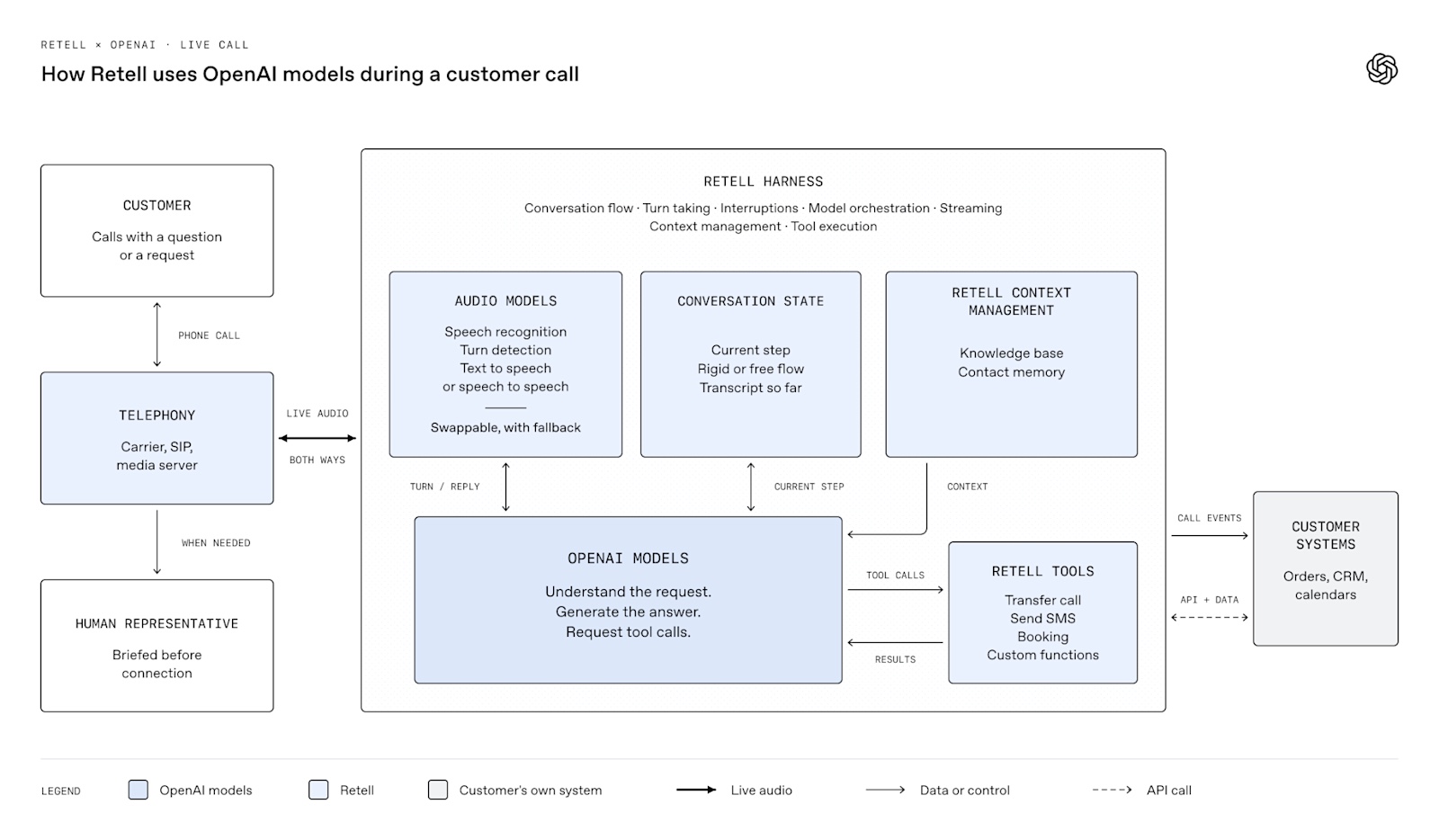
Take the architecture apart (below): Retell's harness owns the skeleton of the conversation — audio models handle speech recognition, turn detection and text-to-speech (or speech-to-speech, swappable with fallback); conversation state tracks the current step, the flow's rigidity and the transcript so far; context management holds the knowledge base and contact memory. The OpenAI models (GPT-6.1 Sol, GPT-6 Astra, GPT-5.5) do three things: understand the request, generate the answer, request tool calls. Tool execution happens on Retell's side — transfer, SMS, booking, custom functions — with results written back for the conversation to continue. When human judgment is needed, the agent briefs the representative first, answers the representative's follow-ups and confirms they are ready before connecting; after hang-up, GPT-5.6 Terra analyzes the transcript and extracts the outcomes.
The engineering constraints of voice are in the story too: daytime traffic can reach 50 times the overnight low, absorbed on dedicated servers shared with OpenAI; healthcare and financial-services customers route through regional API endpoints for data residency; redundancy is doubled — Retell runs its own telephony stack with a second ready to take over, and both voice and model services keep backups. The latency figures (October 13 benchmark terms): GPT-6 Astra and GPT-6 Sol both post a median first-sentence latency of 883 milliseconds, with GPT-5.6 Luna fastest at 497 — how quickly the first sentence lands decides how human the other end of the line feels. One version note: the post-call transcript reader is GPT-5.6 Terra; the GPT-6.1 Terra this site covered on October 27 is the newer generation — keep the two apart.
Sources and further reading
- OpenAI: Retell uses OpenAI models to help power 100M monthly callsOfficial customer story · news-feed record dated October 27, 2026Full text read October 29. Used for the platform scale (4,000+ businesses), monthly calls (about 30 million in early 2026 → 100 million+ in September), OpenAI models generating responses for 80% of calls, 1 trillion+ cumulative tokens across OpenAI models, customer resolution rates above 80%, the call architecture (harness split; GPT-6.1 Sol / GPT-6 Astra / GPT-5.5 live conversation; pre-handoff briefing; GPT-5.6 Terra on the transcript afterwards), latency (883 ms median first sentence for GPT-6 Astra and GPT-6 Sol, 497 ms for GPT-5.6 Luna; daytime traffic up to 50× overnight lows), the vCX benchmark (October 13: GPT-6 Astra first on instruction following at 89.7%; GPT-5.5 pre-launch evals at 88.0% non-hallucination and 88.3% tool-call correctness), Anker (80.4% resolution, NPS 63), Pine Park Health (2.1 full-time roles recovered, 55.7% booking rate on contact), and Codex with the $1.6M annual revenue run rate per employee. All figures are Retell-/customer-reported.
vCX: picking models on real calls, not demos
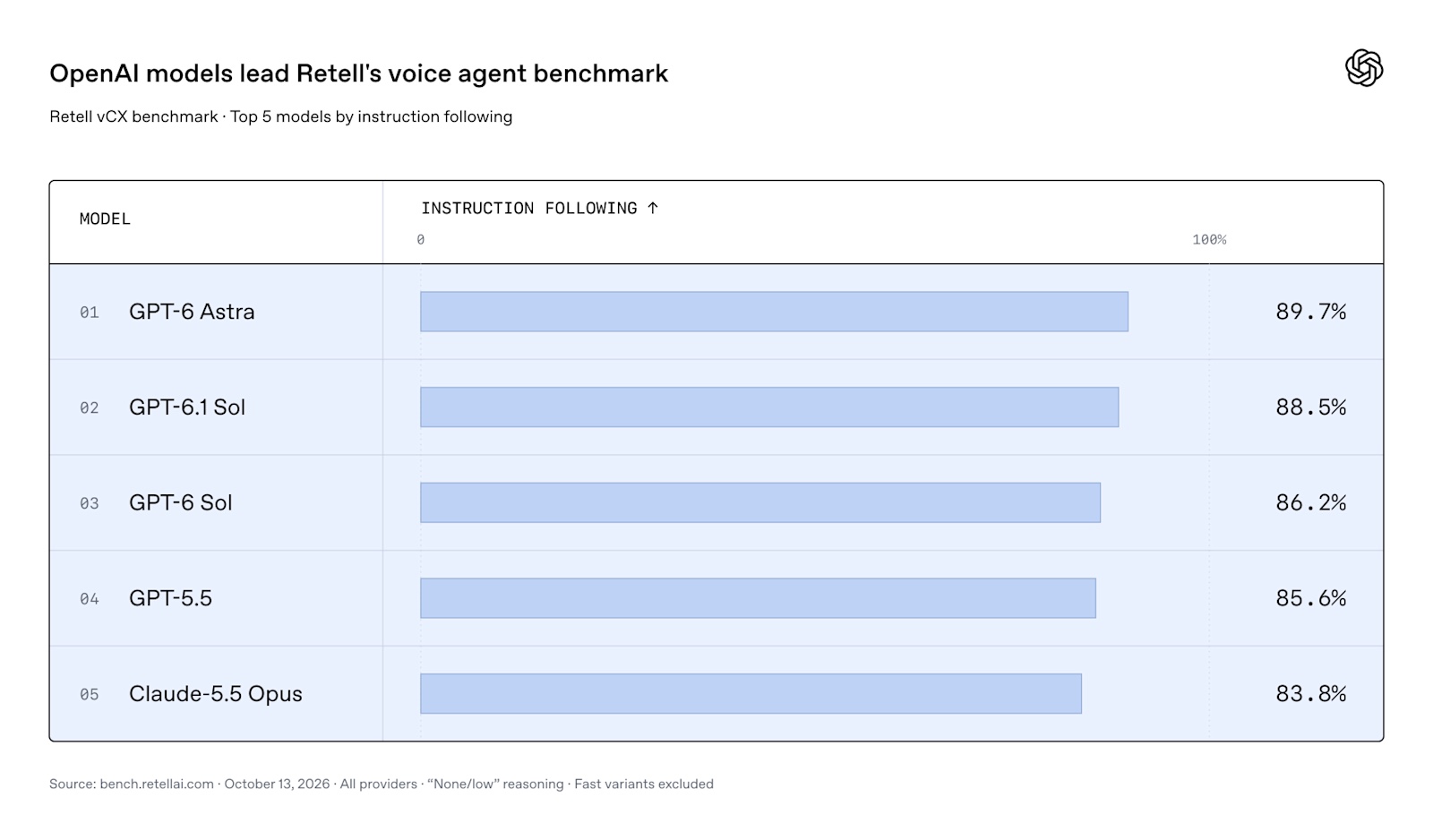
vCX is Retell's own benchmark: it takes difficult multi-turn conversations drawn from real production scenarios and tests instruction following, groundedness (whether answers stay pinned to facts and context), tool calling and natural conversation. On the October 13 board, GPT-6 Astra leads instruction following at 89.7% (top five in the chart: GPT-6.1 Sol 88.5, GPT-6 Sol 86.2, GPT-5.5 85.6, Claude-5.5 Opus 83.8; terms are "None/low" reasoning with fast variants excluded). Pre-launch evaluation is the second track: with reasoning enabled, GPT-5.5 posted an 88.0% non-hallucination rate and 88.3% tool-call correctness, ahead of Gemini-3.1-Pro and Claude-4.6; with reasoning off it still led non-hallucination. New models get a vCX re-run before they ship onto the platform — that is what "on real calls" concretely means.
The boundary first: vCX is Retell's home benchmark — its tasks come from Retell's own customer scenarios, its terms are Retell's, and the numbers are relayed by Retell/OpenAI. It is not one of this site's three independently tracked boards (AA intelligence, Pi coding, Physics-IQ physical video); we do not merge or mix it — in our AA board records, GPT-6 Astra's 57 (max tier) measures something else. What this chart is for: seeing the standard a voice-heavy platform uses to pick models — instruction following and tool calling sit at the top, while the general intelligence index recedes.
Sources and further reading
- OpenAI: Retell uses OpenAI models to help power 100M monthly callsOfficial customer story · news-feed record dated October 27, 2026Full text read October 29. Used for the platform scale (4,000+ businesses), monthly calls (about 30 million in early 2026 → 100 million+ in September), OpenAI models generating responses for 80% of calls, 1 trillion+ cumulative tokens across OpenAI models, customer resolution rates above 80%, the call architecture (harness split; GPT-6.1 Sol / GPT-6 Astra / GPT-5.5 live conversation; pre-handoff briefing; GPT-5.6 Terra on the transcript afterwards), latency (883 ms median first sentence for GPT-6 Astra and GPT-6 Sol, 497 ms for GPT-5.6 Luna; daytime traffic up to 50× overnight lows), the vCX benchmark (October 13: GPT-6 Astra first on instruction following at 89.7%; GPT-5.5 pre-launch evals at 88.0% non-hallucination and 88.3% tool-call correctness), Anker (80.4% resolution, NPS 63), Pine Park Health (2.1 full-time roles recovered, 55.7% booking rate on contact), and Codex with the $1.6M annual revenue run rate per employee. All figures are Retell-/customer-reported.
- Retell Model Benchmark site (bench.retellai.com)Benchmark site · dynamic pageThe story's chart carries the source line: bench.retellai.com · October 13, 2026 · All providers · "None/low" reasoning · Fast variants excluded. The site is a dynamic page; on October 29 this site read only its shell (title and description: comparing model response quality, speed and reliability). The October 13 table numbers rest on the chart and text relayed in OpenAI's story, not a row-by-row re-check on the benchmark site itself.
Two scenes: Anker's after-sales and the clinic's front desk
The life end is two concrete scenes. Anker hands its US/UK Tier-1 after-sales to voice agents on Retell: order tracking, warranty checks, troubleshooting. The reported figures: an 80.4% case resolution rate, an NPS of 63, and — by the team's account — agent tone, pacing and warmth that met the human-agent standard. Pine Park Health runs the other direction: agents handle clinic appointment reminders and proactive scheduling, writing outcomes into patients' medical charts; the company's terms are medical-assistant time equivalent to 2.1 full-time roles recovered and redirected to patient care, with 55.7% of calls that reach a patient ending in a booking.
Both are company-reported figures published via OpenAI's story; we placed none of these calls. Placed in this site's thread: Anima, covered last week, is one clinic company wiring models into its own workflows, while Retell is the platform layer under thousands of phone lines — two ends of the same "phone you can't get through" story, one clinic's fifty minutes becoming ten, and a platform carrying a hundred million calls a month. The telephone as an entry point is being rebuilt from both ends at once.
Sources and further reading
- OpenAI: Retell uses OpenAI models to help power 100M monthly callsOfficial customer story · news-feed record dated October 27, 2026Full text read October 29. Used for the platform scale (4,000+ businesses), monthly calls (about 30 million in early 2026 → 100 million+ in September), OpenAI models generating responses for 80% of calls, 1 trillion+ cumulative tokens across OpenAI models, customer resolution rates above 80%, the call architecture (harness split; GPT-6.1 Sol / GPT-6 Astra / GPT-5.5 live conversation; pre-handoff briefing; GPT-5.6 Terra on the transcript afterwards), latency (883 ms median first sentence for GPT-6 Astra and GPT-6 Sol, 497 ms for GPT-5.6 Luna; daytime traffic up to 50× overnight lows), the vCX benchmark (October 13: GPT-6 Astra first on instruction following at 89.7%; GPT-5.5 pre-launch evals at 88.0% non-hallucination and 88.3% tool-call correctness), Anker (80.4% resolution, NPS 63), Pine Park Health (2.1 full-time roles recovered, 55.7% booking rate on contact), and Codex with the $1.6M annual revenue run rate per employee. All figures are Retell-/customer-reported.
The company Codex built, and the boundaries
How the platform itself gets built is in the story too: engineers use Codex throughout — researching unfamiliar code by having it survey the code, check against actual data and explain what needs to change; catching details during implementation; debugging by cross-referencing logs and database records; and writing the instructions customers give their agents. GPT-6 Astra's computer use tests front-ends: opening the interface, clicking through flows, trying to break them and reporting the issues — in the story's words, earlier models could not do this reliably. The business terms: an annual revenue run rate of $1.6 million per employee, with the engineering team not needing to grow at the same pace as the business. What's announced for later — QA and simulation in more languages, knowledge bases that learn on their own — is a roadmap, not a delivered result.
Pin the boundaries: every figure here comes from the customer story published by OpenAI, reported by Retell and its customers; we placed no calls, auditioned no recordings and re-ran nothing; the vCX and latency figures are October 13 terms — cite them with the date. To keep reading on-site: the GPT-6 Astra model entry and our running Astra thread (the same source capabilities on desks and in agents); the GPT-6.1 Terra piece — remembering that the model doing post-call work here is the previous 5.6 Terra; and the personal AI companions topic, where "agents taking over chores" is the longer line.
Sources and further reading
- OpenAI: Retell uses OpenAI models to help power 100M monthly callsOfficial customer story · news-feed record dated October 27, 2026Full text read October 29. Used for the platform scale (4,000+ businesses), monthly calls (about 30 million in early 2026 → 100 million+ in September), OpenAI models generating responses for 80% of calls, 1 trillion+ cumulative tokens across OpenAI models, customer resolution rates above 80%, the call architecture (harness split; GPT-6.1 Sol / GPT-6 Astra / GPT-5.5 live conversation; pre-handoff briefing; GPT-5.6 Terra on the transcript afterwards), latency (883 ms median first sentence for GPT-6 Astra and GPT-6 Sol, 497 ms for GPT-5.6 Luna; daytime traffic up to 50× overnight lows), the vCX benchmark (October 13: GPT-6 Astra first on instruction following at 89.7%; GPT-5.5 pre-launch evals at 88.0% non-hallucination and 88.3% tool-call correctness), Anker (80.4% resolution, NPS 63), Pine Park Health (2.1 full-time roles recovered, 55.7% booking rate on contact), and Codex with the $1.6M annual revenue run rate per employee. All figures are Retell-/customer-reported.