AI in everyday life · The clinic line you can't get through
Anima's three AI teammates: clinic phone waits from 50 minutes to 10
Anima, a platform serving 1,000+ UK clinics and 14 million patients, uses a GPT-Live voice receptionist named Andi to cut phone queues from 40–50 minutes to 10, a GPT-6 document pipeline keyed to roughly 800,000 SNOMED clinical codes to lift throughput from 15 to 30–45 items per hour and clear 100,000-item backlogs within days, and GPT 5.6 Luna to turn referral letters from 5–15 minutes into seconds. All figures are Anima-reported; staff review stays in the loop. We did not trial the product.
This account draws on OpenAI's official customer story (the English page metadata dates it October 26; the French edition is marked October 23; we read the full text on October 28). Unless noted, every figure is the vendor's — Anima-reported, not tested or trialed here, and we logged into no clinic system. Screenshots are official release artwork.
From a six-month queue to three AI teammates
Anima is a UK healthcare platform built around the three most clerical parts of clinic life: patient requests, clinical letters and consultation notes. In the official customer story's terms, it now serves more than 14 million patients across 1,000+ UK clinics, processes over 800,000 cases a month, and is expanding into the US and Australia. Founder Shun Pang's starting point came from his clinical training: one patient's abnormal test results sat in a queue for six months, unactioned — and that patient missed potentially life-saving care. His conclusion: headcount alone would never keep up; the change had to come from software.
On model choice, Anima says it benchmarked closed and open models before settling on OpenAI; Shun Pang's stated reasons were "superior intelligence, intelligence per dollar, and steerability with in-context learning." In the product this becomes three AI teammates with distinct jobs: Andi the receptionist takes calls with GPT-Live, the document pipeline runs clinical letters on GPT-6, and Scribe writes notes with GPT 5.6 Luna. Worth noting is the split itself — voice, documents and note-writing each get a fitting model rather than one generalist doing everything, and deterministic rules stay at the critical points (the next two sections).
Sources and further reading
- OpenAI: Anima helps clinics cut call waits by 75% with GPT-6 and GPT-LiveOfficial customer story · October 26 (page metadata)Full text read October 28 (earlier fetches that day were blocked by 403 / a content filter; the retry succeeded). Used for the platform scale (14M patients / 1,000+ clinics / 800,000 monthly cases), CEO Shun Pang's six-month-backlog origin and model-selection quotes, the Andi / Documents / Scribe split and their models, 40–50 minutes to 10, the 86% survey, ~800,000 SNOMED codes, 15 to 30–45 items per hour, the 100,000-item backlog, referral letters from 5–15 minutes to seconds, and resolution within 24 hours with a ~3.5-hour median. All figures are Anima-reported.
Andi the receptionist: phone waits from 40–50 minutes to 10
Andi is a voice receptionist running on GPT-Live. A patient calls and describes symptoms; Andi listens and asks. But what gets asked next is not the model improvising — it is Anima's own policy engine walking a deterministic, clinically approved intake workflow. Each call starts with GPT-5.4 mini selecting the right questionnaire from the library; once the history is complete it becomes a structured case in the clinic's dashboard, where staff review and act. The model carries the "understanding human speech" part, while every clinical step stays pinned to approved rules.
The numbers: clinics using Andi cut phone queues from 40–50 minutes to 10 — roughly a 75% reduction in the headline's terms; 86% of patient surveys say they would use Andi again, and users in their eighties and nineties rank among the happiest, with quoted praise for being "infinitely patient and very polite." These are Anima-reported figures published by OpenAI, not our trial; but the order of change — fifty minutes to ten — maps to a real difference on the patient's side of the line. The clinic phone you can't get through is among the most concrete doors AI walks into daily life.
| Teammate · model | What it does | Official figure |
|---|---|---|
| Andi · GPT-Live (GPT-5.4 mini picks the questionnaire) | Voice intake along approved workflows; staff review and act | Phone queues 40–50 minutes → 10; 86% would use again |
| Documents · GPT-6 | Letter extraction, patient matching, next-action suggestions; per-practice in-context learning | 15 → 30–45 items per hour; 100,000-item backlogs cleared in days |
| Scribe · GPT 5.6 Luna | Consultation recordings to structured notes; the same context reused for referrals and follow-ups | Referral letters 5–15 minutes → seconds |
Sources and further reading
- OpenAI: Anima helps clinics cut call waits by 75% with GPT-6 and GPT-LiveOfficial customer story · October 26 (page metadata)Full text read October 28 (earlier fetches that day were blocked by 403 / a content filter; the retry succeeded). Used for the platform scale (14M patients / 1,000+ clinics / 800,000 monthly cases), CEO Shun Pang's six-month-backlog origin and model-selection quotes, the Andi / Documents / Scribe split and their models, 40–50 minutes to 10, the 86% survey, ~800,000 SNOMED codes, 15 to 30–45 items per hour, the 100,000-item backlog, referral letters from 5–15 minutes to seconds, and resolution within 24 hours with a ~3.5-hour median. All figures are Anima-reported.
800,000 clinical codes and notes in seconds
The document line shows the capability-plus-integration combination best. The GPT-6 pipeline first extracts sender, recipient, document type and event dates from each letter, matches the letter to the right patient through a multi-stage pipeline, maps it to SNOMED clinical codes — engineering lead Michael Skupien cites a number worth keeping: SNOMED has roughly 800,000 possible codes — and then suggests the next action. Adaptation happens through in-context learning per practice, with no per-customer fine-tuning. The throughput figures: staff move from 15 items per hour to 30–45, the best clinics to 45–60, and historical backlogs above 100,000 items clear within days.
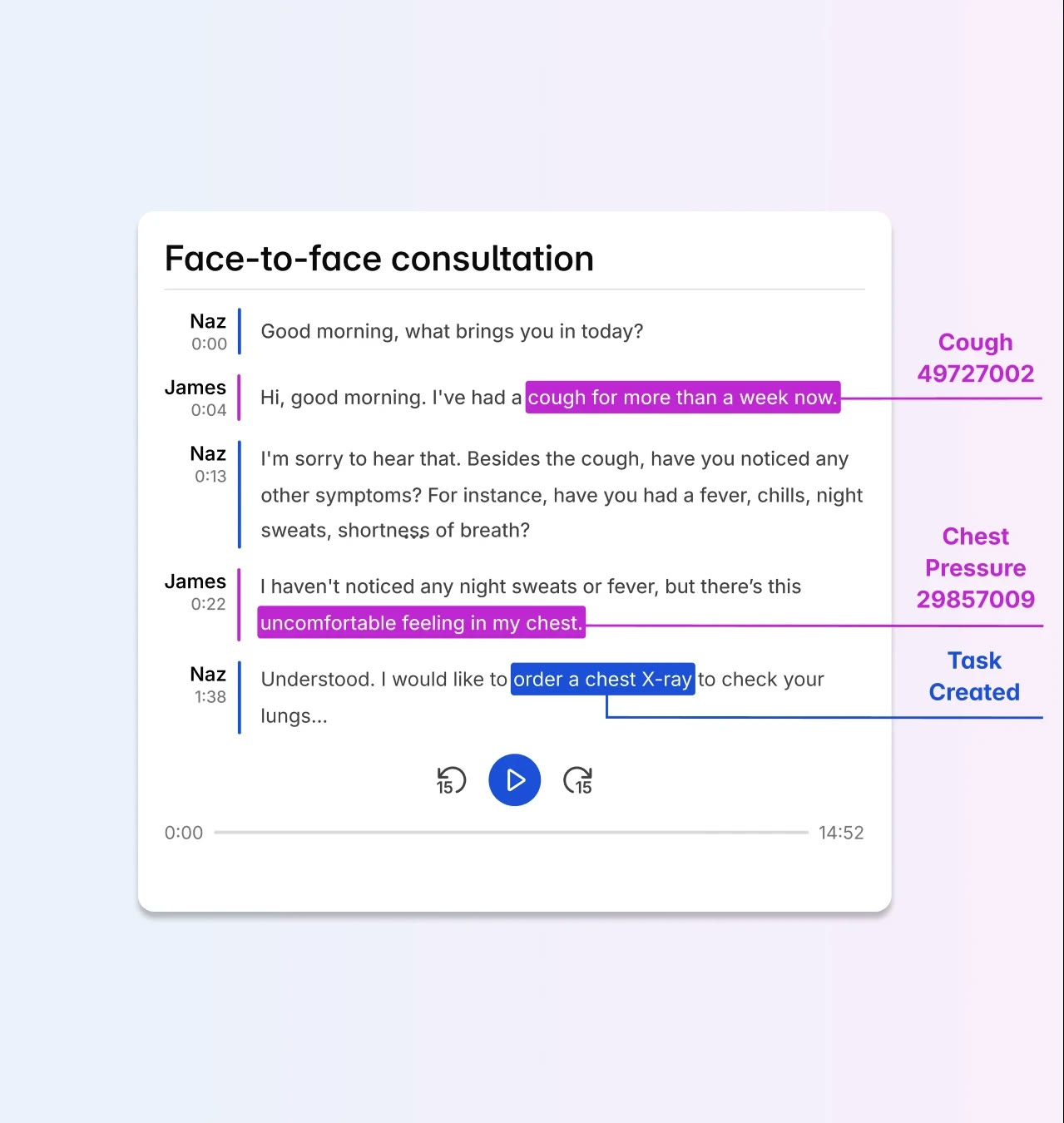
Scribe, on GPT 5.6 Luna, turns consultation recordings into structured notes. The official screenshot shows one 14-minute-52-second consultation: "cough for over a week" and chest pressure are highlighted in the transcript, SNOMED codes appear alongside (Cough 49727002, Chest Pressure 29857009), and a blue underline creates the chest X-ray task. The same context is reused for referral letters — five to fifteen minutes down to seconds — and follow-up messages. One quoted doctor's version: finishing on time instead of at eight or nine at night. Most cases resolve within 24 hours, with a roughly 3.5-hour median.
Sources and further reading
- OpenAI: Anima helps clinics cut call waits by 75% with GPT-6 and GPT-LiveOfficial customer story · October 26 (page metadata)Full text read October 28 (earlier fetches that day were blocked by 403 / a content filter; the retry succeeded). Used for the platform scale (14M patients / 1,000+ clinics / 800,000 monthly cases), CEO Shun Pang's six-month-backlog origin and model-selection quotes, the Andi / Documents / Scribe split and their models, 40–50 minutes to 10, the 86% survey, ~800,000 SNOMED codes, 15 to 30–45 items per hour, the 100,000-item backlog, referral letters from 5–15 minutes to seconds, and resolution within 24 hours with a ~3.5-hour median. All figures are Anima-reported.
Boundaries and on-site references
Pin the basis first: every figure here comes from the Anima customer story published by OpenAI — Anima-reported, with patient surveys likewise vendor-cited; this site trialed nothing and logged into no clinic system. By design the AI teammates do not act alone — every case reaches the dashboard for staff review before action, and phone intake walks deterministic, clinically approved workflows. Expansion beyond the UK has just begun, with no US or Australia figures yet. How large the real-world difference is, and how errors get caught, will take independent material.
Placed in this site's thread, it is a full source-to-life arc: voice (GPT-Live) and document understanding (GPT-6) are the source capabilities; Anima's policy engine, per-practice in-context learning and staff review are the integration work; the life end is the unanswered phone, the piled-up letters and the late notes. On-site references: the GPT-6 family's Terra covers the same source at the office desk; Luna, which appeared in our Sol/Luna/Opus cost comparison, here takes dictation; and the personal AI companions topic's running question — agents taking over everyday chores — is told here in a clinic's voice.
Sources and further reading
- OpenAI: Anima helps clinics cut call waits by 75% with GPT-6 and GPT-LiveOfficial customer story · October 26 (page metadata)Full text read October 28 (earlier fetches that day were blocked by 403 / a content filter; the retry succeeded). Used for the platform scale (14M patients / 1,000+ clinics / 800,000 monthly cases), CEO Shun Pang's six-month-backlog origin and model-selection quotes, the Andi / Documents / Scribe split and their models, 40–50 minutes to 10, the 86% survey, ~800,000 SNOMED codes, 15 to 30–45 items per hour, the 100,000-item backlog, referral letters from 5–15 minutes to seconds, and resolution within 24 hours with a ~3.5-hour median. All figures are Anima-reported.
- OpenAI (French edition): cross-check of the same storyOfficial alternate-language edition · dated October 23Numbers cross-checked paragraph by paragraph against the English edition (40–50 to 10 minutes, 86%, 800,000 codes, 15 to 30–45, the 100,000 backlog, 5–15 minutes to seconds, ~3.5-hour median); the official image URLs for our cover and body screenshot come from this edition's assets.