
01 / ANALYSIS
Product analysis
- Maturity
- Live
- Confidence
- Partial
- Verified
- 2026-07-18
- Commercial relation
- Not sponsored
Problem solved
Product specs are often written in a document tool while code lives in GitHub. Engineers read a linked doc once, implementation moves on, and the two drift apart. Plain Markdown can colocate them, but shifts Git and PR mechanics onto collaborators who may not know that workflow.
Why it was selected
The site connects editing, live collaboration, inline comments, redlines, approvals, and merge in one visible flow, and says the GitHub App reaches only repositories the user grants. The free tier covers one repository and five publishes per month without a card; Pro and Pro Plus are currently $8 and $16 per seat per month. Pricing can change, so these are verification-time values only.
What is genuinely novel
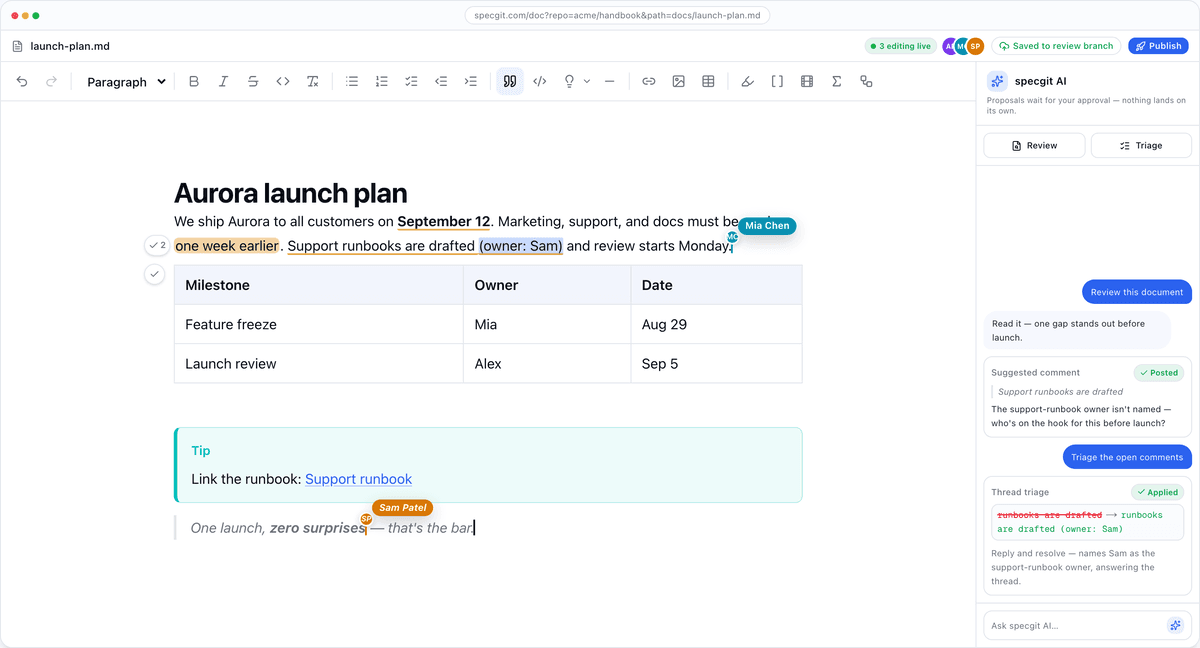
Visual editing, collaboration, and AI review are not individually new. The stronger combination maps saves to commits, comments to PR threads, and publishing to merges while preserving branch protection and required approvals. The homepage also exposes the real editor as a no-sign-up demo, making the interaction claim publicly inspectable.
Best for
Teams that keep product specs in GitHub but need PMs, designers, and engineers to author and review them together
Editorial evaluation
KEEP DISCOVERING
A few more products worth noticing
A small set selected by product shape and profile similarity, with independent verification records.

Hangar
Adithya Shreshti
What it solves
Long-lived local projects mix source, dependencies, build caches, development servers, Git worktrees, and unpushed work that exists only on one machine. Generic cleaners see file size without project meaning, while terminal scripts require developers to remember every directory, launch command, port, and backup state.
TokRepo
Regulus K.K.
What it solves
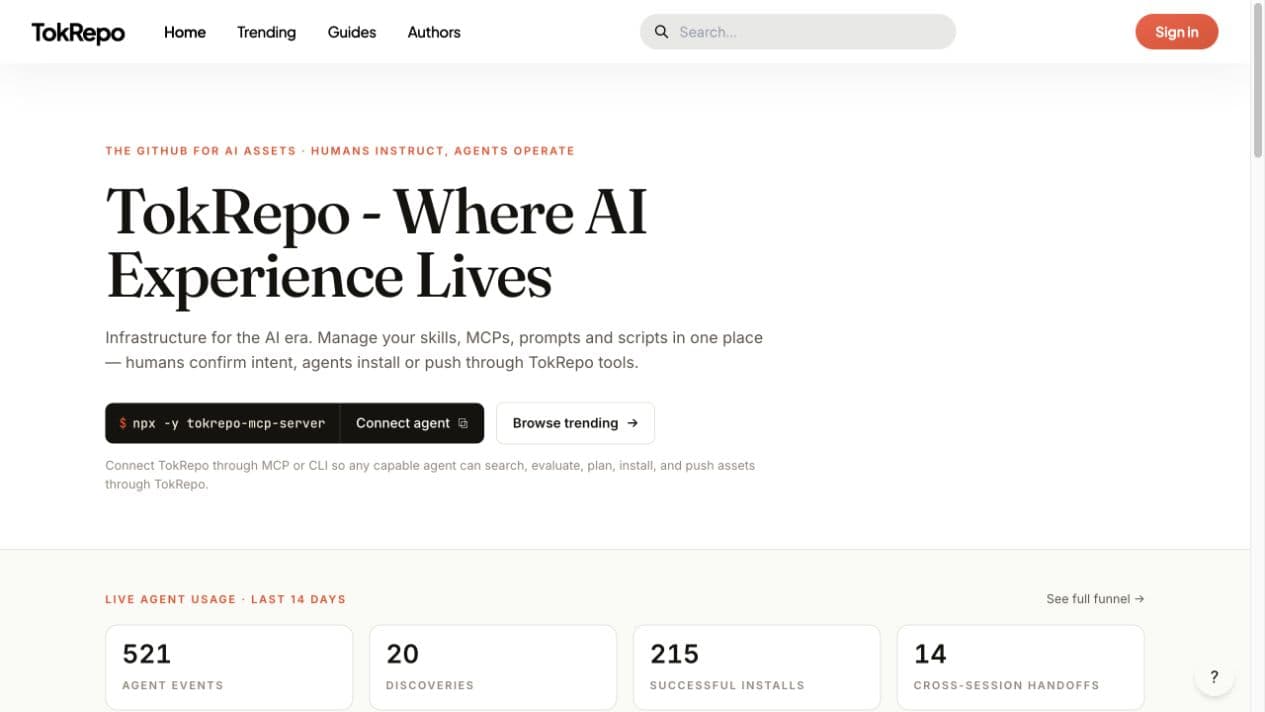
Agent skills, system prompts, MCP configurations, and workflows are scattered across repositories, documentation, and chat history. Before copying them, teams lack a consistent way to assess provenance, permissions, dependencies, target tools, write scope, rollback, and reusable install records.

Domain Details
Uneed publisher julianengel / Julian Engel and Simple Bytes
What it solves
Domain research often means moving among registries, WHOIS/RDAP, DNS, certificates, Wayback, registrar pricing, and several aftermarket venues. Domain Details reduces that fragmentation with a shared search, browser-local history, bulk entry points, and monitoring alerts.
02 / WHAT STANDS OUT
Three product decisions worth noticing
Map new UX onto trusted primitives
Mapping save, comment, and publish to commits, PR threads, and merges improves usability without discarding the team's audit trail and approval rules.
Prefer reversibility to automation speed
Redlines, selective undo, branch protection, and required reviews turn document changes into an inspectable, rejectable, recoverable release process.
Describe privacy by data path
Repository files, temporary collaboration state, AI requests, explicitly shared feedback, product analytics, and operational logs have different recipients and retention windows and should be disclosed separately.
Product insight worth carrying forward
Do not invent a parallel publishing and review state; map an approachable interface onto the commits, branches, PRs, approvals, and merge rules the team already trusts, while keeping the durable record portable.
03 / DO NOT COPY
What not to copy
04 / LIMITS & RISKS
Limits and risks
'Docs stay in GitHub' does not mean zero processing. The GitHub App needs read/write contents and pull-request permissions on granted repositories, and realtime collaboration state may persist temporarily for up to seven days. When a user invokes AI, document text and relevant comments go to xAI, whose API data may be retained for abuse monitoring for up to 30 days; explicitly shared AI conversations may be kept for up to 90 days. The current privacy page also discloses allowlisted, content-free analytics through PostHog Cloud EU: region- and consent-gated, with raw events retained up to 12 months and operational logs up to 30 days. These boundaries are more specific than older 'no analytics' summaries and deserve review before adoption.
Compared with alternatives
Compared with Google Docs or Notion, specgit keeps files, versions, and review history in repository and PR workflows. Compared with raw Markdown, GitHub's web editor, or a local IDE, it lowers the authoring and collaboration barrier for non-engineering roles. The cost is another commercial service, meaningful repository permissions, temporary collaboration state, and optional AI and analytics processing, so adoption cannot be judged on editing UX alone.
05 / EVIDENCE
Visual evidence
06 / SOURCE
Source and verification
- Original author
- Fn First Holdings LLC
- Country / region
- United States / global
- Maturity
- Live
- Confidence
- Partial
- Discovered
- 2026-07-18
- Last verified
- 2026-07-18
What this review checked
We verified the live site, no-sign-up editor demo, official share image, pricing, privacy policy, security page, terms, company identity, and Uneed launch page. We did not sign in with GitHub, install the App, grant repository access, open private documents, submit edits, invite collaborators, invoke AI, test branch protection, or inspect network traffic, so save, approval, merge, and permission behavior remain first-party claims.
Latest change
Initial profile created from the live site, public editor demo, official share image, pricing, privacy, security, terms, company identity, and Uneed launch page; no sign-in or repository access was granted, and current GitHub permission, temporary collaboration, xAI, PostHog, and retention boundaries are recorded.
Ready to explore further?
Open the product, or return to the original source to verify the details.
ONE-TAP FEEDBACK
Did this profile help you judge the product?
One tap. No writing required.