
01 / ANALYSIS
Product analysis
- Maturity
- Pilot
- Confidence
- Partial
- Verified
- 2026-07-19
- Commercial relation
- Not sponsored
Problem solved
Developers paste `.env` values, logs, customer records, or proprietary code into Cursor, Claude Code, Copilot, and similar tools. Traditional network DLP may not see an app's composer, while vendor dashboards do not provide one cross-tool signal.
Why it was selected
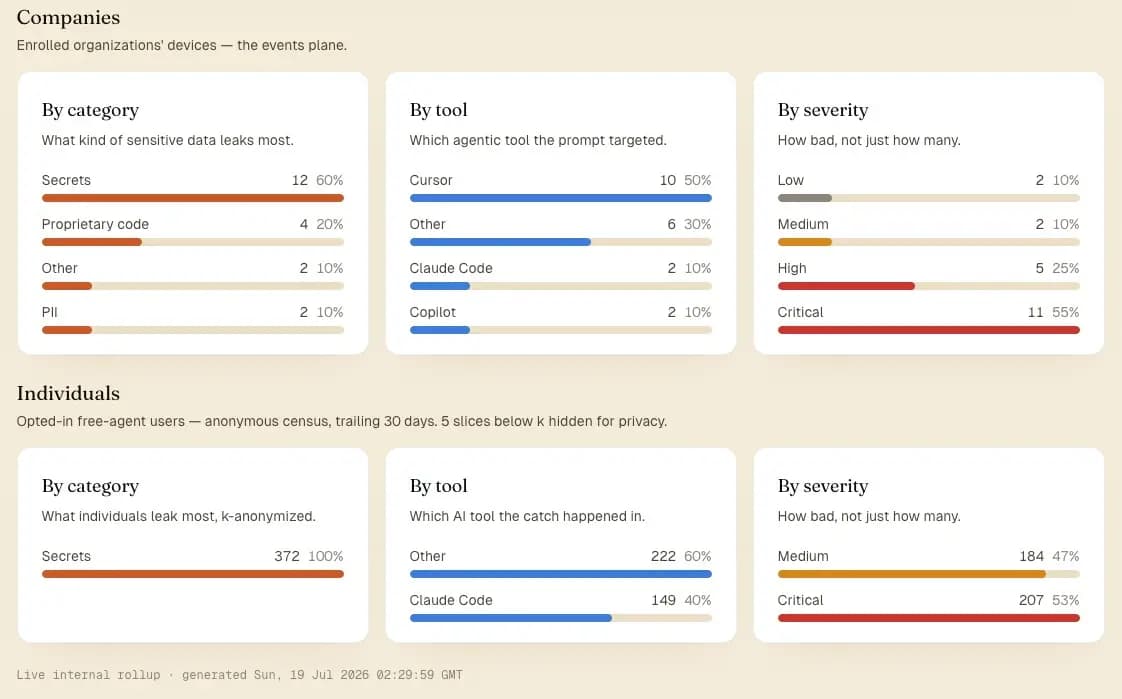
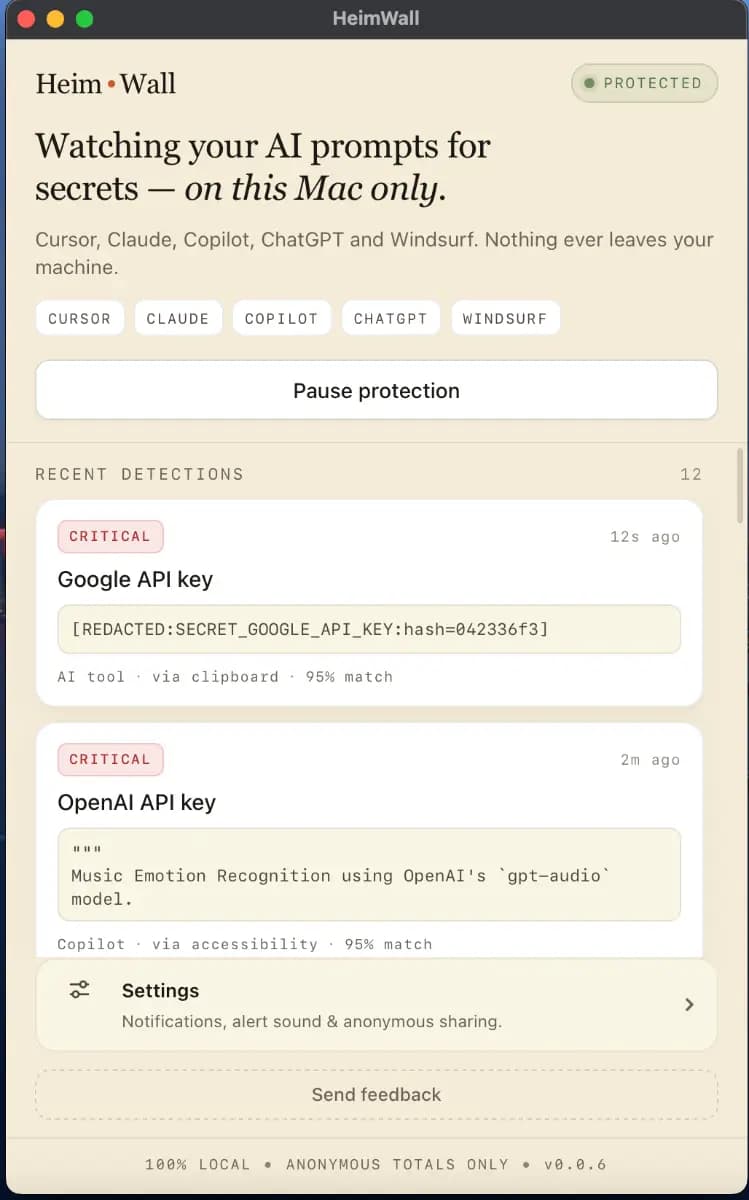
Both publisher originals are real product interfaces: an internal rollup split by category, tool, and severity, and a macOS v0.0.6 detection window showing local protection, recent findings, redaction markers, capture source, and settings. The current architecture also separates individual, team, manager, and company planes and names Accessibility, clipboard polling, a local TLS proxy, 25+ regex rules, confidential terms, a pending ONNX layer, redacted snippets up to 500 characters, and hashes. Turning 'who can see what' into product structure is transferable. The screenshots only prove that the publisher presents these interfaces; they do not prove real customers, detection rates, latency, zero egress, or deployment scale.
What is genuinely novel
Secret scanning, clipboard observation, local proxies, endpoint DLP, and management dashboards are established capabilities. The more instructive combination is running explainable rules before send, separating zero-uplink individual use from redacted team uplink, and making employee notice and a no-performance-review covenant part of the product. The distinction depends on reproducible evidence for all capture paths and the investigation sealed payload.
Best for
macOS developers or security teams willing to evaluate a local prompt-leak workflow with fake credentials in an isolated environment; not for production rollout before installer verification, network evidence, final contracts, and employee-governance review
Editorial evaluation
KEEP DISCOVERING
A few more products worth noticing
A small set selected by product shape and profile similarity, with independent verification records.
CodeAgentSwarm
Arturo Garcia
What it solves
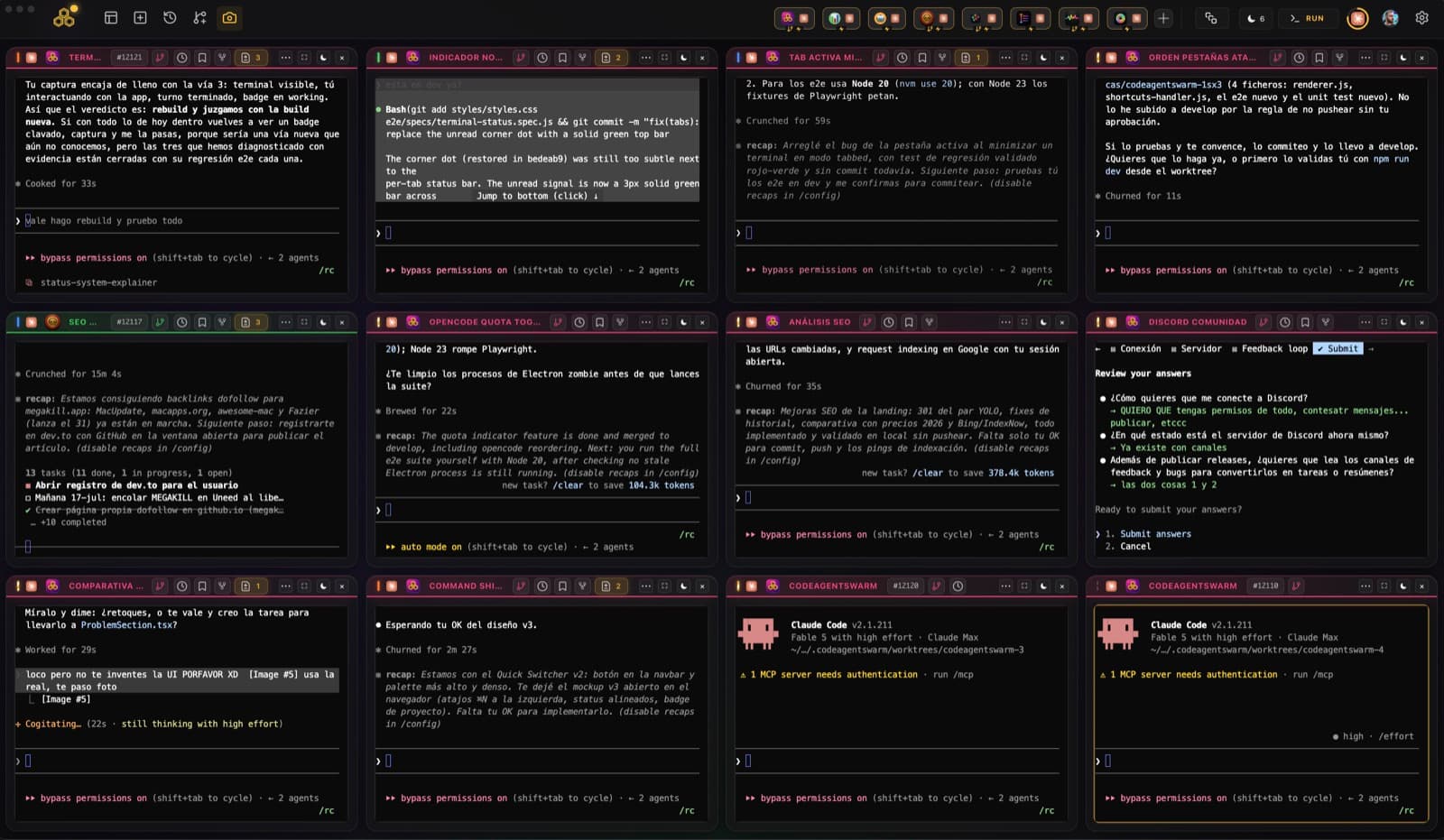
Once several coding agents run in parallel, their execution gains can be erased by polling terminals, reconstructing context, finding sessions waiting for approval, and reconciling overlapping edits. Plain terminal panes can display processes side by side but do not understand each agent's task, state, or change scope.
CartaStudio
12vectors team (Nik Eleftheriou and Ronald Ashri)
What it solves
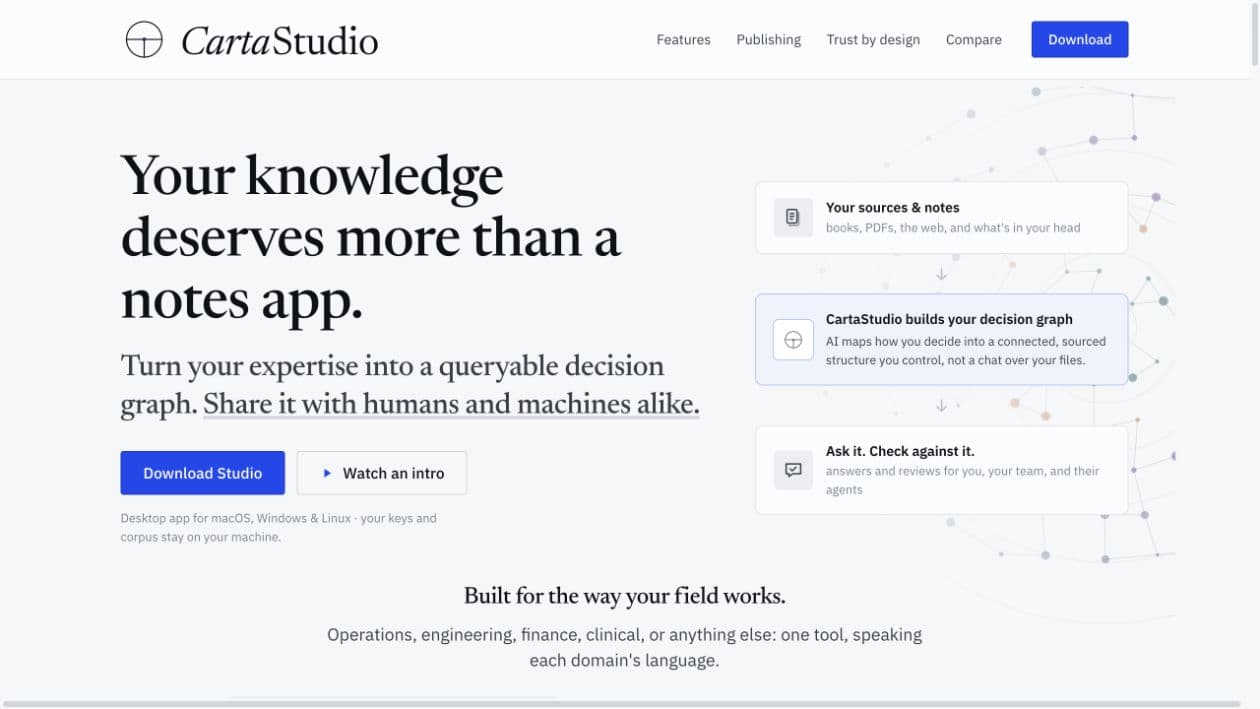
Real decision criteria are scattered across documents, PDFs, web pages, and individual experience. Generic chat and file search struggle to express applicability, exceptions, and rationale. CartaStudio turns that material into typed, scoped, sourced decision graphs stored as Markdown in a user-chosen folder.
nForms
Noah Kellner
What it solves
A basic contact form often needs separate delivery, bot protection, and accessible validation systems. nForms accepts submissions through a form action or one script tag and layers SHA-256 proof-of-work with ARIA error states.
02 / WHAT STANDS OUT
Three product decisions worth noticing
Bind privacy promises to runtime modes
'No upload' cannot describe individual, team, and investigation modes at once. List inputs, output fields, storage, network, actors, keys, notices, and retention per mode so the product page becomes testable.
Use one release manifest as the source of truth
Generate the page, download API, and changelog from one signed manifest for version, size, rule count, tool coverage, classifier status, and installer hash to prevent pilot-stage drift.
Make employee visibility a product capability
Monitoring products cannot rely only on buyer contracts. The endpoint should show current mode, uploaded fields, recent access, investigation reason, revocation, and export so the monitored person can verify governance promises.
Product insight worth carrying forward
Express the privacy promise as a mode-specific, testable state machine: individual mode captures, detects, warns, and drops locally; team mode may upload a constrained redacted event only after explicit enrollment; investigation mode separately names the actor, keys, notice, time box, audit trail, and deletion conditions.
03 / DO NOT COPY
What not to copy
04 / LIMITS & RISKS
Limits and risks
This is an early version, not a finished enterprise control plane. The team product is labeled early access. The Individual page still says v0.0.5 and 3.9 MB, while the download API pointed to v0.0.6 and the publisher screenshot also shows v0.0.6. No public changelog, installer SHA-256, reproducible build, or source code was found to map the binary. Feature definitions drift as well: the maker's Uneed copy says 47 hand-written rules while the current site says 25+; Individual says a pretrained classifier runs locally while the architecture labels it 'architecture shipped · model pending'; FAQ says 'no browser extension, no proxy' while Home and How it works include a local TLS proxy; and pages plus screenshots differ on coverage for Cursor, Claude Code, Copilot, Windsurf, and ChatGPT. The privacy boundary needs precision. Individual claims no account, backend, or network. Team mode may upload tool, category, severity, rule, timestamp, a redacted snippet up to 500 characters, and a correlatable hash. Privacy names Investigation Mode as the sole exception to no raw-prompt upload and retains investigation records for a contractual legal-hold period, while the architecture says the server stores an unreadable sealed payload. Public material does not explain whether that payload contains raw prompt text, when it is produced on the endpoint, who holds decryption keys, whether an employee can refuse or revoke it, what happens if notice fails, or the guessing risk of deterministic hashes over low-entropy secrets. Team events are queryable for 90 days, cold-stored for another 180, then retained as org aggregates. A public subprocessor page is still in preparation; the draft Privacy page names Supabase, ClickHouse Cloud, Clerk, Vercel, Fly.io, Resend, and Anthropic. The public site bundle also includes a PostHog page-view provider configured with memory persistence and session recording/autocapture disabled, while the current Privacy draft does not separately explain website analytics. Compliance and contracts are incomplete: Privacy and Terms are both April 22, 2026 drafts, and the binding terms and MSA are still being prepared with counsel. FAQ says SOC 2 Type II is in progress and HIPAA eligibility arrives with a future v1.5, while Pricing directly lists an Enterprise SOC 2 report, HIPAA eligibility, BYOK, and on-prem and also marks some items 'soon' in its comparison table. GDPR, signing/notarization, <50ms p95, 95% soft notifications, 99.9% SLA, the blog's three teams / 312 engineers, and enforcement of the no-performance-review covenant are team statements. No audit report, corpus, false-positive/negative results, notarization ticket, customer reference, or final contract was independently checked. Team and Business are annual per-seat subscriptions, and FAQ describes a $15K deposit for a 30-day paid POC. Before production procurement, confirm the available version, seat minimums, refunds, legal entity and address, lawful basis for employee monitoring, DPA, regions, subprocessors, keys, and deletion flow.
Compared with alternatives
Compared with Git hooks, repository scanners, and pre-commit secret checks, HeimWall attempts to intervene between the prompt composer and send action. Compared with endpoint DLP, it says managers receive categories and redacted signal. Compared with single-vendor Cursor or Copilot consoles, it seeks a cross-tool view. Its mode and permission narrative is clear; implementation, versions, evidence, and final governance material have not yet converged with that narrative.
05 / EVIDENCE
Visual evidence
06 / SOURCE
Source and verification
- Original author
- Uneed publisher atacinargenc / the HeimWall team
- Country / region
- United States (target market)
- Maturity
- Pilot
- Confidence
- Partial
- Discovered
- 2026-07-19
- Last verified
- 2026-07-19
What this review checked
We checked the official read-only Uneed profile, publisher identity, two publisher originals and their media order, plus HeimWall's live home, Individual, How it works, Pricing, FAQ, Privacy, Terms, blog, public page bundle, and download-API redirect. The download page labeled the app v0.0.5 while the API redirected to `HeimWall-0.0.6-arm64.dmg` at verification. We did not download or mount the DMG; inspect signing or notarization; install the app; grant Accessibility; read the clipboard; configure a local proxy; enter fake secrets; observe the network; join a team; create an account; enter the waitlist; upload an event; open Investigation Mode; buy a POC; or contact the team. Runtime, security, performance, billing, and contractual conclusions therefore remain independently untested.
Latest change
Initial profile created from the current Uneed launch, publisher identity, two maker interfaces, live home, Individual, architecture, pricing, FAQ, privacy, terms, blog, page-analytics code, and download-API redirect. No download, installation, permission grant, secret entry, network observation, waitlist entry, account, event upload, or payment occurred. Version, rules, capture methods, classifier, investigation payload, retention, subprocessors, compliance, contracts, and employee-governance boundaries are recorded.
Ready to explore further?
Open the product, or return to the original source to verify the details.
ONE-TAP FEEDBACK
Did this profile help you judge the product?
One tap. No writing required.