AI video · Case study
Snow Mountain Fox: how a duck became a story and a store visit
The product became the story's reversal. Selection, rework and audience remixes shaped what the team could make next. The sales gains are maker claims without independent orders or a profit ledger.
Published · Reviewed
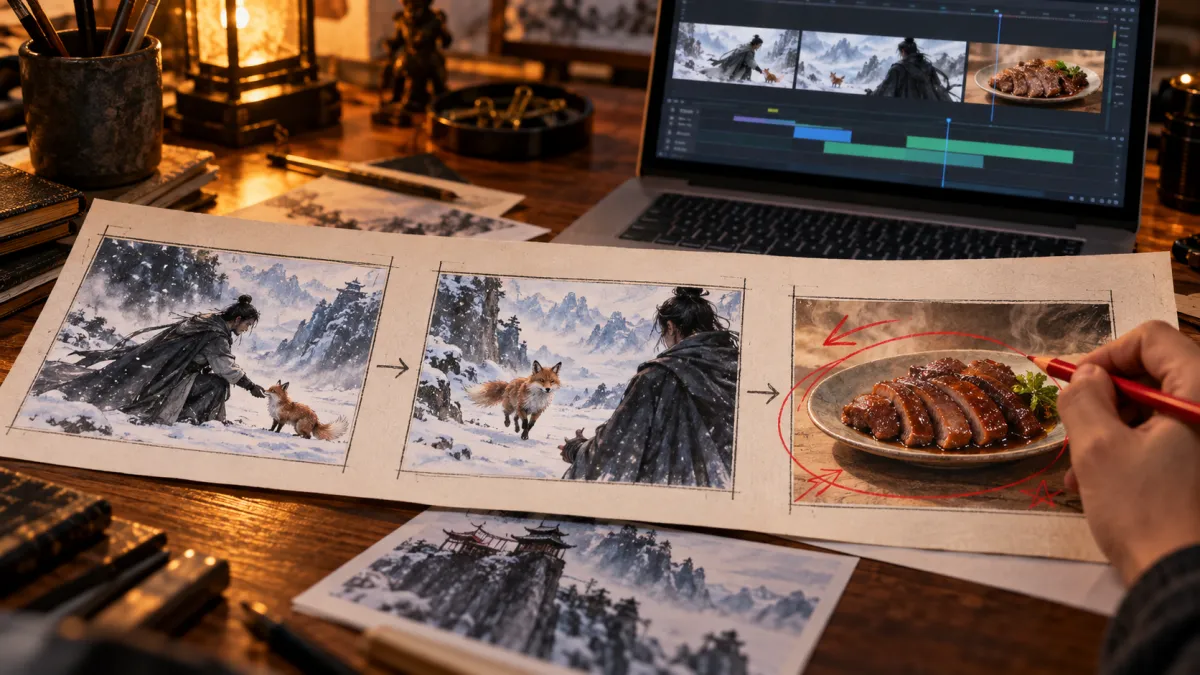 Open a related finished video on the brand's Douyin account ↗BitShovel illustration · not film footage
Ai Linjunji told Yangzi Evening News this figure. A March 26 interview gives separate Tmall month-on-month and promoted-product measures below. The three figures cannot be added or treated as profit. No independent order data, full cost ledger or causal test is public.
Check this resultA sauce-duck seller set out to make routine promotion. Its team borrowed the familiar fox-spirit repayment setup, then brought back the eaten duck for revenge, making the product the punchline. A related finished video is available on the brand's Douyin account, and two reporter interviews record the maker's choices, rework and sales claims. Together they show a path from a short series to product attention, but do not isolate orders, incremental revenue or profit caused by the video.
Verified material
Watch the brand's story before counting its reach
A brand-account video is directly available; the exact debut Xiaohongshu URL remains unverified.
Chuanwa Sauce Duck posted a related Snow Mountain Fox video on Douyin on March 9, 2026. The Hubei Daily interview says the project began as a routine Xiaohongshu update, but we do not have a stable link to that first post. This brand upload is therefore a work entry, not a claimed February 27 debut or episode one.
The maker says the team went on to make five main episodes, one extra, behind-the-scenes material and a music video. The reported 'five billion' refers to discussion and many remixes across the web, not views of this brand video or a count of buyers.
Sources for this section: Chuanwa Sauce Duck: Snow Mountain Fox related video · Hubei Daily interview with maker Ai
Public account
Make the product the twist, not a late ad frame
The four-person team changed the character, setting, food and ending so the duck became a story character.
Ai Linjunji says the team saw a predictable AI fox-repayment clip. They changed the farmer to a woodcutter, forest to snow, wild fowl to their own sauce duck, and repayment to the duck's revenge. He chose a recognisable retro wuxia look that he said the tools could generate more smoothly. The product and punchline were designed together, rather than adding a purchase message after the film was finished.
The maker also reports revising the reveal line repeatedly. The transferable decision is to define the audience expectation, what the product does in the story and how the ending breaks that expectation. The original dialogue and character treatment remain the maker's work, not a ready-made template for another brand.
Sources for this section: Hubei Daily interview with maker Ai · Yangzi Evening News interview with Ai Linjunji
Public account
Five hours for episode one; generation still needed selection
The maker advises writing the whole story, then splitting it into roughly 15-second parts; no specific failed take is public.
In Hubei Daily's interview, the maker describes writing the whole story, splitting it into roughly 15-second scripts and generating segments. He says AI footage can deviate and needs repeated adjustment and selection to avoid continuity faults; he does not name a failed shot in this title. He mentions Doubao for script breakdown and generation tools for visuals, but no shot-by-shot prompts or version files are public. He told Yangzi Evening News that episode one took about five hours from idea to release. This is the four-person team's recollection, not a reproducible labour or cost record.
We can watch finished footage and read the maker's general selection method, but cannot compare this film's rejected clips against repaired cuts. The reports do not identify a shot that failed in character, prop, motion or continuity terms, so a supposedly successful prompt comparison would be invented.
Documented process
The production chain supported by public material
A finished brand video and two maker interviews; no raw project files or rejected footage.
Rewrite · product becomes the twist
Changed fox repayment into duck revenge, with a snowy woodcutter and retro wuxia look.
Check the source for this stepSplit · roughly 15-second parts
Wrote the full story before breaking it into short scripts and generating piece by piece.
Check the source for this stepSelect · guard against continuity faults
The maker describes repeated adjustment and selection as a method; no rejected shot from this film or exact revised input is confirmed.
Check the source for this stepRelease · respond to viewers
The team extended the series after episode one; a related finished video remains on the brand's Douyin account.
Check the source for this step
Evidence limitThis sequence is supported by interviews. It is not a shot-by-shot version history, controlled prompt A/B test or visual comparison of successful and failed takes.
Sources for this section: Hubei Daily interview with maker Ai · Yangzi Evening News interview with Ai Linjunji · Chuanwa Sauce Duck: Snow Mountain Fox related video
Public account
The harder part after success: keeping up with remixes
Audience remixes expanded the story and contributed to the original series' pause.
The team told Hubei Daily that viewers took the premise beyond its own ideas, yet it finished five main episodes and an extra. On April 1, Ai told Yangzi Evening News that the original series had stopped: production time and cost were rising, and the team doubted it could top audience remixes. It began another AI short series. The pause is a problem of sustaining quality and ideas, not evidence that video generation itself failed.
A small trial would decide which characters, visual rules and product facts must persist, then use real response to one episode to judge the next investment. That is BitShovel's inference from the case, not the team's recipe for a hit.
Sources for this section: Hubei Daily interview with maker Ai · Yangzi Evening News interview with Ai Linjunji
Public account
Read the three sales claims separately
March 26 has Tmall and promoted-product measures; April 1 has an online-store gain without a defined baseline.
In the March 26 Hubei Daily interview, the maker said duck sales at the company's Tmall flagship store were up 10%–15% month on month. Later in the same report he said sales of the duck he promoted had risen by more than 20%. The second statement gives no platform, comparison period or overlap with Tmall, so it is not another distinct block of incremental sales.
On April 1, Ai told Yangzi Evening News that recent 'online-store sales' were up 70%–75%, without identifying the store, comparison period or exact products. All three figures are maker statements recorded by reporters. We have no independent orders, media spend, returns, inventory, labour or full production ledger, and no control test that separates the videos from other causes. His claim that the whole series cost a little over RMB 1,000 also lacks an itemised scope. None of this permits an incremental-revenue or profit calculation.
Sources for this section: Hubei Daily interview with maker Ai · Yangzi Evening News interview with Ai Linjunji
Sources and limits
Where the material comes from
- Chuanwa Sauce Duck: Snow Mountain Fox related videoFinished video on the brand's Douyin accountPublished Checked
Confirms the brand account, finished imagery and March 9 post; it is not proof of debut or series-wide metrics.
- Hubei Daily interview with maker AiFirsthand reporter interviewPublished Checked
Maker statements on the four-person team, five episodes, script splitting, general selection method and two distinct March 26 sales measures.
- Yangzi Evening News interview with Ai LinjunjiOriginal newspaper interview; conducted April 1, published April 2Published Checked
Confirms the company and maker names, 70%–75% store claim, episode-one time, reported series cost and pause; no sales or cost records attached.