AI video · Case study
Born From Fire: when the pour failed, the maker redesigned the shot
Start with the film, then trace the pour still, the maker's account of the failed motion, the ice-drop redesign and the edit seam. The fix was a new shot design, not just a revised prompt for the same pour.
Published · Reviewed
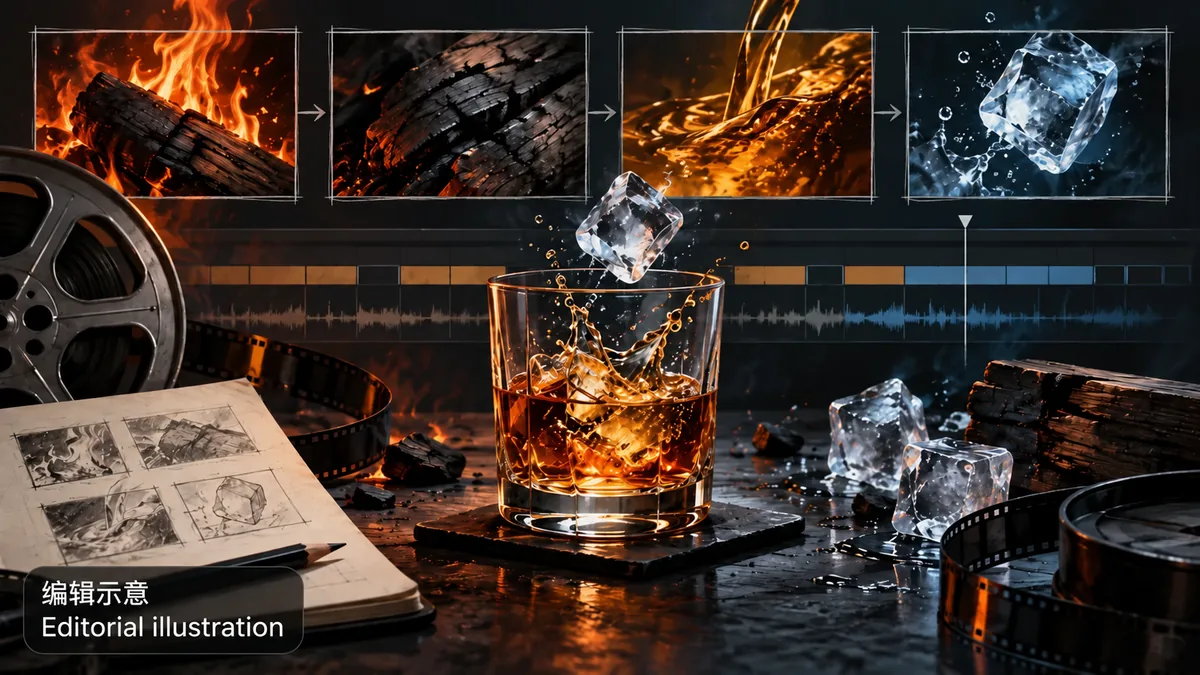 BitShovel illustration · not film footage
Documented outcome · independent spec adA 15-second film and published process account
The maker explicitly states that Jack Daniel's neither commissioned nor took part in the project. A published film and process do not establish an order, audience reach or income.
Check this resultRead the context and editorial assessment
The 15-second spot moves from fire and a charred barrel through a drop, ice and a bottle. Its useful lesson is not a one-pass AI ad: after generation, the maker dropped a hand-held pour in beat four, let the ice and liquid carry the action, and edited the replacement back into the first three beats. The film and two stills are available to inspect; the failed motion is described by the maker, with no failed clip to compare frame by frame.
01
Verified material
Watch the 15-second film first
This is a self-initiated, publicly shared portfolio spec ad.
Calixte LeBlanc introduces the spot as Born From Fire on his site; the linked original video is titled Born In Fire. He labels it an independent Jack Daniel's spec ad, neither affiliated with nor commissioned by the brand. Firelight and amber colour connect five beats; watch the original to see the ice-drop beat lead into the bottle ending.
The film and shared production files establish a completed piece of work. There is no public client contract, campaign dashboard, order, fee or income record, so this case cannot establish earnings from making an AI ad.
Sources for this section: Calixte LeBlanc: original 15-second film · Calixte LeBlanc: Born From Fire full workflow
02
Public account
Five beats before moving footage
The maker planned the product story and motion, then approved a still for each beat.
The maker locked five beats: FIRE, CHAR, PATIENCE, AMBER and HERO. He used Claude for boards and prompts, made visuals through Higgsfield, chose a Midjourney V8 character reference, used GPT Image 2 for most other stills, then generated motion with Seedance 2.0. The models made images and motion; the five-beat story, screen direction, firelight and camera moves were the maker's decisions.
Each beat had an approved still before video generation. The maker also added grain and slight softness to the keyframes to carry the visual treatment into motion. He records 135 service credits for one 15-second 1080p run at the time, not a total project cost. A successful still establishes one image, not believable hands and liquid in motion.
Sources for this section: Calixte LeBlanc: Born From Fire full workflow
03
Public account
Pour to ice: what actually failed?
The pour still is visible; the bad hands, frozen figure and dissolve are the maker's report about the first motion run.
The original fourth beat had the distiller's hand enter as whiskey poured into a glass holding a square ice cube. The page preserves the discarded pour still and its GPT Image 2 prompt, specifying a character reference, worn sleeve, fingers nearing the glass and firelight through glass and liquid. The maker explicitly says the still was not what failed; motion was.
The maker reports that beat two and its transition into three worked in the first 15-second run, while the distiller stared at a wall in beat one. In beat four, the hands looked waxy, the figure froze during the pour and an unwanted cross-dissolve appeared. After two more pour keyframe candidates, he dropped the hand-and-glass action. The failed moving footage is not playable on the public page; readers can inspect his account, not a frame-by-frame failed clip.
The replacement was not the same pour shot with one phrase changed. A square cube now plunges into the glass; the new prompt explicitly excludes hands and people, giving the action to the ice, liquid and splash. The maker shares that still and prompt too. Task, actor, action and references changed together, so no single word can be credited with fixing hands.
Documented process
One project, an inspectable design change
Follow the maker's stills, prompt account and film in order. Failed motion is documented only in prose.
Original design · pour still
A hand enters as whiskey pours towards the cube. The still is visible and its full input is on the maker's page.
Open the maker's pour stillFailed motion · maker's account
The maker reports waxy hands, a frozen figure and an unwanted dissolve; no failed clip is available on the public page.
Read the maker's Stage 3 accountRedesign · ice-drop still
Ice, whiskey and splash replace the hand action; the full new prompt is on the maker's page.
Open the maker's ice-drop stillFinal film · inspect beat four
Watch the ice-drop beat lead to the bottle; it is not side-by-side failed footage.
Return to the maker's final film
Evidence limitThe public record contains stills of two different designs, the maker's prose and the final film. It lacks the first failed clip, moving versions of both intermediate candidates and a controlled prompt A/B test. BitShovel links to the originals without rehosting them.
Sources for this section: Calixte LeBlanc: Born From Fire full workflow · Original pour keyframe · Replacement ice-drop keyframe · Calixte LeBlanc: original 15-second film
04
Public account
Keep the working beats, regenerate the rest and edit
The final edit joins usable early beats to a new ending rather than using one complete run.
The maker says a full 15-second generation with five references still broke different beats across runs. The edit therefore kept beats one to three from a master run and generated a separate roughly ten-second clip for the ice and bottle ending. It opens on a calm amber glass matched to the previous shot's liquid and firelight before the cube drops. The seam still and dedicated prompt are public.
The maker joined the segments in Premiere, retained Seedance's fire, drop and ice effects, added his own score and typeset end card, then upscaled in Topaz to 4K. The video prompt's no-music instruction and the final score are consistent: music was added in post. Tools made and finished material; the maker's choices made the result cohere.
Sources for this section: Calixte LeBlanc: Born From Fire full workflow · Calm-glass match-cut still · Calixte LeBlanc: original 15-second film
05
Our analysis
What to borrow, and what the spec ad cannot prove
Shot redesign, retaining good takes and documenting rework are reusable; an order or income is not evidenced.
For a small trial, choose your own product and material you may use, plan five beats that express its value and approve stills before motion. Keep inputs, outputs, duration, attempts and costs. If a complex hand action keeps failing, ask whether the shot can change before spending more generations. This is a suggested trial derived from the maker's experience, not a guaranteed recipe.
The maker offers prompts, keyframes, boards and a grain script for download, but we found no separate permission to republish the film or other media here. Brand marks, product photos, likeness and music each raise separate rights questions. We link to the source and film so readers can check terms for their own use. The maker offers production services, but this uncommissioned sample has no published client payment, viewing income, total tool bill or profit.
Sources for this section: Calixte LeBlanc: Born From Fire full workflow
A BitShovel exercise · not the maker’s tutorial
Try a 15-second film for your own product
BitShovel designed this exercise from the documented pour-to-ice decision. Use a small film to test the product story, motion difficulty and rework cost rather than copying the whiskey ad.
Before you begin
- Use your own product or one you are allowed to show; clear images, likenesses, music and marks for this trial.
- Write down the intended viewer, the one idea they should remember and limits for time, spend and generation attempts.
Plan five beats with a job each
Write one shot each to catch attention, identify the product, show its use, create a turn and leave a product impression. Give each shot one clear action.
- Keep
- A five-shot board with image, action and estimated seconds for each shot, totalling no more than 15 seconds.
- Check
- Ask someone who sees only the board to name the product and its final image. If they cannot, revise the story first.
Approve stills before motion
Make one rights-cleared reference frame per shot and arrange the five in order, keeping product appearance, colour and screen direction consistent.
- Keep
- Five numbered keyframes and a still-image sequence preview.
- Check
- Without captions, the product, turn and beginning-to-end link should still read. Fix the stills before paying for longer motion.
Test the hardest shot and keep a log
Generate the riskiest action shot first. Save its references, actual input, tool version, duration, each result, time and cost; stop at the attempt limit set in advance.
- Keep
- An attempt log and at least one replayable candidate clip.
- Check
- Check identity, whether the action happens, whether hands or liquid hold up and whether the shot can join its neighbours. A nice still cannot pass this check.
Redesign the action when it fails
If the same action repeatedly fails, note exactly where, then propose a simpler shot that carries the same product idea. Keep both plans in the decision record.
- Keep
- A board for both the original and alternative shot, plus the reason for keeping or dropping each.
- Check
- The new shot should still serve the same product story and remove the hard action. Do not describe a changed task as one magic word fixing the old shot.
Edit a sample and ask viewers
Edit only usable clips into 10–15 seconds, finish the sound and ending, then ask a few intended viewers what product they recall, which moment they would rewatch and what confused them.
- Keep
- A playable sample, itemized viewer feedback and actual time/spend notes.
- Check
- Record completion, viewer understanding and any later orders separately. Do not claim reach or earnings without publication or transaction evidence.
Make one final choice: Continue toward a final piece only if viewers understand the product, the key shot works and spend remains within the set limit. If one shot needs endless retries, revise the board or stop.
This is a BitShovel starter exercise, not Calixte LeBlanc's step-by-step recipe or permission to use Jack Daniel's marks, images or music. Inspect the maker's actual inputs and stills in his account; the failed motion and the film's income are not public.
Sources and limits
Where the material comes from
- Calixte LeBlanc: Born From Fire full workflowFirst-party production accountChecked
Five-beat structure, both beat-four stills and prompts, self-reported motion problems, edit seam, spec-ad status and downloadable material. No failed clip or business ledger.
- Calixte LeBlanc: original 15-second filmCreator's original videoChecked
Inspect the final ice-drop and bottle sequence; the maker's page embeds this film too.
- Original pour keyframeCreator-published stillChecked
Discarded pour design, not moving footage of a failed generation.
- Replacement ice-drop keyframeCreator-published stillChecked
New action design without hands; not a controlled prompt test against the pour still.
- Calm-glass match-cut stillCreator-published stillChecked
Opening reference for the separate ice-drop clip, matching the two liquid shots in the edit.