Source to life · health
65.8% vs 55.3%: Google turns smartwatch waveforms into cuffless hypertension screening, published in Nature
Researchers from Google, Beth Israel Deaconess Medical Center, Harvard Medical School and the University of Washington turned two smartwatch waveform streams — photoplethysmography (PPG) and the accelerometer (ACC, including the ballistocardiogram) — into a cuffless hypertension screen called AI-PPG-ACC-HTN: no cuff calibration anywhere, the task redefined from "measure blood pressure" to "is this person in a persistent hypertensive state", validated against 24-hour ambulatory blood pressure monitoring in a prospective, multi-center study across five US sites with 196 participants wearing the watch for seven days. In the screening scenario it reached 65.8% sensitivity, 90.0% specificity and 80.6% positive predictive value; initial office screening in the same clinical framework caught only 55.3%. The model has two stages: self-supervised contrastive embeddings over 15-second waveform windows, aggregated across days into a person-level representation, then height and regularized logistic regression; pretraining consumed 492,347 unlabeled hours from 2,109 participants. The boundaries read just as clearly: early feasibility research, not a product feature, no replacement for cuff-based diagnosis — 65.8% sensitivity means roughly one in three people with hypertension still slips past this screen.
This account draws on the Nature article page (s41586-026-11336-3, published online November 5, 2026; read by this site on November 9: title, all 16 authors and affiliations, DOI and the full abstract), the Google Research blog post (published November 5, 2026, signed Paolo Di Achille and Ming-Zher Poh; read in full on November 9), and the IT Home coverage (published November 7, read November 9). The three screening-scenario metrics come from the paper's abstract; the confirmatory-scenario figures, training data, model structure and Health Guardian wording come from the Google blog narrative — the full paper text was not checked section by section here. The study is publisher-reported: this site took no part in the research, touched no participant data and reproduced no metric.
What was published, and who signed it
On November 5, 2026, Nature published online "Opportunistically Detecting Signs of Hypertension on a Consumer Smartwatch" (DOI 10.1038/s41586-026-11336-3). Sixteen authors span four institutions: three Google Research offices, the Division of Medicine at Beth Israel Deaconess Medical Center and Harvard Medical School, and the University of Washington in Seattle — the last two positions held by Matthew Thompson (UW) and Google's Ming-Zher Poh. The same day, the Google Research blog carried an explainer signed by first author Paolo Di Achille and Ming-Zher Poh. The system's name, AI-PPG-ACC-HTN, is the ingredient list: AI + PPG (photoplethysmography) + ACC (accelerometer) + HTN (the medical shorthand for hypertension).
The problem's scale sits in the paper's first sentence: hypertension is the "silent killer", affecting over one billion people globally, with more than half of the adults who have it unaware. No awareness means no intervention; no intervention, and cardiovascular events accumulate downstream. That is why the paper's endpoint is not "measure more precisely" but "screen earlier" — find, inside ordinary symptom-free days, the people who should see a doctor.
Keep the timeline apart: the research became public on November 5 (Nature paper and Google blog the same day); the material entered this site's collection on November 5 (the research blog) and November 7 (IT Home's Chinese report, 18:26 Beijing); this site's account went public on November 9. Most Chinese readers met the story first through IT Home's headline — "no cuff calibration; a normal consumer smartwatch alone passively detects signs of hypertension" — a correct direction, but the numbers and the boundaries live in the paper abstract and the blog.
Sources and further reading
- Nature: Opportunistically Detecting Signs of Hypertension on a Consumer SmartwatchArticle page · published online November 5, 2026, read November 9DOI 10.1038/s41586-026-11336-3. Abstract read in full: AI-PPG-ACC-HTN detects hypertension from multimodal smartwatch waveforms (PPG + ACC) with no cuff calibration, at accuracy "comparable to traditional cuffed blood pressure devices in the existing clinical framework"; a prospective, multicenter study of 196 diverse participants free from known cardiovascular disease and antihypertensive medication, against gold-standard 24-hour ambulatory BP monitoring; over seven days of real-world wear, 65.8% sensitivity (95% CI 54.0–76.3), 90.0% specificity (83.2–94.7), 80.6% PPV (68.6–89.6); the office-screening comparison reached 55.3% sensitivity (43.4–66.7), 90.0% specificity, 77.8% PPV (64.4–88.0). The 16 authors' affiliations: Google Research (Cambridge / Mountain View / Seattle), the Division of Medicine at Beth Israel Deaconess Medical Center and Harvard Medical School, and the University of Washington, Seattle; the last two authors are Matthew Thompson and Ming-Zher Poh. The confirmatory scenario and training details sit outside the abstract and are taken from the Google blog.
- Google Research blog: Detecting signs of hypertension using wearable sensorsResearcher's own account · published November 5, 2026, read in full November 9Signed Paolo Di Achille and Ming-Zher Poh. Checked sentence by sentence: "prospective, multi-center clinical study across five US sites involving 196 consenting diverse participants"; pretraining on "492,347 hours of sensor data from 2,109 consenting participants" (unlabeled); the task reframed — not point-in-time BP estimation but aggregating days of signal to identify a "persistent hypertensive state"; the two-stage model (contrastive 1D-CNN over 15-second windows → person-level embedding + height → regularized logistic regression emitting a "continuous hypertension probability score"); the ACC channel doubles for stillness detection and the ballistocardiogram (tiny wrist vibrations from each cardiac ejection); "existing commercial solutions usually require regular calibration using a traditional arm cuff"; confirmatory scenario (48 people with elevated office BP): watch 78.4% sensitivity / 90.9% specificity / 96.7% PPV, return office visit 67.6/63.6/86.2, multi-day home monitoring 89.2/81.8/94.3; interpretability — narrower pulse width, slower systolic upstroke, lower d/a ratio, deeper BCG K waves and wider IJK complexes; "These research findings helped inform the blood pressure trends Health Guardian feature in the Google Health app."; the disclaimer: "early feasibility research ... purely exploratory and are not indicative of any existing or upcoming commercial product feature or device capability"; positioning: no cuff replacement, no standalone diagnosis — opportunistic screening that prompts at-risk people toward clinical assessment.
- IT Home: Google AI research detects hypertension from a consumer smartwatch without a cuff, published in NatureChinese coverage · published November 7, 2026 (18:26 Beijing), read November 9Headline and summary: "no cuff calibration needed; a normal consumer smartwatch alone passively detects signs of hypertension", naming the system AI-PPG-ACC-HTN. This is the first layer most Chinese readers met; this site treats the Nature abstract page and the Google blog as the factual base and uses this report only as timeline and distribution context — no metric here was transcribed from it.
What "cuffless" removes, and how the task gets redefined
First, take "cuffless" apart. The blog's sentence is precise: "existing commercial solutions usually require regular calibration using a traditional arm cuff" — today's cuffless products generally still need periodic arm-cuff calibration before they can track relative changes from that baseline. Calibration is not removed there, only diluted. AI-PPG-ACC-HTN's difference is that no calibration exists anywhere in it: it never produces a millimeters-of-mercury reading, so it never needs a cuff-derived baseline.
That is possible because the task itself is redefined. The paper does not try to answer "what is the blood pressure right now" (point-in-time estimation); it answers a two-way question: "is this person in a persistent hypertensive state?" A single waveform reading cannot answer that; aggregation over days can — the blog states the method explicitly aggregates signals across days before judging. The reference standard moves up accordingly: validation is not against one office cuff reading but against 24-hour ambulatory blood pressure monitoring (ABPM), the clinical gold standard for diagnosis.
The inputs are two waveforms and one number. PPG is the light reflected back to the watch's optical sensor: each heartbeat pushes blood into the vessels, the blood volume in wrist tissue rises and falls, and light absorption follows — the pulse wave's shape is itself the signal. ACC is the accelerometer, doing two jobs in this system: finding still stretches of wear (the waveform is only usable when still), and picking up the ballistocardiogram (BCG) — the tiny recoil of the body each time the heart ejects blood into the aorta, arriving at the wrist as a faint vibration. Height is the third input, which the blog calls a reliable proxy for arterial path length: the distance the pulse travels from heart to wrist shapes the waveform.
Sources and further reading
- Google Research blog: Detecting signs of hypertension using wearable sensorsResearcher's own account · published November 5, 2026, read in full November 9Signed Paolo Di Achille and Ming-Zher Poh. Checked sentence by sentence: "prospective, multi-center clinical study across five US sites involving 196 consenting diverse participants"; pretraining on "492,347 hours of sensor data from 2,109 consenting participants" (unlabeled); the task reframed — not point-in-time BP estimation but aggregating days of signal to identify a "persistent hypertensive state"; the two-stage model (contrastive 1D-CNN over 15-second windows → person-level embedding + height → regularized logistic regression emitting a "continuous hypertension probability score"); the ACC channel doubles for stillness detection and the ballistocardiogram (tiny wrist vibrations from each cardiac ejection); "existing commercial solutions usually require regular calibration using a traditional arm cuff"; confirmatory scenario (48 people with elevated office BP): watch 78.4% sensitivity / 90.9% specificity / 96.7% PPV, return office visit 67.6/63.6/86.2, multi-day home monitoring 89.2/81.8/94.3; interpretability — narrower pulse width, slower systolic upstroke, lower d/a ratio, deeper BCG K waves and wider IJK complexes; "These research findings helped inform the blood pressure trends Health Guardian feature in the Google Health app."; the disclaimer: "early feasibility research ... purely exploratory and are not indicative of any existing or upcoming commercial product feature or device capability"; positioning: no cuff replacement, no standalone diagnosis — opportunistic screening that prompts at-risk people toward clinical assessment.
The two-stage model and two sets of numbers
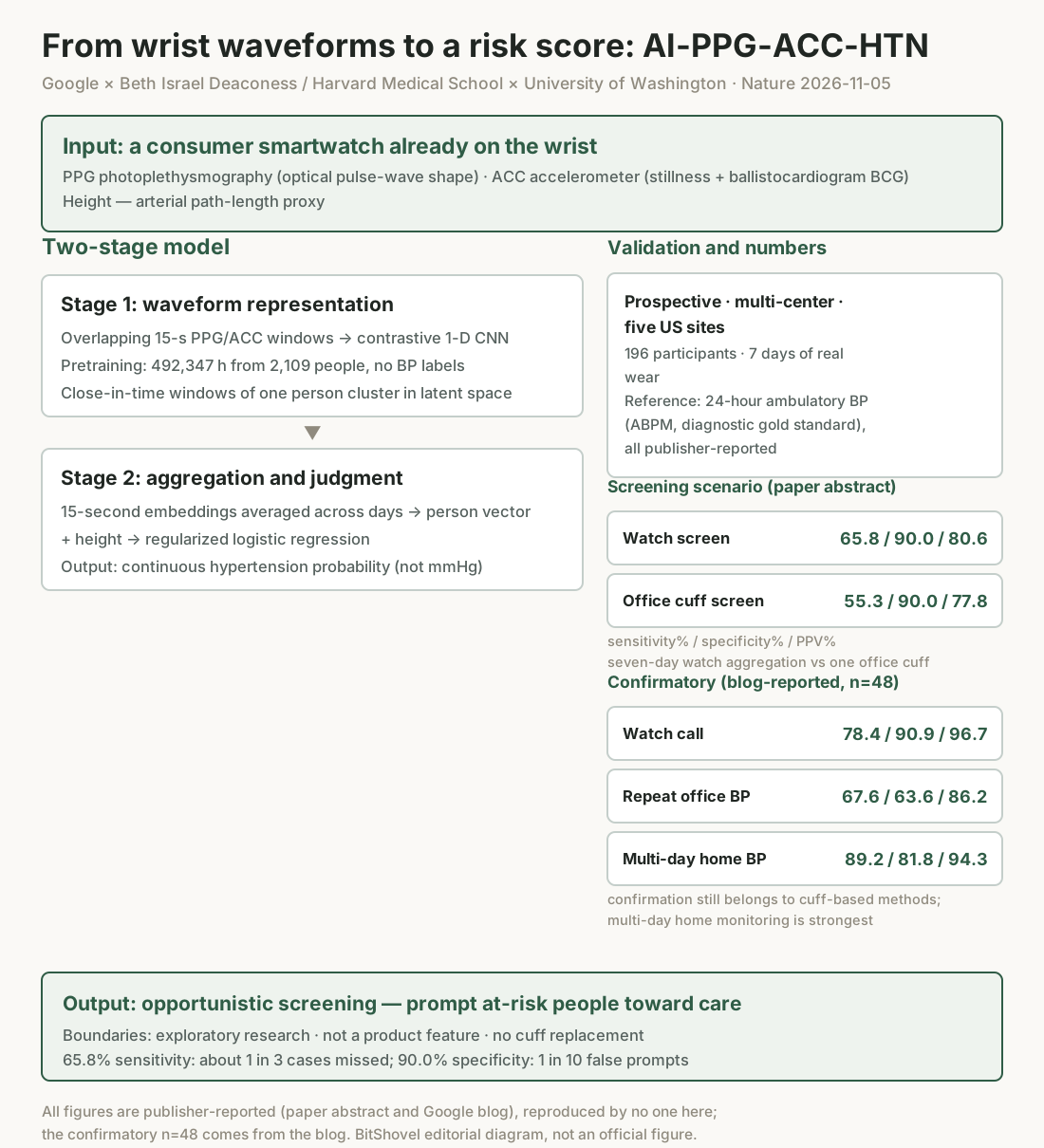
The model has two stages. Stage one trains on unlabeled data: 492,347 hours of sensor waveforms from 2,109 consenting participants, cut into overlapping 15-second windows, used to train a 1-D deep convolutional network with self-supervised contrastive learning — windows from the same person close in time pulled together in latent space, others pushed apart, with no blood-pressure labels at all. Stage two aggregates and judges: one person's 15-second embeddings are averaged across days into a person-level representation, height is appended, and a regularized logistic regression emits a continuous hypertension probability score. Scale does the pretraining; the final judgment is a logistic regression — the heavy lifting lives in the representation.
The first set of numbers is the screening scenario: 196 participants (free from known cardiovascular disease, not on antihypertensive medication), five US sites, prospective and multi-center, seven days of real-world wear, against 24-hour ABPM. The watch screen reached 65.8% sensitivity (95% CI 54.0–76.3), 90.0% specificity (83.2–94.7) and 80.6% PPV (68.6–89.6). In the same clinical framework, one office blood-pressure screen caught 55.3% (43.4–66.7), with the same 90.0% specificity and 77.8% PPV. That comparison is what "Opportunistically" in the title cashes out: across seven passive days outside any checkup, the watch finds roughly a tenth more of the hypertensive population than a single office measurement.
The second set is the confirmatory scenario (blog-reported; outside the paper's abstract): among the 48 participants with elevated office blood pressure needing follow-up, the watch's calls reached 78.4% sensitivity, 90.9% specificity and 96.7% PPV; the same people returning for a repeat office measurement scored 67.6/63.6/86.2; multi-day home blood-pressure monitoring scored 89.2/81.8/94.3 — still the strongest of the cuff-based options. How to read it: confirmation still belongs to cuff-based methods, and the watch's role in this group is deciding who should measure seriously; multi-day home monitoring beats a single repeat visit, itself an observation about the clinical framework.
The model's "why" comes with a ledger too: people with higher risk scores show narrower pulse waves (possibly stiffer arteries), slower systolic upstroke, a lower d/a ratio (changed wave reflection), and on the BCG deeper K waves with wider IJK complexes — all consistent with the physics of arterial stiffening, not correlations pulled from a black box. Read the confidence intervals together with the point estimates: 65.8% sensitivity carries a 54.0–76.3 interval — wide, because a 196-person study cannot pin the value tightly. That is the honest cost of the study's size.
- Check the screening numbers in the abstract
- Check the confirmatory scenario and interpretability account
Sources and further reading
- Nature: Opportunistically Detecting Signs of Hypertension on a Consumer SmartwatchArticle page · published online November 5, 2026, read November 9DOI 10.1038/s41586-026-11336-3. Abstract read in full: AI-PPG-ACC-HTN detects hypertension from multimodal smartwatch waveforms (PPG + ACC) with no cuff calibration, at accuracy "comparable to traditional cuffed blood pressure devices in the existing clinical framework"; a prospective, multicenter study of 196 diverse participants free from known cardiovascular disease and antihypertensive medication, against gold-standard 24-hour ambulatory BP monitoring; over seven days of real-world wear, 65.8% sensitivity (95% CI 54.0–76.3), 90.0% specificity (83.2–94.7), 80.6% PPV (68.6–89.6); the office-screening comparison reached 55.3% sensitivity (43.4–66.7), 90.0% specificity, 77.8% PPV (64.4–88.0). The 16 authors' affiliations: Google Research (Cambridge / Mountain View / Seattle), the Division of Medicine at Beth Israel Deaconess Medical Center and Harvard Medical School, and the University of Washington, Seattle; the last two authors are Matthew Thompson and Ming-Zher Poh. The confirmatory scenario and training details sit outside the abstract and are taken from the Google blog.
- Google Research blog: Detecting signs of hypertension using wearable sensorsResearcher's own account · published November 5, 2026, read in full November 9Signed Paolo Di Achille and Ming-Zher Poh. Checked sentence by sentence: "prospective, multi-center clinical study across five US sites involving 196 consenting diverse participants"; pretraining on "492,347 hours of sensor data from 2,109 consenting participants" (unlabeled); the task reframed — not point-in-time BP estimation but aggregating days of signal to identify a "persistent hypertensive state"; the two-stage model (contrastive 1D-CNN over 15-second windows → person-level embedding + height → regularized logistic regression emitting a "continuous hypertension probability score"); the ACC channel doubles for stillness detection and the ballistocardiogram (tiny wrist vibrations from each cardiac ejection); "existing commercial solutions usually require regular calibration using a traditional arm cuff"; confirmatory scenario (48 people with elevated office BP): watch 78.4% sensitivity / 90.9% specificity / 96.7% PPV, return office visit 67.6/63.6/86.2, multi-day home monitoring 89.2/81.8/94.3; interpretability — narrower pulse width, slower systolic upstroke, lower d/a ratio, deeper BCG K waves and wider IJK complexes; "These research findings helped inform the blood pressure trends Health Guardian feature in the Google Health app."; the disclaimer: "early feasibility research ... purely exploratory and are not indicative of any existing or upcoming commercial product feature or device capability"; positioning: no cuff replacement, no standalone diagnosis — opportunistic screening that prompts at-risk people toward clinical assessment.
The boundaries, and where this sits in daily life
Keep the disclaimer and the product line apart. The blog states this work "represents early feasibility research", the methods are "purely exploratory", and "not indicative of any existing or upcoming commercial product feature or device capability" — research is not a feature promise. The same post also says the findings "helped inform the blood pressure trends Health Guardian feature in the Google Health app" — the research fed an existing product capability. Both sentences are true and aim at different layers: the paper validates how the algorithm performs in a study population, not that feature's clinical effectiveness; the feature is not what the paper validated.
How you read sensitivity sets your expectations. 65.8% means: of one hundred people with hypertension, about sixty-six get prompted toward care and about thirty-four slip past the screen — missing cases is not an edge case here, it is one of the design's costs: specificity sits at 90.0% (about one in ten healthy people gets a false prompt), and pushing sensitivity higher means more false prompts. So the paper's positioning is never diagnosis but "opportunistic screening": collected passively in the gaps of daily life, moving high-risk people toward clinical assessment, with confirmation still done by cuff-based methods — screening reminds, the cuff adjudicates.
Place this in this site's health line: Anima used AI to cut clinic phone waits from 50 minutes to 10 — the service side, where the door to care moves; Cosmos3-H-Dreams generates surgical imagery with a world model for training — the education side, how surgeons practice; this one is the sensing side — data the body already produces and discards every day, put to a clinical question for the first time. Read together, the three mark three different pipes for AI in medicine: reception, training, perception — not one vague "AI healthcare".
From source to life, every link is identifiable. The source is self-supervised contrastive learning — the ability to squeeze representations out of unlabeled data, where 492,347 hours of waveforms needed no manual labeling by anyone. The middle is the research and validation of a two-stage model — five clinical sites, 196 people, seven days, an ABPM reference: research becoming evidence. The end is the life-side entry — a consumer watch already on most wrists, adding no device and no gesture, where days of passive everyday data become a single prompt to see a doctor. Capability, evidence, entry: three layers that each hold on their own, together forming one complete path from source to life.
- Compare: Anima cut clinic phone waits from 50 minutes to 10
- Compare: Cosmos3-H-Dreams generates surgical imagery for training
Sources and further reading
- Nature: Opportunistically Detecting Signs of Hypertension on a Consumer SmartwatchArticle page · published online November 5, 2026, read November 9DOI 10.1038/s41586-026-11336-3. Abstract read in full: AI-PPG-ACC-HTN detects hypertension from multimodal smartwatch waveforms (PPG + ACC) with no cuff calibration, at accuracy "comparable to traditional cuffed blood pressure devices in the existing clinical framework"; a prospective, multicenter study of 196 diverse participants free from known cardiovascular disease and antihypertensive medication, against gold-standard 24-hour ambulatory BP monitoring; over seven days of real-world wear, 65.8% sensitivity (95% CI 54.0–76.3), 90.0% specificity (83.2–94.7), 80.6% PPV (68.6–89.6); the office-screening comparison reached 55.3% sensitivity (43.4–66.7), 90.0% specificity, 77.8% PPV (64.4–88.0). The 16 authors' affiliations: Google Research (Cambridge / Mountain View / Seattle), the Division of Medicine at Beth Israel Deaconess Medical Center and Harvard Medical School, and the University of Washington, Seattle; the last two authors are Matthew Thompson and Ming-Zher Poh. The confirmatory scenario and training details sit outside the abstract and are taken from the Google blog.
- Google Research blog: Detecting signs of hypertension using wearable sensorsResearcher's own account · published November 5, 2026, read in full November 9Signed Paolo Di Achille and Ming-Zher Poh. Checked sentence by sentence: "prospective, multi-center clinical study across five US sites involving 196 consenting diverse participants"; pretraining on "492,347 hours of sensor data from 2,109 consenting participants" (unlabeled); the task reframed — not point-in-time BP estimation but aggregating days of signal to identify a "persistent hypertensive state"; the two-stage model (contrastive 1D-CNN over 15-second windows → person-level embedding + height → regularized logistic regression emitting a "continuous hypertension probability score"); the ACC channel doubles for stillness detection and the ballistocardiogram (tiny wrist vibrations from each cardiac ejection); "existing commercial solutions usually require regular calibration using a traditional arm cuff"; confirmatory scenario (48 people with elevated office BP): watch 78.4% sensitivity / 90.9% specificity / 96.7% PPV, return office visit 67.6/63.6/86.2, multi-day home monitoring 89.2/81.8/94.3; interpretability — narrower pulse width, slower systolic upstroke, lower d/a ratio, deeper BCG K waves and wider IJK complexes; "These research findings helped inform the blood pressure trends Health Guardian feature in the Google Health app."; the disclaimer: "early feasibility research ... purely exploratory and are not indicative of any existing or upcoming commercial product feature or device capability"; positioning: no cuff replacement, no standalone diagnosis — opportunistic screening that prompts at-risk people toward clinical assessment.
- IT Home: Google AI research detects hypertension from a consumer smartwatch without a cuff, published in NatureChinese coverage · published November 7, 2026 (18:26 Beijing), read November 9Headline and summary: "no cuff calibration needed; a normal consumer smartwatch alone passively detects signs of hypertension", naming the system AI-PPG-ACC-HTN. This is the first layer most Chinese readers met; this site treats the Nature abstract page and the Google blog as the factual base and uses this report only as timeline and distribution context — no metric here was transcribed from it.