Models and evaluations
Reading Qwen4-Max's release notes in full: three architecture changes and a 58% cost ledger
Alibaba shipped Qwen4-Max on November 16, but the official blog's body was script-rendered that day and never came through, so this site catalogued the model and added its AA board row from relayed figures alone; on the morning of November 17 a browser render finally returned the full text, and the gap between relay and primary source became clear: the official ledger is a Work360 per-task average cost falling from 26.58 to 11.16 yuan (about 58%), while circulating relay headlines say "over 60% / 62%". Architecturally, Qwen4-Max is the first model in the new Qwen4-series structure: 2.4 trillion trunk parameters, 71B active per token, plus 328B N-gram Embedding parameters; three of every four layers are Gated DeltaNet (history compressed into a fixed-size state) and one is Qwen Sparse Attention, which picks relevant context block by block through a lightweight indexer; the residual stream runs as four parallel branches with gated read/write; and a second-layer N-gram lookup extends capacity cheaply. Pretraining is reported spike-free, with base-model BPB about 5–13% below the predecessor across knowledge, code, QA and STEM internal suites at roughly 25% fewer active parameters. On capability: Work360 52.69 versus the predecessor's 47.74, token consumption down about 24%/35% (Xhigh/High) on Work360 and about 48%/49% on Terminal-Bench 4.0, API prices cut across the board with cache-hit pricing lowered the most. In the official 16-panel comparison chart it leads its predecessor on all sixteen panels but tops only four against other labs' models (DeepSWE, Agents' Last Exam, HLAB-Vals, BioMysteryBench), with Claude Opus 5.5 higher on most knowledge-work panels; the evaluation notes say several scores are cited from third-party boards. A factory, a law firm, an ICU and a 48-hour coolant closed loop are four vendor-run demonstrations this site has not reproduced; weights are not open, and the promise that smaller Qwen4 models will be open-sourced deserves tracking. The AA board row joined at 43 on our November 16 evening read and is unchanged on November 17; it does not substitute for the self-reported Work360 figures.
This account rests on three sources: the full text of Qwen's official blog "Qwen4-Max: Your New Teammate Has Arrived" (this site read only the page title and release facts on November 16; the body came through via browser render on the morning of November 17); IT之家's November 16 relay (read in full, used to check the relay's wording); and this site's direct AA-board fetches on the evenings of November 16 and the morning of November 17. All official architecture, benchmark and case figures are vendor-reported; the independent board score (AA 43) is recorded separately and does not substitute for them; the cases are vendor demonstrations this site has not reproduced — no model was run, no task re-executed; wherever circulating relays and the official text disagree, both wordings are given.
From preview to full text: what happened in nine days
The timeline is short, but every step carried a different evidentiary footing. On November 11, Qwen opened the limited qwen4-max-preview on its Token Plan (only a preview page was readable then; this site logged it as working). On November 16 the model shipped, and the official blog's title was readable that morning — "Qwen4-Max: Your New Teammate Has Arrived", rendered in Chinese as "your new colleague, already at the desk" — but the body was script-rendered and a fetch returned only the shell. That evening this site did two things: it completed the catalogue entry and company evolution row from IT之家's relay, and it joined the model to the AA board (the source table showed a 43 that night; scope 34→35) — while recording the gap explicitly: the body was unread, and the figures were relay caliber.
On the morning of November 17 a browser render returned the full text, and the ledger could be re-recorded from the primary source. Most figures match the relay: Work360's 52.69 versus 47.74, the token reductions and the open-source promise all check out; one does not — the circulating wording says task costs fell "over 60%" (English aggregator headlines went to 62%), while the official text is a Work360 per-task average falling from 26.58 to 11.16 yuan, a 58% cut. Nobody is at fault here, but it shows why going back to the source matters: every pass through a relay sands the number rounder, and 58% versus "over 60%" is no difference in a headline but a real one on an API bill.
A Chinese aggregator relay on launch day also claimed Qwen4-Max "tops Agent Arena among Chinese models, lifting Alibaba to 14th overall", pointing to an Arena social post — this site could not read the original post (it is unread logged out), so it is not recorded as fact; it sits with the same-direction signals we already track: independent boards and vendor claims beginning to point at each other, to be rejoined when a checkable source appears.
Sources and further reading
- Qwen's official blog: Qwen4-Max, Your New Teammate Has ArrivedOfficial release notes · this site read only the title and release facts on Nov 16, the full body via browser render on the morning of Nov 17Read in full. Checked the key claims: 2.4T trunk parameters, 71B active per token, plus 328B N-gram Embedding parameters; native vision; 1M context. Three architecture items: GDN+QSA (three of every four layers are Gated DeltaNet compressing history into a fixed-size state, one is Qwen Sparse Attention selecting context block-wise via a lightweight indexer), Gated Residual (the residual stream becomes four parallel branches with dynamic gated read/write), N-gram Embedding (a layer-2 lookup by local context). Pretraining reported spike-free; Qwen4-Max-Base posts the lowest BPB of five models on knowledge/code/QA/STEM internal suites, about 5–13% below Qwen3.8-Max-Base per domain with ~25% fewer active parameters per token. Work360 52.69 versus Qwen3.8-Max's 47.74 (a taxonomy of 26/182/721 domain levels); token consumption down ~24%/35% (Xhigh/High) on Work360 and ~48%/49% on Terminal-Bench 4.0; API prices cut across the board, cache-hit pricing the most; Work360 per-task average cost 26.58→11.16 yuan, −58%. Live Delivery with the open-sourced Qwen-Live-Delivery-Plugin; three cloud-scheduling results (annotation model-call cost −10.42%, GPU idle-capacity hours +4.62%, CPU rescheduling solve speed 14.61×). Cases: machining programming ~475→24 minutes at Sanfeng Intelligent/统联 Precision (~−95%); a 198-document IPO due-diligence bundle turned into an 86-page report; an ICU record with 1,433 images; a 48-hour coolant-molecule closed loop (2.7M candidates, four rounds); NLRP3 molecular optimization (454 tool calls, RBFE ~3.6×). Safety: Last Secure Code Bench function-level functional+security dual pass 22.0%→31.8%, all-three-granularity secure 8%→14.7%; CBRN internal evals claim no over-refusal and no significant capability uplift found. Evaluation notes: JobBench on their own updated dataset; APEX-Agents cited from Mercor, AA-Briefcase/AutomationBench-AA from Artificial Analysis, CodeArena/AgentArena from Arena, HLAB-Vals from Vals Index, Agents' Last Exam from its board. Access: the Qwen AI platform (Token Plan or API), Qwen Work, Qoder CN, the Qwen app and Qwen Studio. Smaller series models are promised for open-sourcing. The closing BibTeX is dated November 2026.
- IT之家's relay of the launchRelay · read in full November 16 · headline says task costs down "over 60%"On launch day this site could read only the official blog's page title, so the catalogue and board row were recorded from this relay (Work360 52.69/47.74, token reductions, the open-source promise). After the official full text came through on November 17: the Work360 and token figures match the official blog; "task costs down over 60%" does not match the official 58% (26.58→11.16 yuan), and English aggregator headlines go further to 62%. This site records the official 58% and notes the relay's wording as it stands.
Three architecture changes: GDN+QSA, four-branch residuals, an N-gram vocabulary
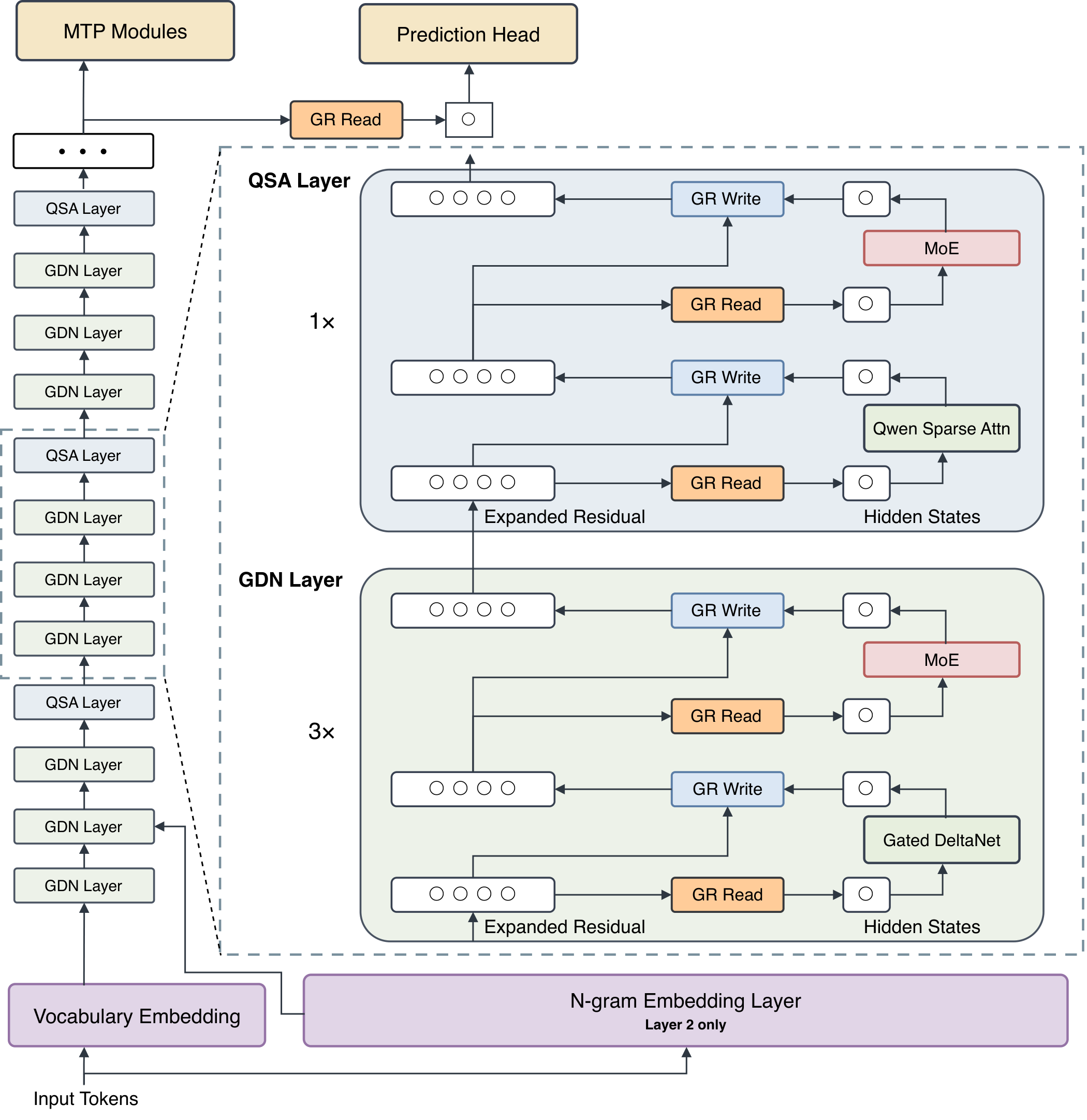
Qwen4-Max is the first model in the new Qwen4-series structure: 2.4 trillion trunk parameters, 71B active per token, plus 328B N-gram Embedding parameters. The vendor frames the upgrade as systematic work on attention, residuals and embeddings. The attention side pairs GDN with Qwen Sparse Attention (QSA): three of every four layers are Gated DeltaNet, which compresses history into a fixed-size state — long conversations no longer inflate attention compute linearly with length; the remaining layer, QSA, picks relevant context block by block through a lightweight indexer, cutting long-sequence attention and indexing overhead. That is where the "1M-token context" comes from structurally: not standard attention stretched to a million tokens, but a stack where most layers never face the full sequence at all.
On the residual side, Gated Residual widens the residual stream from one into four parallel branches, with dynamic gated reads and writes (the GR Read / GR Write in the diagram) deciding what crosses layers — which the vendor credits for training stability. On the embedding side, the N-gram Embedding looks up local-context tables at layer two, giving the model a cheap representation of local patterns and extra capacity at low overhead. The training evidence offered for the package: pretraining at 2.4T ran with no loss spike, and Qwen4-Max-Base posts the lowest BPB (bits per byte, lower is better) of five models on knowledge, code, QA and STEM internal suites — about 5–13% below Qwen3.8-Max-Base per domain, at roughly 25% fewer active parameters per token. Those are base-model pretraining figures, not chat-model exam scores.
Read against recent records, this generation's structure rhymes with two sparse routes we have covered: mixing layers that compress history linearly with a few global-attention layers, and trading extra parameter tables for capacity — both serve "more total parameters, less compute per step". The difference is that Qwen4-Max is a closed-weights hosted service — the structure can only be read from the notes and diagrams, the weights are unavailable, and third parties cannot recompute claims from the architecture itself; the official promise that smaller Qwen4 models will be open-sourced is when structural claims become independently checkable.
Sources and further reading
- Qwen's official blog: Qwen4-Max, Your New Teammate Has ArrivedOfficial release notes · this site read only the title and release facts on Nov 16, the full body via browser render on the morning of Nov 17Read in full. Checked the key claims: 2.4T trunk parameters, 71B active per token, plus 328B N-gram Embedding parameters; native vision; 1M context. Three architecture items: GDN+QSA (three of every four layers are Gated DeltaNet compressing history into a fixed-size state, one is Qwen Sparse Attention selecting context block-wise via a lightweight indexer), Gated Residual (the residual stream becomes four parallel branches with dynamic gated read/write), N-gram Embedding (a layer-2 lookup by local context). Pretraining reported spike-free; Qwen4-Max-Base posts the lowest BPB of five models on knowledge/code/QA/STEM internal suites, about 5–13% below Qwen3.8-Max-Base per domain with ~25% fewer active parameters per token. Work360 52.69 versus Qwen3.8-Max's 47.74 (a taxonomy of 26/182/721 domain levels); token consumption down ~24%/35% (Xhigh/High) on Work360 and ~48%/49% on Terminal-Bench 4.0; API prices cut across the board, cache-hit pricing the most; Work360 per-task average cost 26.58→11.16 yuan, −58%. Live Delivery with the open-sourced Qwen-Live-Delivery-Plugin; three cloud-scheduling results (annotation model-call cost −10.42%, GPU idle-capacity hours +4.62%, CPU rescheduling solve speed 14.61×). Cases: machining programming ~475→24 minutes at Sanfeng Intelligent/统联 Precision (~−95%); a 198-document IPO due-diligence bundle turned into an 86-page report; an ICU record with 1,433 images; a 48-hour coolant-molecule closed loop (2.7M candidates, four rounds); NLRP3 molecular optimization (454 tool calls, RBFE ~3.6×). Safety: Last Secure Code Bench function-level functional+security dual pass 22.0%→31.8%, all-three-granularity secure 8%→14.7%; CBRN internal evals claim no over-refusal and no significant capability uplift found. Evaluation notes: JobBench on their own updated dataset; APEX-Agents cited from Mercor, AA-Briefcase/AutomationBench-AA from Artificial Analysis, CodeArena/AgentArena from Arena, HLAB-Vals from Vals Index, Agents' Last Exam from its board. Access: the Qwen AI platform (Token Plan or API), Qwen Work, Qoder CN, the Qwen app and Qwen Studio. Smaller series models are promised for open-sourcing. The closing BibTeX is dated November 2026.
The cost ledger: fewer tokens, cheaper cache, 26.58→11.16 yuan per task
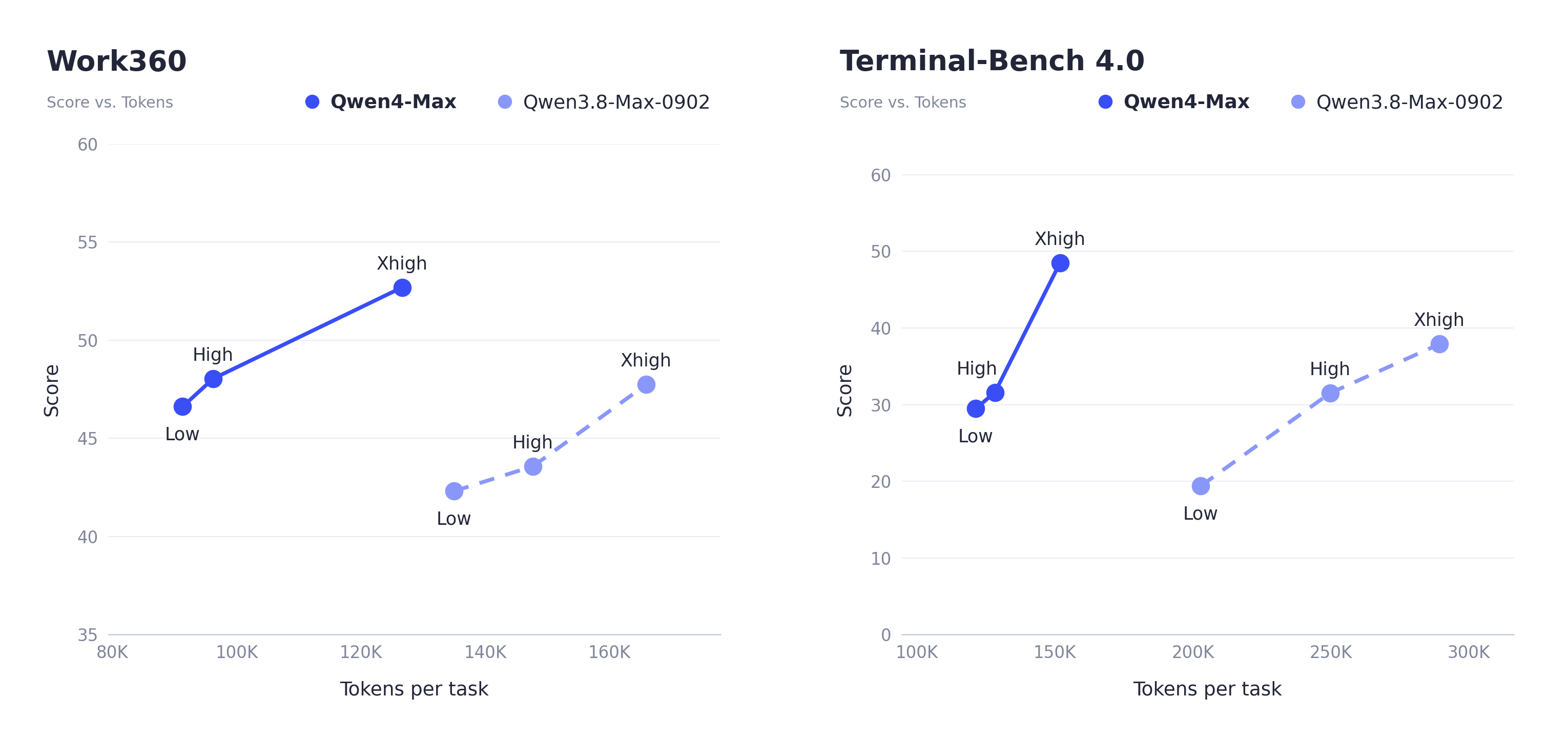
The most concrete stretch of the official notes is cost. First the capability baseline: on Work360 (the vendor's own industry-scenario benchmark, with a taxonomy spanning 26 first-level, 182 second-level and 721 third-level domains) Qwen4-Max scores 52.69 against the predecessor Qwen3.8-Max's 47.74. On top of that comes efficiency: stronger performance with token consumption down about 24%/35% at Xhigh/High on Work360, and about 48%/49% on Terminal-Bench 4.0. The official efficiency chart draws it plainly — on both benchmarks the new model's score-versus-tokens curve sits up and to the left of its predecessor's.
Then pricing: API prices are cut across the board versus Qwen3.8-Max, with cache-hit pricing lowered the most — for agent workloads with repeated long contexts, the cache rate often moves the bill more than the base rate. The official bottom line: in the Work360 evaluation, the average cost per task fell from 26.58 to 11.16 yuan, a 58% reduction. That is exactly where 58% and "over 60%" part ways: the official figure is a same-board, same-task bill-line number, and extrapolating from efforts or token rates alone can produce other figures — cite the official line as written, and this site rounds nothing for either side.
A set of self-referential figures is easy to skim past: the vendor says Qwen4-Max schedules its own resources inside Alibaba Cloud's real business — data-annotation model-call scheduling costs down 10.42% on average against a reference baseline, GPU online-allocation idle-capacity hours up 4.62%, and CPU offline-rescheduling solve speed up more than 14.61×. A model optimizing the system it runs on is a loop worth noting; it is also vendor-reported, with no independent check.
Sources and further reading
- Qwen's official blog: Qwen4-Max, Your New Teammate Has ArrivedOfficial release notes · this site read only the title and release facts on Nov 16, the full body via browser render on the morning of Nov 17Read in full. Checked the key claims: 2.4T trunk parameters, 71B active per token, plus 328B N-gram Embedding parameters; native vision; 1M context. Three architecture items: GDN+QSA (three of every four layers are Gated DeltaNet compressing history into a fixed-size state, one is Qwen Sparse Attention selecting context block-wise via a lightweight indexer), Gated Residual (the residual stream becomes four parallel branches with dynamic gated read/write), N-gram Embedding (a layer-2 lookup by local context). Pretraining reported spike-free; Qwen4-Max-Base posts the lowest BPB of five models on knowledge/code/QA/STEM internal suites, about 5–13% below Qwen3.8-Max-Base per domain with ~25% fewer active parameters per token. Work360 52.69 versus Qwen3.8-Max's 47.74 (a taxonomy of 26/182/721 domain levels); token consumption down ~24%/35% (Xhigh/High) on Work360 and ~48%/49% on Terminal-Bench 4.0; API prices cut across the board, cache-hit pricing the most; Work360 per-task average cost 26.58→11.16 yuan, −58%. Live Delivery with the open-sourced Qwen-Live-Delivery-Plugin; three cloud-scheduling results (annotation model-call cost −10.42%, GPU idle-capacity hours +4.62%, CPU rescheduling solve speed 14.61×). Cases: machining programming ~475→24 minutes at Sanfeng Intelligent/统联 Precision (~−95%); a 198-document IPO due-diligence bundle turned into an 86-page report; an ICU record with 1,433 images; a 48-hour coolant-molecule closed loop (2.7M candidates, four rounds); NLRP3 molecular optimization (454 tool calls, RBFE ~3.6×). Safety: Last Secure Code Bench function-level functional+security dual pass 22.0%→31.8%, all-three-granularity secure 8%→14.7%; CBRN internal evals claim no over-refusal and no significant capability uplift found. Evaluation notes: JobBench on their own updated dataset; APEX-Agents cited from Mercor, AA-Briefcase/AutomationBench-AA from Artificial Analysis, CodeArena/AgentArena from Arena, HLAB-Vals from Vals Index, Agents' Last Exam from its board. Access: the Qwen AI platform (Token Plan or API), Qwen Work, Qoder CN, the Qwen app and Qwen Studio. Smaller series models are promised for open-sourcing. The closing BibTeX is dated November 2026.
- IT之家's relay of the launchRelay · read in full November 16 · headline says task costs down "over 60%"On launch day this site could read only the official blog's page title, so the catalogue and board row were recorded from this relay (Work360 52.69/47.74, token reductions, the open-source promise). After the official full text came through on November 17: the Work360 and token figures match the official blog; "task costs down over 60%" does not match the official 58% (26.58→11.16 yuan), and English aggregator headlines go further to 62%. This site records the official 58% and notes the relay's wording as it stands.
The official 16-panel chart: a clean sweep over its predecessor, four panel wins over Opus 5.5
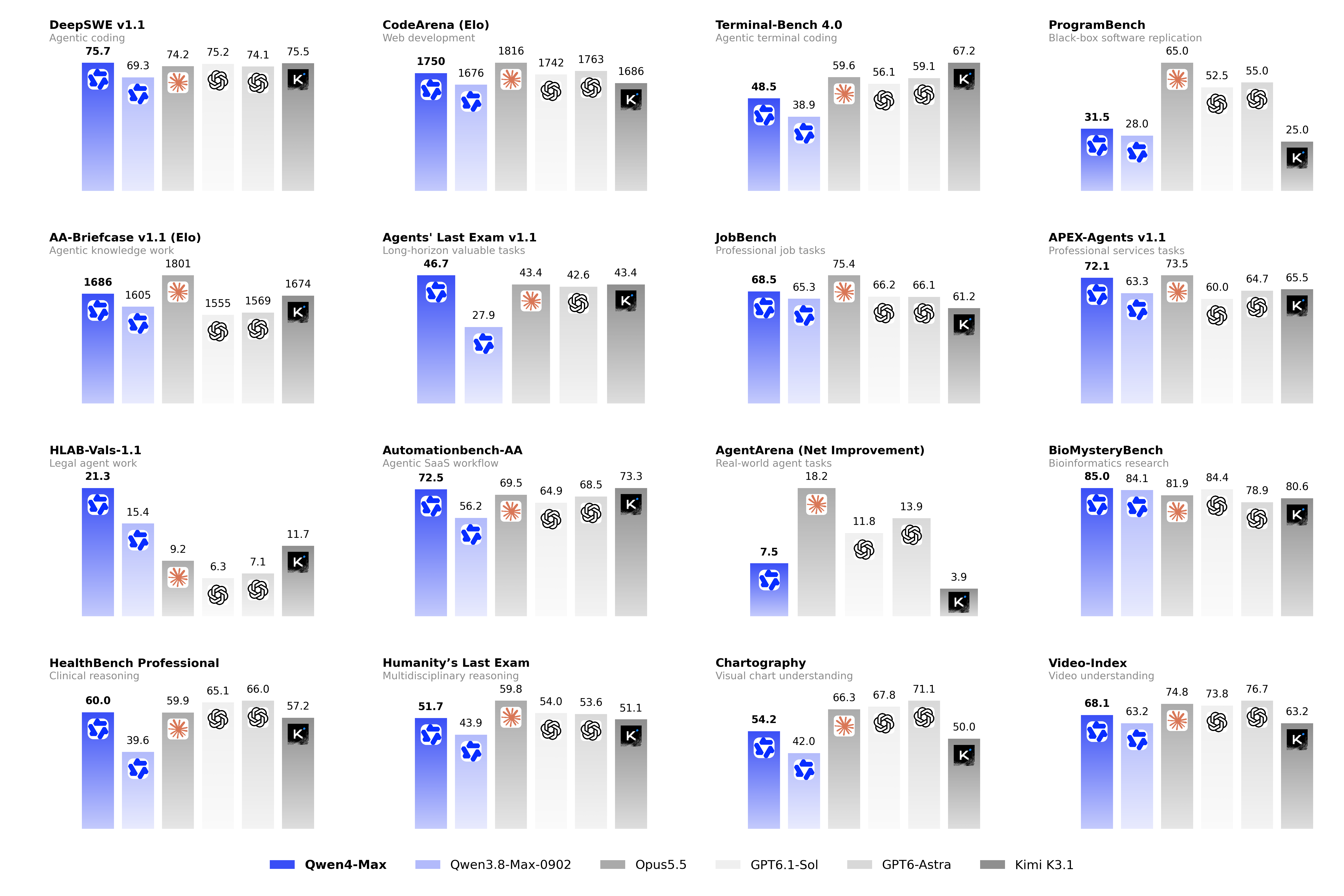
The official 16-panel chart puts Qwen4-Max beside Qwen3.8-Max-0902, Claude Opus 5.5 (the starburst-marked column), GPT-6.1-Sol, GPT-6-Astra and Kimi K3.1 across coding, office and long-horizon tasks. Read panel by panel: against its predecessor it is higher on all sixteen — from DeepSWE 75.7 versus 69.3 to HealthBench Professional 60.0 versus 39.6, the generational gain has no exception in the vendor's own chart. Against other labs' models the picture is entirely different: Qwen4-Max tops exactly four panels — DeepSWE 75.7, Agents' Last Exam 46.7, HLAB-Vals 21.3 and BioMysteryBench 85.0 — while the other twelve all contain a higher comparison bar, mostly Claude Opus 5.5 (CodeArena 1816 to 1750, AA-Briefcase 1801 to 1686, JobBench 75.4 to 68.5, APEX-Agents 73.5 to 72.1, Humanity's Last Exam 59.8 to 51.7, AgentArena 18.2 to 7.5), with terminal coding belonging to Kimi K3.1 at 67.2 versus 48.5.
It is a vendor chart that draws the generational gain and the gap to the frontier at once: the new colleague leads its own predecessor across the board while still trailing Opus 5.5 on twelve panels. Both halves deserve reporting as written — citing only the first exaggerates the launch, only the second buries the generation-over-generation gain. One caveat: neither the legend nor the notes state which reasoning effort each comparison bar uses, a common difference between vendor charts and independent boards.
Citing this chart means citing its footnotes too. The official evaluation notes state: JobBench is scored on their own updated dataset and code; APEX-Agents v1.1 is cited from Mercor's leaderboard; AA-Briefcase v1.1 and AutomationBench-AA from Artificial Analysis; CodeArena and AgentArena from Arena; HLAB-Vals-1.1 from Vals Index; Agents' Last Exam v1.1 from its own board. The chart mixes vendor-run numbers with third-party citations — two different levels of verifiability, and reading them as one "official measurement" would be a mistake.
Back to the independent board: the AA v5.0.1 composite gives Qwen4 Max a row at 43 (catalogued on our November 16 evening read, unchanged on the November 17 morning re-read; effort not named in the source table), sitting below Muse Wonder (44) and above Claude Haiku 5.5 and Muse Ember (both 36), with the top — Claude Fable 5.2 at 65 — still a stretch away. The independent composite and the vendor's 16 panels do not answer the same question — one is a cross-benchmark synthesis shown at integer resolution, the other a task-level side-by-side — and each constrains the other: the 43 says "strong at everything" has not happened, the 16 panels say where strong actually lives.
Sources and further reading
- Qwen's official blog: Qwen4-Max, Your New Teammate Has ArrivedOfficial release notes · this site read only the title and release facts on Nov 16, the full body via browser render on the morning of Nov 17Read in full. Checked the key claims: 2.4T trunk parameters, 71B active per token, plus 328B N-gram Embedding parameters; native vision; 1M context. Three architecture items: GDN+QSA (three of every four layers are Gated DeltaNet compressing history into a fixed-size state, one is Qwen Sparse Attention selecting context block-wise via a lightweight indexer), Gated Residual (the residual stream becomes four parallel branches with dynamic gated read/write), N-gram Embedding (a layer-2 lookup by local context). Pretraining reported spike-free; Qwen4-Max-Base posts the lowest BPB of five models on knowledge/code/QA/STEM internal suites, about 5–13% below Qwen3.8-Max-Base per domain with ~25% fewer active parameters per token. Work360 52.69 versus Qwen3.8-Max's 47.74 (a taxonomy of 26/182/721 domain levels); token consumption down ~24%/35% (Xhigh/High) on Work360 and ~48%/49% on Terminal-Bench 4.0; API prices cut across the board, cache-hit pricing the most; Work360 per-task average cost 26.58→11.16 yuan, −58%. Live Delivery with the open-sourced Qwen-Live-Delivery-Plugin; three cloud-scheduling results (annotation model-call cost −10.42%, GPU idle-capacity hours +4.62%, CPU rescheduling solve speed 14.61×). Cases: machining programming ~475→24 minutes at Sanfeng Intelligent/统联 Precision (~−95%); a 198-document IPO due-diligence bundle turned into an 86-page report; an ICU record with 1,433 images; a 48-hour coolant-molecule closed loop (2.7M candidates, four rounds); NLRP3 molecular optimization (454 tool calls, RBFE ~3.6×). Safety: Last Secure Code Bench function-level functional+security dual pass 22.0%→31.8%, all-three-granularity secure 8%→14.7%; CBRN internal evals claim no over-refusal and no significant capability uplift found. Evaluation notes: JobBench on their own updated dataset; APEX-Agents cited from Mercor, AA-Briefcase/AutomationBench-AA from Artificial Analysis, CodeArena/AgentArena from Arena, HLAB-Vals from Vals Index, Agents' Last Exam from its board. Access: the Qwen AI platform (Token Plan or API), Qwen Work, Qoder CN, the Qwen app and Qwen Studio. Smaller series models are promised for open-sourcing. The closing BibTeX is dated November 2026.
- Artificial Analysis intelligence board (v5.0.1)Independent board · our Nov 16 evening fetch found the Qwen4 Max row at 43 and catalogued it; the Nov 17 morning re-read keeps 43November 17 re-read (direct HTML): all 35 catalogued rows keep their highest-tested scores and settings; Qwen4 Max stays at 43 (effort not named in the source table); the same day the source table retired the Qwen3.8 Max (0902) (34) and Gemini 3.8 Flash (high 31) rows, preserved on our board under the standing precedent. The 43 is an independent composite and does not substitute for the vendor-reported Work360 figures or the 16-panel chart.
Four vendor cases, and one open-source promise
The second half of the notes is a case collection, with one checkable number from each of four directions. Manufacturing: in real production settings at Sanfeng Intelligent Equipment and 统联 Precision, per-workpiece human effort for machining programming fell from about 475 minutes to 24 (~−95%), with the model doing drawing comprehension, parametric modelling, toolpath generation and simulation checks that catch over-cutting before the machine runs. Law: 198 inconsistently formatted IPO due-diligence documents renamed and filed into 14 folders, cross-checked against public registries, and delivered as an 86-page, 60,000-character report whose conclusions cite the source documents. Medicine: a critical-care record read in a single conversation — dozens of lab reports and 1,433 raw images — with the CT finding (bilateral dorsal lung consolidation) matching the attending physician and four disposition suggestions mapping one-to-one onto the day's orders. Science: a 48-hour autonomous run through a 2.7-million-candidate molecule space with four design–synthesize–test rounds producing an experimentally validated new coolant molecule, and an NLRP3-target optimization that made 454 tool calls across 3,239 computed evaluations, with RBFE estimating ~3.6× the patent starting point's binding affinity.
The boundary must be said plainly: all of these are vendor-run demonstrations in partner settings — this site ran no model and reproduced no task; "matches the physician" and "maps onto the orders" are the vendor's wording, not an independent clinical review. Evidence that these flows hold up in production has to come from the users' own records. The mechanism attached to the cases, though, is verifiable right now: Live Delivery — ship a usable first version, keep delivering versions, let the user steer at any point — ships with the open-sourced Qwen-Live-Delivery-Plugin, whose code is actually there to download; that is one of the few artifacts in this announcement that can be checked directly. The safety numbers are quoted as given: Last Secure Code Bench's function-level functional-and-security dual pass rises from 22.0% to 31.8% over the predecessor, all-three-granularity secure code goes from 8% to 14.7%; CBRN internal evals claim no over-refusal and no significant capability uplift found.
For readers of this site, the line worth pinning as a tracking item is this: "Max is only Qwen4's first model; the series' smaller models will also be open-sourced in turn." Qwen4-Max itself ships no open weights — every experience runs through the Qwen platform, Token Plan/API, Qwen Work, Qoder CN and similar front doors; once a smaller open model lands, this article's structural claims (the GDN+QSA layer ratio, the real cost of the N-gram vocabulary) become independently checkable against weights for the first time, and the cost ledger gains a community reference. Our catalogue already carries Qwen4 Max on the models page with its AA row attached; when the open weights arrive, the structural description here should be re-checked against them.
- Read the full official Qwen4-Max release notesThe source of every architecture, cost, case and safety figure here; the closing evaluation notes say which scores are cited from third parties, plus the BibTeX.
- See our model page and board positionThe catalogue entry, the AA 43 row's configuration note, and hooks for future independent evaluations.
- Compare the full AA board as we track itThe 35 catalogued models and each board's rules; Qwen4 Max (43) sits between Muse Wonder (44) and Haiku 5.5 / Muse Ember (36).
Sources and further reading
- Qwen's official blog: Qwen4-Max, Your New Teammate Has ArrivedOfficial release notes · this site read only the title and release facts on Nov 16, the full body via browser render on the morning of Nov 17Read in full. Checked the key claims: 2.4T trunk parameters, 71B active per token, plus 328B N-gram Embedding parameters; native vision; 1M context. Three architecture items: GDN+QSA (three of every four layers are Gated DeltaNet compressing history into a fixed-size state, one is Qwen Sparse Attention selecting context block-wise via a lightweight indexer), Gated Residual (the residual stream becomes four parallel branches with dynamic gated read/write), N-gram Embedding (a layer-2 lookup by local context). Pretraining reported spike-free; Qwen4-Max-Base posts the lowest BPB of five models on knowledge/code/QA/STEM internal suites, about 5–13% below Qwen3.8-Max-Base per domain with ~25% fewer active parameters per token. Work360 52.69 versus Qwen3.8-Max's 47.74 (a taxonomy of 26/182/721 domain levels); token consumption down ~24%/35% (Xhigh/High) on Work360 and ~48%/49% on Terminal-Bench 4.0; API prices cut across the board, cache-hit pricing the most; Work360 per-task average cost 26.58→11.16 yuan, −58%. Live Delivery with the open-sourced Qwen-Live-Delivery-Plugin; three cloud-scheduling results (annotation model-call cost −10.42%, GPU idle-capacity hours +4.62%, CPU rescheduling solve speed 14.61×). Cases: machining programming ~475→24 minutes at Sanfeng Intelligent/统联 Precision (~−95%); a 198-document IPO due-diligence bundle turned into an 86-page report; an ICU record with 1,433 images; a 48-hour coolant-molecule closed loop (2.7M candidates, four rounds); NLRP3 molecular optimization (454 tool calls, RBFE ~3.6×). Safety: Last Secure Code Bench function-level functional+security dual pass 22.0%→31.8%, all-three-granularity secure 8%→14.7%; CBRN internal evals claim no over-refusal and no significant capability uplift found. Evaluation notes: JobBench on their own updated dataset; APEX-Agents cited from Mercor, AA-Briefcase/AutomationBench-AA from Artificial Analysis, CodeArena/AgentArena from Arena, HLAB-Vals from Vals Index, Agents' Last Exam from its board. Access: the Qwen AI platform (Token Plan or API), Qwen Work, Qoder CN, the Qwen app and Qwen Studio. Smaller series models are promised for open-sourcing. The closing BibTeX is dated November 2026.
- Artificial Analysis intelligence board (v5.0.1)Independent board · our Nov 16 evening fetch found the Qwen4 Max row at 43 and catalogued it; the Nov 17 morning re-read keeps 43November 17 re-read (direct HTML): all 35 catalogued rows keep their highest-tested scores and settings; Qwen4 Max stays at 43 (effort not named in the source table); the same day the source table retired the Qwen3.8 Max (0902) (34) and Gemini 3.8 Flash (high 31) rows, preserved on our board under the standing precedent. The 43 is an independent composite and does not substitute for the vendor-reported Work360 figures or the 16-panel chart.