AI supply chain and privacy
Fake keys in two million prompts: who reads what you send to AI
From July to November, researchers at the security firm Dragos sent roughly two million prompts to widely used AI services, each carrying an AWS key that had never been used, a DNS name and a private link: if any of them was ever touched, it traced back to the exact prompt, router and privacy setting. Three kinds of finding followed. At least three hosting providers were compromised: in a late-October batch of a couple hundred keys, some were tested within hours and the bait keys drew tens of thousands of AWS calls, including keys from requests rejected before a model ever ran. Resellers on an inference marketplace listed popular models at the lowest price, switched on request logging and waited — one person typed root passwords by hand from a home broadband line. Privacy flags were not honored: the systems of a “Chinese AI lab”, in Dragos's words, fetched the secret URLs in more than half the prompts sent to its models, including roughly two-thirds of requests marked Zero Data Retention, and prompts forwarded by US hosting providers flowed back to the same scraper; one link surfaced in a Feishu group chat 24 days after it was sent. The research went public on November 19; Phala had posted a preliminary incident report a week earlier, Together, Novita and Atlas Cloud followed with notices, and on November 22 the gateway OpenRouter off-boarded three providers and removed 125 endpoints from Zero Data Retention eligibility. Dragos names no company; the naming of MiniMax comes from the providers' own notices. This piece walks the chain: every router hop can read the full prompt, a privacy flag binds only the first hop, and if you don't decide where your prompts go, the lowest price decides for you.
This piece rests on the full text of the research that Dragos Chief Research Officer HD Moore published on November 19 (read in full by this site on November 23), and on five first-party notices from the involved parties: Phala's preliminary incident report of November 10 (after the researchers' private notification, before publication), Together's security-event notice of November 21, the statements by Novita and OpenRouter on November 22, and Atlas Cloud's security notice of November 23 (all read in full); Ars Technica's November 20 report was read in full to check its relay. The experiment ran from July to November, the research went public on November 19, the gateway and provider actions landed across early November to November 23, and this site read and wrote on November 23 — four separate dates. Dragos names no provider or lab and does not map its incidents onto specific companies, and this site does not fill that in for it; every company named here appears in its own notice or in the gateway's. All figures are the researcher's and the parties' own; this site sent no test requests and touched none of the services involved; as of the evening of November 23 this site had found no public response from MiniMax.
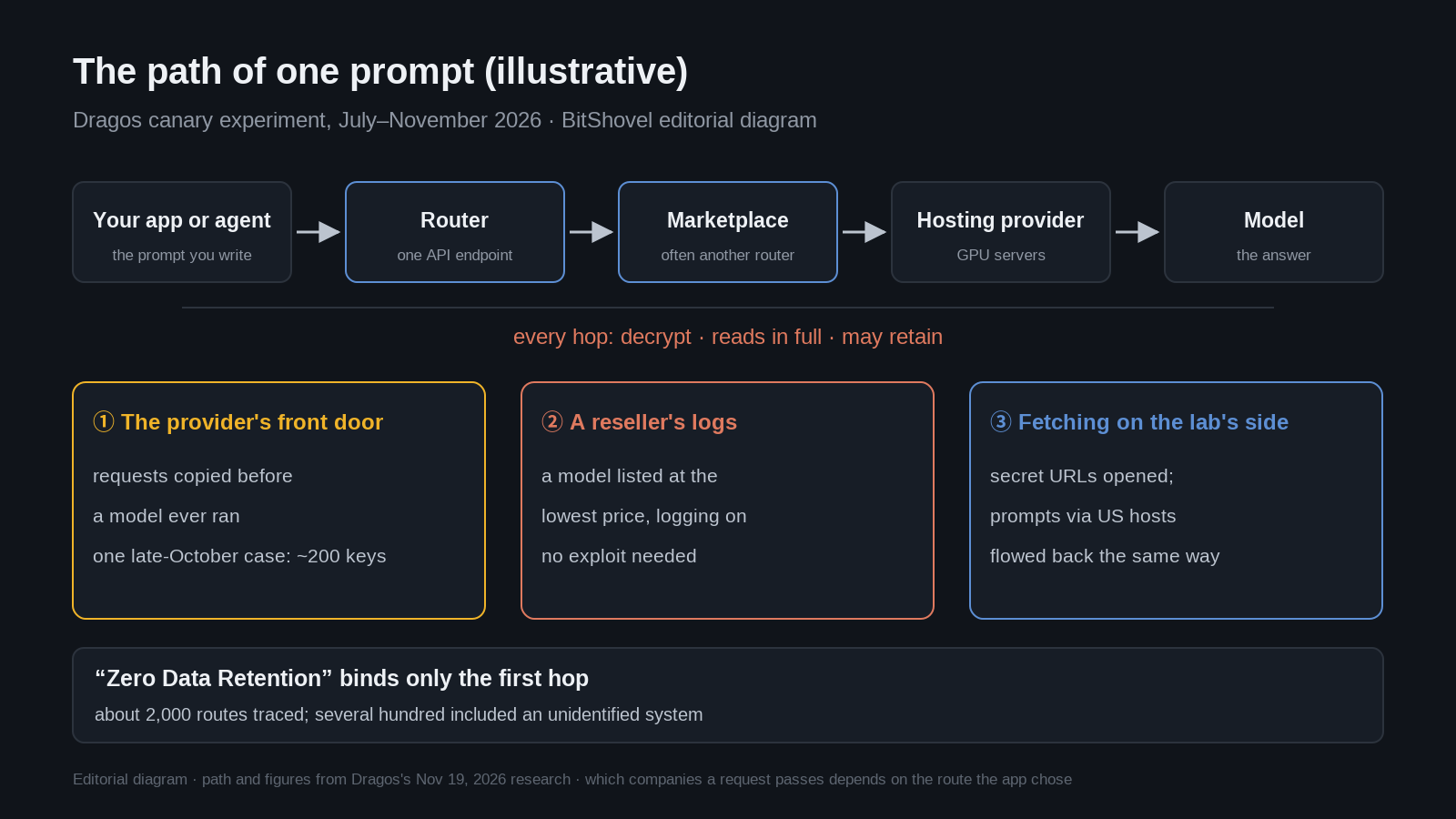
One key, one use: how the experiment made an invisible path visible
Start with the method, because it sets what this research can and cannot say. Dragos borrows the coal-mine canary: a secret that exists in exactly one place, so that any use of it shows that place leaked. From July to November the team sent roughly two million prompts to widely used AI services, each carrying three things — a real AWS key tied to an empty account with full logging, a DNS name, and a URL that had never appeared anywhere before. They began with Thinkst Canarytokens in July; tokens started firing within days, and the ones seeded in July were still firing as of writing. They then built a dedicated service that derives unique hostnames, links and credentials per prompt and runs the services those point to — DNS, web, git, SSH, databases, mail. Every touch therefore traces back to its origin: which prompt, to which model, through which router, under which privacy setting. The limit is just as clear — a canary proves that a prompt leaked and who touched it afterwards; it cannot reconstruct where every request went, and the roughly two thousand routes Dragos traced are a sample.
Then the path itself. Most people picture AI inference as a question and an answer: text goes in, GPUs juggle some bits, text comes back out. What Dragos describes is that the request first reaches an AI router — one API endpoint that forwards it to a pool of available models with unified billing, sparing you several accounts and credentials — and that the road to the inference server often passes through more than one router before it reaches the machine actually hosting the target model. The risk: every hop can see the entire prompt and response. On open marketplaces the lowest-priced seller gets the request, and low prices have sources of their own — pooling requests through unmetered consumer subscriptions, startup credits, and, in shadier places, inference billed to stolen AWS credentials or consumer API keys. A seller who wants to siphon customer data need not break anything: list popular models at the lowest price, route the traffic, pay the difference, and collect the data from the platform logs. Privacy controls do exist — set per account, per API key or per request; the strictest is Zero Data Retention (ZDR), which specifies that prompt and response are not stored, and routers are supposed to forward such requests only to providers offering the same controls. In Dragos's wording the reality is quite different: providers often ignore the settings, intentionally or through bugs in their processing flow.
A canary says that something leaked, not at which hop — a router typically reports a single upstream, and that upstream is often just another router. So the team did two things that amount to a traceroute for AI inference. First, they placed an image URL in the request pointing back to their own servers; every system that fetches it leaves an IP address, an HTTP client and a timestamp. Second, they sent small, slightly broken requests on purpose: each router tends to wrap the error from the hop behind it in its own format, so a single response carries three or four nested envelopes, and matching each layer against a signature database yields the hop list, the software at each one, the network and often the company operating it. Among about two thousand routes, several hundred included a system they could not identify, and a handful sent the image to a company that was not on the advertised path at all. The traces also turned up middle layers the route never mentions: one marketplace seller quietly adds about a thousand hidden tokens to every prompt, and another fetches images through a shared consumer subscription account. Those details are worth keeping, because they show how far “we use provider X” can be from describing where a request actually went.
Sources and further reading
- Dragos (HD Moore): Three breaches, endless leaks: Your AI supply chain needs canariesSecurity firm's research report · published Nov 19, updated Nov 20, 2026 · read in full Nov 23Read in full. Setup: about two million prompts from July to November, each carrying a real AWS key (tied to an empty account with full logging), a DNS name and a URL never seen before, starting with Thinkst Canarytokens in July; every touch traced back to the exact prompt, model, router and privacy setting, and the July tokens were still firing as of writing. Path: a router forwards each request from one endpoint to a pool of models, often through more than one router before the hosting provider, and every hop can read the full prompt and response; on open marketplaces the lowest price wins, with discounts coming from pooled unmetered consumer subscriptions, startup credits and the like, and shadier sellers billing to stolen AWS credentials or consumer API keys; ZDR requests should go only to providers offering the same controls, but the settings are often ignored, deliberately or through bugs. Three findings. First, at least three hosting providers were compromised — the earliest in mid-July, none aware until notified, with the bait processed alongside real customers' requests; the largest involved a couple hundred keys, with every request in a few short late-October windows stolen, some from requests rejected before a model ever ran, and stolen requests marked ZDR in the other two; keys were tested within hours, followed by S3, Secrets Manager and Parameter Store listing, Bedrock hosted-model enablement, Bedrock API keys and new IAM users, tens of thousands of AWS API calls in all; one adversary hit two providers at once, tooling moving from a script pretending to be Chrome on Windows to Boto3 inside OrbStack to the AWS CLI on Kali Linux, and adding the LLM-driven pentest framework ARTEX on November 1 (which made only a handful of calls confirming keys were live). Second, marketplace resellers viewed and kept customer prompts with standard request logging, no exploit needed: prompts for the same model through another seller were never touched; a Mac on a home broadband line in France typed root passwords by hand over SSH; and one router quietly forwarded traffic to the marketplace, an undisclosed hop. Third, privacy and retention policies were ignored: a “Chinese AI lab”, in Dragos's wording, had systems that fetched the secret URLs from more than half the prompts sent to its models between July and October, including roughly two-thirds of requests marked “no data collection” or ZDR, typically two or three days later, with prompts forwarded by several US hosting providers triggering the same scraper; a git client on a different cloud later tried to clone the private repositories referenced; one large US provider kept crawling a secret URL more than two months after a single call to its search endpoint, and another's scraper returned days after each request regardless of router; one link, 24 days after its prompt went to a Chinese provider, was posted into a Feishu channel and within two minutes opened from three desktops and three phones in Beijing and Shanghai, although the disclosure to that provider had included only the link's first eight characters. Tracing method: an image URL pointing back to their servers; slightly broken requests whose errors each router wraps in its own format, three or four nested envelopes per response matched against a signature database to yield hops, software, networks and operating companies; about two thousand routes traced, several hundred including a system they could not identify, a handful sending the image to a company not on the advertised path; one marketplace seller adds about a thousand hidden tokens to every prompt, another fetches images through a shared consumer subscription. Disclosure: the first provider first suspected misconfigured internal tooling, then a partner data-processing problem, until evidence showed the attacker had also compromised internal credentials; it had still not disclosed publicly as of writing, and the stolen data kept leading to attempted logins as of late October; the late-October batch was reported as soon as third-party access was confirmed, and one of those providers has published a preliminary security notice; less severe issues were reported from early November, with about a dozen providers now involved; the router forwarding to the marketplace says it stopped. Advice: host it yourself if affordable (a 512 GB Mac Studio from $22,299, DGX Spark at $6,950, DGX Station from about $105,000, an eight-GPU B300 server from $570,000); otherwise go directly to a first-tier provider; with routers, pick the upstream yourself, verify that privacy settings actually change where requests go and stay away from reseller marketplaces; seed your own canaries; enable secret filtering. The report names no provider, router or lab.
Three ways out: a copied front door, a reseller's logs, ignored flags
The first way out is the most direct. Dragos found attackers actively stealing data from three different hosting providers; the earliest incident dates to mid-July, and none of the three knew about the breach until notified. The bait prompts were processed along with real customers' requests, which were almost certainly copied too. The largest breach involved a couple hundred AWS keys: each key was sent in exactly one request to one provider, all within a few short windows in late October, and every request sent during those windows was stolen. Some of the stolen keys came from requests the provider had rejected before a model ever ran — which tells us the attacker was copying requests at the provider's front door, not somewhere deeper in the inference stack. In the other two breaches some of the stolen requests were marked ZDR: a privacy flag doesn't help when the attacker is already inside.
Once the attacker held a key, the path was predictable. First test whether it was live, in some cases within hours of the request; next go looking for data — listing S3 buckets, searching Secrets Manager and Parameter Store; finally try to enable hosted models in AWS Bedrock, create Bedrock API keys and add their own IAM users to keep access. The bait keys were used for tens of thousands of AWS API calls in all. In one case a single adversary had compromised two providers at once: secrets sent to both were used together, almost immediately, from a single rented server. Over the three weeks Dragos watched, the tooling kept changing — first a script pretending to be Chrome on Windows, then Boto3 inside OrbStack, later the AWS CLI on Kali Linux — and on November 1 the same attacker added ARTEX, an LLM-driven penetration-testing framework. In this case ARTEX did very little: a handful of calls confirming that keys already held were still live. But two of the user agents it sent, artex-agent and artex-judge-r121, appear in no public indicator list the researchers could find, and are worth adding to detections. For defenders the good news is that such tools tend to announce themselves in the user agent AWS records in CloudTrail; the bad news is that this self-identification was present in only a small fraction of traffic.
The second way out required no exploit at all. The marketplace sellers caught did three things: list a model at the lowest price, turn on request logging, and wait. What struck Dragos was how personal it was — individuals, working from what looked like home internet connections and personal computers, trying the canary servers one login at a time. In one case two prompts went through a single seller's offer; about a day and a half later someone on a home broadband connection opened both secret URLs in a desktop browser and started guessing usernames at the login page. Prompts for the same model sent through a different seller were never touched — the leak follows the seller, not the marketplace as a whole. In another, someone on a Mac on a home broadband line in France took the passwords from two prompts and tried to log in as root over SSH, typing each attempt by hand; the same Mac later tested several AWS keys in a single session. Most of those keys had gone through the marketplace, but one had travelled through a different router that was quietly forwarding some of its traffic there — another undisclosed hop.
In the third way out nobody used a credential, yet it comes closest to ordinary use: the secret URLs inside prompts were scraped again and again, and the code repositories they referenced became cloning targets — by companies that were never supposed to see the prompt in the first place, often in direct conflict with the privacy settings on the request. Dragos's clearest example is a “Chinese AI lab”: its systems fetched the secret URLs from more than half the prompts sent to its models between July and October, including roughly two-thirds of the requests marked “no data collection” or Zero Data Retention, and the scraper typically turned up two or three days after the request. That was not limited to requests sent to the lab directly — several US hosting providers resell its models, and prompts sent to those providers triggered the very same scraper; the prompts were flowing back to the lab. A customer who picked a US provider specifically to keep data in the US did not get what they paid for. Later a git client on a different cloud began trying to clone the private repositories referenced in the prompts, and only for prompts that used this lab's models. The large US providers have their own problems: one kept crawling a secret URL more than two months after a single inference call to its search endpoint; another runs a scraper that returns days after each request, regardless of the router used to reach it.
The strangest incident took place in a company chat. Twenty-four days after a prompt was sent to one Chinese provider, the secret link from it was posted into a Feishu channel; within two minutes it was opened from three desktops and three phones in Beijing and Shanghai. Dragos's disclosure to that provider had included only the first eight characters of the link — so whoever shared it was reading from a stored copy of the full prompt, for a request sent more than three weeks earlier to a US-based provider with the ZDR flag. Their summary is a single line: Zero Data Retention is supposed to mean something; in practice these prompts were retained, shared with other companies, and read by people.
Sources and further reading
- Dragos (HD Moore): Three breaches, endless leaks: Your AI supply chain needs canariesSecurity firm's research report · published Nov 19, updated Nov 20, 2026 · read in full Nov 23Read in full. Setup: about two million prompts from July to November, each carrying a real AWS key (tied to an empty account with full logging), a DNS name and a URL never seen before, starting with Thinkst Canarytokens in July; every touch traced back to the exact prompt, model, router and privacy setting, and the July tokens were still firing as of writing. Path: a router forwards each request from one endpoint to a pool of models, often through more than one router before the hosting provider, and every hop can read the full prompt and response; on open marketplaces the lowest price wins, with discounts coming from pooled unmetered consumer subscriptions, startup credits and the like, and shadier sellers billing to stolen AWS credentials or consumer API keys; ZDR requests should go only to providers offering the same controls, but the settings are often ignored, deliberately or through bugs. Three findings. First, at least three hosting providers were compromised — the earliest in mid-July, none aware until notified, with the bait processed alongside real customers' requests; the largest involved a couple hundred keys, with every request in a few short late-October windows stolen, some from requests rejected before a model ever ran, and stolen requests marked ZDR in the other two; keys were tested within hours, followed by S3, Secrets Manager and Parameter Store listing, Bedrock hosted-model enablement, Bedrock API keys and new IAM users, tens of thousands of AWS API calls in all; one adversary hit two providers at once, tooling moving from a script pretending to be Chrome on Windows to Boto3 inside OrbStack to the AWS CLI on Kali Linux, and adding the LLM-driven pentest framework ARTEX on November 1 (which made only a handful of calls confirming keys were live). Second, marketplace resellers viewed and kept customer prompts with standard request logging, no exploit needed: prompts for the same model through another seller were never touched; a Mac on a home broadband line in France typed root passwords by hand over SSH; and one router quietly forwarded traffic to the marketplace, an undisclosed hop. Third, privacy and retention policies were ignored: a “Chinese AI lab”, in Dragos's wording, had systems that fetched the secret URLs from more than half the prompts sent to its models between July and October, including roughly two-thirds of requests marked “no data collection” or ZDR, typically two or three days later, with prompts forwarded by several US hosting providers triggering the same scraper; a git client on a different cloud later tried to clone the private repositories referenced; one large US provider kept crawling a secret URL more than two months after a single call to its search endpoint, and another's scraper returned days after each request regardless of router; one link, 24 days after its prompt went to a Chinese provider, was posted into a Feishu channel and within two minutes opened from three desktops and three phones in Beijing and Shanghai, although the disclosure to that provider had included only the link's first eight characters. Tracing method: an image URL pointing back to their servers; slightly broken requests whose errors each router wraps in its own format, three or four nested envelopes per response matched against a signature database to yield hops, software, networks and operating companies; about two thousand routes traced, several hundred including a system they could not identify, a handful sending the image to a company not on the advertised path; one marketplace seller adds about a thousand hidden tokens to every prompt, another fetches images through a shared consumer subscription. Disclosure: the first provider first suspected misconfigured internal tooling, then a partner data-processing problem, until evidence showed the attacker had also compromised internal credentials; it had still not disclosed publicly as of writing, and the stolen data kept leading to attempted logins as of late October; the late-October batch was reported as soon as third-party access was confirmed, and one of those providers has published a preliminary security notice; less severe issues were reported from early November, with about a dozen providers now involved; the router forwarding to the marketplace says it stopped. Advice: host it yourself if affordable (a 512 GB Mac Studio from $22,299, DGX Spark at $6,950, DGX Station from about $105,000, an eight-GPU B300 server from $570,000); otherwise go directly to a first-tier provider; with routers, pick the upstream yourself, verify that privacy settings actually change where requests go and stay away from reseller marketplaces; seed your own canaries; enable secret filtering. The report names no provider, router or lab.
Disclosures, four notices and the gateway's response
Publication did not end the story, and Dragos itself records mixed reactions. The provider in the earliest incident (mid-July) first took it for a misconfiguration of internal tooling, then for a partner's data-processing problem, until the investigation uncovered evidence that the attacker had compromised its internal credentials too; it had still not publicly disclosed as of writing, and the stolen data continued to lead to attempted logins as of late October. For the second batch of intrusions, in late October, the team reached out as soon as it confirmed evidence of third-party access, and one of those providers has published a preliminary security notice. For the less severe issues — data sharing without credential abuse — reports began in early November, each with the list of stolen requests and unique strings the provider could search for in its own logs; about a dozen providers are now involved, and Dragos would not be surprised to see that expand. The router that had been forwarding traffic to the marketplace says it stopped, and several providers have opened their own investigations; on the other hand, stolen keys and secret URLs continue to be accessed, months after the first incidents.
Set the four notices beside the research's calendar and several different kinds of leak appear. Phala's preliminary report of November 10 belongs to the “compromised” kind: the attacker chained a legacy internet-facing service with management interfaces that trusted loopback access and did not authenticate callers independently, creating unauthorized confidential virtual machines and obtaining application credentials; evidence the researcher supplied on November 8 pointed to an inference deployment on a new GPU server that was serving production traffic without full production hardening — the attacker took control of the inference VM in a similar way, making in-flight request data visible. The requests involved were DeepSeek V4 Flash 0731 routed to Phala by OpenRouter: only canaries the researcher sent on October 21 and 22 were later misused, the first at 05:41 UTC on October 22; because the tests sampled requests, Phala lists the whole window from October 21 to November 8 as precautionary and asks users from that period to treat the secrets in their requests as exposed. The timing lines up with the batch Dragos describes — seeded October 21, used from the next day, still in use about three weeks later — but Dragos names no provider; that correspondence is this site's inference from the dates.
Together's notice of November 21 describes a different kind of leak, with a bend in it. As part of routine software testing, Together had collected prompt samples authorized for that use and stored them in a private Hugging Face repository; the samples came from requests to the MiniMax M3, GLM-5.2 and Kimi K2.6 models. While developing its public GitHub repository, an AI coding agent named xorl committed a credential that gave access to that private repository. Automated scanning caught it and the commit was reverted, but during the exposure window an unauthorized party obtained the credential, downloaded the samples and searched them for credentials to other services to test — five of those tested were the very canaries Dragos had planted. In other words, nobody broke into an inference system here; a set of data kept for testing left the building through a coding agent's mistake. That is why Together's remediation list carries an entry few others have: updated development processes governing the use of AI coding agents, along with Zero Data Retention made the default for new accounts.
The notices from Novita and Atlas Cloud point at the third way out, and both name MiniMax. On November 22 Novita said a routing configuration issue had caused an API forwarding path intended for specific customers to apply more broadly, so some requests were forwarded to MiniMax's official API instead of being processed on Novita's own infrastructure; the window runs from May 28 to November 11, 2026 and includes requests routed to Novita through OpenRouter. What the researcher saw in those requests was URLs and hostnames being accessed, with no use of the AWS test keys; Novita's reading is that the access patterns “suggest automated content review may have been involved”, and it is verifying that with MiniMax. Atlas Cloud on November 23 is more direct: it has stopped sending requests to MiniMax's official API, MiniMax models stay available only where Atlas Cloud hosts them itself or the hosting provider confirms requests do not reach MiniMax's official API, and anyone who used MiniMax M3, M2.7 or M3.1 Flash there should treat any secret they sent as exposed. It also did something providers rarely do: it took all of its models off OpenRouter by its own choice until each passes its tests, and it has Moore testing them four times a day.
At the gateway layer, OpenRouter's notice of November 22 first draws a line: the findings did not show any breach or unauthorized access of OpenRouter itself, and the testing revealed new findings about specific inference providers. Then three things done — three providers off-boarded on the basis of its own investigations; 125 endpoints removed from Zero Data Retention eligibility, both those flagged by the researchers and others removed as a precaution; and all potentially affected customers notified. The three things under way matter more: adapting the researchers' testing approach to run these checks on an ongoing basis; technical verification of network paths to find where requests and responses may be forwarded to third parties; and requiring appropriate assurances and validation before any removed endpoint regains ZDR eligibility. In other words, the fix is not one more flag but continuous checks behind the flag. The notice lists the four that have posted — Atlas Cloud, Novita, Phala and Together — and notes that not all affected providers have gone public. As for the company Dragos calls a “Chinese AI lab” and Novita and Atlas Cloud name as MiniMax, this site found no public response from it as of the evening of November 23; a paragraph Ars Technica added on November 21, relaying OpenRouter's customer email, also points at MiniMax-model endpoints. On that side of the story, only others are speaking for now.
Sources and further reading
- Dragos (HD Moore): Three breaches, endless leaks: Your AI supply chain needs canariesSecurity firm's research report · published Nov 19, updated Nov 20, 2026 · read in full Nov 23Read in full. Setup: about two million prompts from July to November, each carrying a real AWS key (tied to an empty account with full logging), a DNS name and a URL never seen before, starting with Thinkst Canarytokens in July; every touch traced back to the exact prompt, model, router and privacy setting, and the July tokens were still firing as of writing. Path: a router forwards each request from one endpoint to a pool of models, often through more than one router before the hosting provider, and every hop can read the full prompt and response; on open marketplaces the lowest price wins, with discounts coming from pooled unmetered consumer subscriptions, startup credits and the like, and shadier sellers billing to stolen AWS credentials or consumer API keys; ZDR requests should go only to providers offering the same controls, but the settings are often ignored, deliberately or through bugs. Three findings. First, at least three hosting providers were compromised — the earliest in mid-July, none aware until notified, with the bait processed alongside real customers' requests; the largest involved a couple hundred keys, with every request in a few short late-October windows stolen, some from requests rejected before a model ever ran, and stolen requests marked ZDR in the other two; keys were tested within hours, followed by S3, Secrets Manager and Parameter Store listing, Bedrock hosted-model enablement, Bedrock API keys and new IAM users, tens of thousands of AWS API calls in all; one adversary hit two providers at once, tooling moving from a script pretending to be Chrome on Windows to Boto3 inside OrbStack to the AWS CLI on Kali Linux, and adding the LLM-driven pentest framework ARTEX on November 1 (which made only a handful of calls confirming keys were live). Second, marketplace resellers viewed and kept customer prompts with standard request logging, no exploit needed: prompts for the same model through another seller were never touched; a Mac on a home broadband line in France typed root passwords by hand over SSH; and one router quietly forwarded traffic to the marketplace, an undisclosed hop. Third, privacy and retention policies were ignored: a “Chinese AI lab”, in Dragos's wording, had systems that fetched the secret URLs from more than half the prompts sent to its models between July and October, including roughly two-thirds of requests marked “no data collection” or ZDR, typically two or three days later, with prompts forwarded by several US hosting providers triggering the same scraper; a git client on a different cloud later tried to clone the private repositories referenced; one large US provider kept crawling a secret URL more than two months after a single call to its search endpoint, and another's scraper returned days after each request regardless of router; one link, 24 days after its prompt went to a Chinese provider, was posted into a Feishu channel and within two minutes opened from three desktops and three phones in Beijing and Shanghai, although the disclosure to that provider had included only the link's first eight characters. Tracing method: an image URL pointing back to their servers; slightly broken requests whose errors each router wraps in its own format, three or four nested envelopes per response matched against a signature database to yield hops, software, networks and operating companies; about two thousand routes traced, several hundred including a system they could not identify, a handful sending the image to a company not on the advertised path; one marketplace seller adds about a thousand hidden tokens to every prompt, another fetches images through a shared consumer subscription. Disclosure: the first provider first suspected misconfigured internal tooling, then a partner data-processing problem, until evidence showed the attacker had also compromised internal credentials; it had still not disclosed publicly as of writing, and the stolen data kept leading to attempted logins as of late October; the late-October batch was reported as soon as third-party access was confirmed, and one of those providers has published a preliminary security notice; less severe issues were reported from early November, with about a dozen providers now involved; the router forwarding to the marketplace says it stopped. Advice: host it yourself if affordable (a 512 GB Mac Studio from $22,299, DGX Spark at $6,950, DGX Station from about $105,000, an eight-GPU B300 server from $570,000); otherwise go directly to a first-tier provider; with routers, pick the upstream yourself, verify that privacy settings actually change where requests go and stay away from reseller marketplaces; seed your own canaries; enable secret filtering. The report names no provider, router or lab.
- Phala: November Preliminary Incident ReportInference provider's preliminary incident report · published Nov 10, 2026 · read in full Nov 23Read in full. Two groups may need to act: users whose DeepSeek V4 Flash 0731 requests were routed to Phala by OpenRouter between October 21, 2026 00:00 UTC and November 8, 05:35 UTC should treat request contents as exposed and rotate any secrets; and owners of affected confidential virtual machines (CVMs), who were contacted directly. What happened: on November 5 unauthorized activity was found on one server — the attacker chained a legacy internet-facing service with management interfaces that trusted loopback access and did not authenticate callers independently, creating unauthorized CVMs and obtaining application credentials; the KMS root key was rotated on November 6; on November 8 a third-party researcher provided evidence that request data sent to DeepSeek V4 Flash 0731 had been exposed, traced to an inference deployment on a new GPU server that was serving production traffic without full production hardening — the attacker took control of the inference VM in a similar way, making in-flight request data visible; the deployment was taken offline the same day, with containment complete at 05:35. Timeline: the precautionary exposure window opens October 21 00:00; requests sent October 21–22 were subsequently confirmed exposed; the earliest observed misuse of stolen data came October 22 at 05:41; the most recent on November 9; the preliminary report on November 10. The researcher had placed unique per-request canary credentials in requests to Phala from July 1 to November 7, and only those sent on October 21 and 22 were later misused; the tests sampled requests, so the wider window stands as guidance. Phala assesses that the attack sequences and infrastructure overlap and treats the intrusions as one incident by a single actor. A full root-cause analysis is to follow.
- Together AI: Security event: prompt leakage for requests in June and July of 2026Inference provider's security-event notice · published Nov 21, updated Nov 22, 2026 · read in full Nov 23Read in full; signed by CEO and co-founder Vipul Ved Prakash. What happened: as part of routine software testing, Together collected prompt samples authorized for that use and stored them in a private Hugging Face repository; the samples came from requests to the MiniMax M3, GLM-5.2 and Kimi K2.6 models, primarily on June 24, July 4, July 8 and July 14, 2026. While developing its public GitHub repository, an AI coding agent named xorl committed a credential that gave access to the private repository; automated scanning caught the exposed credential and the commit was reverted, but during the exposure window an unauthorized party obtained the credential and downloaded the stored samples, then searched them for credentials to other services and tested whether those were valid — five of the credentials tested were canary credentials tied to a Dragos experiment. An external forensic firm and law enforcement are involved; no evidence of further prompt leakage beyond this incident has been identified, and review of the affected contents is ongoing. Changes: scoped or short-lived credentials and keyless access where supported; credential checks on every pull request; Zero Data Retention (ZDR) made the default for new accounts; updated development processes governing the use of AI coding agents. Customers handling sensitive prompt data are advised to enable ZDR in their account settings.
- Novita: Privacy Notice Regarding MiniMax Requests on NovitaInference provider's privacy notice · published Nov 22, 2026 · read in full Nov 23Read in full. After receiving a report from an independent security researcher, Novita's review confirmed that some requests were forwarded to MiniMax's official API rather than processed on Novita-hosted infrastructure — a routing configuration issue caused an API forwarding path intended for specific customers to apply more broadly; the affected models were suspended. If you used MiniMax models through Novita between 2026-05-28 and 2026-11-11, including requests routed to Novita through OpenRouter, your request contents may have been accessed or retained by a third party. Findings: the researcher observed accesses to URLs and hostnames embedded in test requests, with no use of the AWS test key markers; the access patterns suggest automated content review may have been involved, and Novita is following up with MiniMax to verify that assessment and its handling of the affected data. Novita states that it does not retain customer prompts or generated outputs or use them for training. Next: verifying the processing paths for the affected MiniMax endpoints, following up with MiniMax on any retained customer data and its deletion, and improving Partner API labeling and disclosures of the relevant providers' data-retention policies and Terms of Service. Anyone whose requests included live credentials, API keys or other secrets is advised to revoke or rotate them.
- OpenRouter: Data Processing Incidents on Inference ProvidersAI gateway's official notice · published Nov 22, 2026 · read in full Nov 23Read in full. OpenRouter says that earlier in the week security researchers reported evidence that certain inference providers had data compromised or were not upholding their data policies, and that it has been collaborating closely with the researchers and with providers; the findings did not show any breach or unauthorized access of OpenRouter itself, and the testing revealed new findings about specific inference providers. Taken: three providers off-boarded on the basis of its investigations; 125 endpoints removed from Zero Data Retention (ZDR) eligibility, including providers flagged by researchers plus additional endpoints removed as a precaution; all potentially affected customers notified. Underway: adapting the researchers' testing approach to run these checks on an ongoing basis; technical verification of network paths to identify instances where requests and responses may be forwarded to third parties; and requiring appropriate assurances and validation before restoring ZDR eligibility to any endpoint removed in the review. A live list of provider security announcements follows — Atlas Cloud, Novita, Phala and Together — with the note that not all affected providers have posted publicly and affected users were notified regardless.
- Atlas Cloud: Security notice: MiniMax's official API and how we protect your dataInference provider's security notice · published Nov 23, 2026 · read in full Nov 23Read in full. Atlas Cloud writes that Dragos Chief Research Officer HD Moore tests AI providers by placing private links in prompts and watching who opens them; his testing showed a third party opened links from prompts sent to MiniMax's official API, including MiniMax M3 and M2.7 prompts sent through Atlas Cloud in the third quarter and early fourth quarter of 2026, so the prompts and outputs of other requests to these models may also have been accessed; as far as his testing shows, the access happened after requests reached MiniMax, not on Atlas Cloud's infrastructure, and Atlas Cloud did not store those requests' prompts or outputs. Response: it stopped sending requests to MiniMax's official API and will not resume until confident in its security; MiniMax models stay available only where Atlas Cloud hosts them itself or the hosting provider confirms requests do not reach MiniMax's official API; accounts that used these models were emailed. Anyone who used MiniMax M3, M2.7 or M3.1 Flash on Atlas Cloud should treat any secret sent to these models as exposed, since misuse cannot be ruled out, and check prompts and outputs for API keys, passwords, tokens and private URLs and revoke them. On every other model: Atlas Cloud says it has found no problem so far and that Moore's testing agrees — the only access he has seen through Atlas Cloud involves MiniMax's official API; it is testing every model it serves anyway, and as part of that chose to take every Atlas Cloud model off OpenRouter (its own decision, it says, with OpenRouter told beforehand), each returning once it passes; it has asked Moore to keep testing, now four times a day.
- Ars Technica: Researcher plants 2m canaries into the AI supply chainMedia relay · published Nov 20, updated Nov 21, 2026 · read in full Nov 23 · used to check the relay's wordingRead in full (Dan Goodin); the lead this story entered through. The hard figures match the research: nearly two million prompts, at least three compromised hosting providers, a couple hundred AWS keys, tens of thousands of AWS API calls, more than half of prompts and roughly two-thirds of ZDR requests, and the link surfacing in a company chat 24 days later. The report gives Vercel and OpenRouter as examples of a router chaining to another router and explains that prompts are encrypted in transit but decrypted at each hop inside the reseller network — background framing from the reporter; Dragos's own text says only that every hop can read the full prompt and response. Its November 21 update relays posts on X and Hacker News saying OpenRouter had emailed customers that some prompts may have been read, that the potential exposure involved prompts sent to MiniMax whether directly or through three resellers (AtlasCloud, Novita and StreamLake), and that the Zero Data Retention label had been removed from MiniMax-model endpoints. This site did not read that email; the account was then carried by OpenRouter's official notice of November 22 and the provider notices, which the article treats as primary.
A flag binds only the first hop: what the research changes
Moore's advice is written for teams, five specific lines. Host it yourself if you can afford it — the only option where nobody else gets to read your prompts, though the hardware is not cheap, and he lists prices: a 512 GB Mac Studio from $22,299, NVIDIA's DGX Spark at $6,950, a DGX Station from about $105,000, an eight-GPU B300 server from $570,000; for most teams only the most sensitive work justifies it. If not, go directly to a first-tier provider — one company, one contract, one privacy policy to read; this can still leak through data-sharing agreements or a breach at the provider, but it is the smallest exposure you can buy. Use routers with care: pick the upstream providers yourself instead of accepting the default pool; verify that your privacy settings actually change where your requests go; stay away from reseller marketplaces, where some of the capacity comes from stolen keys — and a few of those services accept only cryptocurrency for a reason. Two more work for individuals as well: seed your own canary — add a fake credential to the context your agents and pipelines already send and treat any use of it as an incident; a free Canarytoken is enough to start today — and enable secret filtering, which scrubs known credential formats from prompt data; it cannot hurt, but it is no panacea, since plenty of sensitive data in prompts is not shaped like an API key.
For most ordinary users the line to keep is the one just before the conclusions: where your prompts go is a decision, and if you don't make it, the lowest price will make it for you. The trouble is that people using consumer apps almost never make that decision themselves — the app's developer chooses the router — and nothing in the interface tells you which road a snippet of code, a contract draft or a set of account details you pasted took, or how long it sat in whose logs. Moore has one more warning, aimed at agents: a privacy flag binds only the first hop, and AI agents will happily send whatever they can read, including credentials. It is not redundant to set that line beside another of this week's notices — Together's leak began exactly with an AI coding agent committing a credential into a public repository. The more capable the assistant that reads and writes for you, the more it needs a person to decide what must not be read, and not sent.
Placed back into the line this site follows, the research fills in a road that could only be guessed at before. On November 13 we mapped the chain by which Notion AI chat records were stolen through Fireworks: the inference provider's systems held a copy of the chat records Notion AI's “Insights” had used — neither company said which feature stored it — and an attacker took it through a development machine hosted by a third-party cloud; the zero-retention-by-default inference was unaffected, and what was stolen was exactly the copy left on the storage side. That piece centered on how one provider was pierced; this one shows that the road between an app and a model is far longer than “one provider”, and that part of it is in no published path at all — resellers, hidden middle layers, forwarding nobody disclosed. Read together they explain why “we use a well-known provider” amounts to almost no guarantee for a reader. Four things are worth watching: whether other gateways follow OpenRouter's plan to turn the researchers' tests into routine checks; whether MiniMax, named by Novita and Atlas Cloud, offers its own account; the first provider, which has still not disclosed; and the full root-cause reports the parties have promised. This site sent no test requests; every figure here comes from the researchers and the parties involved.
- Read Dragos's research in fullAbout 15 minutes: the three findings, how the inference traceroute works and the five recommendations; no company is named.
- Read OpenRouter's handling noticeThree providers off-boarded, 125 endpoints removed from ZDR eligibility, three lines of follow-up; the providers that have posted are listed at the end.
- Read Phala's preliminary incident reportThe full timeline and exposure window for the compromised kind, with rotation guidance for users; a full root-cause analysis is still to come.
- Compare our record of the Notion → Fireworks leakThe stretch where a third-party inference provider stored and lost data — read with this piece: one chain pierced, one chain that was long to begin with.
Sources and further reading
- Dragos (HD Moore): Three breaches, endless leaks: Your AI supply chain needs canariesSecurity firm's research report · published Nov 19, updated Nov 20, 2026 · read in full Nov 23Read in full. Setup: about two million prompts from July to November, each carrying a real AWS key (tied to an empty account with full logging), a DNS name and a URL never seen before, starting with Thinkst Canarytokens in July; every touch traced back to the exact prompt, model, router and privacy setting, and the July tokens were still firing as of writing. Path: a router forwards each request from one endpoint to a pool of models, often through more than one router before the hosting provider, and every hop can read the full prompt and response; on open marketplaces the lowest price wins, with discounts coming from pooled unmetered consumer subscriptions, startup credits and the like, and shadier sellers billing to stolen AWS credentials or consumer API keys; ZDR requests should go only to providers offering the same controls, but the settings are often ignored, deliberately or through bugs. Three findings. First, at least three hosting providers were compromised — the earliest in mid-July, none aware until notified, with the bait processed alongside real customers' requests; the largest involved a couple hundred keys, with every request in a few short late-October windows stolen, some from requests rejected before a model ever ran, and stolen requests marked ZDR in the other two; keys were tested within hours, followed by S3, Secrets Manager and Parameter Store listing, Bedrock hosted-model enablement, Bedrock API keys and new IAM users, tens of thousands of AWS API calls in all; one adversary hit two providers at once, tooling moving from a script pretending to be Chrome on Windows to Boto3 inside OrbStack to the AWS CLI on Kali Linux, and adding the LLM-driven pentest framework ARTEX on November 1 (which made only a handful of calls confirming keys were live). Second, marketplace resellers viewed and kept customer prompts with standard request logging, no exploit needed: prompts for the same model through another seller were never touched; a Mac on a home broadband line in France typed root passwords by hand over SSH; and one router quietly forwarded traffic to the marketplace, an undisclosed hop. Third, privacy and retention policies were ignored: a “Chinese AI lab”, in Dragos's wording, had systems that fetched the secret URLs from more than half the prompts sent to its models between July and October, including roughly two-thirds of requests marked “no data collection” or ZDR, typically two or three days later, with prompts forwarded by several US hosting providers triggering the same scraper; a git client on a different cloud later tried to clone the private repositories referenced; one large US provider kept crawling a secret URL more than two months after a single call to its search endpoint, and another's scraper returned days after each request regardless of router; one link, 24 days after its prompt went to a Chinese provider, was posted into a Feishu channel and within two minutes opened from three desktops and three phones in Beijing and Shanghai, although the disclosure to that provider had included only the link's first eight characters. Tracing method: an image URL pointing back to their servers; slightly broken requests whose errors each router wraps in its own format, three or four nested envelopes per response matched against a signature database to yield hops, software, networks and operating companies; about two thousand routes traced, several hundred including a system they could not identify, a handful sending the image to a company not on the advertised path; one marketplace seller adds about a thousand hidden tokens to every prompt, another fetches images through a shared consumer subscription. Disclosure: the first provider first suspected misconfigured internal tooling, then a partner data-processing problem, until evidence showed the attacker had also compromised internal credentials; it had still not disclosed publicly as of writing, and the stolen data kept leading to attempted logins as of late October; the late-October batch was reported as soon as third-party access was confirmed, and one of those providers has published a preliminary security notice; less severe issues were reported from early November, with about a dozen providers now involved; the router forwarding to the marketplace says it stopped. Advice: host it yourself if affordable (a 512 GB Mac Studio from $22,299, DGX Spark at $6,950, DGX Station from about $105,000, an eight-GPU B300 server from $570,000); otherwise go directly to a first-tier provider; with routers, pick the upstream yourself, verify that privacy settings actually change where requests go and stay away from reseller marketplaces; seed your own canaries; enable secret filtering. The report names no provider, router or lab.
- Together AI: Security event: prompt leakage for requests in June and July of 2026Inference provider's security-event notice · published Nov 21, updated Nov 22, 2026 · read in full Nov 23Read in full; signed by CEO and co-founder Vipul Ved Prakash. What happened: as part of routine software testing, Together collected prompt samples authorized for that use and stored them in a private Hugging Face repository; the samples came from requests to the MiniMax M3, GLM-5.2 and Kimi K2.6 models, primarily on June 24, July 4, July 8 and July 14, 2026. While developing its public GitHub repository, an AI coding agent named xorl committed a credential that gave access to the private repository; automated scanning caught the exposed credential and the commit was reverted, but during the exposure window an unauthorized party obtained the credential and downloaded the stored samples, then searched them for credentials to other services and tested whether those were valid — five of the credentials tested were canary credentials tied to a Dragos experiment. An external forensic firm and law enforcement are involved; no evidence of further prompt leakage beyond this incident has been identified, and review of the affected contents is ongoing. Changes: scoped or short-lived credentials and keyless access where supported; credential checks on every pull request; Zero Data Retention (ZDR) made the default for new accounts; updated development processes governing the use of AI coding agents. Customers handling sensitive prompt data are advised to enable ZDR in their account settings.