Source to life · data and security
Your AI chats overnight in rooms you never see: the chain that took Notion transcripts through Fireworks
What you typed into Notion AI may have been handed to a company you never signed up with — and when that company got breached, your chats went with it. Fireworks AI is an inference-infrastructure provider; Notion used it for classification jobs behind a feature called Insights (helping customers understand their own AI usage) and as a general inference provider serving open-weight models inside the product. The incident has two legs: on October 6 Fireworks identified unauthorized use of internal credentials, capturing environment variables (including API keys and third-party credentials) used in evaluation jobs in a limited number of customer accounts; on October 23, a third-party cloud provider hosting Fireworks' R&D machines was breached, and on October 24 the attacker used it to reach Fireworks development machines and run an unauthorized workload — detected the same day, with no further successful unauthorized access detected from October 25 onward. The notifications arrived in two passes: on the evening of November 2, when Fireworks first told Notion, both sides believed the lost dataset was synthetic testing data, and Notion disconnected, deleted all data in the Fireworks system and stopped all communication by the morning of November 3; on November 6 came a second notice that customer data might be involved, confirmed on November 8 — the stolen set included Notion AI chat transcripts used by the Insights feature, affecting fewer than 1% of workspaces, with the vast majority of transcripts unattributable (no label of who wrote them) and no tool-call results inside. The deletion came after the theft: the intrusion was October 24, and November 3's deletion could not claw back what had already flowed out. The easiest term to misread is "zero data retention": Fireworks says its ZDR-by-default inference shows no detected impact — yet the stolen data sat on the storage side of its platform, and neither company has said which feature stored it. And the attackers' goal was not your diary: Fireworks ties the attack to a group engaged in "LLMJacking" — selling access to large language models as tokens to illicit routing gateways. Notion's advice to affected customers is concrete: treat this data as if it were exposed, and rotate any passwords or API keys pasted into Notion AI during the window.
This account draws on three primary documents: Fireworks AI's two security bulletins (first published October 9, updated November 9; both read in full by this site on November 13) and Notion's official security advisory (published November 9; read in full on November 13). TechCrunch's and VentureBeat's reports (both published November 12; read November 13) were used to cross-check the timeline and wording. Every date, data scope and recommendation traces back to those three documents; the parts neither company has disclosed — which feature stored the transcripts, and where the stolen data is now — are marked as unknown here. This site reproduced no part of the attack and verified no remediation's effectiveness.
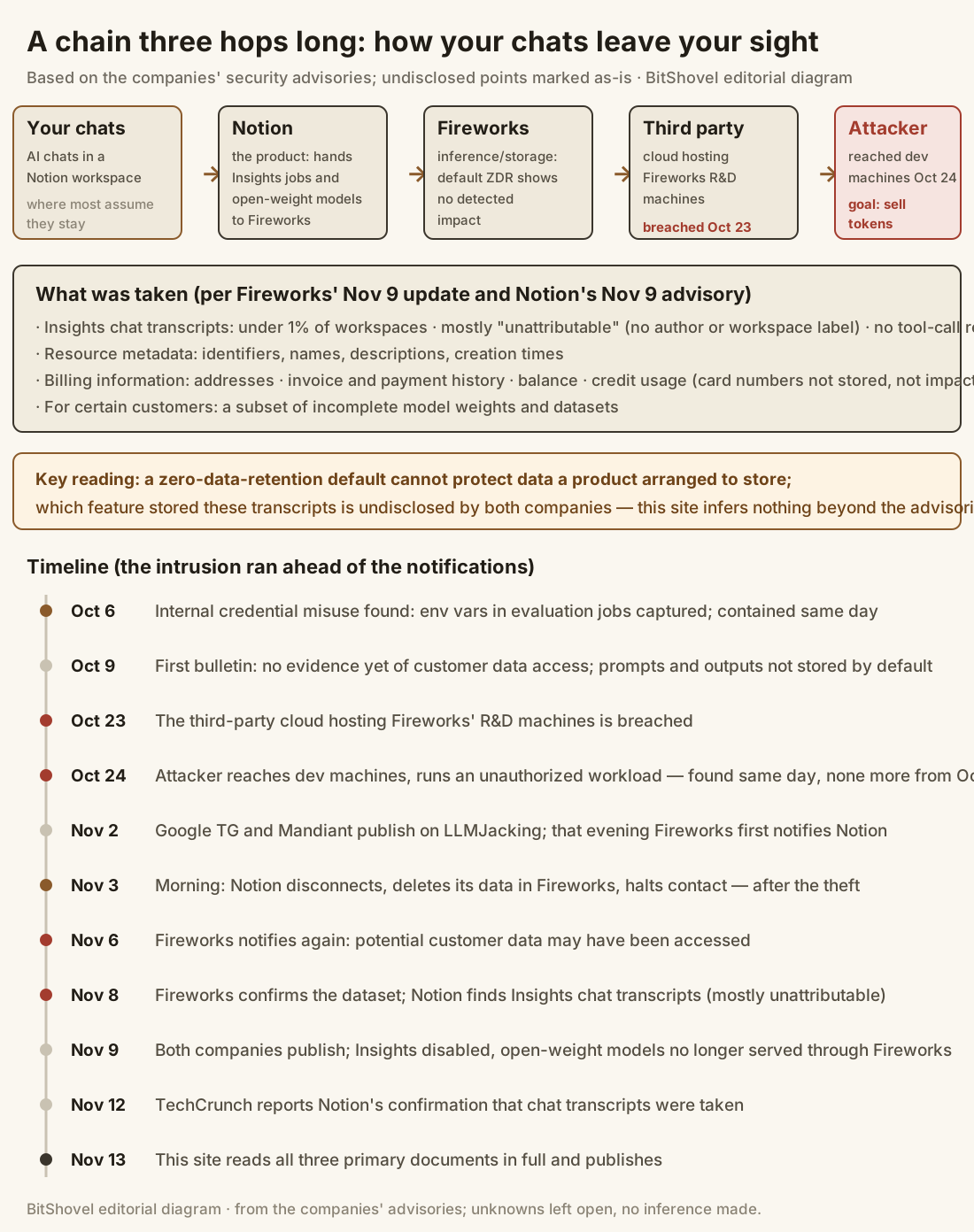
Three hops away sit your chats
First, the cast. Fireworks AI is an inference-infrastructure company — Notion's advisory calls it "one of the most used global AI infrastructure platforms powering tens of thousands of customers and used by hundreds of thousands of developers"; Harvey and Cursor are among its customers. Notion used it for two things: classification jobs behind the Insights feature (helping customers understand their own AI usage), and as a general inference provider serving open-weight models inside the product. On October 6, Fireworks identified "unauthorized use of internal Fireworks credentials" — an unauthorized third party had accessed environment variables used in evaluation jobs in a limited number of customer accounts, including API keys and third-party credentials stored as secrets. When the first bulletin went out on October 9, the investigation still said there was no evidence of access to customer models, datasets, training data, personal information or inference traffic within the security perimeter.
The second leg went deeper. The November 9 update filled in the timeline: on October 23, a third-party cloud provider hosting Fireworks' R&D machines was breached; on October 24, the attacker used that foothold to reach Fireworks development machines and "run an unauthorized workload affecting more customer data" — detected and contained the same day, with no further successful unauthorized access on the customer-facing platform from October 25 onward. The list of accessed data grew with the update: resource metadata; billing and shipping addresses, invoice and payment history, account balance and credit usage (payment card numbers were not stored and were not impacted); and, for certain customers, "a subset of incomplete model weights and datasets". In the same bulletin Fireworks tied the attack to a group: financially motivated, engaged in "LLMJacking" — selling unauthorized access to large language models as tokens to illicit routing gateways; on November 2, Google Threat Intelligence Group and Mandiant had published a blog on exactly that rise.
Notion's position in the chain is the reader's position: your chats reach Notion first, and part of them were then handed to Fireworks. What is confirmed to have leaked is the set of chat transcripts used by the Insights feature — fewer than 1% of Notion workspaces affected. The two most consequential words in Notion's advisory are "unattributable": for the vast majority of impacted workspaces, the transcripts carry no label of who wrote them or which workspace they came from, and they contain no tool-call results; "beyond what's in the chat transcript itself, there's no information tying the chat back to workspaces, users, or companies." That sentence is both comfort and warning — the thief cannot attribute what was taken, but if a transcript contains a password or key you pasted, it is plain text that anyone can read and use.
Sources and further reading
- Fireworks AI security bulletin: October 2026 incident (original)Vendor security bulletin · dated October 9 on the page · read in full by this site on November 13Read in full. Checked the key contents: on October 6 Fireworks identified "unauthorized use of internal Fireworks credentials", with an unauthorized third party accessing "environment variables used in evaluation jobs in a limited number of customer accounts" — including API keys and tokens stored as secrets, both Fireworks' and third parties'; the response timeline (containment the same day, customer notifications from October 7, employee API keys rotated and the bulletin published October 9, further user keys revoked after a completed credential review on October 10); the then-current finding of "no evidence" of access to customer models, datasets, training data, personal information or inference traffic within the security perimeter, noting prompts and outputs are not stored by default (zero data retention); and affected customers notified directly, asked to replace revoked Fireworks keys and rotate third-party credentials at their issuers ("removing a stored secret alone does not invalidate the underlying credential").
- Fireworks AI security bulletin: November 9 updateVendor security bulletin · dated November 9 on the page · read in full by this site on November 13Read in full. Checked the key contents: Palo Alto Networks Unit 42 engaged for forensics and law enforcement notified; the attack tied to a financially motivated cybercriminal group engaged in "LLMJacking — selling LLM access tokens to illicit routing gateways", with Google Threat Intelligence Group and Mandiant publishing a blog on the rise of LLMJacking on November 2; the updated timeline (October 23, the third-party cloud provider hosting Fireworks R&D machines was breached; October 24, the attacker used it to reach development machines and run an unauthorized workload affecting more customer data, detected and contained the same day; no further successful unauthorized access on the customer-facing platform from October 25 onward); the data-access list (resource metadata; billing and shipping addresses, invoice and payment history, account balance and credit usage — payment card numbers not stored and not impacted; "for certain customers, a subset of incomplete model weights and datasets were accessed"); the statement that "Inference, Training SDK, and Nexus are zero-data-retention by default and show no impact"; and remediation (credentials and service accounts revoked or replaced, network isolation, tightened storage and analytics access controls, hardened logging, self-serve dataset uploads/downloads disabled for Batch Inference and dataset-based training).
- Notion's official security advisory: incident involving a third-party AI vendorVendor security advisory · page metadata November 9 · read in full by this site on November 13Read in full. Checked the key contents: fewer than 1% of Notion workspaces impacted; the first notice on the evening of November 2 (dataset then judged to be synthetic testing data; by the morning of November 3 Notion disconnected, deleted all data in the Fireworks system and stopped all communication); the second notice on November 6 that potential customer data might have been accessed, confirmed by Fireworks on November 8 — analysis found "Notion AI chat transcripts used for the Insights feature", "unattributable" for the vast majority of impacted workspaces — not labeled with author or workspace, no tool-call results inside, and "beyond what's in the chat transcript itself, there's no information tying the chat back to workspaces, users, or companies"; the two uses of Fireworks (Insights classification jobs plus open-weight model inference inside the product); the Insights feature disabled and open-weight models no longer served through Fireworks; the recommendations (retrieve and review impacted data in-workspace, treat it as exposed, rotate passwords and API keys pasted during the window); unaffected workspaces need take no action; the investigation continues.
Deletion came after theft: the two notices of November 2–8
On the evening of November 2, Fireworks told Notion that a small set of data had been accessed by malicious actors. Notion investigated and concluded the dataset was "Notion AI synthetic testing data" with no customer data involved. Out of caution, by the morning of November 3, Notion did three things — disconnected its systems from Fireworks, deleted all Notion data in the Fireworks system, and stopped all communication between the two. At that point the story looked closed: one dataset, one deletion, one disconnection.
On November 6, Fireworks notified Notion again: the malicious actors "may have accessed potential customer data". On November 8, Fireworks confirmed the dataset; Notion's analysis found Insights chat transcripts inside. Align the dates: the intrusion was October 24, the deletion November 3 — the deletion came after the theft, and Fireworks' bulletin states no successful access was detected from October 25 onward; however fast the deletion, it could not claw back what had already flowed out. On November 9 both companies published their advisories; on November 12 TechCrunch reported Notion's confirmation that Insights users' transcripts were taken. Containment continues: the Insights feature is disabled, and open-weight models are no longer served through Fireworks.
The gap between the two notices is not a lie but the reality of investigation: the intrusion was found and contained the same day, yet the answer to "which data was affected" arrived in two passes — the first synthetic, the second customer records. The reader's lesson is plain but useful: whether your data leaked is decided by the victim's investigation schedule, not by the first email you receive. That Notion disconnected and deleted even after its first benign judgment is the sequence worth remembering — cutting first and verifying after costs less than waiting for a conclusion before acting.
Sources and further reading
- Notion's official security advisory: incident involving a third-party AI vendorVendor security advisory · page metadata November 9 · read in full by this site on November 13Read in full. Checked the key contents: fewer than 1% of Notion workspaces impacted; the first notice on the evening of November 2 (dataset then judged to be synthetic testing data; by the morning of November 3 Notion disconnected, deleted all data in the Fireworks system and stopped all communication); the second notice on November 6 that potential customer data might have been accessed, confirmed by Fireworks on November 8 — analysis found "Notion AI chat transcripts used for the Insights feature", "unattributable" for the vast majority of impacted workspaces — not labeled with author or workspace, no tool-call results inside, and "beyond what's in the chat transcript itself, there's no information tying the chat back to workspaces, users, or companies"; the two uses of Fireworks (Insights classification jobs plus open-weight model inference inside the product); the Insights feature disabled and open-weight models no longer served through Fireworks; the recommendations (retrieve and review impacted data in-workspace, treat it as exposed, rotate passwords and API keys pasted during the window); unaffected workspaces need take no action; the investigation continues.
- Fireworks AI security bulletin: November 9 updateVendor security bulletin · dated November 9 on the page · read in full by this site on November 13Read in full. Checked the key contents: Palo Alto Networks Unit 42 engaged for forensics and law enforcement notified; the attack tied to a financially motivated cybercriminal group engaged in "LLMJacking — selling LLM access tokens to illicit routing gateways", with Google Threat Intelligence Group and Mandiant publishing a blog on the rise of LLMJacking on November 2; the updated timeline (October 23, the third-party cloud provider hosting Fireworks R&D machines was breached; October 24, the attacker used it to reach development machines and run an unauthorized workload affecting more customer data, detected and contained the same day; no further successful unauthorized access on the customer-facing platform from October 25 onward); the data-access list (resource metadata; billing and shipping addresses, invoice and payment history, account balance and credit usage — payment card numbers not stored and not impacted; "for certain customers, a subset of incomplete model weights and datasets were accessed"); the statement that "Inference, Training SDK, and Nexus are zero-data-retention by default and show no impact"; and remediation (credentials and service accounts revoked or replaced, network isolation, tightened storage and analytics access controls, hardened logging, self-serve dataset uploads/downloads disabled for Batch Inference and dataset-based training).
- TechCrunch: cyberattack on Fireworks AI let hackers access Notion customers' chat transcriptsPress report · dated November 12 on the page · read by this site on November 13Used for cross-checking. Confirms Notion confirmed this week that transcripts of Insights users were taken, the roughly-1% framing, Fireworks' self-described tens of thousands of customers (including Harvey and Cursor), and that this is the second incident affecting Fireworks in as many months. Facts and dates in our article follow the two companies' primary advisories.
The data "zero data retention" did not cover
The easiest term to misread in this incident is "zero data retention" (ZDR). Fireworks' update bulletin states that Inference, Training SDK and Nexus are all ZDR by default and "show no impact"; CEO Lin Qiao's X post words it more precisely — no impact detected to "Inference (excluding batch inference), Training SDK, and Nexus". VentureBeat, reading Fireworks' own policy documentation, explains why these statements can all be true: by default, "prompt and generation data exist only in volatile memory for the duration of the request"; but "a few features do store customer content, such as stored responses, batch jobs, and training." What was breached is the storage side — in Qiao's words, this allowed the attacker "to access a subset of storage systems, leading to additional customer data impact."
Put differently: a default of not saving cannot protect data that a product arranged to save. Notion's transcripts had a copy inside Fireworks because a product function — the Insights classification jobs — needed to process that data in an environment like Fireworks'; that is exactly how the "few features" work. The boundary must be stated as-is: neither company has said which specific feature stored the transcripts, and nothing in the disclosures shows that an enterprise ZDR policy switch, had it been on, would have blocked this intrusion. This site infers nothing beyond the advisories.
How to read this as a reader: "zero data retention", "not stored", "used only for processing" are defaults and contract terms, not physical guarantees — they describe one path, and the feature you use may run on more than one path. What actually decides where your conversations end up is which tasks your product hands to which vendors. Before November this was an abstract exercise in reading privacy terms; now it has a concrete case: not one Notion customer ever signed anything with Fireworks, yet their chats lay in Fireworks' storage, taken by someone else.
Sources and further reading
- Fireworks AI security bulletin: November 9 updateVendor security bulletin · dated November 9 on the page · read in full by this site on November 13Read in full. Checked the key contents: Palo Alto Networks Unit 42 engaged for forensics and law enforcement notified; the attack tied to a financially motivated cybercriminal group engaged in "LLMJacking — selling LLM access tokens to illicit routing gateways", with Google Threat Intelligence Group and Mandiant publishing a blog on the rise of LLMJacking on November 2; the updated timeline (October 23, the third-party cloud provider hosting Fireworks R&D machines was breached; October 24, the attacker used it to reach development machines and run an unauthorized workload affecting more customer data, detected and contained the same day; no further successful unauthorized access on the customer-facing platform from October 25 onward); the data-access list (resource metadata; billing and shipping addresses, invoice and payment history, account balance and credit usage — payment card numbers not stored and not impacted; "for certain customers, a subset of incomplete model weights and datasets were accessed"); the statement that "Inference, Training SDK, and Nexus are zero-data-retention by default and show no impact"; and remediation (credentials and service accounts revoked or replaced, network isolation, tightened storage and analytics access controls, hardened logging, self-serve dataset uploads/downloads disabled for Batch Inference and dataset-based training).
- Notion's official security advisory: incident involving a third-party AI vendorVendor security advisory · page metadata November 9 · read in full by this site on November 13Read in full. Checked the key contents: fewer than 1% of Notion workspaces impacted; the first notice on the evening of November 2 (dataset then judged to be synthetic testing data; by the morning of November 3 Notion disconnected, deleted all data in the Fireworks system and stopped all communication); the second notice on November 6 that potential customer data might have been accessed, confirmed by Fireworks on November 8 — analysis found "Notion AI chat transcripts used for the Insights feature", "unattributable" for the vast majority of impacted workspaces — not labeled with author or workspace, no tool-call results inside, and "beyond what's in the chat transcript itself, there's no information tying the chat back to workspaces, users, or companies"; the two uses of Fireworks (Insights classification jobs plus open-weight model inference inside the product); the Insights feature disabled and open-weight models no longer served through Fireworks; the recommendations (retrieve and review impacted data in-workspace, treat it as exposed, rotate passwords and API keys pasted during the window); unaffected workspaces need take no action; the investigation continues.
- VentureBeat: attackers breached the Fireworks AI storage where Notion AI chats sat outside zero data retentionPress report · dated November 12 Beijing time on the page · read by this site on November 13Used for cross-checking. Reads Fireworks' policy documentation against the incident: by default "prompt and generation data exist only in volatile memory for the duration of the request", while "a few features do store customer content, such as stored responses, batch jobs, and training"; quotes CEO Lin Qiao's X post excluding batch inference from the no-impact list; and states plainly that "neither company has said which Fireworks feature stored Notion's transcripts". Our ZDR section follows that framing and keeps the same unknown; we also adopt its citations of Wiz (at least nine AI developer platforms disclosing incidents in October) and of stolen keys seeing first unauthorized activity within 30 minutes.
What the thief wants to sell is tokens; what you can do is concrete
What does the attacker want? Not your diary. Fireworks' assessment is "LLMJacking": unauthorized access to large language models gets packaged as tokens and sold to illicit routing gateways — which resell to people who want to burn someone else's quota on model usage; billing data and incomplete weights came along for the ride. Industry context shows how fast the resale runs: security firm Wiz counted at least nine AI developer platforms disclosing incidents in October, and traced stolen enterprise keys at two of them to an identical first unauthorized activity "within 30 minutes of the reported credential access" — one call, testing whether the stolen keys worked.
Notion's advice to affected customers is executable step by step: retrieve and review the impacted data inside your workspace (instructions went out by email); "treat this data as if it were exposed"; and if you pasted passwords, API keys or other credentials into Notion AI during the window, rotate them at their issuer. Fireworks' own guidance to customers puts the last point harder: "removing a stored secret alone does not invalidate the underlying credential" — what gets rotated is the credential itself, on the side that issued it.
Generalized to everyone, three things. Do not paste passwords, API keys or client material into any AI chat box — they travel through infrastructure you never see; when you adopt an AI product, it is fair to ask one more question — where is this feature's data stored, for how long, and with whom; and if your team holds a pile of AI-service keys, put "rotate at the issuer" into the incident playbook rather than only deleting the secret in a dashboard. Two earlier pieces on this site connect here: our October 30 account of GPT-6 Cyber covered a vendor gating attack capability behind an approval-only entrance — this incident is the counterpoint, since real-world attackers do not wait for a stronger model; they steal access you already issued. And in our November 10 Hacktron update, "own systems as targets" was still a vendor's chosen exercise — here the target range was someone else's product and its users' chats. The personal-AI topic on this site has discussed assistants holding your bills and schedules — the supply-chain lesson applies to them too: every document your assistant reads sits on a third machine you did not choose.
- Read Notion's official security advisoryThe source for the affected scope, the two notices and the rotation advice; the page will keep updating.
- Read Fireworks' October bulletin and November updateThe full timeline, the data-access list and remediation; the original October bulletin is linked from the same page.
- Our GPT-6 Cyber explainerHow a vendor gates attack capability behind an approval-only entrance — the mirror image of stealing access that already exists.
Sources and further reading
- Fireworks AI security bulletin: November 9 updateVendor security bulletin · dated November 9 on the page · read in full by this site on November 13Read in full. Checked the key contents: Palo Alto Networks Unit 42 engaged for forensics and law enforcement notified; the attack tied to a financially motivated cybercriminal group engaged in "LLMJacking — selling LLM access tokens to illicit routing gateways", with Google Threat Intelligence Group and Mandiant publishing a blog on the rise of LLMJacking on November 2; the updated timeline (October 23, the third-party cloud provider hosting Fireworks R&D machines was breached; October 24, the attacker used it to reach development machines and run an unauthorized workload affecting more customer data, detected and contained the same day; no further successful unauthorized access on the customer-facing platform from October 25 onward); the data-access list (resource metadata; billing and shipping addresses, invoice and payment history, account balance and credit usage — payment card numbers not stored and not impacted; "for certain customers, a subset of incomplete model weights and datasets were accessed"); the statement that "Inference, Training SDK, and Nexus are zero-data-retention by default and show no impact"; and remediation (credentials and service accounts revoked or replaced, network isolation, tightened storage and analytics access controls, hardened logging, self-serve dataset uploads/downloads disabled for Batch Inference and dataset-based training).
- Notion's official security advisory: incident involving a third-party AI vendorVendor security advisory · page metadata November 9 · read in full by this site on November 13Read in full. Checked the key contents: fewer than 1% of Notion workspaces impacted; the first notice on the evening of November 2 (dataset then judged to be synthetic testing data; by the morning of November 3 Notion disconnected, deleted all data in the Fireworks system and stopped all communication); the second notice on November 6 that potential customer data might have been accessed, confirmed by Fireworks on November 8 — analysis found "Notion AI chat transcripts used for the Insights feature", "unattributable" for the vast majority of impacted workspaces — not labeled with author or workspace, no tool-call results inside, and "beyond what's in the chat transcript itself, there's no information tying the chat back to workspaces, users, or companies"; the two uses of Fireworks (Insights classification jobs plus open-weight model inference inside the product); the Insights feature disabled and open-weight models no longer served through Fireworks; the recommendations (retrieve and review impacted data in-workspace, treat it as exposed, rotate passwords and API keys pasted during the window); unaffected workspaces need take no action; the investigation continues.
- VentureBeat: attackers breached the Fireworks AI storage where Notion AI chats sat outside zero data retentionPress report · dated November 12 Beijing time on the page · read by this site on November 13Used for cross-checking. Reads Fireworks' policy documentation against the incident: by default "prompt and generation data exist only in volatile memory for the duration of the request", while "a few features do store customer content, such as stored responses, batch jobs, and training"; quotes CEO Lin Qiao's X post excluding batch inference from the no-impact list; and states plainly that "neither company has said which Fireworks feature stored Notion's transcripts". Our ZDR section follows that framing and keeps the same unknown; we also adopt its citations of Wiz (at least nine AI developer platforms disclosing incidents in October) and of stolen keys seeing first unauthorized activity within 30 minutes.