Source to life · compute and ecosystem
Nvidia's first week without Jensen: money tightening, supply commitments holding
On November 8 Nvidia's board opened an independent investigation after reports that Jensen Huang was targeted by a Chinese spy operation, and Huang admitted an affair with Alice Huang, a former executive at the chip company Megaspeed; on November 12 he resigned as president, CEO and board member, effective immediately, with CFO Colette Kress becoming interim CEO. This explainer separates the three channels readers can actually check. Money: Nvidia joined 105 startup funding rounds this year, often as the largest check, and the interim Kress is expected by investors to be more conservative — open-weight models lose their biggest patron (Reflection AI's $800M, Mistral and the $13B Hugging Face acquisition all sat on that checkbook). Compute: South Korea's 260,000-GPU supply commitment was reaffirmed, the Taiwan headquarters advances, and "delivering to customers over the next 24 months" is the company's stated first goal. Markets: the stock fell 14% intraday on the 12th before closing down 4.3%, while Broadcom and AMD became the biggest contributors to the S&P 500. The investigations, the congressional testimony and the chip-smuggling thread are all ongoing; this article keeps what has already happened apart from what investors expect. Everything here is press and analyst accounts; this site holds no positions and has interviewed no one.
This account draws on seven documents, all read by this site on November 15: four TechCrunch reports — the funding hole (dated November 13), Asian governments' reactions (November 14), banned chips behind China's most powerful models (November 13), and the petition to reinstate Huang (November 14); Interconnects' commentary "Open-source AI without Jensen" (dated November 14); and two Bloomberg reports via IT之家 — Wall Street's attitude toward the AI investment boom (November 14) and the Anthropic IPO subscriptions (November 13). The timeline (the November 8 investigation, the November 12 resignation) follows TechCrunch's reporting; the spy and smuggling material consists of reported allegations under investigation — China's foreign ministry has rejected the spy allegations, and Singaporean authorities found insufficient evidence on the false-declarations matter in February 2026. The November 16 supplement adds three documents — TechCrunch's November 12 report on the Democratic congressional inquiry, the November 15 Equity podcast recap, and the November 14 commentary on Nvidia's security team — see the "two investigations" and "Bank of Nvidia" sections. Boundaries: this site holds no positions, has interviewed no one, and has not re-computed any market figure; every forward-looking statement is attributed to whoever holds the expectation, never presented as this site's judgment.
Four days in November, and an interim CEO
First, what has actually happened, in one line each. On November 8 (Sunday), TechCrunch reported that Nvidia's board launched an independent investigation after reports that Huang was targeted by a Chinese spy operation, and that Huang admitted an affair with Alice Huang, a former executive at the Singapore-based chip company Megaspeed. On November 10, China's foreign ministry rejected the spy allegations as groundless. On November 12 (Thursday), Huang resigned as Nvidia's president, chief executive and board member, effective immediately — after 33 years leading the company he co-founded; CFO Colette Kress became interim CEO while a permanent successor is sought. The stock fell as much as 14% intraday that day before closing down 4.3% (Bloomberg, via IT之家). On November 14, TechCrunch reported a petition to reinstate Huang had passed 115,000 signatures, including 5,965 current employees and 1,108 former ones, with Elon Musk, Replit's Amjad Masad, Epic's Tim Sweeney and Y Combinator's Garry Tan among the signers; its phrasing is "Jensen deserves due process, not mob justice". The report also confirms Huang has agreed to testify before Congress.
Allegations and established facts need separate shelves. The spying accusation and chip smuggling are matters of reporting and ongoing investigation: TechCrunch's November 13 piece lays out another thread — former OpenAI researcher Will DePue analyzed the openly published weights of DeepSeek V4, Kimi K3, MiniMax and Ant Group models and found evidence they were trained on banned Blackwell chips (a researcher's fingerprint-inference method, not an official finding); Epoch AI estimates about 2 million advanced chips entered China in 2024–25 through schemes hiding their destination; and a company linked to Alice Huang is alleged to have smuggled restricted chips to a Shanghai data center (per Bloomberg) — while Nvidia and Huang had vouched for Megaspeed's data centers. Singapore's official timeline is cooler: Alice Huang's passport was seized in June 2025 over an investigation into possible false declarations about server purchases; in February 2026 police found insufficient evidence on the false declarations, issuing a warning only over inaccurate information about her role at Megaspeed and barring her re-entry, with the investigation into Megaspeed and six others ongoing. Appearing in the same news cycle does not make these accusations equivalent — the investigations will answer each on its own.
Sources and further reading
- TechCrunch: Asian governments react to Nvidia CEO Jensen Huang's exitPress report · dated November 14 UTC · read by this site on November 15Read in full. Checked the key contents: on Sunday, November 8, Nvidia's board launched an independent investigation after reports that Huang was targeted by a Chinese spy operation, and Huang admitted an affair with Alice Huang, a former executive at the Singapore-based chip company Megaspeed; China's foreign ministry rejected the spy allegations on November 10; Singapore's Ministry of Home Affairs account — Alice Huang's passport was seized in June 2025 in an investigation into possible false declarations about server purchases, in February 2026 police found insufficient evidence on the false declarations, issued a warning over inaccurate information about her role at Megaspeed and barred her re-entry, with the investigation into Megaspeed and six others ongoing; South Korea's Science Ministry — Nvidia reaffirmed its plan to supply 260,000 advanced GPUs and continue joint AI projects, with the government AI strategy council holding an emergency meeting on Friday; Taiwan — the economy minister sees no significant change to global AI growth, and Taipei's city government says the overseas headquarters remains on track with contractual obligations met; Japan — the industry ministry will monitor closely, with the deputy chief cabinet secretary calling it too early to assess; China — over $3B of AI computing projects reliant on restricted processors face uncertainty (per a Reuters review of procurement notices and disclosures).
- TechCrunch: export-banned Nvidia chips reportedly behind China's most powerful AI modelsPress report · dated November 13 · read by this site on November 15 (key facts checked against the full page)Read and checked. Key contents: Will DePue, a former OpenAI researcher who leads Unemployment Labs, analyzed the weights of openly released Chinese models and found evidence that banned Blackwell GPUs were used to train DeepSeek V4, Kimi K3, MiniMax and Ant Group models; White House tech adviser Michael Kratsios previously said Moonshot used export-banned chips, citing intelligence sources; Epoch AI estimates about 2 million advanced chips entered China in 2024–25 via schemes hiding their destination, with about 275,000 imported into Malaysia and some 600,000 H200 reportedly stockpiled in Hong Kong; current US policy permits H200 exports through a circuitous route with a 25% tariff; a company linked to Alice Huang is alleged to have smuggled restricted chips to a Shanghai data center (per Bloomberg); Nvidia and Huang had vouched for Megaspeed's data centers; confirmed smuggling plus knowledge could create corporate liability. Note: weight-fingerprint analysis is a researcher's inference method, not an official finding; all of the above are reported allegations and analysis.
- TechCrunch: Musk and other execs sign petition calling on Nvidia to reinstate Jensen HuangPress report · dated November 14 · read by this site on November 15 (key facts checked against the full page)Read and checked. Key contents: over 115,000 signatures by Saturday afternoon — 5,965 current Nvidia employees, 1,108 former employees and 63,063 shareholders; signers include Elon Musk, Replit CEO Amjad Masad, Epic Games CEO Tim Sweeney and Y Combinator CEO Garry Tan; the petition is "concerned that Jensen was removed without meaningful due process" and demands a fair investigation and more public information, saying "Jensen deserves due process, not mob justice"; the timeline is confirmed — Huang stepped down Thursday, November 12, four days after admitting to an affair with a chip executive whom US intelligence suspected of being a Chinese spy; reports have also alleged multiple affairs; he has agreed to testify before Congress; Kress serves as interim CEO while a permanent replacement is sought.
- IT之家 relaying Bloomberg: Wall Street "not too worried" about the AI investment boomPress relay · dated November 14 (Bloomberg, November 13) · read by this site on November 15Read in full. Checked the key contents: on November 12 Nvidia fell as much as 14% intraday before closing down 4.3%; Interactive Brokers' Sosnick — "the market is not assessing risk but looking for opportunity: if Nvidia gives up share, who benefits?"; Broadcom and AMD became the largest contributors to the S&P 500's points; the Philadelphia Semiconductor Index opened down 3.7% and closed down just 0.5%; Moor Insights' Moorhead sees no change to the AI investment landscape in the short or medium term, with Broadcom, Intel and startups able to fill gaps; the recent US midterms dampened some investor enthusiasm (anti-datacenter candidates won); large AI cloud providers have committed to sustained investment through 2027; CFRA's Zino notes the AI industry is long past its starting stage; Morningstar's Colaro points out that the advantage of "Huang's endorsement" disappears with him; Nebius and CoreWeave were sold off for a time, and Supermicro fell 11% on a separate item; Jensen Investment Management's Bond argues AI needs enormous compute and the infrastructure boom will continue.
Markets fell, then steadied: investors hunted beneficiaries, not risks
The November 12 session put a price on the event: down 14% at the open, down 4.3% at the close; the Philadelphia Semiconductor Index opened down 3.7% and closed down just 0.5%. Bloomberg's November 13 report was headlined that Wall Street is "not too worried", and Interactive Brokers' chief strategist Sosnick put it plainly: the market is not assessing risk but looking for opportunity — "if Nvidia gives up share, who benefits?" The answer was on the leaderboard the same day: Broadcom and AMD became the largest contributors to the S&P 500's gains. Moor Insights' Moorhead added the structural version: in the short and medium term this changes nothing about the AI investment landscape — Broadcom, Intel and many startups can fill much of any space Nvidia leaves.
"Not worried" does not mean "nothing broke". The same day, the Nvidia-backed AI cloud providers Nebius and CoreWeave were sold off for a time, and server maker Supermicro fell 11% on a separate item; Morningstar's Colaro named the layer most dependent on Huang personally — if small companies benefited from "Huang's endorsement", that advantage disappears with him, and the new CEO inherits the cheerleading too. CFRA's Zino and Jensen Investment Management's Bond supplied the long layer: the AI industry is long past its starting stage, AI needs enormous and expensive compute, and the buildout continues. Large AI cloud providers' commitments to sustained investment through 2027 are the short-term prop the report names. The market spent one day converting "founder risk" into a tradable number; what remains unpriced are the two concrete channels in the next sections.
Sources and further reading
- IT之家 relaying Bloomberg: Wall Street "not too worried" about the AI investment boomPress relay · dated November 14 (Bloomberg, November 13) · read by this site on November 15Read in full. Checked the key contents: on November 12 Nvidia fell as much as 14% intraday before closing down 4.3%; Interactive Brokers' Sosnick — "the market is not assessing risk but looking for opportunity: if Nvidia gives up share, who benefits?"; Broadcom and AMD became the largest contributors to the S&P 500's points; the Philadelphia Semiconductor Index opened down 3.7% and closed down just 0.5%; Moor Insights' Moorhead sees no change to the AI investment landscape in the short or medium term, with Broadcom, Intel and startups able to fill gaps; the recent US midterms dampened some investor enthusiasm (anti-datacenter candidates won); large AI cloud providers have committed to sustained investment through 2027; CFRA's Zino notes the AI industry is long past its starting stage; Morningstar's Colaro points out that the advantage of "Huang's endorsement" disappears with him; Nebius and CoreWeave were sold off for a time, and Supermicro fell 11% on a separate item; Jensen Investment Management's Bond argues AI needs enormous compute and the infrastructure boom will continue.
- TechCrunch: Jensen Huang's departure blasts big hole in AI startup fundingPress report · dated November 13 UTC · read by this site on November 15Read in full. Checked the key contents: Huang's resignation after 33 years; PitchBook's count of 105 rounds this year with Nvidia often the largest investor; the investor expectation that interim CEO Colette Kress is "much more conservative"; the biggest bets being neoclouds, inference providers and open-weight models; the specific cases — CoreWeave's private backing, two Crusoe rounds including a $1.4B Series E, this year's $13B Hugging Face acquisition (expected to close in 2027), Mistral AI, Lambda, Black Forest Labs, and Reflection AI ($800M into a $2B Series B last year, per the WSJ); "Jensen believed in open source and frankly speaking, Europe"; the lock-in analysis of tying startups to Nvidia chips; Google's two new chips announced the same week; Battery Ventures' Thakker on Big Tech rivals stepping in; the structure where infrastructure startups raised half of $100–500M in GPUs at $1B+ valuations from Nvidia first; and "When Nvidia was on the cap table, everyone felt safe".
The most tangible gap: the checkbook behind startups and open-weight models
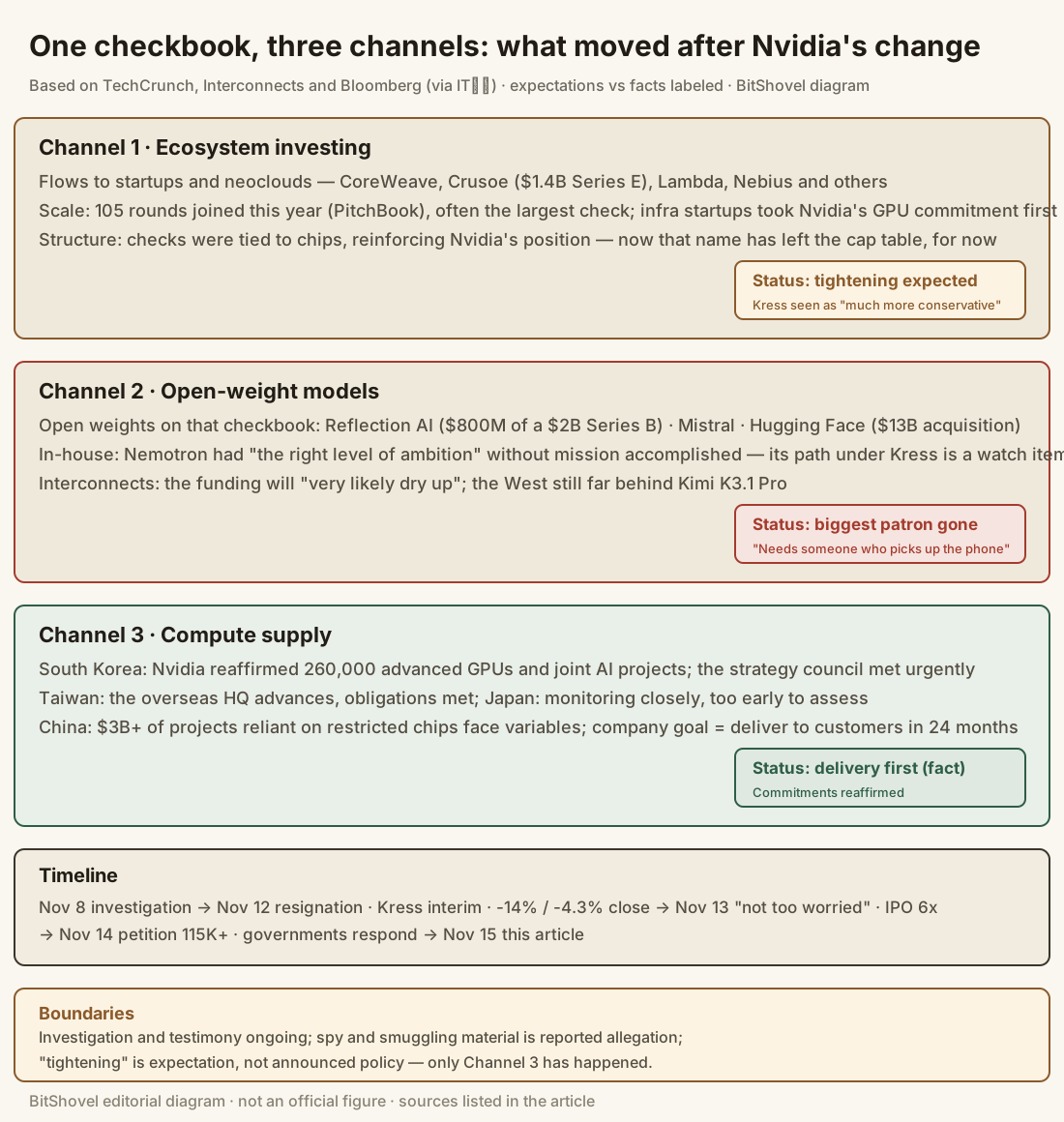
The most immediate visible consequence of Huang's departure is written in other people's term sheets. Per PitchBook, Nvidia joined 105 startup rounds this year, often as the largest investor. The investors and founders TechCrunch interviewed made the direction concrete: the biggest bets were neoclouds, inference providers and open-weight models — CoreWeave was backed while still private, Crusoe's $1.4B Series E included Nvidia, this year saw the $13B Hugging Face acquisition (expected to close in 2027), and Mistral AI, Lambda and Black Forest Labs are all on the list; last year, open-weight Reflection AI took $800M from Nvidia in a $2B Series B before it had meaningful revenue (per the WSJ). Dawn Capital's Bankiya compresses it: Nvidia was "carrying almost every AI-native startup from application to neocloud" — and she recalls the other half: "Jensen believed in open source and frankly speaking, Europe".
The successor's style is everything. Interim CEO Kress is described by interviewed investors as "much more conservative" — "I don't think she's going to commit the same amount of money to keep the early-stage ecosystem going." The expectation propagates from there: Nvidia gets pickier about new bets and writes smaller checks into its existing portfolio, and valuations slide; the old structure — an infrastructure startup taking half of a $100–500M GPU commitment from Nvidia first, then raising the rest at a billion-dollar-plus valuation — loses the name that made other investors comfortable. "When Nvidia was on the cap table, everyone felt safe" — read backwards, that sentence is today's gap.
For open-weight models, this channel narrowing has a concrete reader meaning. The open rows on this site's model board — Kimi K3.1 Pro (46), DeepSeek V4.1 Flash (33), GLM-5.3 (32), Mistral Large 4 (26) — exist as open weights and keep training next generations on the back of various patronage structures, and Nvidia was the biggest patron of the Western open camp. Nathan Lambert's judgment on Interconnects: Nvidia's financial interest in supporting open models remains (to avoid customers concentrating and building their own chips), but Huang's flooding-the-zone funding "will very likely dry up", and the company's first goal becomes stabilizing the ship and delivering to customers over the next 24 months. He names the Western field's state: Inkling 2 Small is the best Western open-weight model in a while yet still far behind Kimi K3.1 Pro, and "the open-weight ecosystem needs someone who will pick up the phone to abate a crisis". Nvidia's in-house Nemotron line had "the right level of ambition" without reaching mission accomplished — how it fares under a more conservative regime is the next checkable node on this channel.
Sources and further reading
- TechCrunch: Jensen Huang's departure blasts big hole in AI startup fundingPress report · dated November 13 UTC · read by this site on November 15Read in full. Checked the key contents: Huang's resignation after 33 years; PitchBook's count of 105 rounds this year with Nvidia often the largest investor; the investor expectation that interim CEO Colette Kress is "much more conservative"; the biggest bets being neoclouds, inference providers and open-weight models; the specific cases — CoreWeave's private backing, two Crusoe rounds including a $1.4B Series E, this year's $13B Hugging Face acquisition (expected to close in 2027), Mistral AI, Lambda, Black Forest Labs, and Reflection AI ($800M into a $2B Series B last year, per the WSJ); "Jensen believed in open source and frankly speaking, Europe"; the lock-in analysis of tying startups to Nvidia chips; Google's two new chips announced the same week; Battery Ventures' Thakker on Big Tech rivals stepping in; the structure where infrastructure startups raised half of $100–500M in GPUs at $1B+ valuations from Nvidia first; and "When Nvidia was on the cap table, everyone felt safe".
- Interconnects: Open-source AI without JensenAnalyst commentary (Nathan Lambert) · dated November 14 · read by this site on November 15Read in full. The positions are the author's; this article relays them as such: the open-model ecosystem suffered "a decapitation"; Nvidia's financial interest in supporting open models remains (avoiding concentration among a few customers who would build their own chips), but the funding "in a way that will very likely dry up"; the company's number-one goal is to stabilize the ship, deliver to customers in the next 24 months and prevent implosion; the open-weight economy is nascent and its long-term payoff — truly commoditized intelligence — is far off; "Jensen was more than a cheerleader" — he would stop problems once winds stirred; the biggest near-term worry is sloppy state-level regulation and "open-weight hawks"; the US needs to incubate a truly frontier open-model player (quoting SemiAnalysis' Dylan Patel: the constraint is talent, not money); Inkling 2 Small is the best Western open-weight model in a while yet still far behind Kimi K3.1 Pro; "the open-weight ecosystem needs someone who will pick up the phone to abate a crisis".
The compute still flows: commitments reaffirmed, delivery first
Alongside the expectation that money tightens stands the current state that compute commitments hold — the only one of the three channels where things have already happened rather than being expected. TechCrunch's November 14 rundown of governments: South Korea's Science Ministry says Nvidia reaffirmed its plan to supply 260,000 advanced GPUs and continue joint AI projects (the government's AI strategy council held an emergency meeting the same day to assess the impact); Taipei's city government says the overseas headquarters advances and the company has met its contractual obligations so far; Japan's industry ministry will monitor closely, with the deputy chief cabinet secretary calling it too early to assess the global impact. On the Chinese mainland the uncertainty is larger: per a Reuters review relayed in the report, over $3B of AI computing projects reliant on Nvidia's restricted processors face variables, while the foreign ministry reiterated opposition to export controls that disrupt global supply chains.
At the company level, Lambert writes Nvidia's first goal as "stabilize the ship, deliver to customers in the next 24 months, prevent implosion" — consistent with the supply commitments governments received: chips keep flowing short-term, and customer contracts outrank ecosystem investing. One checkable test lands next week: per Bloomberg's November 13 report (via IT之家), Anthropic's IPO subscriptions reached about six times the shares on offer, with the IPO raising up to $64.4B plus a $26B private placement at a target valuation around $1.4T; per the filings, Nvidia plans to subscribe about $10B of that $26B private placement — and it is a key strategic partner of Anthropic. Whether that $10B goes as planned is the first public data point for "does Nvidia under Kress still write big checks": at the market level, the $81B revenue run-rate Anthropic disclosed (as of October 31, annualized) explains the demand; at the company level, it tests exactly this article's second channel.
Sources and further reading
- TechCrunch: Asian governments react to Nvidia CEO Jensen Huang's exitPress report · dated November 14 UTC · read by this site on November 15Read in full. Checked the key contents: on Sunday, November 8, Nvidia's board launched an independent investigation after reports that Huang was targeted by a Chinese spy operation, and Huang admitted an affair with Alice Huang, a former executive at the Singapore-based chip company Megaspeed; China's foreign ministry rejected the spy allegations on November 10; Singapore's Ministry of Home Affairs account — Alice Huang's passport was seized in June 2025 in an investigation into possible false declarations about server purchases, in February 2026 police found insufficient evidence on the false declarations, issued a warning over inaccurate information about her role at Megaspeed and barred her re-entry, with the investigation into Megaspeed and six others ongoing; South Korea's Science Ministry — Nvidia reaffirmed its plan to supply 260,000 advanced GPUs and continue joint AI projects, with the government AI strategy council holding an emergency meeting on Friday; Taiwan — the economy minister sees no significant change to global AI growth, and Taipei's city government says the overseas headquarters remains on track with contractual obligations met; Japan — the industry ministry will monitor closely, with the deputy chief cabinet secretary calling it too early to assess; China — over $3B of AI computing projects reliant on restricted processors face uncertainty (per a Reuters review of procurement notices and disclosures).
- Interconnects: Open-source AI without JensenAnalyst commentary (Nathan Lambert) · dated November 14 · read by this site on November 15Read in full. The positions are the author's; this article relays them as such: the open-model ecosystem suffered "a decapitation"; Nvidia's financial interest in supporting open models remains (avoiding concentration among a few customers who would build their own chips), but the funding "in a way that will very likely dry up"; the company's number-one goal is to stabilize the ship, deliver to customers in the next 24 months and prevent implosion; the open-weight economy is nascent and its long-term payoff — truly commoditized intelligence — is far off; "Jensen was more than a cheerleader" — he would stop problems once winds stirred; the biggest near-term worry is sloppy state-level regulation and "open-weight hawks"; the US needs to incubate a truly frontier open-model player (quoting SemiAnalysis' Dylan Patel: the constraint is talent, not money); Inkling 2 Small is the best Western open-weight model in a while yet still far behind Kimi K3.1 Pro; "the open-weight ecosystem needs someone who will pick up the phone to abate a crisis".
- IT之家 relaying Bloomberg: Anthropic IPO ~6x oversubscribed; Nvidia to subscribe ~$10B in the private placementPress relay · dated November 13 (Bloomberg, same day) · read by this site on November 15Read in full. Checked the key contents: subscription orders reached about six times the shares on offer; the IPO aims to raise up to $64.4B, with a concurrent $26B private placement — up to $90.4B combined; the target fully diluted valuation is about $1.4T, below some earlier investor expectations; underwriters have told some investors that existing shareholders will be prioritized; per the filings, Nvidia plans to subscribe about $10B of the $26B private placement and is a key strategic partner of Anthropic; a November 10 filing disclosed a revenue run-rate of $81B as of October 31 (up $10B from the end of September), annualized from recent consumption and subscription revenue — not realized full-year revenue; Amodei and JPMorgan CEO Jamie Dimon appeared at a livestream event on November 13.
What readers can check next
List the next data point for each channel, and every one has a clear way to be checked. Money: the first investment decisions under Kress — on what-sized checks follow-on rounds proceed, and whether Nvidia still appears as the largest investor; the planned $10B in Anthropic's private placement next week is the fastest one. Models: Nemotron's next release — Nvidia's in-house open line, and whether open weights still get a slot under a delivery-first regime; and whether anyone in the Western open-weight camp picks up the phone — the open rows on this site's model board (Kimi K3.1 Pro, DeepSeek V4.1 Flash, GLM-5.3 and others) keep recording real scores as they land. Compute: the delivery rhythm behind Korea's 260,000 GPUs and other national projects. People and process: Huang's congressional testimony, the board's independent investigation, and the choice of a permanent CEO.
Finally, the boundaries. This article makes no predictions: the tightening is investors' expectation of an interim CEO, not an announced policy; the drying-up of open-model funding is one analyst's judgment, not an accomplished fact; of the three channels only the supply commitments carry a "has happened" status. At the allegations layer, the spy and smuggling material consists of reporting and ongoing investigation — China's foreign ministry has rejected the spy allegations, Singaporean authorities found insufficient evidence on the false declarations in February 2026, and the weight-fingerprint analysis appears as a researcher's inference reported as such. What makes the leadership change worth ten minutes of a reader's time is not that it changes any product's price next week, but that it is a rare moment when one chain can be seen end to end: a personnel change at the source becomes other people's term sheets, then becomes whether the model board's next open-weight row exists at all, and only later becomes changes in products and services. This article pins the first two links of that chain; the last two wait for data.
- Read the Interconnects commentaryThe full "Open-source AI without Jensen"; the open-weight ecosystem's gains, losses and quotes all come from this piece.
- See this site's model boardLive scores and observation dates for the open-weight rows (Kimi K3.1 Pro, DeepSeek V4.1 Flash, GLM-5.3, Mistral Large 4 and others), updated with each maintenance round.
- Our Nemotron 3.5 explainerThe previous stop for Nvidia's in-house open-model line; its next move under a delivery-first regime is one of the watch points this article lists.
Sources and further reading
- TechCrunch: Jensen Huang's departure blasts big hole in AI startup fundingPress report · dated November 13 UTC · read by this site on November 15Read in full. Checked the key contents: Huang's resignation after 33 years; PitchBook's count of 105 rounds this year with Nvidia often the largest investor; the investor expectation that interim CEO Colette Kress is "much more conservative"; the biggest bets being neoclouds, inference providers and open-weight models; the specific cases — CoreWeave's private backing, two Crusoe rounds including a $1.4B Series E, this year's $13B Hugging Face acquisition (expected to close in 2027), Mistral AI, Lambda, Black Forest Labs, and Reflection AI ($800M into a $2B Series B last year, per the WSJ); "Jensen believed in open source and frankly speaking, Europe"; the lock-in analysis of tying startups to Nvidia chips; Google's two new chips announced the same week; Battery Ventures' Thakker on Big Tech rivals stepping in; the structure where infrastructure startups raised half of $100–500M in GPUs at $1B+ valuations from Nvidia first; and "When Nvidia was on the cap table, everyone felt safe".
- Interconnects: Open-source AI without JensenAnalyst commentary (Nathan Lambert) · dated November 14 · read by this site on November 15Read in full. The positions are the author's; this article relays them as such: the open-model ecosystem suffered "a decapitation"; Nvidia's financial interest in supporting open models remains (avoiding concentration among a few customers who would build their own chips), but the funding "in a way that will very likely dry up"; the company's number-one goal is to stabilize the ship, deliver to customers in the next 24 months and prevent implosion; the open-weight economy is nascent and its long-term payoff — truly commoditized intelligence — is far off; "Jensen was more than a cheerleader" — he would stop problems once winds stirred; the biggest near-term worry is sloppy state-level regulation and "open-weight hawks"; the US needs to incubate a truly frontier open-model player (quoting SemiAnalysis' Dylan Patel: the constraint is talent, not money); Inkling 2 Small is the best Western open-weight model in a while yet still far behind Kimi K3.1 Pro; "the open-weight ecosystem needs someone who will pick up the phone to abate a crisis".
- IT之家 relaying Bloomberg: Anthropic IPO ~6x oversubscribed; Nvidia to subscribe ~$10B in the private placementPress relay · dated November 13 (Bloomberg, same day) · read by this site on November 15Read in full. Checked the key contents: subscription orders reached about six times the shares on offer; the IPO aims to raise up to $64.4B, with a concurrent $26B private placement — up to $90.4B combined; the target fully diluted valuation is about $1.4T, below some earlier investor expectations; underwriters have told some investors that existing shareholders will be prioritized; per the filings, Nvidia plans to subscribe about $10B of the $26B private placement and is a key strategic partner of Anthropic; a November 10 filing disclosed a revenue run-rate of $81B as of October 31 (up $10B from the end of September), annualized from recent consumption and subscription revenue — not realized full-year revenue; Amodei and JPMorgan CEO Jamie Dimon appeared at a livestream event on November 13.
- TechCrunch: Asian governments react to Nvidia CEO Jensen Huang's exitPress report · dated November 14 UTC · read by this site on November 15Read in full. Checked the key contents: on Sunday, November 8, Nvidia's board launched an independent investigation after reports that Huang was targeted by a Chinese spy operation, and Huang admitted an affair with Alice Huang, a former executive at the Singapore-based chip company Megaspeed; China's foreign ministry rejected the spy allegations on November 10; Singapore's Ministry of Home Affairs account — Alice Huang's passport was seized in June 2025 in an investigation into possible false declarations about server purchases, in February 2026 police found insufficient evidence on the false declarations, issued a warning over inaccurate information about her role at Megaspeed and barred her re-entry, with the investigation into Megaspeed and six others ongoing; South Korea's Science Ministry — Nvidia reaffirmed its plan to supply 260,000 advanced GPUs and continue joint AI projects, with the government AI strategy council holding an emergency meeting on Friday; Taiwan — the economy minister sees no significant change to global AI growth, and Taipei's city government says the overseas headquarters remains on track with contractual obligations met; Japan — the industry ministry will monitor closely, with the deputy chief cabinet secretary calling it too early to assess; China — over $3B of AI computing projects reliant on restricted processors face uncertainty (per a Reuters review of procurement notices and disclosures).
Two investigations: one asks about Huang, one asks about Washington
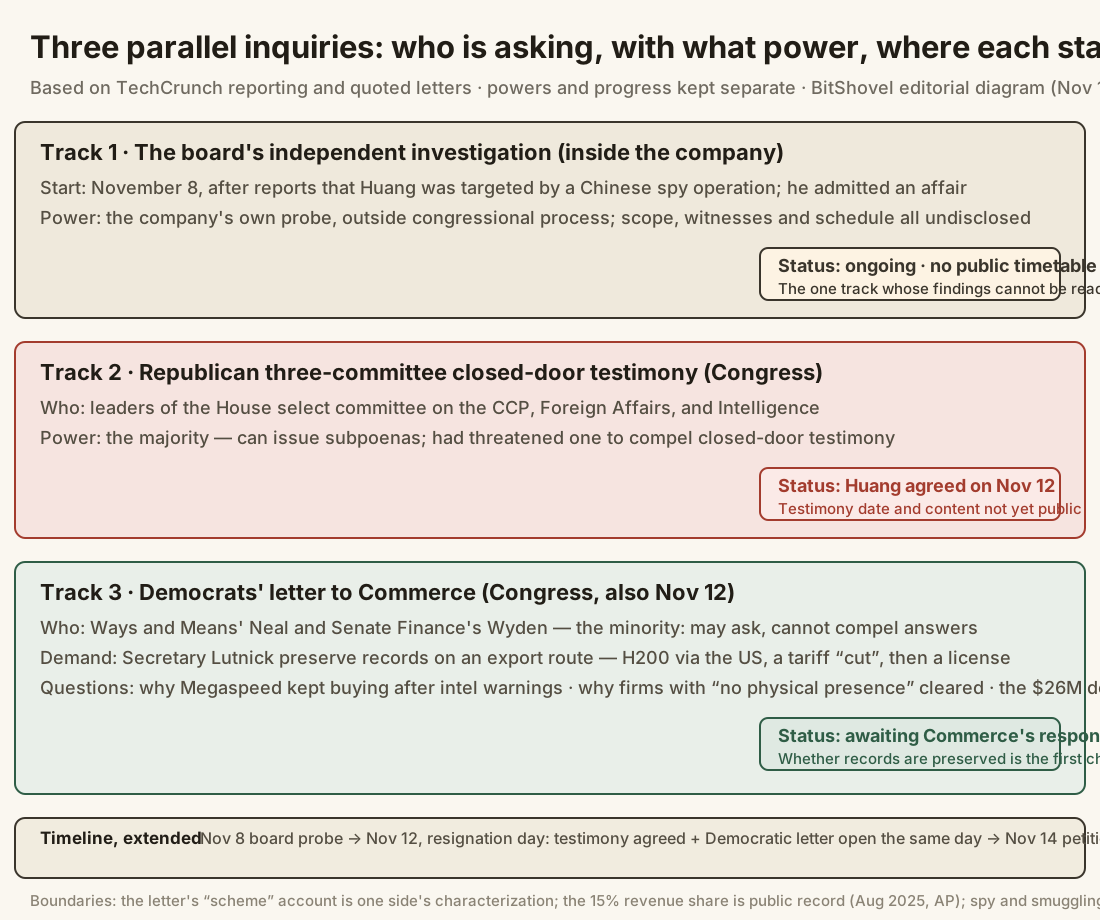
A supplement to the thread this article originally compressed into "congressional testimony". On November 12, the day Huang resigned, Congress in fact ran two tracks. The first took shape after the November 8 investigation became public: on the Republican side, the leaders of the House select committee on the Chinese Communist Party, Foreign Affairs and Intelligence demanded closed-door testimony from Huang and threatened a subpoena — a power the majority has; he agreed on the 12th, the day he resigned. The second opened the same day: Rep. Richard Neal, top Democrat on House Ways and Means, and Sen. Ron Wyden, top Democrat on Senate Finance, wrote to Commerce Secretary Howard Lutnick asking the department to preserve records connected to an export arrangement they call questionable and allegedly illegal. The minority's position is stated plainly: they may ask questions but cannot compel answers — the two tracks could do different things from the start.
The letter's account of the "scheme" is worth laying out as written, because it is the policy underneath this article's "the compute still flows" section. As the letter describes it: Trump agreed to sales of H200 chips to China on condition that the Taiwan-made chips ship to the United States first; on arrival a tariff was added — in the letter's words, "effectively taking a cut of Nvidia's sales to China through what appears to be an unconstitutional export tax system"; Commerce then issued the export license. Part of this is public record: in August 2025, Nvidia and AMD agreed to hand over 15% of their China chip-sales revenue to the US government in exchange for export licenses (the AP reported at the time). The letter aims at the administration, not just Nvidia and Huang: why Megaspeed was still allowed to buy chips after US intelligence reportedly flagged suspicions about Alice Huang and her relationship with Jensen Huang; why Asian companies "with no physical presence at their listed addresses" were green-lit. It also asks how Nvidia's donations to Trump's projects — $26M including the White House ballroom — figured against the export deal's approval, appearing to ask whether knowledge of "Mr. Huang's compromised position" was used to secure donations. Trump himself sketched a vignette in the "60 Minutes" interview aired Sunday: he and his team once threatened an unnamed AI executive with jail, and the executive "totally changed". All of this is currently the account of one letter and one interview — whether Commerce preserves the records, and how it responds, is the first checkable move on this track.
Sources and further reading
- TechCrunch: Democrats launch Nvidia investigation, write scathing letter on Huang's 'scheme' with TrumpPress report · dated November 12 UTC · read in full by this site on November 16 (collected November 13, unused in earlier rounds)Read in full. Checked the key contents: on November 12 — the day Huang resigned — Democrats opened an inquiry into how the Trump administration handled Nvidia's chip sales to China, led by Rep. Richard Neal (top Democrat, House Ways and Means) and Sen. Ron Wyden (top Democrat, Senate Finance); their minority status means they can ask questions but cannot compel answers. Their letter to Commerce Secretary Lutnick asks the department to preserve records on an arrangement they call questionable and allegedly illegal; the letter's description of the "scheme": Trump agreed to sales of H200 chips to China as long as the Taiwan-made chips were first shipped to the United States, with a tariff added on arrival — "effectively taking a cut of Nvidia's sales to China through what appears to be an unconstitutional export tax system" — and Commerce then issued the export license. The report notes the August 2025 deal in which Nvidia and AMD agreed to share 15% of China chip-sales revenue with the US government for export licenses was public (AP reported at the time). The letter asks why Megaspeed was allowed to keep buying chips after US intelligence reportedly flagged suspicions about Alice Huang and her relationship with Jensen Huang, and why other Asian companies "with no physical presence at their listed addresses" were green-lit — aiming at the administration, not just Nvidia and Huang. It also asks how Nvidia's donations to Trump's projects ($26M including the ballroom) factored in, appearing to ask whether Trump used knowledge of "Mr. Huang's compromised position" to secure donations; in a "60 Minutes" interview aired Sunday, Trump mentioned threatening an unnamed AI executive with jail, after which the executive "totally changed." This is the second congressional investigation since the spy affair broke — the Republican-led one involves the House select committee on the CCP, Foreign Affairs and Intelligence, demanded closed-door testimony with a subpoena threat, and Huang agreed on the 12th, the day he resigned.
- TechCrunch commentary: Where was Nvidia's security team?Press commentary (Connie Loizos) · dated November 14 · read in full by this site on November 16Read in full. Checked the key contents: Nvidia's longtime chief security officer David Reber stepped down in August (his LinkedIn cites health — young-onset Parkinson's diagnosed over two years earlier); successor Saša Zdjelar spent 17 years at ExxonMobil before Salesforce and ReversingLabs; nothing public connects either change to the Megaspeed matter, and the question of what the security team knew went unanswered. Citing The New York Times: Nvidia's top lawyer was engaged with the government's Megaspeed inquiry more than a year ago (Nvidia says it regularly contacts officials); the Times cited five employees on a relationship with a VP who reported to Huang, and Reuters later cited two people on a second relationship. Expert context (retired intelligence officer Eftimiades and others): intelligence collection runs on everyday conversation rather than hacking, corporate security teams are chronically underfunded, and CEOs answer warnings with "not a nickel more than compliance"; answers will only clarify as the board's independent investigation and federal inquiries proceed. This article uses only the checkable timeline and attributions; expert judgments are relayed as such.
The Bank of Nvidia's books: a company with no succession plan
Why did it collapse so fast? TechCrunch's Equity podcast devoted a November 15 episode to two complementary answers. Anthony Ha's: for most people Jensen Huang is Nvidia — the biggest shareholder, family members at the company, and most importantly no succession plan at all, "not something they were prepared for at all". Rebecca Bellan's is blunter: "Jensen is Nvidia, and so much of this economy is riding on Nvidia." One timeline node previously reported only in passing belongs here: the podcast cites a November 9 Bloomberg report that Nvidia's head attorney had some role in inquiring about the Commerce Department's investigation into Alice Huang, after which events visibly accelerated; TechCrunch's November 14 commentary separately relays The New York Times' account that the top lawyer had been engaged with the government's Megaspeed inquiry for over a year. Put together: outside circles had known for years, and the company's plan B was zero — the four-day collapse grew in the gap between those two curves. The same commentary adds background: Nvidia's longtime chief security officer David Reber stepped down in August (health reasons, per his own account), succeeded by Saša Zdjelar, who came out of the oil industry — with no publicly known connection to the Megaspeed matter, and the question of what security knew went unanswered.
This section pins concrete numbers to the company's weight in the ecosystem — the panoramic figures behind the checkbook in section three. Per the podcast: Nvidia holds roughly 80% of the AI GPU market; $99B already invested, plus $25B in investment commitments and $36B in cloud-service commitments — CoreWeave, Nebius, OpenAI, Anthropic and major data-center projects on the list, "their fingers in literally everybody's pie", as Bellan put it. Ha calls the structure the AI circular economy: Nvidia both funds and supplies the compute underneath, and if it retreats, "even a small pullback could have really dramatic repercussions"; Bellan's question is shorter: "what happens to the Bank of Nvidia without Jensen?" Kress arrives as a CFO — the podcast reads the appointment as caretaking: "we're going to manage expenses right now." The boundaries stand: these figures are the podcast's, not re-verified by this site; no investigation has findings; the letter's "scheme" account is one side's characterization, with the 15% revenue share public record and the constitutional dispute the letter's own claim. For readers, these two sections each extend the checklist at the end of the original article: money — whether Commerce preserves the records, and Kress's first big check (the planned $10B in Anthropic's private placement remains the fastest one); people and process — the closed-door testimony date, the board's findings, and whether the Democrats' letter picks up co-signers.
Sources and further reading
- TechCrunch (Equity podcast recap): Is bad news for Jensen Huang also bad news for the AI industry?Podcast recap (Anthony Ha, with Rebecca Bellan and Tim De Chant) · dated November 15 · read in full by this site on November 16Read in full. The views are the hosts', relayed as such: Bellan's "Jensen is Nvidia... so much of this economy is riding on Nvidia"; Ha's point that for most people Huang is Nvidia — the biggest shareholder, family members at the company, and most importantly no succession plan, "not something they were prepared for at all". De Chant's turning point: a November 9 Bloomberg report that Nvidia's head attorney had some role in inquiring about the Commerce Department's investigation into Alice Huang, after which things accelerated. Bellan's scale figures: Nvidia holds roughly 80% of the AI GPU market; $99B invested, plus $25B in investment commitments and $36B in cloud-service commitments — CoreWeave, Nebius, OpenAI, Anthropic and major data-center projects on the list, "their fingers in literally everybody's pie"; she also asks "what happens to the Bank of Nvidia without Jensen?". Ha frames it as the AI circular economy: Nvidia both funds and provides infrastructure, and even a small pullback from a lockdown posture "could have really dramatic repercussions". Bellan reads Kress's appointment as caretaker: a CFO stepping in means "we're going to manage expenses right now". Boundaries: the figures are the podcast's, not re-verified by this site.
- TechCrunch commentary: Where was Nvidia's security team?Press commentary (Connie Loizos) · dated November 14 · read in full by this site on November 16Read in full. Checked the key contents: Nvidia's longtime chief security officer David Reber stepped down in August (his LinkedIn cites health — young-onset Parkinson's diagnosed over two years earlier); successor Saša Zdjelar spent 17 years at ExxonMobil before Salesforce and ReversingLabs; nothing public connects either change to the Megaspeed matter, and the question of what the security team knew went unanswered. Citing The New York Times: Nvidia's top lawyer was engaged with the government's Megaspeed inquiry more than a year ago (Nvidia says it regularly contacts officials); the Times cited five employees on a relationship with a VP who reported to Huang, and Reuters later cited two people on a second relationship. Expert context (retired intelligence officer Eftimiades and others): intelligence collection runs on everyday conversation rather than hacking, corporate security teams are chronically underfunded, and CEOs answer warnings with "not a nickel more than compliance"; answers will only clarify as the board's independent investigation and federal inquiries proceed. This article uses only the checkable timeline and attributions; expert judgments are relayed as such.