Platforms & policies · The source document of behavior
OpenAI updates its Model Spec: five values, from following instructions to understanding intent
On October 29 OpenAI updated the Model Spec — the public document describing how the company wants its models to behave. The revision reorganizes all of its guidance around five underlying values: faithfulness to human intent, harm minimization, honesty and transparency, human agency, and care. A new “consider context carefully” subsection writes conversations and memories into the rules for understanding intent, the chain of command is updated, most of the detailed style guidance is retired, and the model is now called “GPT.” The document also states plainly that current models do not yet fully reflect it. This account reads the announcement and the Spec itself, cross-checking terminology against OpenAI's official Chinese edition.
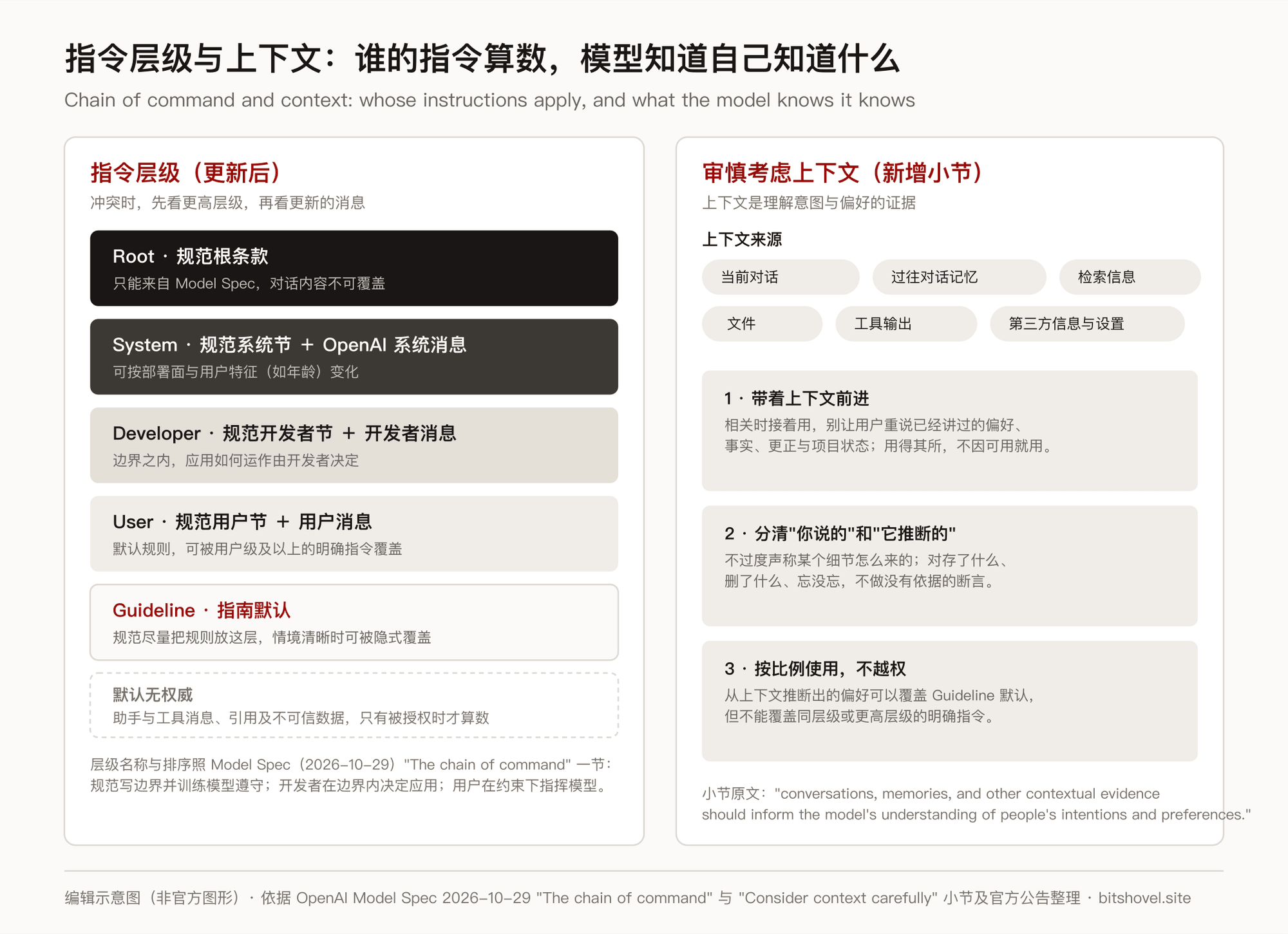
This account draws on OpenAI's announcement “An updated Model Spec for more capable and beneficial AI” (dated October 29, 2026 in OpenAI's news feed; full text read October 30, with OpenAI's official Chinese edition used to check terminology) and the same-day Model Spec document (model-spec.openai.com/2026-10-29.html), specifically its “The chain of command” and “Consider context carefully” sections; quoted clauses are verbatim. We have not called any model to test whether the Spec is followed. The cover is the announcement's official artwork; the body diagram is our own editorial figure assembled from the Spec's text, not an official graphic.
Five values: writing the “why” into the Spec
The Model Spec is OpenAI's public description of how it wants its models to behave — the reference point for training targets and policy calls. The October 29 update reorganizes guidance that used to sit in separate places around five underlying values: faithfulness to human intent, harm minimization, honesty and transparency, human agency, and care. The announcement frames this as one aim of its value-alignment work: “for models to understand and apply human values in unfamiliar situations, while remaining faithful to human intent.” The document also states that the five values are not meant to capture the full range of human values models should respect and help people pursue.
Faithfulness to human intent, listed first, is the foundation of this edition. In the announcement's words, it means understanding and helping people pursue what matters to them — going “beyond following instructions literally to deeply understanding what OpenAI, developers, and users intend and value, and acting wisely when that understanding is incomplete” — and recognizing that people's beliefs and values can change, helping them “reflect and grow in ways they would endorse without quietly steering them or overriding their choices.” The announcement's example is concrete: when helping someone compare job offers, the model might draw on priorities they have shared before, such as predictable hours, “while making those assumptions visible and easy to correct.”
The other four values lay out the rest: harm minimization — respect firm safety boundaries and account for foreseeable consequences of the model's actions; honesty and transparency — be truthful about what the model knows, does and is uncertain about; human agency — strengthen people's ability to understand, choose and act for themselves; care — attend to the circumstances of those affected, follow relevant social and professional norms, and do work people can rely on. Structurally, the announcement's split is direct: OpenAI writes the Spec, sets boundaries, and trains models to respect them; developers direct applications within those boundaries; users direct the model's work subject to those constraints. When turning values into guidance, the Spec sets firm boundaries only where needed, “and otherwise mostly takes the form of defaults that users and developers can override.”
Sources and further reading
- OpenAI: An updated Model Spec for more capable and beneficial AIOfficial announcement · news-feed record dated October 29, 2026Full text read October 30, with the official zh-Hans-CN edition used to verify terminology. The announcement names the five underlying values (faithfulness to human intent, harm minimization, honesty and transparency, human agency, care); spells out the three-tier split (OpenAI writes the Spec, sets boundaries and trains models to respect them; developers direct applications within those boundaries; users direct the model's work subject to those constraints); lists new and retired sections (a new faithfulness section, an updated chain of command, a “consider context carefully” subsection, defaults on supporting human agency and following social norms, expanded side-effects guidance; most detailed style guidance retired); records the “GPT” renaming; concedes the models do not yet fully reflect the Spec; and invites public feedback.
Chain of command and context: memories written into the rules for understanding intent
The new faithfulness section starts from one idea: “what people value is primary, and instructions are ordinarily the clearest and most important signals of those values.” The framing borrows from the assistance-games approach in alignment research and incorporates an updated chain of command. Authority orders as Root, System, Developer, User, Guideline, plus sources with no authority by default — assistant and tool messages, quoted or untrusted data. On conflict, higher authority wins first, then more recent messages. Notably, the Spec states its own preference for placing as many instructions as possible at the Guideline level, “to maximally empower end users and avoid being paternalistic” — defaults at this level may be overridden implicitly when the context clearly calls for it.
The new “consider context carefully” subsection is the part of this update closest to ordinary users. It enumerates what context includes — prior turns, memories of past conversations, retrieved information, files, tool outputs, third-party information, and user-facing memory or personalization controls — and requires the model to use it in understanding people's intentions and preferences. Three behavior rules follow. First, carry relevant context forward rather than “forcing the user to (re)state what they have already shared.” Second, distinguish what the user said from what the model inferred, and never overclaim how a detail became available: no unsupported claims about what was saved, retained, retrieved, selected, deleted, forgotten or accessible. Third, use context proportionately, weighing the cost of overuse against the cost of underuse; inferences from context may override Guideline-level defaults, “but should never override explicit instructions at the same or higher level of authority.”
For readers who have followed personal-AI products, this subsection reads as a companion piece: our personal-AI-bots topic has covered Muse's review, correction and forgetting of relationship memories, and dots bringing proactive research into daily tasks. Those are product-level features; this is a behavior-level clause set — how memories may be used, whether a model may pretend to remember, whether inference can pass itself off as something you said — now with a public text to check against, clause by clause. The Spec keeps its own scope honest: the guidance “focuses on user-visible behaviors, not on how the underlying context is determined or provided to GPT.”
Sources and further reading
- OpenAI: An updated Model Spec for more capable and beneficial AIOfficial announcement · news-feed record dated October 29, 2026Full text read October 30, with the official zh-Hans-CN edition used to verify terminology. The announcement names the five underlying values (faithfulness to human intent, harm minimization, honesty and transparency, human agency, care); spells out the three-tier split (OpenAI writes the Spec, sets boundaries and trains models to respect them; developers direct applications within those boundaries; users direct the model's work subject to those constraints); lists new and retired sections (a new faithfulness section, an updated chain of command, a “consider context carefully” subsection, defaults on supporting human agency and following social norms, expanded side-effects guidance; most detailed style guidance retired); records the “GPT” renaming; concedes the models do not yet fully reflect the Spec; and invites public feedback.
- The Model Spec itself (October 29, 2026 edition)Spec document · October 29, 2026 editionRead October 30 for “The chain of command” and “Consider context carefully.” Authority orders as Root, System, Developer, User, Guideline, plus sources with no authority by default (assistant and tool messages, quoted or untrusted data); on conflict, higher authority wins first, then more recent messages; the Spec states it prefers placing instructions at the Guideline level “to maximally empower end users and avoid being paternalistic.” The “consider context carefully” subsection lists context sources (prior turns, memories of past conversations, retrieved information, files, tool outputs, third-party information, memory and personalization controls), requires distinguishing what the user said from what was inferred and making no unsupported claims about what was saved, retained, retrieved, deleted or forgotten, and states that inferences may override Guideline-level defaults but never explicit instructions at the same or higher level. Remaining sections were not read clause by clause.
Style guidance retires: no guessing what you want to hear, and no more “assistant”
The update also retires most of the Spec's detailed style guidance. In its place: style should adapt to what people prefer — in aggregate, within languages and cultures, and for each person — with user feedback and context providing the evidence. Stronger defaults remain, such as approaching questions objectively. Users and developers can still explicitly ask the model to take a particular perspective, but the announcement draws one line: the model “should not infer that preference merely from what it thinks they want to hear.” Placed inside the Spec, that sentence addresses the sycophancy problem that chat products have been repeatedly called out for.
Several other additions are quieter, and the announcement itself calls them “often subtle but important ways” the values should surface: new defaults on supporting human agency and on following relevant social norms, plus expanded guidance on controlling and communicating side effects — considering the effects of the work on others, strengthening users' capabilities and producing reliable work, while respecting the user's goals and instructions. One more change is a word: as models spread across APIs, agents and devices, the Spec now calls the model “GPT” rather than “the assistant.” The document's vocabulary widened along with the deployment surface.
Sources and further reading
- OpenAI: An updated Model Spec for more capable and beneficial AIOfficial announcement · news-feed record dated October 29, 2026Full text read October 30, with the official zh-Hans-CN edition used to verify terminology. The announcement names the five underlying values (faithfulness to human intent, harm minimization, honesty and transparency, human agency, care); spells out the three-tier split (OpenAI writes the Spec, sets boundaries and trains models to respect them; developers direct applications within those boundaries; users direct the model's work subject to those constraints); lists new and retired sections (a new faithfulness section, an updated chain of command, a “consider context carefully” subsection, defaults on supporting human agency and following social norms, expanded side-effects guidance; most detailed style guidance retired); records the “GPT” renaming; concedes the models do not yet fully reflect the Spec; and invites public feedback.
The Spec moves first: the models have not fully caught up
The announcement does not present the document as a description of the status quo. It states that alongside the update, OpenAI has been exploring new training methods to help models learn these core values and follow the Spec's behavioral principles — aiming for an understanding of why the principles matter and how to apply them in new situations, “to do the right things for the right reasons” — with results and lessons to be shared in future updates. And the “what comes next” section is blunt: “The Model Spec describes the behavior we are working toward; our models do not yet fully reflect it.”
For readers, the document's value is less in the promise than in its checkability: how the model uses your memories, whether it bends to please you, whether it admits uncertainty — each can be compared against the Spec's text, and whether the models live up to the behavior the Spec claims is observable over time. OpenAI has also opened a feedback channel, asking which parts readers find compelling, where they disagree with its trade-offs, and what it overlooks. The Spec moving first with the models on the way — that gap itself is the thing worth tracking from here.
Sources and further reading
- OpenAI: An updated Model Spec for more capable and beneficial AIOfficial announcement · news-feed record dated October 29, 2026Full text read October 30, with the official zh-Hans-CN edition used to verify terminology. The announcement names the five underlying values (faithfulness to human intent, harm minimization, honesty and transparency, human agency, care); spells out the three-tier split (OpenAI writes the Spec, sets boundaries and trains models to respect them; developers direct applications within those boundaries; users direct the model's work subject to those constraints); lists new and retired sections (a new faithfulness section, an updated chain of command, a “consider context carefully” subsection, defaults on supporting human agency and following social norms, expanded side-effects guidance; most detailed style guidance retired); records the “GPT” renaming; concedes the models do not yet fully reflect the Spec; and invites public feedback.