From model to work · Following visual evidence
Glimpse: find the second that deserves another look
Is a train slowing, how do two birds cross a camera move, and when should a robot take its next step? Three original clips and the maker’s records explain visual reinspection, observation, planning and execution.
Elorian opened the Glimpse research preview October 16. On October 19 we checked the source, three complete silent clips and selected frames. Model judgments and costs are the maker’s records; we did not call the model or run a robot.
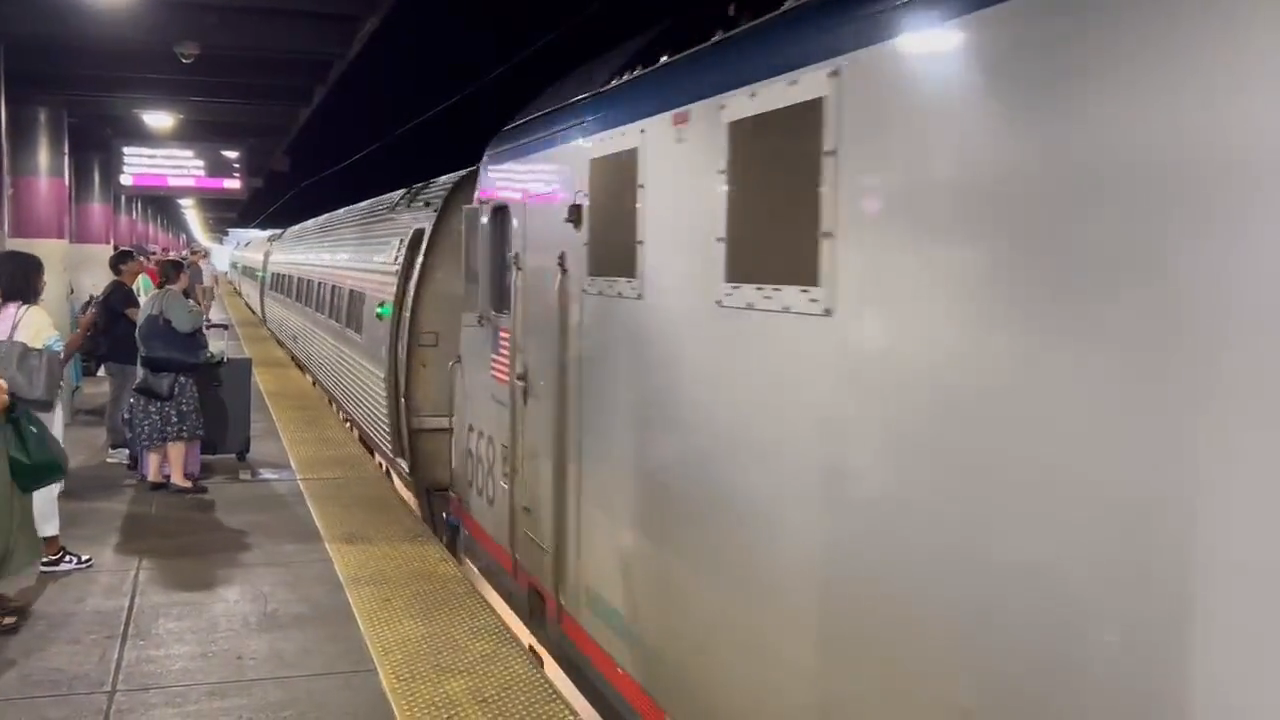
Recognizing a train is not the same as judging its speed
A frame can establish that a train is passing a platform. A change in speed requires observations across time. Elorian labels Glimpse’s answer as deceleration and publishes a condensed trace: locate a trackable window edge, compare displacement and rewatch an interval near the apparent stop.
The interesting behavior is returning to evidence that determines the answer. A still or two arbitrarily spaced frames cannot independently validate speed: tracking, sampling intervals, perspective and camera movement matter. This is the maker’s example and checking procedure, rather than an independent physical speed measurement.
Sources and further reading
- Elorian · Glimpse launchVendor source · October 16, 2026Research preview, model records, mixed evaluation configurations and pricing, rather than our independent test.
- Train-speed question · Original clipPublic input clip · about 5.17 seconds, no audio trackRead with the launch’s condensed trace. A still cannot establish speed, and no ground-truth speedometer reading is supplied.
The uncertain part can be less than a second long
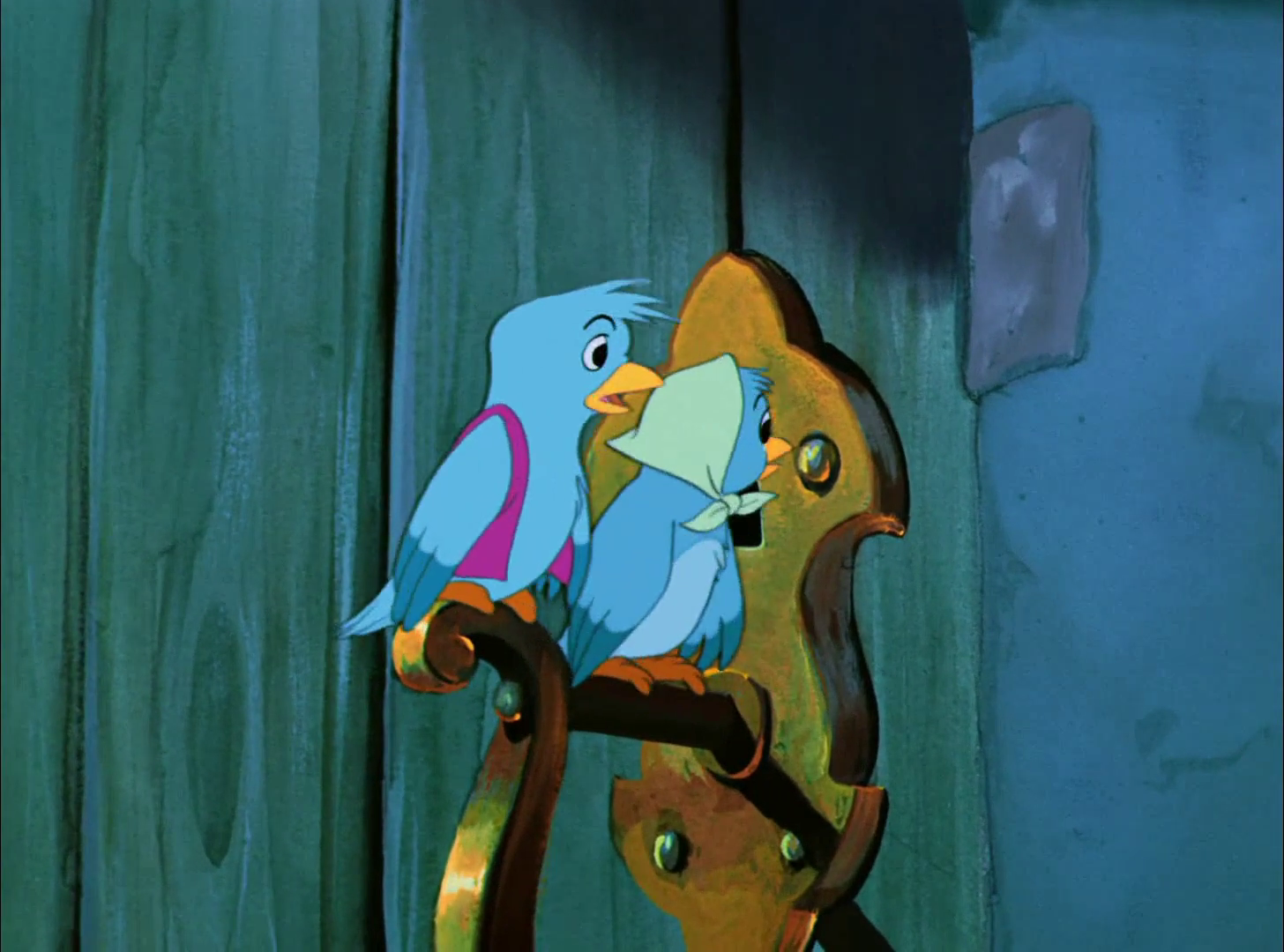
A 6.13-second animation asks for a complete description of two birds’ actions: order, identity and what happens during a camera move. The published run first inspects the clip at 8 fps, then revisits roughly 4.3–5.2 seconds at about 14 fps. Intermediate wall positions support a continuous pan rather than a hard cut.
The magenta strap and pale-green head covering distinguish the birds, while the targeted rewatch helps recover the sequence of departure, movement and entry into the lit arch. For video organization, work analysis or experimental footage, concentrating inspection on uncertainty is a useful capability to compare. Less omission or misordering still needs evaluation on the intended material.
Sources and further reading
- Elorian · Glimpse launchVendor source · October 16, 2026Research preview, model records, mixed evaluation configurations and pricing, rather than our independent test.
- Two birds and a camera move · Original clipAnimated evaluation input · about 6.13 secondsThis is input to understand, not animation generated by Glimpse. The trace describes an 8 fps pass followed by a targeted rewatch at about 14 fps.
Separate planning from the policy that moves the arm
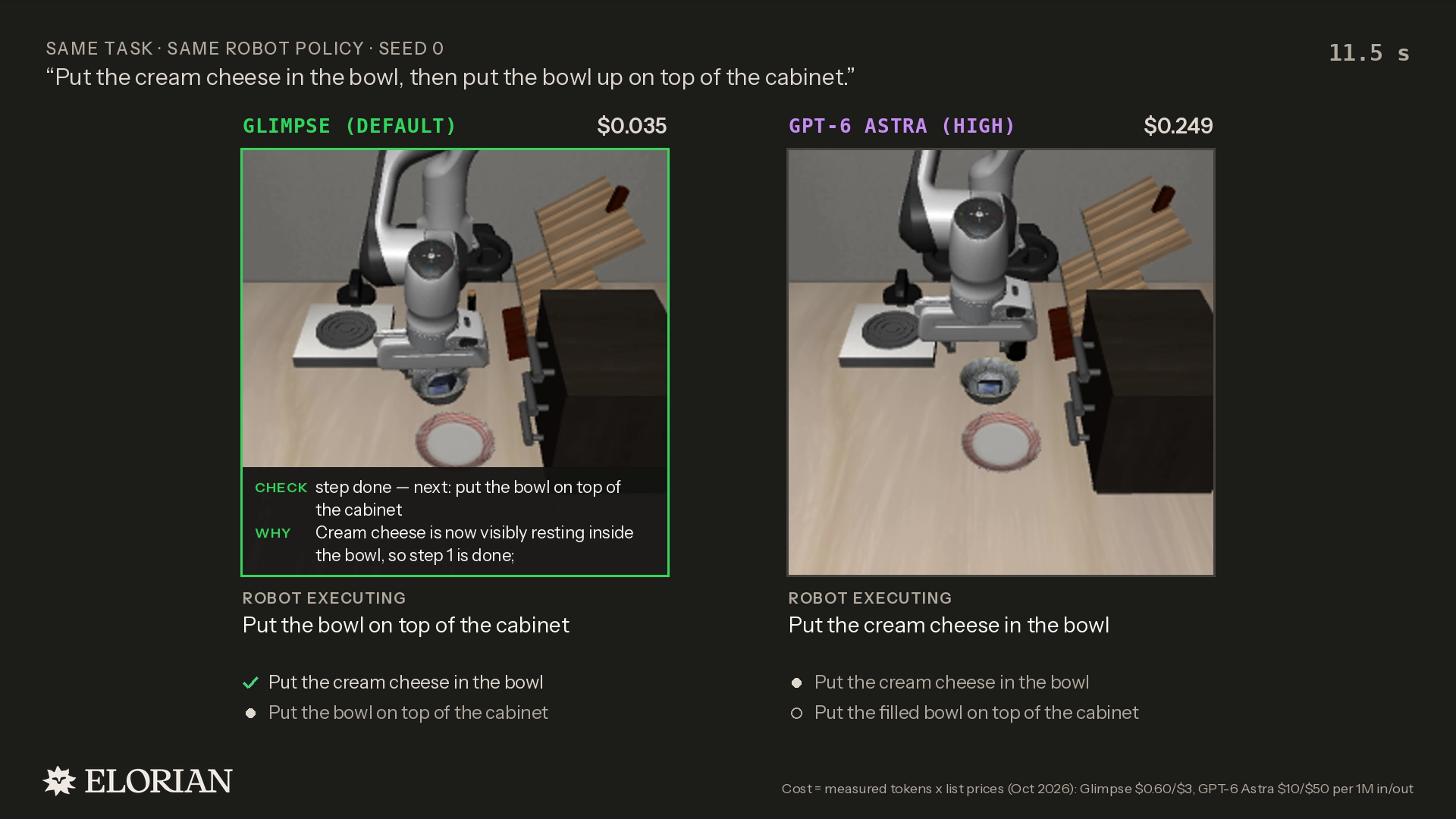
The robot demo asks when to finish putting cream cheese in a bowl and move on to placing that bowl atop a cabinet. Glimpse and Astra serve as separate high-level planners, inspecting cameras and deciding whether steps are complete. The same π0.5 policy generates the lower-level actions. Both demonstrated runs finish.
The graphic labels Glimpse default versus Astra high, with episode planning costs of $0.035 and $0.249. A shared executor helps isolate the planning role, but does not establish equal reasoning effort, total compute or results across many tasks. Those figures also exclude the full robot system. The demonstration connects visual interpretation to action checks without establishing general robot control.
Sources and further reading
- Elorian · Glimpse launchVendor source · October 16, 2026Research preview, model records, mixed evaluation configurations and pricing, rather than our independent test.
- The same LIBERO task · Original planner demoVendor simulation comparison · 43.5-second fileThe graphic labels Glimpse default and Astra high, sharing π0.5 and seed 0. This is not equal reasoning compute or a physical-robot test.
Keep evidence quality and total task cost in view
Not every explanation on the launch page is a Glimpse run. Tire, railway-lever and plier examples include reviewed reference answers; the what-happens-next animation uses Seedance 2.5 to illustrate reference outcomes. Runs, references and illustrations are different evidence. The vendor table also combines tools, effort settings and paper-reported results, rather than proving universal superiority.
Listed prices are $0.60 per million input tokens and $3 per million output tokens through the API and chat research preview. Reinspection and denser frames consume time and tokens, so unit prices do not establish total task cost. Useful follow-up compares the same footage and criteria: which errors does reinspection correct, how much observation does it add, and how are the results checked?
Sources and further reading
- Elorian · Glimpse launchVendor source · October 16, 2026Research preview, model records, mixed evaluation configurations and pricing, rather than our independent test.
- HSS · Benchmark and reference-answer scopeResearch team’s source · October 8, 2026Scene-inference questions evaluated with particular versions and effort settings; newer releases do not automatically inherit the earlier results.