Conversation and commercial information
How do ChatGPT’s suggestions relate to the ad underneath?
OpenAI’s new architecture account helps separate answers, paid placements and purchases—and personalization from an ad-free experience.
A product card beneath an answer is a distinct paid placement. Current OpenAI rules allow ads for some eligible Free and Go users; Plus, Pro, Business, Enterprise and Edu remain ad-free. We explain official rules and illustrations without testing an account or campaign.
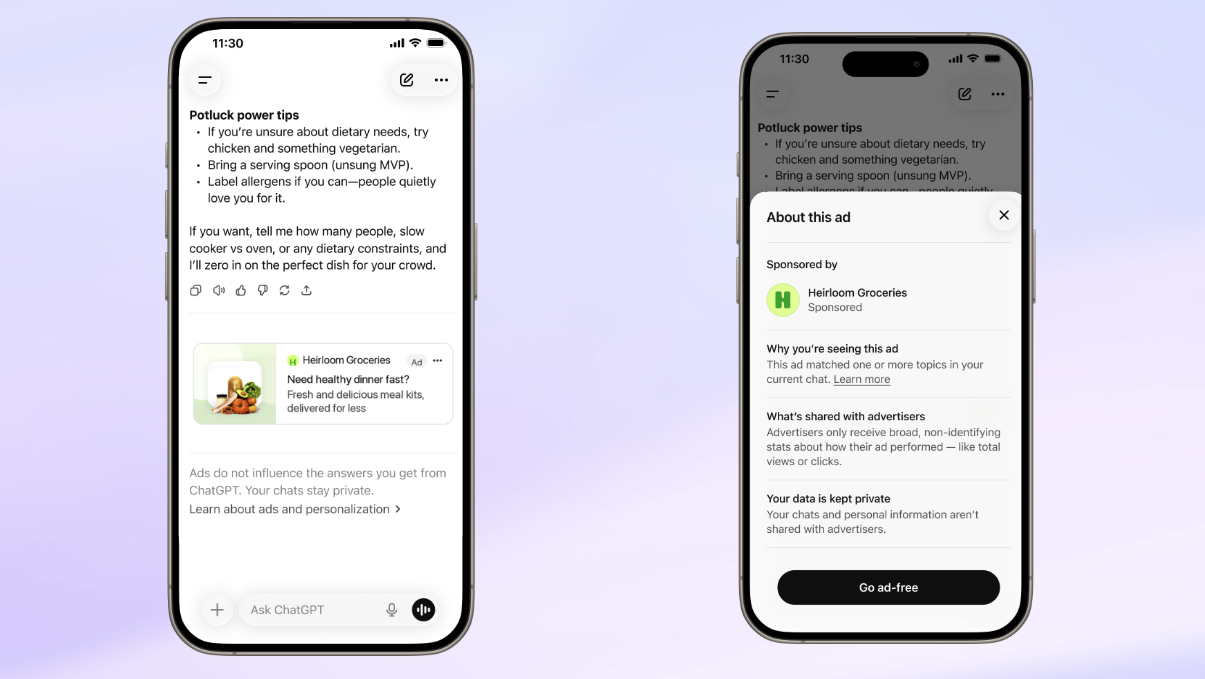
Identify the answer and the paid placement
On October 21, OpenAI announced 26 additional advertising markets, reaching 89. For readers, the useful distinction is an answer versus a labeled paid placement. Official rules say advertisers cannot alter answers; an ad is not an endorsement.
Sources and further reading
- OpenAI Help: eligibility and ad controlsOfficial live help · checked October 22, 2026Personalization, hiding, deletion and Free’s ad-free option remain eligibility-dependent.
- OpenAI: October 21 advertising expansionOfficial announcement · October 21, 2026The reported 26 additional and 89 total countries describe service expansion, not guaranteed immediate impressions for every user.
- OpenAI: original advertising principlesOfficial principles · January 16, 2026Answer independence, labeling, privacy and control; ads had not yet launched at that announcement.
How a need reaches an ad card
The engineering account describes parallel paths: one generates the answer; another model interprets intent, retrieves and filters ads, then calls an auction tool. Final checks can reject a placement; an ad arriving too late is not shown that turn. Retrieval, selection and an impression are distinct outcomes.
Our reading method follows that distinction: identify the speaker and placement reason before evaluating whether the offer fits. We have not reproduced this system or independently verified its claimed separation.
Sources and further reading
- OpenAI: advertising architectureOfficial engineering account · October 21, 2026Separate answer generation and ad selection, with candidate, auction and display stages; not an independent audit.
Personalization and going ad-free change different things
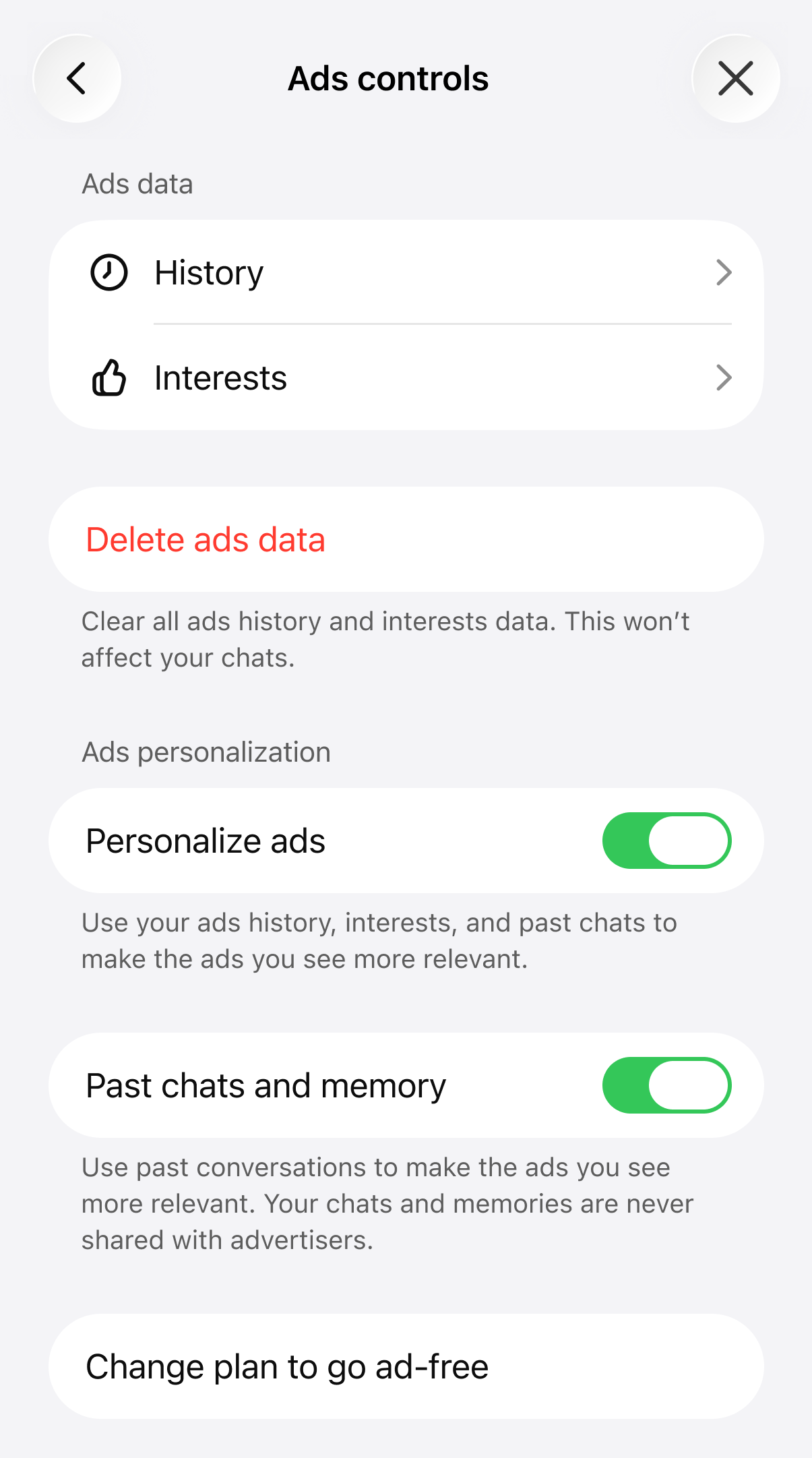
Current help distinguishes personalization from removal: turning personalization off still permits current-thread context. The ad menu supports hiding, reporting and explanations. Free’s ad-free option reduces message/tool access, subject to eligibility. Clearing ad data does not delete chats; server removal can take up to 30 days.
Past chats and memory is a separate ad control, not deletion of general chat memory. Disabling it leaves current-thread context. ChatGPT cannot see your displayed ad by default; Ask ChatGPT shares that particular ad into the conversation.
Sources and further reading
- OpenAI Help: eligibility and ad controlsOfficial live help · checked October 22, 2026Personalization, hiding, deletion and Free’s ad-free option remain eligibility-dependent.
An offer still leaves a purchase decision
Following discovery through comparison to purchase raises further questions: do specifications match the merchant, does today’s price include shipping, and who handles returns? A new offer does not answer those. The Muse shopping topic follows authorization and fulfillment; the memory article asks what context persists.
Sources and further reading
- OpenAI: advertising architectureOfficial engineering account · October 21, 2026Separate answer generation and ad selection, with candidate, auction and display stages; not an independent audit.
- OpenAI Help: eligibility and ad controlsOfficial live help · checked October 22, 2026Personalization, hiding, deletion and Free’s ad-free option remain eligibility-dependent.