Data methods · Business AI adoption
The census questionnaire no longer asks about “AI”: how the “Super Intelligence” rename breaks the adoption curve
From the October 19 collection round, the U.S. Census Bureau's biweekly BTOS business survey asks whether businesses used “Super Intelligence or SI (formerly referred to as Artificial Intelligence or AI)”. The wording follows Executive Order 14434, signed September 29 — and the Bureau knows what wording changes do: a November 17, 2025 expansion once jumped 250+-employee companies' “Yes” from about 12% to about 30%, and the Bureau responded by starting a new time series. At the rename round, the same size class rose another 7.1 points (36.5% → 43.6%, about 4.7 standard errors) — the rename doesn't change the technology; the examples stay machine learning, natural language processing, ChatGPT and Claude. How to read “X% of companies use AI” numbers: check the questionnaire, the wording, the series.
This account draws on Simon Willison's post (November 2, 2026), the full text of Executive Order 14434 “Inaugurating the Era of Super Intelligence” (signed September 29, 2026), the BTOS questionnaire PDF (Content Year 5), the Census Bureau's “AI Question Wording Updates” (December 3, 2025), and the by-firm-size XLSX (November 1, 2026 version, downloaded and parsed by script here; round-by-round figures taken from the raw columns), with standard errors from the same file's SE sheet. Survey scale (about 200,000 businesses, each answering once every 12 weeks) is per Willison's account; the official about page could not be read directly. We ran no surveys and no statistical review — this is a verification and explanation piece; all percentages keep their source-file values.
The rename reaches the questionnaire
From the collection round starting October 19, America's biweekly business survey BTOS changed its question. Where it asked “in the last two weeks, did this business use Artificial Intelligence (AI)”, it now asks: “In the last two weeks, did this business use Super Intelligence or SI (formerly referred to as Artificial Intelligence or AI) in any of its business functions?” — the questionnaire keeps a parenthetical reminding respondents this is the same question. The change follows Executive Order 14434, “Inaugurating the Era of Super Intelligence”, signed September 29: the executive branch uses Super Intelligence/SI in place of AI in correspondence, public communications, websites, reports and policy documents, and does not acknowledge the older terms; regulations, contracts, grants and historical documents are out of scope; SI's legal definition remains the artificial-intelligence definition in 15 U.S.C. 9401(3).
The examples did not change: machine learning, natural language processing, virtual agents, voice recognition. The generative question (Question 8) even names names: ChatGPT, Gemini, Copilot, Claude, Grok, Dall E, MidJourney, GitHub Copilot — all counted as “Generative SI”. What changed is the name, not what is being measured. The Census Bureau applying the order to its survey is its own implementation — the order's text never mentions surveys — but BTOS's rounds roll every two weeks, and the October 19 round became the first with the SI wording.
Sources and further reading
- Simon Willison: The U.S. Census Bureau and “Super Intelligence”Independent author post · November 2, 2026 · read in full November 3, 2026This site's entry point to the thread: Willison records that BTOS renamed AI to Super Intelligence or SI from the October 19 collection round (keeping the “formerly referred to as Artificial Intelligence or AI” parenthetical), and notes the earlier November 17, 2025 wording change that broke trend comparability (officially documented December 3). Using his own chart from public data: large companies about 12% under the old wording in September 2025, about 30% by February 2026, about 40% by October 2026; data from the Census by-firm-size XLSX (published October 22). In September 2025 he had used the same dataset to test GPT-5 and Claude's Code Interpreter. Survey scale (biweekly, about 200,000 businesses, each answering every 12 weeks, alternate-Thursday releases) is per this post.
- Executive Order 14434: Inaugurating the Era of Super IntelligenceGovernment document · signed September 29, 2026 · read November 3, 2026The order directs the executive branch to use Super Intelligence/SI in place of AI in official correspondence, public communications, websites, reports, policy documents and other non-statutory documents, and to not acknowledge the older terms; regulations, presidential actions, contracts, grants and historical documents are out of scope; SI is defined as the same technologies as artificial intelligence under 15 U.S.C. 9401(3); the President's science advisor must submit proposed legislative language for a federal “Super Intelligence” definition within 60 days. The order's text does not mention surveys; the Bureau applying it to BTOS is its own implementation.
- BTOS questionnaire PDF (Content Year 5, fielded January 18 – April 11, 2027)Official questionnaire · read November 3, 2026 (via Willison's archived copy)Question 7 (two-week use): did this business use Super Intelligence or SI (formerly referred to as Artificial Intelligence or AI) in any of its business functions? (Examples: machine learning, natural language processing, virtual agents, voice recognition, etc.), with Yes/No/Do not know. Question 8 (generative SI): defined as “a type of Super Intelligence that uses prompts or other inputs to create text, images, music, videos, or code”, naming ChatGPT, Gemini, Copilot, Claude, Grok, Dall E, MidJourney and GitHub Copilot. Question 28 (next six months) carries the same SI wording. The instrument notes about 10 minutes to complete and a two-week economic snapshot.
What “40% of companies” actually measures
BTOS (Business Trends and Outlook Survey) is the Bureau's economic barometer: rolling two-week collection, a questionnaire that takes about 10 minutes, each business answering once every 12 weeks (about 200,000 businesses, per Willison's account), data released every other Thursday. The AI question is self-reported, three options: Yes / No / Do not know, with the examples printed in the question — so the boundary of “using AI” is drawn by the questionnaire's examples: machine learning, natural language processing, virtual agents, voice recognition, and answers lean that way.
The “40% of large companies use AI” quoted in media reports corresponds in the data file to the 250+-employee class (class G) answering “Yes”. Parsing the November 1, 2026 by-size file: class G's latest round (202621) is 43.6%, the previous round (202620) 36.5%; the 1-4-employee class (A) is 24.3%. Standard errors run about 1.5-1.9 points — these are sampling estimates, not a census of every business, and every figure carries an error bar.
Self-reported, examples drawing the boundary, and the same question returning only after 12 weeks — these three facts make it a trend indicator rather than a precision instrument. Willison's other detail matters as much: the November 17, 2025 wording change put “any of its business functions” into the stem, the questionnaire kept its structure, so the question a business faces 12 weeks later may already differ from its previous one.
Sources and further reading
- Simon Willison: The U.S. Census Bureau and “Super Intelligence”Independent author post · November 2, 2026 · read in full November 3, 2026This site's entry point to the thread: Willison records that BTOS renamed AI to Super Intelligence or SI from the October 19 collection round (keeping the “formerly referred to as Artificial Intelligence or AI” parenthetical), and notes the earlier November 17, 2025 wording change that broke trend comparability (officially documented December 3). Using his own chart from public data: large companies about 12% under the old wording in September 2025, about 30% by February 2026, about 40% by October 2026; data from the Census by-firm-size XLSX (published October 22). In September 2025 he had used the same dataset to test GPT-5 and Claude's Code Interpreter. Survey scale (biweekly, about 200,000 businesses, each answering every 12 weeks, alternate-Thursday releases) is per this post.
- BTOS questionnaire PDF (Content Year 5, fielded January 18 – April 11, 2027)Official questionnaire · read November 3, 2026 (via Willison's archived copy)Question 7 (two-week use): did this business use Super Intelligence or SI (formerly referred to as Artificial Intelligence or AI) in any of its business functions? (Examples: machine learning, natural language processing, virtual agents, voice recognition, etc.), with Yes/No/Do not know. Question 8 (generative SI): defined as “a type of Super Intelligence that uses prompts or other inputs to create text, images, music, videos, or code”, naming ChatGPT, Gemini, Copilot, Claude, Grok, Dall E, MidJourney and GitHub Copilot. Question 28 (next six months) carries the same SI wording. The instrument notes about 10 minutes to complete and a two-week economic snapshot.
- Census by-firm-size XLSX (November 1, 2026 version; Willison's archived copy)Official data file · November 1, 2026 version · downloaded and parsed November 3, 2026Downloaded and parsed here. The file carries rounds from 2023 through 2026 (202621 the newest column); two-week “Yes” by size class: 250+ (class G) 30.5% at the new series' start (round 202524) → about 31.9%/33.5% (rounds 202604/05) → 36.5% (round 202620) → 43.6% (round 202621); 1-4 employees (class A) 24.3% latest. Standard errors for class G: 1.51% (202621), 1.89% (202620). The two-week question's text in this file already carries the SI wording; the future-use question (Q24) likewise. The official download page is census.gov/hfp/btos/data_downloads.
Two wording changes, two broken series
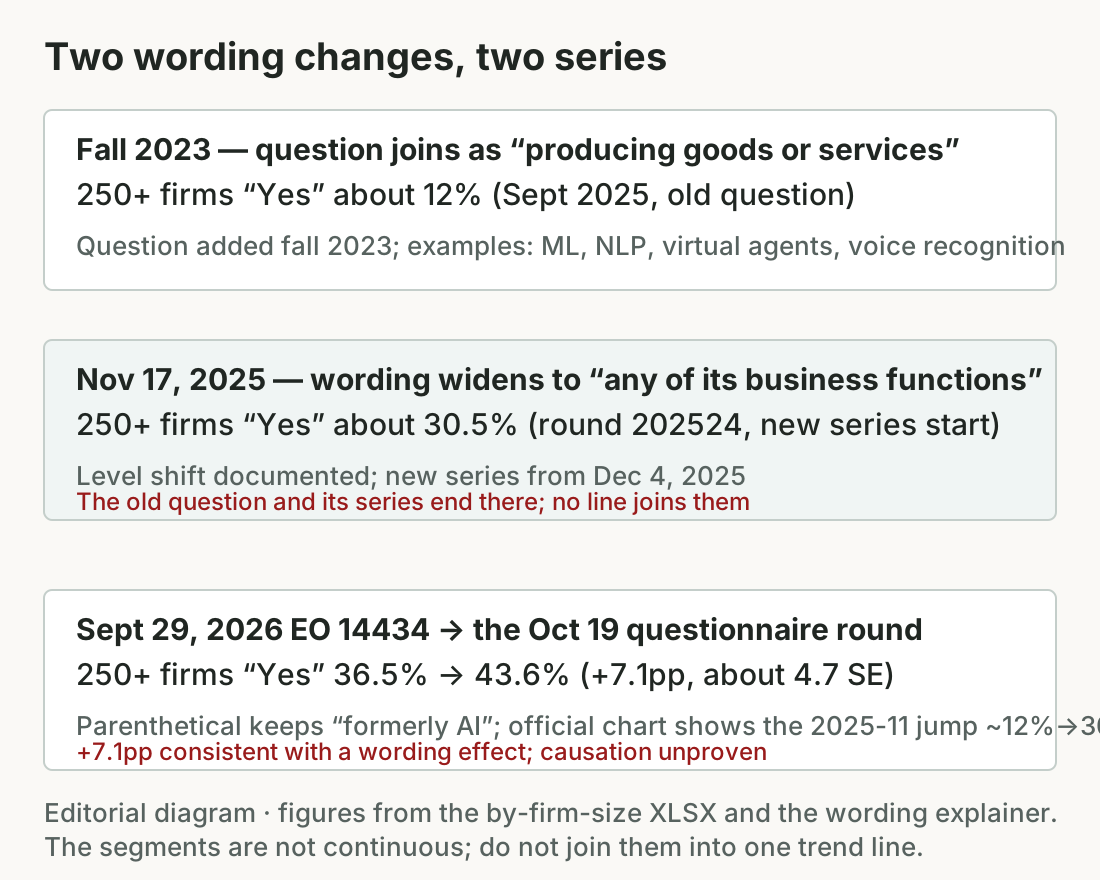
This is not BTOS's first wording change to this question. On November 17, 2025, the Bureau changed “using AI in producing goods or services” to “using AI in any of its business functions” — the official explainer is explicit: expert feedback and cognitive testing found businesses that did not see themselves as producers of goods or services, and businesses using AI in hiring, project management, accounting and R&D that initially answered “No”; the new wording came with a level shift. The Bureau handled it by the book: acknowledged the shift, started a new time series from the December 4, 2025 release, kept old-wording data in a historical table; its comparison chart shows 250+ companies jumping from about 12% to about 30%.
The rename's consequence has the same shape: round 202621 is the first SI-wording round in the file (the two-week question's text already carries it), and class G's “Yes” jumps from the previous round's 36.5% to 43.6% — +7.1 points, about 4.7 standard errors. That magnitude exceeds sampling noise and is consistent with a wording effect; honesty requires the caveat: class G wobbles round to round anyway (the 44.0% → 36.5%, a −7.5pp swing, happened entirely under one wording), so a jump coinciding with the rename is not proof of causation. The Bureau's December 2025 handling shows it knows wording is methodology.
Sources and further reading
- Census Bureau: AI Question Wording Updates (December 3, 2025)Official explainer · December 3, 2025 · read in full November 3, 2026The Bureau states: from November 17, 2025 the core AI questions changed from “producing goods or services” to “any of its business functions” (based on expert feedback and cognitive testing); because the new wording came with a level shift, a new time series was created from data released December 4, 2025, with old-wording data kept in the AI Core Questions (Original) historical table. The Bureau's own comparison charts show the national two-week average jumping from about 10% to about 17.5%, and 250+ companies from about 12% to about 30%. The FAQ explains why: some businesses did not see themselves as producers of goods or services, and interviews found AI in hiring, project management, accounting and R&D.
- Census by-firm-size XLSX (November 1, 2026 version; Willison's archived copy)Official data file · November 1, 2026 version · downloaded and parsed November 3, 2026Downloaded and parsed here. The file carries rounds from 2023 through 2026 (202621 the newest column); two-week “Yes” by size class: 250+ (class G) 30.5% at the new series' start (round 202524) → about 31.9%/33.5% (rounds 202604/05) → 36.5% (round 202620) → 43.6% (round 202621); 1-4 employees (class A) 24.3% latest. Standard errors for class G: 1.51% (202621), 1.89% (202620). The two-week question's text in this file already carries the SI wording; the future-use question (Q24) likewise. The official download page is census.gov/hfp/btos/data_downloads.
How to read adoption numbers
Next time you see “X% of companies use AI”, check four things: which survey (a self-reported Yes/No/Don't-know or a measurement); which wording era (about 12% under “producing goods or services” and 30.5% under “any business functions” cannot be joined into one line); which round (43.6% at round 202621 is the SI-wording round, and how much of its 7.1-point gap to the prior round is wording versus real change will only be separable over more rounds); and how big the error bar is (class G's standard error is about 1.5-1.9 points). “From 12% to 40% in a year” stitches two questionnaire eras and a rename into one trend — it is not one trend line.
The Bureau's own sensitivity to wording is the most useful part of this material: the December 2025 explainer acknowledged the shift, started a new series, kept a historical table — officialdom demonstrating the right way to read it, while the wrong way stitches three segments into a “growth story”. Willison's contribution is turning this dataset into a public lesson: in September 2025 he used it to test GPT-5 and Claude's Code Interpreter, in November 2026 he used it to show how the rename breaks the trend — the same public file, giving ordinary readers a checkable reading both times.
Boundaries stated plainly: we ran no surveys and no statistical tests — the relation between +7.1pp and a wording effect is “consistent, causation unproven”; class G wobbles between rounds, so single-round jumps are not rare there; the rename doesn't change the technology — examples unchanged, legal definition unchanged, only the name. How it connects to existing content: our AA and Pi board readers' pieces made the point “compare within one evaluator and one version”; this survey is the same principle in official statistics: the questionnaire is part of the data.
Sources and further reading
- Simon Willison: The U.S. Census Bureau and “Super Intelligence”Independent author post · November 2, 2026 · read in full November 3, 2026This site's entry point to the thread: Willison records that BTOS renamed AI to Super Intelligence or SI from the October 19 collection round (keeping the “formerly referred to as Artificial Intelligence or AI” parenthetical), and notes the earlier November 17, 2025 wording change that broke trend comparability (officially documented December 3). Using his own chart from public data: large companies about 12% under the old wording in September 2025, about 30% by February 2026, about 40% by October 2026; data from the Census by-firm-size XLSX (published October 22). In September 2025 he had used the same dataset to test GPT-5 and Claude's Code Interpreter. Survey scale (biweekly, about 200,000 businesses, each answering every 12 weeks, alternate-Thursday releases) is per this post.
- Census Bureau: AI Question Wording Updates (December 3, 2025)Official explainer · December 3, 2025 · read in full November 3, 2026The Bureau states: from November 17, 2025 the core AI questions changed from “producing goods or services” to “any of its business functions” (based on expert feedback and cognitive testing); because the new wording came with a level shift, a new time series was created from data released December 4, 2025, with old-wording data kept in the AI Core Questions (Original) historical table. The Bureau's own comparison charts show the national two-week average jumping from about 10% to about 17.5%, and 250+ companies from about 12% to about 30%. The FAQ explains why: some businesses did not see themselves as producers of goods or services, and interviews found AI in hiring, project management, accounting and R&D.
- Census by-firm-size XLSX (November 1, 2026 version; Willison's archived copy)Official data file · November 1, 2026 version · downloaded and parsed November 3, 2026Downloaded and parsed here. The file carries rounds from 2023 through 2026 (202621 the newest column); two-week “Yes” by size class: 250+ (class G) 30.5% at the new series' start (round 202524) → about 31.9%/33.5% (rounds 202604/05) → 36.5% (round 202620) → 43.6% (round 202621); 1-4 employees (class A) 24.3% latest. Standard errors for class G: 1.51% (202621), 1.89% (202620). The two-week question's text in this file already carries the SI wording; the future-use question (Q24) likewise. The official download page is census.gov/hfp/btos/data_downloads.
- Census BTOS data downloads page (public data entry)Official data entry · page could not be read directly November 3, 2026 (script-rendered)The official entry for the by-firm-size, core-questions and AI-supplement XLSX/PDF files; the page is script-rendered, so we verified via direct file links and Willison's archived copies without auditing the page's listing itself.